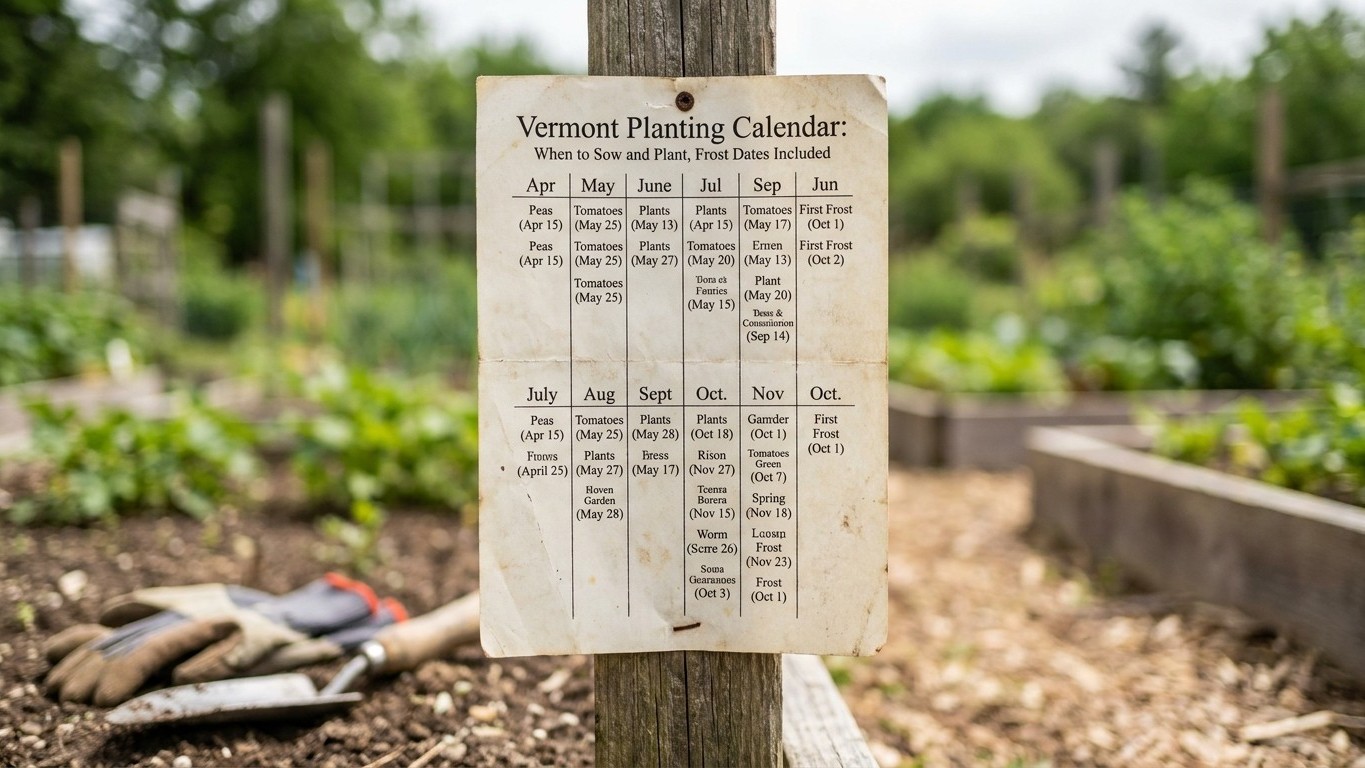

Vermont’s growing season runs on two dates, and if you garden anywhere outside Burlington, both of them are lying to you a little. The city’s last spring frost falls between April 30 and May 10, first fall frost between October 3 and October 13, but Lake Champlain buys that valley a mildness the Green Mountains and Northeast Kingdom don’t share — up there, spring frost lingers into May and fall arrives weeks sooner. So before you plant anything, check how your elevation and distance from the lake actually compare to that lakeside window, because everything else in your season depends on it.
The frost window in Vermont

Every planting date in this calendar traces back to two numbers. NOAA’s National Centers for Environmental Information, using 1991-2020 climate normals from station USW00014742 at Burlington, puts the last spring freeze between April 30 and May 10, and the first fall freeze between October 3 and October 13. Those are 30-70% probability windows for a 32°F freeze, not fixed calendar days, which is why they’re given as a range rather than a single date. A grower who plants on the first mild day in late April is gambling against the later half of that window — see What to Plant in Vermont in April for how to time that early window safely.
Burlington sits directly on Lake Champlain, and that lake is the reason the city’s frost dates are as mild as they are for a state this far north. Open water holds heat into autumn and delays the cold snaps of spring, so the Champlain Valley consistently runs a milder frost calendar than the rest of Vermont. Move east into the Green Mountains, or north into the Northeast Kingdom, and both frost dates shift: spring frost lingers later into May, and fall frost arrives earlier, sometimes by several weeks. Elevation alone can cost a garden ten days or more of growing season for every thousand feet of gain.
What the frost-free window means for a garden plan
Subtract the earlier fall date from the later spring date and Burlington’s shortest realistic season runs about 146 days, from May 10 to October 3. Subtract the later fall date from the earlier spring date and the longest realistic season runs about 166 days, from April 30 to October 13. That 20-day spread is the difference between a tomato variety finishing comfortably and one that gets caught green, especially once that first fall freeze approaches and late-season crops need to come in — see What to Plant in Vermont in October for that end of the calendar, or start at the season’s earliest edge with What to Plant in Vermont in February, or check What to Plant in Vermont in September for the transition month between them, and once the garden is fully dormant, What to Plant in Vermont in December covers the planning work that carries a grower into the next season, and at the other end of the season What to Plant in Vermont in August for the height of the growing window before that transition beginsost.com/vermont/garden/planting-calendar/april/”>What to Plant in Vermont in April covers the early sowings once that spring frost window closes, and once the freeze actually hits, What to Plant in Vermont in November covers what’s left to do afterward. Anyone gardening outside the immediate Burlington area should treat both ends of that range as optimistic and plan for the shorter season until their own records say otherwise — and starting with early groundwork like What to Plant in Vermont in January, followed by What to Plant in Vermont in March, and then What to Plant in Vermont in May, month-by-month guides like What to Plant in Vermont in June and What to Plant in Vermont in July can help translate that frost math into an actual planting schedule.
Cool-season crops
Peas, spinach, lettuce, brassica transplants, and root crops like carrots and beets tolerate light frost and cold soil, which is exactly why they go in weeks before the last frost date rather than after it. Pea seed germinates in soil that would rot a bean seed, and young lettuce and spinach plants shrug off a frost that would blacken a tomato seedling overnight. The governing question for these crops isn’t the calendar date, it’s whether the soil has thawed and dried out enough to work without compacting into clay-like clumps.
In practice, that means sowing peas, spinach, and radish seed directly into the ground as soon as the soil crumbles rather than smears, which at Burlington is typically several weeks ahead of the April 30 to May 10 last-frost window given by NOAA’s normals. Lettuce and brassica transplants, started indoors four to six weeks earlier, can go into the garden under the same cold tolerance, though a floating row cover helps them through a late hard freeze rather than the ordinary light frost they’re bred to handle. Carrots and beets are usually direct-sown a bit later, once soil temperature climbs enough for even germination, but still comfortably ahead of the frost-free date that governs tomatoes and peppers.
Kale, cabbage, and broccoli transplants set out in this window benefit from cooler air holding back the flea beetle and cabbage worm pressure that builds once temperatures rise, which is one more reason to get them in early rather than waiting for a “safe” date that doesn’t apply to them at all. None of these crops need to wait for the last frost. Waiting costs them their entire advantage.
Warm-season crops

Tomatoes, peppers, squash, beans, and corn are killed outright by frost, but the more common mistake is planting them the moment the frost date passes without checking soil temperature. Cold, wet soil in the low 50s stalls a tomato transplant for weeks even if the air never drops below freezing again, and bean and squash seed simply rots in soil that hasn’t warmed enough to trigger germination. NOAA’s Burlington frost data marks the point after which a killing freeze becomes unlikely, not the point at which the soil is actually ready.
Counting back from transplant to indoor sowing
Catalogue days-to-maturity figures for tomatoes are counted from the transplant date, not from seed, and they shift by a week or two depending on the season’s heat. Given a last-frost window of April 30 to May 10 at Burlington, and a typical practice of waiting a week or two past that date for the soil to warm before setting tomatoes out, a mid-May to late-May transplant window is the reasonable target for most of the valley. Counting back six to eight weeks from that transplant window for indoor seed-starting lands in early to mid March, not a single fixed date, since both ends of the calculation are ranges rather than points.
Once transplanted in that mid-to-late-May window, different tomato cultivars reach their first ripe fruit and their margin before the earliest possible fall frost (October 3, per NOAA’s Burlington normals) very differently:
| Variety | Days to maturity | Type | First ripe | Margin before frost |
|---|---|---|---|---|
| Sakura | 55 | Indeterminate | Mid July | 77 days |
| Sun Gold | 57 | Indeterminate | Mid July | 75 days |
| Valentine | 55 | Indeterminate | Mid July | 77 days |
| Juliet | 60 | Indeterminate | Late July | 72 days |
| Amalfi | 68 | Determinate | Late July | 64 days |
| Cherokee Purple | 72 | Indeterminate | Early August | 60 days |
| Big Beef Plus | 72 | Indeterminate | Early August | 60 days |
| Tiren | 75 | Indeterminate | Early August | 57 days |
| Granadero | 75 | Indeterminate | Early August | 57 days |
| San Marzano II | 78 | Indeterminate | Early August | 54 days |
| Celebrity Plus | 78 | Determinate | Early August | 54 days |
Every one of these still finishes with weeks to spare before Burlington’s earliest fall frost. A grower in the Northeast Kingdom, with a first frost that arrives earlier than Burlington’s, has far less margin to work with, and should weight the shorter end of that table, cultivars like Sakura or Sun Gold, over the 78-day options like San Marzano II or Celebrity Plus. Peppers follow the same soil-temperature logic as tomatoes and are usually set out on the same schedule. Squash, beans, and corn are typically direct-sown rather than transplanted, and all three germinate poorly in cold soil regardless of how far past the frost date the calendar sits.
The fall planting window
Fall crops are planned backward from the first fall frost rather than forward from spring, and the arithmetic has to include a buffer beyond the raw days-to-maturity figure. NOAA’s Burlington normals put that first frost at October 3 to October 13, but growth slows as daylight shortens through September, so a crop listed at 40 days to maturity in a seed catalogue can take noticeably longer when sown in August than it would in May.
Building in a slowdown buffer
A practical approach is to add roughly two extra weeks to whatever the catalogue lists as days to maturity, then count that total back from the earlier end of the frost window, October 3, rather than the later end, to keep the estimate conservative. A grower in the Green Mountains or the Northeast Kingdom, where the first frost lands earlier than Burlington’s, needs to shift that whole calculation earlier still, since NOAA’s Burlington figures don’t apply directly outside the Champlain Valley.
Some crops don’t just tolerate that first light frost, they improve because of it. Kale, Brussels sprouts, and spinach convert stored starches to sugars when temperatures drop toward freezing, which is why a fall-grown kale plant reads sweeter than the same variety grown in July heat. Carrots left in the ground through the first few frosts do the same thing underground. None of this works if the crop is planted too late to reach a harvestable size before the ground freezes solid, which is the entire reason the backward calculation from the fall frost date matters more for these crops than the spring frost date ever does.
Reading a planting calendar properly
A statewide planting calendar, including this one, is built from a single weather station’s data and applied across a state with mountains, a large lake, and hundreds of feet of elevation change between towns twenty miles apart. NOAA’s figures come from Burlington specifically, and treating them as true for Rutland, St. Johnsbury, or a hillside garden a few hundred feet above the valley floor is the single most common way gardeners get burned by a calendar.
What actually shifts the dates
- Elevation: higher ground loses heat faster at night, pushing spring frost later and fall frost earlier
- Lake effect: proximity to Lake Champlain moderates temperature swings in both directions
- Urban heat: a paved, built-up area holds heat longer into fall and warms faster in spring than open farmland nearby
- Cold air drainage: low spots and valley bottoms collect cold air on clear, calm nights and frost first
- A late cold snap: even within the 30-70% probability window NOAA publishes, some years produce a hard freeze well after the stated date
Every one of these local effects is a different kind of climate problem, and it’s why gardening advice doesn’t transfer cleanly between regions, let alone between states. A grower working from the Oregon Planting Calendar is dealing with a maritime climate where Pacific moisture, not elevation, drives the frost pattern, and the New Mexico Planting Calendar answers a completely different question, since high-desert heat and aridity matter more there than any frost date. The only reliable fix within Vermont is to keep a simple log of your own garden’s last and first frost each year, and adjust this calendar toward your own observed dates rather than Burlington’s over time.
Local help
UVM Extension publishes county-level frost data, soil testing services, and cultivar trial results that go well beyond what a single Burlington weather station can tell you about your own property. Their extension office is the right first call for a soil test before you amend anything, and for frost records specific to your county rather than the Champlain Valley. For more on gardening elsewhere in the state, our Vermont guides cover conditions outside Burlington in more detail.
Common questions
When can I plant tomatoes outside in Vermont?
Most of the Champlain Valley waits until mid to late May, a week or two past NOAA’s last-frost window of April 30 to May 10 at Burlington, to let the soil warm up. Gardens at higher elevation or in the Northeast Kingdom should push that later, since their frost dates run well behind Burlington’s.
Is Vermont’s growing season long enough for long-season tomatoes like San Marzano?
Yes, at Burlington. San Marzano II needs 78 days from transplant and, set out in the mid-to-late May window, still finishes with roughly 54 days of margin before the earliest fall frost on October 3. That margin shrinks fast at higher elevation, so a shorter cultivar is the safer bet outside the valley.
Can I trust a planting calendar written for the whole state?
Treat it as a starting point rather than an instruction. NOAA’s frost data is specific to the Burlington station, and elevation, lake effect, and cold air drainage can shift both frost dates by weeks in either direction elsewhere in Vermont.
What happens if I plant warm-season crops too early?
Cold soil stalls growth even without a frost, so tomato and pepper transplants set out before the ground has warmed often sit stunted for weeks and end up no further ahead than a later, properly timed planting. Bean and squash seed sown into cold soil frequently rots before it germinates at all.
Do I need a soil thermometer or is the frost date enough?
The frost date only tells you when a freeze becomes unlikely, not when the soil is warm enough to support root growth. A soil thermometer, checked a few inches deep, gives a far more reliable signal for transplanting tomatoes, peppers, and squash than the calendar date alone.
Related guides
- New Hampshire Planting Calendar: When to Sow and Plant, Frost Dates Included
- Massachusetts Planting Calendar: When to Sow and Plant, Frost Dates Included
- Oregon Planting Calendar: When to Sow and Plant, Frost Dates Included