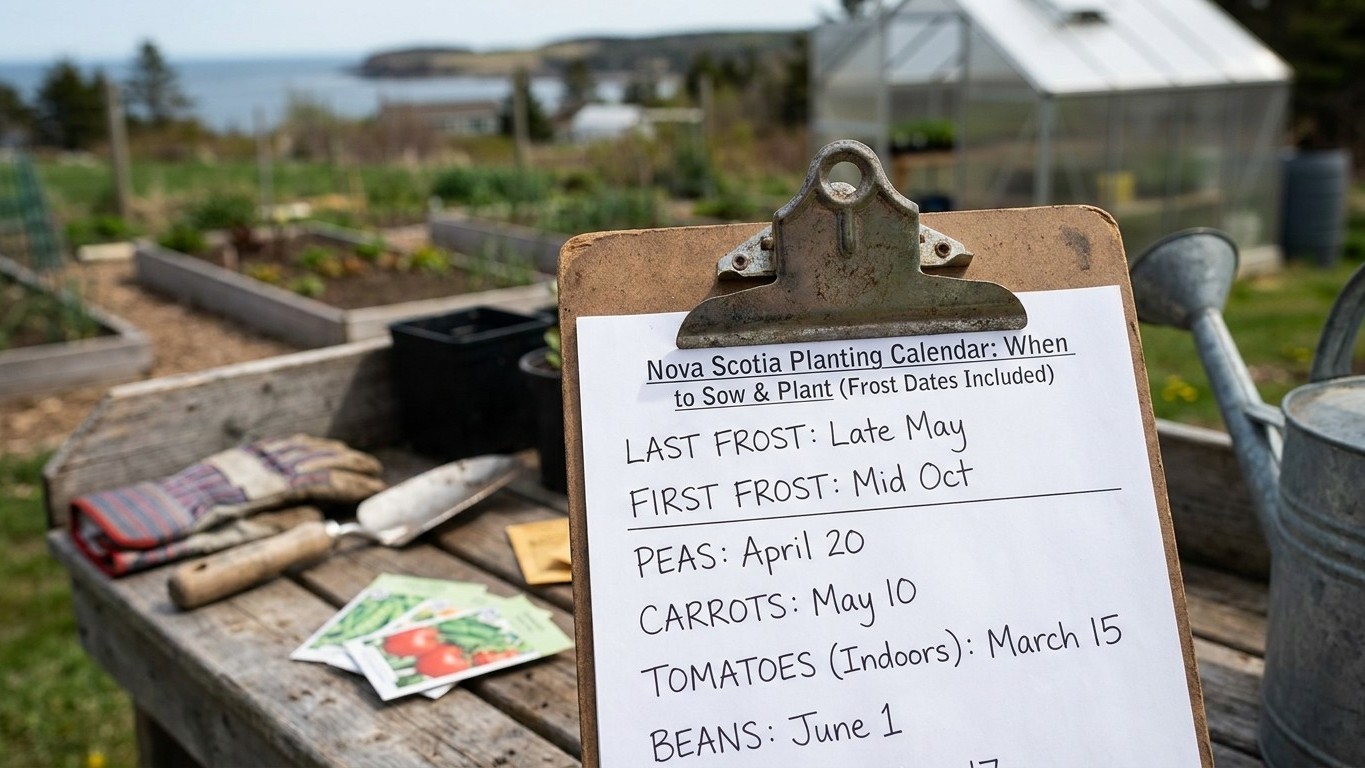

Nova Scotia’s growing season, measured at Halifax Stanfield International Airport, runs on average from a last spring frost on May 7 to a first fall frost on October 18, according to Environment and Climate Change Canada’s 1981-2010 Climate Normals. That’s a mean date, not a promise: in half of all years, frost arrives later than either one. Set your warm-season transplant date by soil temperature and your own garden’s history, using the Halifax averages only as the starting point to work backward from.
The frost window in Nova Scotia

Environment and Climate Change Canada’s 1981-2010 Climate Normals put the average last spring frost at Halifax Stanfield International Airport on May 7, and the average first fall frost on October 18. Both figures come from a single coastal station, and both are means rather than probability bands. That distinction matters more than the dates themselves: a mean date is the midpoint of a spread, so in roughly half of all years, frost shows up after May 7 in spring and before October 18 in fall. Treat the two dates as a planning window, not a green light.
Counted out, the stretch from May 7 to October 18 comes to about 164 days. That’s the average frost-free season at Halifax, and it’s the number every days-to-maturity figure on a seed packet gets measured against. A tomato variety rated at 75 days from transplant needs 75 of those 164 days, plus enough buffer to survive a frost that lands later than expected in spring or earlier than expected in fall. Before the season even starts, What to Plant in Nova Scotia in January covers the earliest planning tasks, while before the ground even begins to thaw, What to Plant in Nova Scotia in February covers the earliest indoor seed-starting tasks, and What to Plant in Nova Scotia in March covers what can be started indoors or sown as soon as the soil allows. Once the soil starts warming toward that window, see What to Plant in Nova Scotia in April for what to get started early, right around the average last frost date What to Plant in Nova Scotia in May covers the main transplanting push, and What to Plant in Nova Scotia in June for what goes in once the frost risk has passed, and as the season reaches its peak, What to Plant in Nova Scotia in July and What to Plant in Nova Scotia in August cover what still has time to mature before frost, while once that season winds down, check out What to Plant in Nova Scotia in December to see what still has a place in the garden after the main harvest ends, and What to Plant in Nova Scotia in November covers the transition period just before that.
How much later inland and upland gardens run
The Halifax Stanfield figures describe one station near the coast, and Nova Scotia is not one climate. Areas farther from the moderating effect of the Atlantic, and gardens at higher elevation in the interior or in the northern parts of the province, run weeks behind that coastal reading in spring and lose their growing season weeks earlier in fall. If you garden away from the Halifax area, budget extra time on both ends of the calendar rather than assuming the airport’s dates apply to your yard.
Cool-season crops
Peas, spinach, lettuce, and most brassicas germinate in cold soil and shrug off a light frost once they’re up, which is why they don’t wait for the last frost date the way tomatoes do. The practical trigger for these crops is whether the soil can be worked, not a date on the calendar. If the ground has thawed, drained, and crumbles rather than clumps when you squeeze it, peas and spinach can go in well ahead of the May 7 average last frost at Halifax.
What tolerates the early window
- Peas: sow direct as soon as soil is workable, ahead of the average last frost
- Spinach and lettuce: direct-sow or set out transplants early, tolerating a light frost
- Brassica transplants (cabbage, broccoli, kale): move hardened-off seedlings out ahead of the frost date
- Root crops (carrots, beets, radishes): direct-sow early, since they need cool soil to germinate evenly
Root crops are the trickiest to rush. Carrots and beets germinate slowly in cold soil, so an overly early sowing can sit for weeks without emerging, inviting rot rather than saving you time. Radishes are the exception: they germinate fast even in cool ground and are usually the first thing up in a spring garden. None of these crops need to wait for the frost-free window that governs tomatoes and peppers, and treating them as if they did just shortens the harvest window for no benefit.
Warm-season crops

Tomatoes, peppers, squash, beans, and corn are frost-tender at every stage, and unlike the cool-season crops, soil temperature matters at least as much as the date on the frost calendar. Cold, wet soil rots seed and stalls transplant roots even when the air feels mild, so gardeners typically hold warm-season transplants until soil has warmed well past the point where the average May 7 frost has passed.
Counting back for indoor starts
For the tomato varieties below, catalogue days-to-maturity are counted from the transplant date, not from seed, and the figures below assume transplants go out in late May, roughly two to three weeks after the Halifax area’s average last frost. Start seed indoors six to eight weeks before that transplant date, which lands most indoor sowings in early to mid April for this province. That’s a range, not a single day: adjust earlier if your garden runs cooler than the coastal average, later if it runs warmer.
| Variety | Days to maturity | Type | First ripe | Margin before Oct. 18 frost |
|---|---|---|---|---|
| Sakura | 55 | Indeterminate | Mid July | 95 days |
| Edox | 55 | Indeterminate | Mid July | 95 days |
| Valentine | 55 | Indeterminate | Mid July | 95 days |
| Glacier | 55 | Determinate | Mid July | 95 days |
| Sun Gold | 57 | Indeterminate | Mid July | 93 days |
| Supersweet 100 | 60 | Indeterminate | Mid July | 90 days |
| Juliet | 60 | Indeterminate | Mid July | 90 days |
| Amalfi | 68 | Determinate | Late July | 82 days |
| Cherokee Purple | 72 | Indeterminate | Early August | 78 days |
| Big Beef Plus | 72 | Indeterminate | Early August | 78 days |
| Tiren | 75 | Indeterminate | Early August | 75 days |
| Granadero | 75 | Indeterminate | Early August | 75 days |
| San Marzano II | 78 | Indeterminate | Early August | 72 days |
| Celebrity Plus | 78 | Determinate | Early August | 72 days |
Every variety on this list still leaves at least 72 days of margin before the average October 18 fall frost, which is a comfortable cushion for a slow-ripening August fruit. The shorter-season varieties, Sakura, Edox, Valentine, and Glacier at 55 days, buy the most insurance if a cold spring pushes your transplant date later than planned. Peppers, squash, and beans follow the same logic even without named varieties here: check the days-to-maturity on the packet and run it against the same late-May transplant date and October 18 fall frost.
The fall planting window
Fall crops get planted by working backward from the October 18 average first fall frost at Halifax, the same way spring transplants get planned forward from the last frost. Take the days-to-maturity printed on the seed packet, count back from October 18, then add one to two weeks of buffer, since growth slows as daylight shortens through September even when temperatures stay mild. A crop that needs 60 days on paper often needs closer to 75 in practice once sown for a fall harvest.
What holds up past that date
Not every crop needs to finish before the frost arrives. Kale, brussels sprouts, parsnips, and carrots are widely reported by growers to taste better after a light frost, since cold triggers the plant to convert stored starches into sugars. These are worth leaving in the ground past October 18 rather than rushing to harvest before it, as long as the crop itself is frost-tolerant. Tender crops like beans, squash, and tomatoes have no such grace period. A frost that arrives on schedule, or earlier than the Halifax average, ends their season outright.
The gap between a light frost and a hard freeze also matters for row cover and cold frames. A single degree or two of protection is often enough to stretch a harvest of frost-tolerant greens well past the point an unprotected bed would have stopped producing, which is worth the setup for a fall lettuce or spinach planting timed around the October date.
Reading a planting calendar properly
A provincial planting calendar, this one included, is built from a single weather station and a set of averages. It’s a starting point for arithmetic, not an instruction that applies unchanged to every yard in Nova Scotia. Elevation shifts the frost date in both directions: low spots where cold air pools tend to frost first and thaw last, while a slope or a spot near open water often runs a week or two milder than the flat ground around it.
Urban and coastal heat effects work the same way. A garden tucked against a south-facing wall in a built-up area holds warmth overnight that an open rural field loses fast, and that difference can be enough to dodge a light frost that hits a more exposed garden a few miles away. None of this shows up in a station reading from Halifax Stanfield, because it’s a property-level effect rather than a regional one.
A late cold snap is the other thing a calendar can’t predict. The May 7 average is a midpoint, and a year with a cold, wet spring can push the last frost two or three weeks later without breaking any historical record. The only real defense is watching your own garden: keep a simple log of the date you plant and the date frost actually hits, year over year, and within two or three seasons you’ll have a better predictor for your own yard than any provincial average.
Local help
For county-level frost data, soil testing, and crop advice specific to your part of the province, contact Nova Scotia’s Department of Agriculture directly rather than relying on a single provincial average. Soil testing in particular is worth doing before you plan a season around any calendar, since it tells you what the frost date alone never will. For more region-specific planning tools, see our other Nova Scotia guides.
Common questions
Is it safe to plant tomatoes right after the last frost date passes?
Not usually. The May 7 average at Halifax is a mean, not a safe cutoff, and cold soil will stall tomato roots even on a frost-free night. Most gardeners wait until soil has warmed for a stretch of days after that average before setting transplants out.
How different is the frost date in Cape Breton or the Annapolis Valley compared to Halifax?
The FACTS behind this page come from one station, Halifax Stanfield International Airport, and other parts of the province run on their own schedule, often weeks behind the coast at higher elevation or farther inland. Check with the Nova Scotia Department of Agriculture for anything closer to your county.
Can I trust a planting calendar from a US extension service for Nova Scotia?
Only for general technique, not for dates. US frost data is typically built on NOAA’s 1991-2020 climate normals, a different reference period than the 1981-2010 Canadian normals used here, and the two aren’t directly comparable for date-setting purposes.
What happens if I plant cool-season crops too early?
Seed sown in cold, waterlogged soil is more likely to rot than to simply wait it out. Wait for soil that crumbles rather than clumps when squeezed, regardless of the date on the calendar.
Do these frost dates apply to a colder province like Nunavut or a hot state like Nevada?
No. Nunavut’s frost-free season is dramatically shorter and later, as covered in our Nunavut planting calendar, while Nevada’s arid warm-season window runs on an entirely different set of pressures, detailed in our Nevada planting calendar. Every calendar on this site is built from the local station data for that specific area.
Related guides
- New Brunswick Planting Calendar: When to Sow and Plant, Frost Dates Included
- Nunavut Planting Calendar: When to Sow and Plant, Frost Dates Included