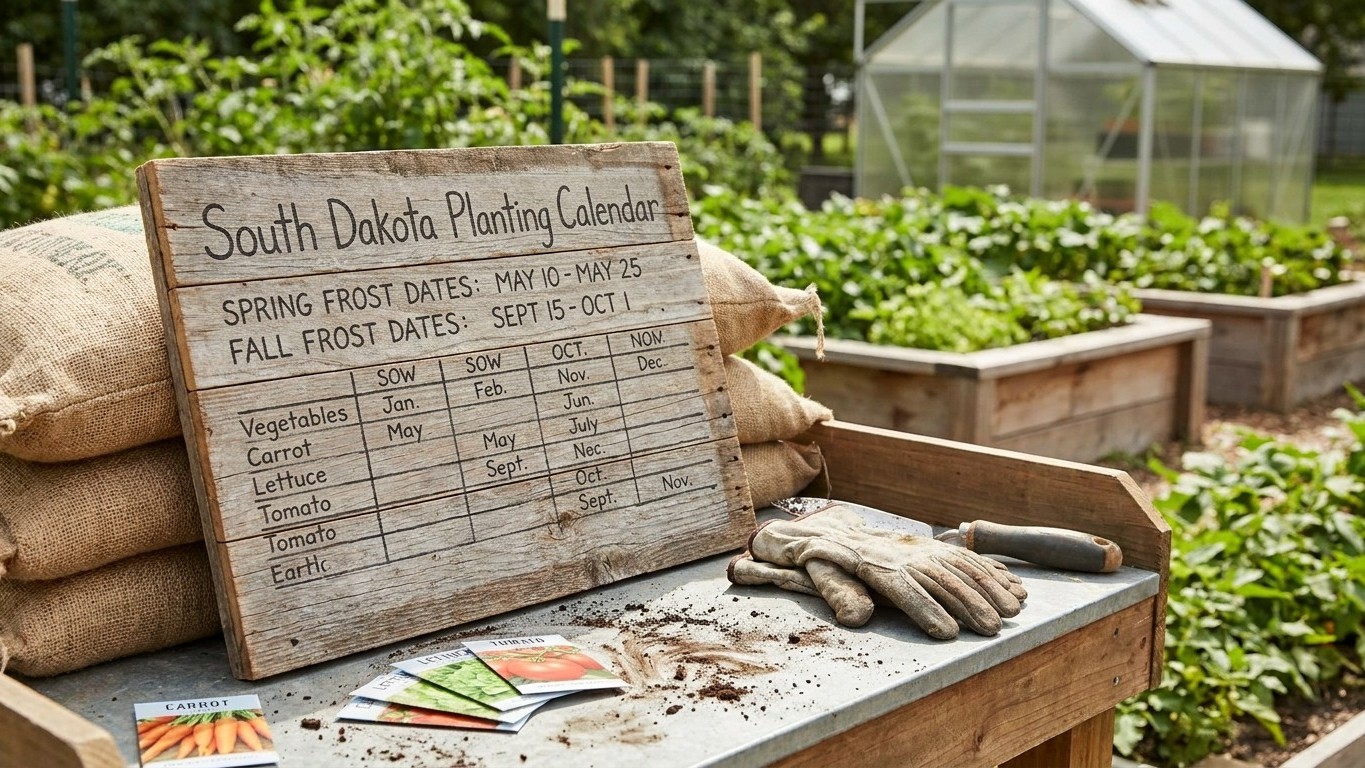

Near Sioux Falls, NOAA’s 1991-2020 climate normals put the last spring frost between April 29 and May 9, and the first fall frost between September 24 and October 4. That eleven-day spread in spring, and ten-day spread in fall, is the whole planting calendar in two numbers. Check your own county’s frost record against the Sioux Falls figures below before you set a single transplant, because gardens west of the Missouri River and at higher elevation typically run later in spring and earlier in fall.
The frost window in South Dakota

The reference station for these numbers is Sioux Falls (NOAA station USW00014944), and NOAA’s 1991-2020 Climate Normals give the last spring freeze there as falling somewhere between April 29 and May 9. The first fall freeze at the same station falls between September 24 and October 4. Those two ranges are not a guarantee for any single year or any single yard. They describe the 30 to 70 percent probability band for a 32°F freeze, meaning a freeze this late in spring, or this early in fall, happens often enough to plan around but not every year.
Do the arithmetic and you get a growing season that runs roughly 140 to 160 days long between the earliest possible last frost and the latest possible first frost, though the actual number in any given year depends on which end of each range you land on. That is a workable season for the full range of vegetable crops grown in the Upper Midwest, but it is tight enough that a warm-season crop with a long days-to-maturity figure needs real margin built in, which the tomato table further down shows in detail. Well before the season even begins, gardeners can consult What to Plant in South Dakota in January for the earliest indoor seed-starting and planning tasks. Before the season even begins, gardeners can consult What to Plant in South Dakota in February for planning and early preparation tasks. Long before that last frost arrives, gardeners can already get a head start by consulting What to Plant in South Dakota in March for early indoor sowing and cold-tolerant crops. As spring progresses, What to Plant in South Dakota in April covers the transitional crops that bridge the gap before the frost-free window opens. As the last spring frost date approaches, What to Plant in South Dakota in May lays out the transplants and direct-sown crops that fit that window. Once the last spring frost has passed, gardeners can check What to Plant in South Dakota in June for what to get in, and at the other end of the season, What to Plant in South Dakota in November covers the final cold-hardy tasks once the first fall frost has arrivedto the ground first, and by midsummer, once the frost risk has fully passed, they can turn to What to Plant in South Dakota in July for succe, and once the growing season winds down, What to Plant in South Dakota in December covers indoor growing and planning ahead for next yearssion plantings, while gardeners looking ahead to late summer can consult What to Plant in South Dakota in August for what still has time to mature before the fall frost arrivesssion sowing and warm-season crop guidance. As late summer gives way to early fall, What to Plant in South Dakota in September covers the last window for quick-maturing crops before the cold sets in. Later in the season, as the first fall frost approaches, What to Plant in South Dakota in October covers the cold-hardy crops and cleanup tasks that fit that window.
Northern and higher-elevation parts of South Dakota run later in spring and earlier in fall than Sioux Falls, sometimes by a week or two, and the state’s western reaches near the Black Hills add elevation on top of latitude. A gardener in Aberdeen or Rapid City should treat the Sioux Falls dates as a starting reference, not a local forecast. Gardeners across the border dealing with a similar swing between microclimates will recognize the pattern from the Wisconsin Planting Calendar, where lake effect stretches the same kind of spread even wider.
Cool-season crops
Peas, spinach, lettuce, and most brassicas tolerate a light frost and actually prefer to get into the ground while the soil is still cool. These crops germinate at soil temperatures well below what tomatoes or peppers need, and hard frost damages them only once temperatures drop well past the light frost they’re bred to shrug off.
Counting back from the Sioux Falls last-frost window of April 29 to May 9, gardeners direct-sowing peas and spinach typically go in four to six weeks before that window, which lands roughly in mid-March to mid-April depending on how the soil has thawed and dried that year. Lettuce and radishes follow a similar logic, though lettuce transplants can go out a bit later, two to three weeks ahead of the last frost, since young transplants are more frost-tender than the hardened seed itself.
What goes in early, and why
- Peas: sown as soon as soil can be worked, well ahead of the last frost date
- Spinach and lettuce: direct-sown four to six weeks before the last frost window
- Brassica transplants (cabbage, broccoli): set out two to three weeks before the last frost
- Carrots, beets, radishes: direct-sown two to four weeks before the last frost, since they need loose, workable soil more than warmth
Root crops in particular do not care about air temperature the way transplants do. What matters for them is whether the soil is workable, which in a heavy South Dakota clay loam can lag behind the calendar by a week or two after a wet spring. Watch the ground, not just the date.
Warm-season crops

Tomatoes, peppers, squash, beans, and corn all stall or rot if soil temperature is too low, regardless of what the calendar says about frost. A frost-free date does not mean warm soil. Soil at 6 inches deep often needs another one to two weeks past the last frost window before it reaches the range these crops actually germinate and root in, which is why the safe transplant window for tomatoes in this region runs from mid May to late May, roughly one to three weeks after the Sioux Falls last-frost range of April 29 to May 9.
Counting backward from a mid-to-late May transplant date, and using the standard six-to-eight-week indoor head start most tomato seed packets call for, seeds started indoors for a mid-May transplant go into trays roughly late March to early April. That is the arithmetic to run yourself with whatever variety you have chosen, since the exact number shifts by a week either way depending on the cultivar’s stated days to maturity and how warm your seed-starting setup runs.
Matching variety to the season
Short-season tomatoes carry the least risk in a state where the frost-free window itself is a range rather than a fixed date. Sakura, a 55-day indeterminate cherry tomato resistant to nematodes, Tomato Mosaic Virus, and Fusarium wilt races 1 and 2, set out mid May to late May, ripens by mid July and still leaves roughly 69 days of margin before the Sioux Falls fall frost window opens. Compare that to a longer-season paste tomato like San Marzano II, at 78 days from transplant, which ripens closer to early August and leaves only about 46 days of margin, a gap worth watching if your garden runs cooler than Sioux Falls.
| Variety | Days to maturity | Type | First ripe | Margin before fall frost |
|---|---|---|---|---|
| Sakura | 55 | Indeterminate | Mid July | ~69 days |
| Sun Gold | 57 | Indeterminate | Mid July | ~67 days |
| Juliet | 60 | Indeterminate | Late July | ~64 days |
| Amalfi | 68 | Determinate | Late July | ~56 days |
| Cherokee Purple | 72 | Indeterminate | Early August | ~52 days |
| Celebrity Plus | 78 | Determinate | Early August | ~46 days |
These days-to-maturity figures come from the seed packet and are counted from transplant, not from seed. They shift by a week or so depending on the season you actually get, so treat the “first ripe” column as a planning range, not a promise.
Peppers behave much like tomatoes and want the same mid-to-late-May transplant window. Squash, beans, and corn are more often direct-sown, and all three germinate poorly in cold soil, so waiting until the soil has had one to two weeks of warmth past the last frost window saves you a replant rather than an earlier but rot-prone start.
The fall planting window
Working backward from the Sioux Falls first fall frost of September 24 to October 4, a fall crop needs its full days-to-maturity figure plus a margin of roughly ten to fourteen days, since growth slows as daylight shortens in late summer even before a frost arrives. Subtract both numbers from the earlier end of the frost window, September 24, to find the latest safe sowing date for your particular crop, using the days-to-maturity figure printed on that crop’s own seed packet.
A fast crop with a 30-day maturity figure, for example, needs roughly 40 to 44 days of runway before September 24, which lands the latest sowing date in early to mid August. A slower 50-day crop needs to go in closer to mid to late July to have any real margin. Run this math against whatever variety you’re actually growing rather than trusting a single date, since the packet figure and your garden’s own microclimate both shift the answer by a week in either direction.
Crops that improve after a light frost
Not every crop is racing the frost. Some are better for it.
- Kale and collards sweeten noticeably after a light frost converts starches to sugars
- Carrots left in the ground through a light frost gain sweetness before harvest
- Brussels sprouts are traditionally harvested after one or two frosts for the same reason
- Spinach tolerates hard frost and often overwinters under mulch in milder pockets of the state
That last point matters more in South Dakota than in a state with a longer, gentler fall, since the drop from first light frost to a hard, growth-ending freeze can happen fast once the calendar turns into October.
Reading a planting calendar properly
A state-wide planting calendar, this one included, is built from a single weather station’s climate normals, and South Dakota is too large and too varied in elevation and terrain for one station to speak for the whole map. The Sioux Falls figures used throughout this page reflect the eastern part of the state at a modest elevation. Gardens near the Black Hills, gardens tucked in a river valley that pools cold air, and gardens on an exposed ridge that catches wind all depart from that reference in different directions and by different amounts.
What actually shifts your local date
Elevation is the biggest single factor: gardens several hundred feet higher than Sioux Falls typically see frost arrive earlier in fall and linger later in spring. Urban heat cuts the other way. A garden against a south-facing wall in town, or shielded by pavement and buildings, often runs a week or more ahead of an open rural plot nearby. Low spots that pool cold air overnight are frost pockets even within a single town, and a late cold snap outside the normal probability band can still show up in any given year regardless of what the 30-year average says.
The only real fix is to keep your own log: the date of your last spring frost and first fall frost, year over year, in your actual garden. After three or four seasons you’ll have a more accurate calendar for your own yard than any state-wide page can give you, this one included.
Local help
For county-level frost dates, soil testing, and crop recommendations specific to your part of the state, SDSTATE Extension is the resource to use rather than a general state-wide page. Their office network covers the same wide range of elevation and microclimate this article can only describe in general terms, and a soil test through their lab will tell you more about your particular bed than any calendar can. Start at SDSTATE Extension, and for the broader set of growing guides specific to this state, the South Dakota guides portal collects them in one place.
Common questions
Is it too late to plant if I miss the last frost date?
No, most warm-season crops actually do better transplanted a week or two after the Sioux Falls last-frost window closes, once soil has had time to warm. Cool-season crops sown late lose some of their spring window but can often be replanted for a fall crop instead.
Why did my tomatoes stall even after the frost date passed?
Cold soil is the usual culprit. Air temperature can clear the frost threshold while soil six inches down is still too cool for tomato roots to take up water and nutrients efficiently, which shows up as purplish leaves and stunted growth rather than frost damage.
Can I trust these dates if I live near the Black Hills?
Treat them as a starting point only. The Sioux Falls station sits at lower elevation in the eastern part of the state, and higher, western parts of South Dakota typically run later in spring and earlier in fall, sometimes by a week or two.
How do I know when my soil is actually warm enough for direct-sown squash or beans?
Watch germination speed as your guide rather than a fixed date. Seeds sitting in cold, wet soil without sprouting for a week or more are more likely to rot than to eventually come up, so a short delay for warmer soil usually beats an early but failed sowing.
Does this calendar apply the same way in a state like Kentucky?
No. Kentucky’s frost-free season runs considerably longer than South Dakota’s, which changes both the safe window for long-season crops and the fall planting math. The Kentucky Planting Calendar lays out that state’s own frost dates and crop timing for comparison.
Related guides
- North Dakota Planting Calendar: When to Sow and Plant, Frost Dates Included
- Minnesota Planting Calendar: When to Sow and Plant, Frost Dates Included
- Wisconsin Planting Calendar: When to Sow and Plant, Frost Dates Included