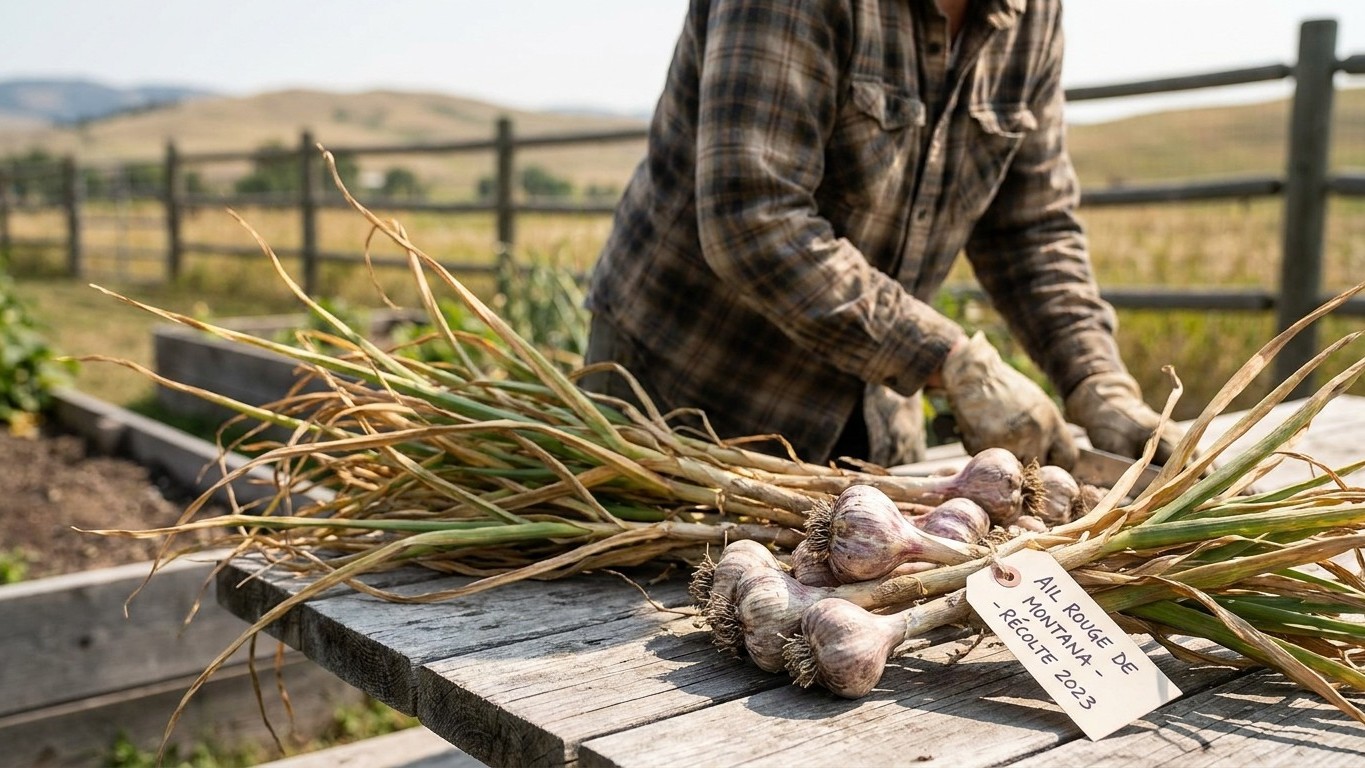

One smooth, undivided bulb — that’s what you lift next July if garlic clove goes into warm soil and never meets real cold. No cloves, no papery wrapper split into segments, just a solid round mass that cooks fine but won’t replant. Montana growers rarely cause this by planting too early; the state’s winters run subfreezing for months, far past the six to eight weeks below 40°F a clove needs to divide. The mistake here is different, and it’s timing, not temperature.
Will garlic get the cold it needs in Montana

A garlic clove is not a seed. Plant it in warm soil and skip the cold, and the following summer you lift one smooth, undivided bulb instead of a head split into cloves. University of Georgia Extension publication C854 puts the requirement at six to eight weeks of temperatures below 40°F after planting, the trigger that tells the clove to divide.
Montana’s winters clear the bar
Montana clears that bar without much help from the gardener. NOAA’s 1991-2020 climate normals put the first fall freeze in the Billings area at October 1 to October 14, and from that point into spring, the state’s winters run subfreezing for stretches far longer than the six to eight weeks garlic needs. That holds at low valley elevations near Billings and gets only more emphatic at higher elevation and in the mountain valleys further west and north, where cold arrives earlier and sits longer. The caution runs the other way here. A grower in Montana almost never needs to worry about too little cold. The real question is whether a bed drains well and gets planted early enough to root before that cold sets in, a timing issue covered in detail by the guide on When to Plant Garlic in Montana, which the next section also touches on.
Where the two workarounds still matter
Even in a state this cold, two situations call for a workaround. A very late planting, pushed into October after the ground has already begun to cool hard, may not leave the clove rooted long enough to take up that chill efficiently. A mild winter in an unusually sheltered valley bottom under deep, insulating snow can occasionally run warmer than open ground nearby. A gardener in a warmer state like Nebraska, where winter chill runs more marginal, faces this decision far more often than a Montana grower does, but it can still come up here.
- Refrigerate cloves, unplanted, at refrigerator temperature for the six to eight weeks the UGA figure calls for, then plant once the ground can be worked, mimicking the cold artificially.
- Grow softneck garlic instead, since it needs less cold to divide and tolerates a mild or interrupted winter better than hardneck does.
Neither option means giving up on the crop. It means matching the variety, or the pre-treatment, to the actual site rather than to a statewide average, and choosing among the Garlic Varieties That Suit Montana Winters makes that match easier to get right.
When to put the cloves in
There’s no way to give Montana a single planting date, because frost timing shifts with elevation and open water across a state this size. What you can do is work backward from the local frost window and the catalog’s own set-out range.
The frost window as an anchor
NOAA’s 1991-2020 climate normals put the first fall freeze in the Billings area at October 1 to October 14. That’s the midpoint of a probability band, not a guaranteed date, and it describes one relatively mild valley among many in the state. Garlic wants to go into the ground while the soil is still workable but cool enough that the clove roots without pushing much leaf growth, and it wants that root system in place several weeks before the ground freezes hard.
Reading the catalog window against that frost date
Set against Billings’ October 1 to October 14 frost window, early September sits roughly four to six weeks ahead of it, and late September lands one to three weeks ahead. That range gives a clove enough time to grow roots into cooling soil without putting up much top growth before winter locks things down. Planting later than that, once the ground is already cold, risks a clove that hasn’t rooted well before freeze-up, which slows it going into spring.
What moves the date at your place
Elevation is the biggest local variable in Montana. A garden a few thousand feet higher than Billings can see its first freeze arrive noticeably earlier, which argues for planting toward the early end of the September window rather than the late end. A large body of water works the other way. Gardens near a sizeable lake tend to see frost arrive later than nearby high ground, because the water holds warmth into fall. Montana has no coastline to soften its winters the way a coastal state does, so elevation and open water are the two factors worth checking against your own site rather than against Billings’ figures.
Which types suit Montana
Hardneck and softneck garlic are not interchangeable, and the choice matters more here than in a mild-winter state. Hardneck varieties send up a flowering stalk called a scape, produce a single ring of large, easy-to-peel cloves, and need a real winter to perform well. Softneck varieties skip the scape, form multiple smaller cloves, and tolerate winters too mild to satisfy a hardneck’s chill requirement. Montana has cold to spare, which is exactly the condition hardneck garlic wants.
Hardneck for the state’s cold winters
Because Montana’s winters reliably clear the six to eight week chill window, hardneck varieties are the safer default across most of the state. Bavarian Purple, Blue Music, Chesnok Red, Duganski, Fall Festival, Georgian Crystal, Georgian Fire, German Red, German White, and Ivan are all hardneck types that go into the ground in the same early September to late September window.
Where softneck still earns a place
Softneck garlic isn’t ruled out here, and it has one real advantage. It stores longer in the kitchen than hardneck typically does, often keeping well past the point hardneck starts to soften. Early Red Italian, Inchelium Red, Italian Late, and Lorz Italian are the softneck options on this list, and all four share the same early September to late September set-out window as the hardnecks. In a milder state such as West Virginia, softneck holds an edge because its winters don’t reliably deliver a hardneck’s chill requirement. In Montana that advantage narrows to storage life alone, since the cold here suits both types.
| Variety | Type | Set-out window |
|---|---|---|
| Early Red Italian | Softneck | Early September to late September |
| Inchelium Red | Softneck | Early September to late September |
| Italian Late | Softneck | Early September to late September |
| Lorz Italian | Softneck | Early September to late September |
| Bavarian Purple | Hardneck | Early September to late September |
| Blue Music | Hardneck | Early September to late September |
| Chesnok Red | Hardneck | Early September to late September |
| Duganski | Hardneck | Early September to late September |
| Fall Festival | Hardneck | Early September to late September |
| Georgian Crystal | Hardneck | Early September to late September |
| Georgian Fire | Hardneck | Early September to late September |
| German Red | Hardneck | Early September to late September |
| German White | Hardneck | Early September to late September |
| Ivan | Hardneck | Early September to late September |
Soil and bed preparation
Garlic spends eight to ten months in the same bed, through freeze, thaw, and spring melt, so the ground has to drain before it has to do anything else. Standing water in a heavy clay bed will rot a clove over the winter long before any disease gets the chance.
Drainage and tilth
Work the bed as soon as it’s evident where water sits after a fall rain. A raised bed or a hilled row solves drainage on heavy clay better than any amendment does, because it lifts the clove above the water table rather than trying to fix the whole soil profile. Loosen the ground a full 10 to 12 inches deep so roots can move down before the frost line reaches them, and break up any compacted layer left by a summer of foot traffic or equipment.
Feeding the bed before planting
Work a couple of inches of finished compost into the top of the bed several weeks before the early September planting window opens, giving it time to settle rather than sitting loose around the clove. Skip fresh, unfinished manure this close to planting. It’s high in nitrogen the clove doesn’t need going into dormancy, and it can carry pathogens straight into a bed the crop will sit in for most of a year. A soil test through your local extension office is the only reliable way to know whether the bed needs lime or added phosphorus before you commit a whole season to it.
What the climate here favours, and what it does not
Temperature doesn’t cause garlic disease by itself. Every pathogen below still needs to be present in the soil or on planting stock, and Montana’s climate only decides how active it can get once it’s there. UC IPM’s Onion and Garlic Pest Management Guidelines, UC ANR Publication 3453, publish the temperature ranges each pathogen favors, measured in soil, and what follows compares those ranges against Montana’s monthly average air temperatures for the growing season.
Where the numbers line up
White rot, caused by Sclerotium cepivorum, has a published range of 50°F to 75°F. Montana’s growing season mean air temperature falls inside that range in four months, September, May, June, and July, and two of those months sit at the pathogen’s published optimum. Fusarium basal rot, caused by Fusarium oxysporum f. sp. cepae, favors 59°F to 90°F, a range Montana’s monthly means fall inside for three months: September, June, and July. Those overlaps don’t mean either disease is present in a given garden. They mean that if infected seed stock or contaminated soil introduces one, the months in that overlap are when it can do the most damage.
Where they don’t, and why that’s not the same as safe
Southern blight and pink root both want a narrower, hotter optimum, 86°F to 95°F for Southern blight and 75°F to 85°F for pink root, and no month of Montana’s growing season reaches either range on average. That makes both diseases less active here than in a hot southern state, not impossible. A single reference station doesn’t describe the whole state either, and a monthly average hides real variation, since a month that averages a cool reading still holds individual days considerably warmer. The published thresholds are soil temperatures, and soil lags air by weeks and swings less than the air readings quoted here, so treat this as a description of tendency, not a forecast of infection. The one thing climate can’t fix is planting stock. Clean, certified seed garlic keeps every one of these pathogens out of a bed regardless of what the thermometer does.
Getting it through the winter
Montana’s winters are exactly the kind mulch is built for: real cold, real snow load in most years, and freeze-thaw cycles in the shoulder seasons that can heave a shallow clove right out of the ground.
Mulch timing and depth
Lay mulch once the ground has cooled and the top inch or two has firmed up, but before a hard freeze locks the soil solid. Straw, shredded leaves, or spoiled hay all work, laid on thick enough that you can’t see soil through it, on the order of four to six inches settled. That depth does two jobs. It evens out the freeze-thaw swings that heave cloves, and it holds soil moisture through a dry stretch in a winter with thin snow cover.
The heaving problem
A clove planted too shallow, or one that lost its mulch to wind partway through winter, can get pushed upward as the soil freezes and thaws repeatedly, ending up half exposed by the time spring arrives. Bury cloves at the depth given on the variety’s own planting instructions, mulch promptly, and check the bed after any winter windstorm strips it bare. In spring, pull the mulch back gradually once green shoots push through, rather than stripping it all at once, since a late-season cold snap can still catch new growth if the bed is bared too early.
Harvest and curing here
Garlic tells you when it’s ready with its leaves, not with a date on the calendar. Once the lower third to half of the plant’s leaves have browned and dried back while the upper leaves are still green, it’s time to lift.
Reading the leaves, not the calendar
Pulling too early leaves cloves undersized and the wrappers unfinished. Waiting too long, past the point where most of the leaves have collapsed, lets the papery wrappers split and the individual cloves separate in the ground, which cuts storage life sharply. Loosen the soil with a fork before pulling. Yanking a bulb straight up out of firm ground tears the wrapper and bruises the cloves, and a bruised bulb doesn’t store.
Curing in Montana air
Montana’s climate runs dry through most of the state’s summer, which generally favors curing: garlic wants warmth, shade, and steady airflow for several weeks, and low humidity speeds that process along without inviting mold. Hang bulbs in loose bunches or lay them in a single layer on a screen, out of direct sun, somewhere air moves freely. In an unusually humid or rainy stretch, which does happen in pockets of the state even in summer, add a fan to keep air moving across the bulbs, because trapped moisture at this stage is what turns a cured crop moldy in storage rather than in the field.
Local help
County-level frost dates, soil testing, and variety guidance specific to your part of Montana go beyond what a single Billings-based figure can tell you. Montana State University Extension maintains county offices across the state that can run a soil test on your specific bed and give planting guidance tuned to your elevation and valley.
Common questions
Can I Plant Garlic in spring in Montana instead of fall?
No, not with any expectation of a full-sized bulb. Garlic planted in spring misses the extended cold that triggers a clove to divide, so it tends to bulb small or not divide at all. Fall planting, timed to the local frost window, is what lets the cold do that work over winter.
What do I do if I miss the September planting window?
Plant as soon as you can once the ground is still workable, and mulch heavily right away to compensate for the shorter rooting time. Expect somewhat smaller bulbs the following summer if the clove didn’t get several weeks to root before the ground froze.
Do I need to cut off the scapes on hardneck garlic?
Yes, most growers cut scapes once they curl, because leaving them on redirects the plant’s energy into the flower stalk instead of the bulb. The scapes are edible and worth cooking with, not something to discard.
Can I plant garlic from the grocery store?
You can, but it’s a gamble. Grocery garlic is often treated to suppress sprouting, may not be a variety suited to a cold climate, and can carry diseases like white rot into a bed that will otherwise stay clean for years. Certified disease-free seed stock costs more for a reason.
How long will my cured garlic actually keep?
Softneck varieties generally keep longer in storage than hardneck, sometimes well past hardneck’s typical shelf life, which is part of why softneck still gets grown in a state built for hardneck. Either type keeps longest cool, dry, and out of direct light, and starts to soften and sprout once conditions drift warm or humid.