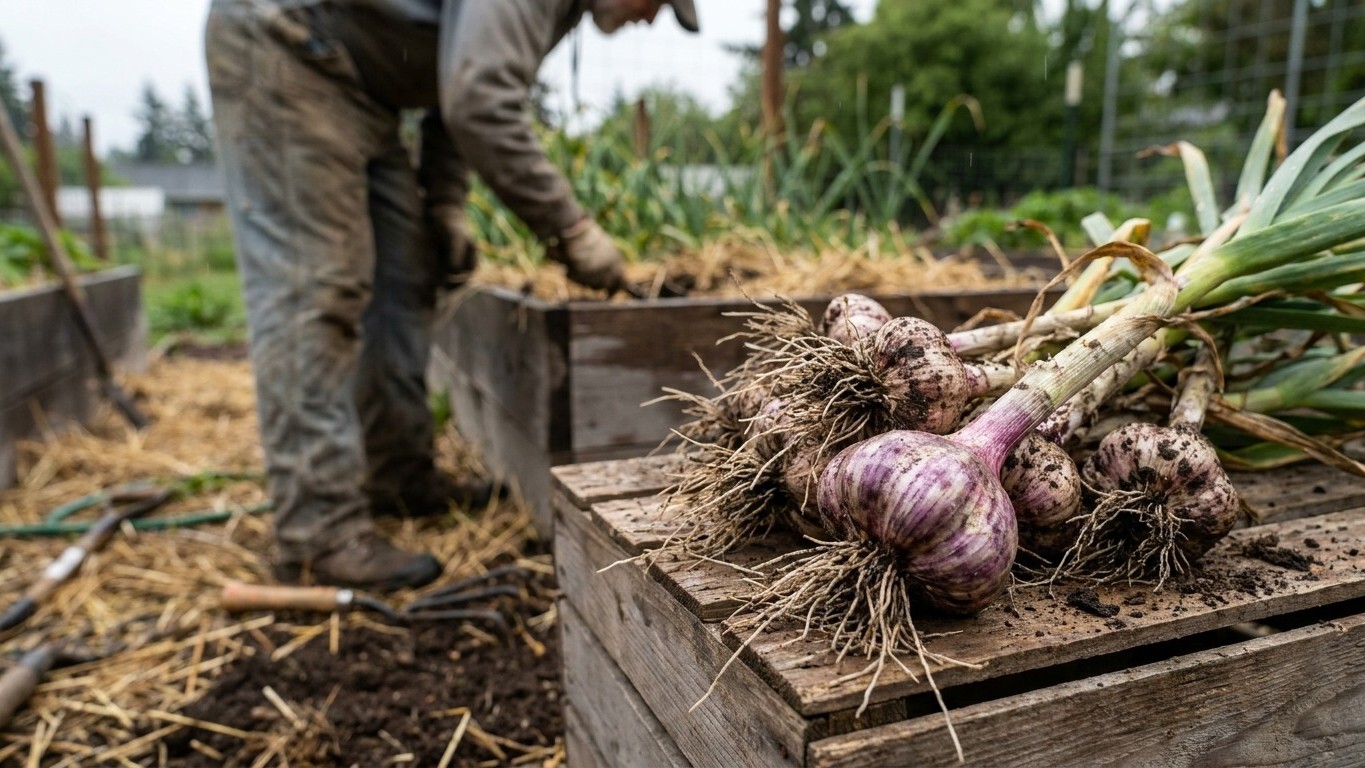

Six to eight weeks below 40°F is what a garlic clove needs to split into a full head, and Oregon hands out that cold on wildly different terms depending on where the ground sits. A bulb planted in the Willamette Valley can come up looking more like a shallot than garlic — round, undivided — if a mild winter never quite delivers the stretch. Climb a few hundred feet into the Coast Range foothills, though, and the same clove gets more freezing nights than the valley floor ten miles away. Elevation, not the calendar, decides this.
Will garlic get the cold it needs in Oregon

The six-to-eight-week threshold
A garlic clove needs to feel a real stretch of cold after planting or it never splits into cloves at all. Instead of a head, the grower digs up a single round bulb that looks more like a shallot than garlic. The University of Georgia Extension’s garlic publication C854 sets that requirement at six to eight weeks with soil temperatures below 40°F, and that number is the one to test your own garden against, not the calendar.
Oregon does not answer that question the same way twice. West of the Cascades, in the Willamette Valley and around Portland, winters run wet and comparatively mild. Hard freezes tend to be short-lived events rather than a long settled cold snap, and NOAA’s NCEI 1991-2020 normals show the first fall freeze at Portland not arriving until November 11 to November 27. A valley winter can still deliver six to eight weeks under 40°F, but in a mild year it runs close to the edge, especially on the warmer parts of the valley floor. Elevation changes this calculation quickly: a garden a few hundred feet up in the Coast Range or the Cascade foothills sees more nights below freezing than the valley floor a few miles away, so a chill margin that looks tight in Portland can be comfortable ten miles into the hills. Central and eastern Oregon are a different matter entirely. The high desert holds a much shorter, colder season, and a garden there clears the chill requirement without difficulty most winters.
If your winter comes up short
If you garden in one of the milder western valleys and worry the winter came in short, you have two working options rather than one. Refrigerate the cloves for four to six weeks before planting, tucked dry in a paper bag in the crisper drawer, to force the vernalization the ground might not fully supply on its own. Or plant a softneck type instead of a hardneck, since softnecks split reliably on a shorter, milder cold spell. That is exactly why softneck garlic dominates in warm-winter states already, and checking a guide to Garlic Varieties That Suit Oregon Winters can help you pick the right type for your microclimate. Do not skip planting because the winter looks mild. Either move solves the problem, and Oregon growers use both depending on what they’ve got in the bin.
When to put the cloves in
Garlic wants time to grow roots before the ground freezes solid, but not so much time that it pushes tall green shoots into the first hard freeze, which is why checking When to Plant Garlic in Oregon matters before putting cloves in the ground for your specific region. That balance is why every variety in the catalogue for this territory is set out late October to early November, timed against the autumn freeze rather than a fixed date on the calendar.
NOAA’s NCEI 1991-2020 climate normals put Portland’s first fall freeze in a window running from November 11 to November 27, roughly November 19 at the midpoint of that range. That places the late-October-to-early-November planting window two to four weeks ahead of the freeze itself, long enough for roots to establish in still-warm soil, short enough that top growth stays low going into winter. Treat that November 19 figure only as a rough anchor, never as a safe date to plant by. Some years the freeze lands at the early edge of the range, some years at the late edge, and Portland’s own normal is only one station’s record.
What shifts the anchor
What moves that anchor is mostly elevation and proximity to water. Gardens near the coast or close to the Columbia River tend to see freezes arrive later and milder than gardens at the same latitude further inland, because open water buffers the air. Higher ground in the Coast Range or the Cascade foothills tips the other way, with frost settling in earlier than on the valley floor. If you garden in central or eastern Oregon’s high desert, do not borrow Portland’s window at all. That region freezes weeks earlier and harder, and while the same October-to-November planting range still applies to the catalogue varieties, it lands much closer to your own first frost than it does in the Willamette Valley. For a fuller look at a genuinely cold-winter garlic climate, see how growers time it in Growing Garlic in Idaho: Planting Dates, Varieties and Winter Cold.
Soil temperature is the more reliable signal than the calendar if you want to fine-tune within that window. Garlic roots best once the top few inches of soil have cooled from summer’s heat but are still workable, well before the ground turns cold and heavy with autumn rain. Willamette Valley growers watch that cooling trend through October rather than waiting for a specific date, planting as soon as the bed is ready rather than pushing it to the far end of the window.
Which types suit Oregon
The hardneck-versus-softneck choice in Oregon comes down to which winter you are actually gardening in, not personal taste. Hardneck garlic needs a real, settled cold season to divide well, and rewards a grower with a central woody scape and big, easy-to-peel cloves. Softneck garlic tolerates a milder, wetter winter without complaint and stores for far longer afterward, which is why it is the type usually sold braided in a grocery store.
Softneck for mild winters
West of the Cascades, where winters are mild by comparison and the chill margin can run tight in some years as covered above, softneck varieties are the safer default. Inchelium Red is a reliable softneck for a mild valley winter and keeps well into the following year in storage. Lorz Italian is another softneck bred for Pacific Northwest conditions and suits the same growing pattern. Early Red Italian and Italian Late round out the softneck options, and both set out on the same late-October-to-early-November window as the rest of the catalogue.
Hardneck for colder pockets
Hardneck garlic still has a place here, especially for gardeners in the Cascade foothills, the Coast Range, or anywhere winter reliably delivers a longer freeze than the Portland normal. German Red and German White are two of the more forgiving hardnecks for a marginal winter. Chesnok Red and Duganski are hardneck standards worth the extra step of refrigerating cloves ahead of a mild winter. Bavarian Purple, Blue Music, Georgian Crystal, and Georgian Fire round out the stronger hardnecks, alongside Fall Festival and Ivan, all set out on the same late-October-to-early-November window.
| Variety | Type | Best fit in Oregon |
|---|---|---|
| Inchelium Red | Softneck | Mild valley winters, long storage |
| Lorz Italian | Softneck | Pacific Northwest conditions generally |
| Italian Late | Softneck | Mild valley winters |
| Early Red Italian | Softneck | Mild valley winters |
| German White | Hardneck | Colder pockets, foothills |
| German Red | Hardneck | Colder pockets, foothills |
| Chesnok Red | Hardneck | Colder winters or pre-chilled cloves |
| Duganski | Hardneck | Colder winters or pre-chilled cloves |
| Bavarian Purple | Hardneck | Colder winters, high desert |
| Blue Music | Hardneck | Colder winters, high desert |
| Georgian Crystal | Hardneck | Colder winters, high desert |
| Georgian Fire | Hardneck | Colder winters, high desert |
| Fall Festival | Hardneck | Colder winters, high desert |
| Ivan | Hardneck | Colder winters, high desert |
Soil and bed preparation
Garlic sits in the same patch of ground through an entire wet Oregon winter, so drainage matters more than fertility when you are choosing and prepping a bed. A clove sitting in saturated soil for weeks rots before any disease organism ever gets involved. If your site holds water after a hard autumn rain, raise the bed several inches above grade rather than planting flat, or work in enough compost and coarse material to open up a heavy clay soil before the rain sets in for the season.
Drainage and rotation
Work the bed in the weeks ahead of planting, not the day of. Loosen the soil a full spade’s depth, remove rocks and old root fragments, and mix in a couple inches of finished compost. Garlic draws heavily on nitrogen and sulfur through the season, so an amended bed going into winter gives roots something to pull from as soon as they start growing, weeks before any top growth shows.
Avoid a bed that has grown onions, garlic, leeks, or shallots in the past few years if you can help it. All four share the same soil-borne disease pressures, covered next, and rotating away from them for a few seasons is the cheapest insurance a grower has. Full sun is worth insisting on too, since garlic bulks up slowly through spring and into summer, and a shaded bed costs it size at harvest. A soil test taken in fall, before the ground cools, tells you whether pH and nutrients need correcting before the cloves go in rather than after a slow spring reveals the problem.
What the climate here favours, and what it does not
UC IPM’s Pest Management Guidelines for Onion and Garlic, UC ANR Publication 3453, publish the temperature ranges each major garlic disease needs to develop, and Oregon’s growing-season air temperatures can be checked against them month by month. Two caveats matter before any of these counts mean something for your own garden. The published thresholds are soil temperatures, while the figures used here are air temperatures, which lag behind the air and swing far less. And a monthly mean is not a month spent inside the danger zone: a month averaging 65°F still holds days at 50 and days at 80.
With that said, here is what the count shows for a growing season running September through July:
- White rot, caused by the fungus Sclerotium cepivorum: the mean air temperature falls inside its published 50-75°F range in six months of the growing season, September, October, April, May, June, and July, including two months at the disease’s published optimum. That is the widest window of any disease on this list.
- Fusarium basal rot, caused by Fusarium oxysporum f. sp. cepae: the mean falls inside its published 59-90°F range in three months, September, June, and July.
- Southern blight, caused by Sclerotium rolfsii: no month reaches its published 86-95°F optimum, so the disease runs less active here, not absent.
- Pink root, caused by Setophoma terrestris: no month reaches its published 75-85°F optimum either, for the same reason: less active, not gone.
What the count means for your garden
None of this is a forecast, and it is not a verdict on any single garden. A count of zero months at a disease’s optimum does not mean that disease cannot occur, because infected seed stock carries these pathogens into a garden regardless of what the thermometer says outside. The practical takeaway is narrower: white rot’s sclerotia can persist in soil for years once established, so buying clean, certified seed garlic rather than reusing bulbs from an unknown source matters more in Oregon’s climate than in a state where the window is shorter. A single reference station, however good the record, does not describe conditions on every farm in the state either. A valley floor with heavy clay holds warmth differently than the same air over a sandy raised bed a few miles away.
Getting it through the winter
Once cloves are in the ground, a mulch layer does two different jobs depending on where in Oregon you garden. In the Willamette Valley’s milder, wetter winters, mulch mostly moderates freeze-thaw swings and keeps the soil surface from crusting under repeated rain. In a colder pocket, the Cascade foothills or the high desert of central and eastern Oregon, mulch is doing the heavier work of insulating the clove against a genuinely hard freeze.
Mulch depth and timing
Lay mulch, loose straw or chopped leaves work well, once the ground has cooled but before a hard freeze locks it up, so it traps the soil’s existing warmth rather than sealing in the cold. A layer that has settled to a few inches thick is usually enough in a mild valley winter. Add more where the winter is genuinely hard, since a thicker layer buys more insulation there.
Heaving is the real risk for a shallow-planted clove through an Oregon winter with repeated freeze-thaw cycles, more so than the cold itself. A clove nudged an inch out of the ground by an overnight freeze and a daytime thaw sits exposed to the next cold snap and often does not recover. Planting at a full, generous depth to begin with and mulching over it addresses most of this before it ever starts.
Pull mulch back gradually in spring as new green shoots push through, rather than stripping it all at once. Leaving it too heavy too long into spring keeps the soil colder and wetter than the bulb wants, which slows bulking later in the season. For comparison, a true cold-winter garlic climate like the one described in Growing Garlic in Pennsylvania: Planting Dates, Varieties and Winter Cold leans on mulch far more heavily and for longer, since the ground there actually freezes solid for a stretch that Oregon’s milder valleys rarely see.
Harvest and curing here
Garlic tells you when it is ready far more reliably than any date on a calendar does. Lift the bulbs when the lower third to half of the leaves have browned and dried while the upper leaves are still green, not when the whole plant has collapsed. Pulling too early costs size and storage life. Waiting too long lets the bulb’s wrapper split open in the ground, which invites rot and cuts storage life just as badly.
Curing in a wet or dry summer
Curing is where an otherwise good Oregon garlic crop often goes wrong, because the harvest itself was fine and the loss happens afterward in a garage or shed. Curing means drying the whole plant, bulb and stalk together, in a shaded, airy spot out of direct sun and rain, until the outer wrappers paper over and the neck tightens down. In a dry Willamette Valley summer that process moves along steadily in a covered, open-sided space. In a wetter or unusually humid stretch, the same crop needs more airflow, not more time sitting in a damp corner, so a fan or a genuinely well-ventilated space matters more than it would in a drier year.
Do not wash the bulbs before curing, and do not cut the roots or trim the tops until curing is finished. Both invite moisture and rot into a bulb that is otherwise sealing itself up for storage. Once the wrappers are papery and the neck is tight and dry, trim roots and tops, brush off loose soil, and move the crop to long-term storage.
Local help
County-level frost dates, soil test results, and variety trials specific to your part of Oregon go well beyond what a statewide page can responsibly give you. Oregon State University Extension maintains county offices across the state that handle exactly this: local planting calendars, soil testing services, and disease diagnosis for a grower who suspects white rot or another soil-borne problem has turned up in a bed.
Common questions
Can I still plant garlic in spring if I missed the fall window?
You can plant leftover cloves in late winter once the ground is workable, but expect smaller bulbs. Garlic is an autumn-planted, summer-harvested crop, and a spring-planted clove misses most or all of the cold period it needs to divide well, so the payoff is usually a single rough bulb rather than a full head of cloves.
My garlic came up as one round clove instead of a head. What happened?
That is a vernalization failure, meaning the clove never got the sustained cold it needed after planting. It usually points to a planting date too late in a mild year, cloves that were never refrigerated ahead of a marginal winter, or a hardneck variety planted where a softneck would have been the safer choice.
Is it okay to Plant Garlic bought from the grocery store?
It is risky rather than flatly wrong. Grocery garlic is often treated to slow sprouting, which can hurt germination, and it carries no guarantee against soil-borne diseases like white rot, which can persist in a bed for years once introduced. Certified seed garlic from a known source costs more up front and avoids that gamble.
Do I need to cut the scapes on hardneck garlic?
Cutting the scape once it curls redirects the plant’s energy into the bulb instead of the flower stalk, and most growers report a modestly larger head as a result. Softneck varieties don’t produce a scape at all, so this only applies to hardneck types.
How do I know if white rot is already in my soil?
Look for yellowing, stunted plants and a fluffy white fungal growth studded with tiny black specks around the base of the bulb, usually showing up as the crop nears maturity rather than early on. If you suspect it, do not replant garlic or onions in that bed and contact your county extension office for a proper diagnosis before you decide what to do with the ground.