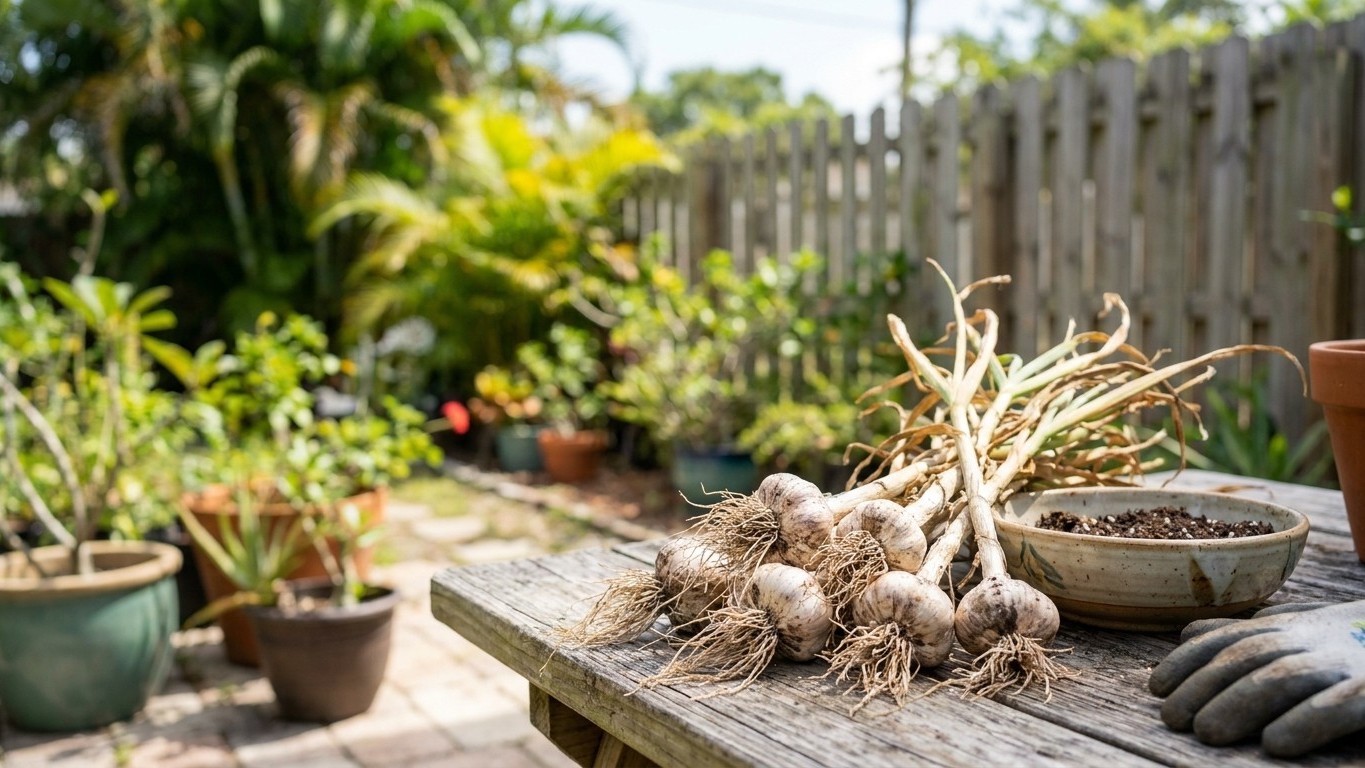

Softneck garlic suits Florida winters better than hardneck does, because the region’s winter cold, measured at Jacksonville, comes nowhere near what garlic needs to divide into cloves. NOAA’s 1991-2020 climate normals put Jacksonville’s first fall frost between November 26 and December 13, a range that only marks the midpoint of when cold usually arrives. Garlic goes into the ground before that, in early to late November. Plant a softneck variety first, and hold off on hardnecks until you’ve pre-chilled the seed cloves in the refrigerator for several weeks.
The short answer for Florida

Softneck garlic is the one to plant first, and here’s why: Florida’s winters never get cold enough to split a hardneck bulb the way it needs to split. Set your cloves in the ground in early to late November, and if you’re set on growing a hardneck anyway, put those seed cloves in the refrigerator for several weeks first so they get the chill the ground won’t give them. That’s the whole decision in front of you right now — softneck goes straight in the dirt, hardneck goes in the fridge first.
The bigger decision isn’t the date. It’s the type. North Florida’s winter almost never delivers real cold: at the Jacksonville station, the growing season logs 0.0 weeks with a mean temperature below 40°F, well short of the six to eight weeks hardneck garlic needs after planting to split into separate cloves, a threshold set by the University of Georgia Extension (publication C854). Softneck types don’t carry that requirement, which is why they’re the safer first planting here.
That doesn’t rule hardnecks out. It means you either accept a smaller, sometimes undivided bulb, or you pre-chill the seed cloves yourself before planting to substitute for the cold the ground won’t provide. Every variety below still goes in the ground on the same early-to-late-November schedule, whether it’s a softneck that skips the chilling step or a hardneck that needs it.
| Variety | Type | Set-out window (north Florida) |
|---|---|---|
| Early Red Italian | Softneck | Early Nov. to late Nov. |
| Inchelium Red | Softneck | Early Nov. to late Nov. |
| Italian Late | Softneck | Early Nov. to late Nov. |
| Lorz Italian | Softneck | Early Nov. to late Nov. |
| Bavarian Purple | Hardneck | Early Nov. to late Nov. |
| Blue Music | Hardneck | Early Nov. to late Nov. |
| Chesnok Red | Hardneck | Early Nov. to late Nov. |
| Duganski | Hardneck | Early Nov. to late Nov. |
| Fall Festival | Hardneck | Early Nov. to late Nov. |
| Georgian Crystal | Hardneck | Early Nov. to late Nov. |
| Georgian Fire | Hardneck | Early Nov. to late Nov. |
| German Red | Hardneck | Early Nov. to late Nov. |
| German White | Hardneck | Early Nov. to late Nov. |
| Ivan | Hardneck | Early Nov. to late Nov. |
Working it out for your own garden
The arithmetic behind the November planting window starts with the frost date, even though garlic isn’t planted to dodge frost the way a tomato transplant is. This whole guide assumes you’ve already worked through the basics covered in Growing Garlic in Florida, so what follows is about fine-tuning the calendar for your own patch of ground. NOAA’s 1991-2020 normals give Jacksonville’s first fall freeze as a range, November 26 to December 13, not a single day, because thirty years of Novembers and Decembers don’t land on the same date twice. Garlic goes in ahead of that range, in early to late November, so the cloves get several weeks of cooling soil before the coldest weather typically shows up. Counting backward from a range gives you another range. Don’t narrow it to a single planting day. The plant doesn’t need one, and for a fuller walk-through of that backward count, see When to Plant Garlic in Florida: Counting Back From the First Frost.
Why the window is wide
Two things widen the calendar rather than narrowing it. First, garlic doesn’t die at 32°F the way a tender seedling does, so there’s no hard deadline forcing an exact date. Second, the frost figure itself is a probability band. NOAA’s normals describe a range in which the freeze becomes likely at the Jacksonville station, which means the real frost date wanders on either side of it almost as often as it falls inside it.
To adapt this for a garden that isn’t next to Jacksonville’s airport, think about what makes a site behave differently from that station. Higher ground drains cold air away and tends to run a little warmer at night, while low, flat land collects cold air and runs colder. A large lake nearby moderates both extremes, holding daytime heat into the evening the same way the ocean does along the coast. None of these effects are big enough to turn a north Florida garden into a frost-free one, but they can shift the practical planting date earlier or later by a week or so relative to what the Jacksonville normal suggests.
The more useful number to track yourself is soil temperature, not air temperature. Garlic roots best once the ground has cooled from its summer highs, and a cheap soil thermometer pushed four inches down tells you more about your own bed than a regional average ever will. If your soil is still warm going into November, there’s no harm waiting the extra week or so the catalogue window allows before you commit the cloves.
What changes across Florida
Everything above describes north Florida, anchored to the Jacksonville station. South of about the Orlando line, the calendar this article describes stops applying. Central and South Florida rarely see a freeze at all, and garlic there goes in for a different reason than frost avoidance. In those regions summer heat, not winter cold, is the limiting factor, and the growing calendar effectively flips. Growers around Orlando and further south treat the mild winter as the main season and summer as the period to work around, the opposite of the frost-driven schedule that governs Jacksonville, Gainesville, and the rest of the Panhandle and northern peninsula.
Within north Florida itself, the same station-based caution applies. Jacksonville’s airport is an inland, cleared site, and NOAA’s own data shows three of the thirty falls it measured there had no freeze whatsoever. A backyard closer to the St. Johns River or nearer the coast can run a little milder than the airport reading suggests, while an inland spot away from that moderation can run a touch colder. None of this changes the recommended plant type. Even the milder pockets of north Florida fall well short of the cold a hardneck wants, so the softneck-first advice holds from the Georgia line down to about the central peninsula.
Elevation matters less in Florida than in most states, since the whole peninsula sits low, but the presence of water does. A pond or lake big enough to hold heat overnight measurably softens the first frost on its downwind side, which is one reason garlic beds set close to water in north Florida sometimes escape a freeze that hits an open field a mile away.
The mistakes this climate punishes
The mistake growers repeat most often here is planting a hardneck variety and expecting it to behave the way it does in a Northern catalogue photo. Without close to the six to eight weeks below 40°F that the University of Georgia Extension credits with triggering clove division, a hardneck bulb often comes up as a single rounded clove instead of the multi-clove head shown on the package. If you plant a hardneck in north Florida, pre-chill the seed cloves in a refrigerator for several weeks before setting them out, and treat the result as a trial rather than a guaranteed harvest.
The second mistake is planting late. The catalogue window closes at the end of November for every variety listed above, and pushing cloves in after that gives the roots less time to establish before whatever cold does arrive. Shallow planting causes its own trouble. A clove set too near the surface heaves out of loose, sandy Florida soil during the wet, up-and-down swings of a north Florida winter, so cloves belong a full two inches deep with a mulch layer over the top.
Disease pressure that doesn’t take a winter off
Florida’s mild winters also keep the soil warm enough, for long enough, to favor two of garlic’s worst soil-borne diseases. Using published temperature ranges from the University of California’s Integrated Pest Management guidelines for onion and garlic (UC ANR Publication 3453), the mean air temperature across a north Florida growing season falls inside white rot‘s 50 to 75°F range for eight months of the year, and inside Fusarium basal rot‘s 59 to 90°F range for another eight. Those figures describe soil conditions using air temperature as a stand-in, a monthly average hides a lot of daily swing, and one station doesn’t describe the whole state, so treat the count as a measure of opportunity for the pathogen, not a forecast of infection. Neither disease needs the climate’s help to arrive. Both travel in on infected seed cloves regardless of the weather, which is why sourcing clean, certified seed garlic matters more here than the exact planting date does.
Pink root and southern blight favor hotter conditions, most active during the heat of early fall and again as bulbs finish up the following summer. Southern blight‘s optimum range doesn’t show up as a monthly average even in Florida’s hottest stretch, but that only means the disease runs less actively outside its peak, not that it’s absent from Florida gardens.
Checking this against your county
Every figure above is measured at one station near Jacksonville, and Florida’s climate changes enough between the Panhandle, the northern peninsula, and the true peninsula that a single frost date can’t cover all of it. For a planting date and variety recommendation specific to your own county, contact your local UF/IFAS Extension office through the Solutions for Your Life directory, part of the USDA’s land-grant extension network. Ask specifically about local frost normals and any garlic trial results, since county agents often carry data that never makes it into a statewide guide.
Common questions
Can I just plant grocery store garlic instead of buying seed garlic?
You can, but it’s a gamble on two fronts. Grocery garlic is rarely labeled by variety, so you don’t know if it’s a softneck suited to a mild winter or a hardneck that needs cold it won’t get, and it isn’t certified disease-free the way seed garlic from a garlic-specific supplier usually is.
What happens if I plant garlic too early, in October?
The cloves may sprout into leaf growth before the weather cools, using up energy the bulb needs later in the season. The planting window for every variety starts in early November for a reason, and going earlier doesn’t buy you anything in a climate this mild.
Do softneck varieties need the refrigerator treatment too?
No. Softneck types like Inchelium Red or Lorz Italian don’t need the extended cold that triggers clove division in hardnecks, which is exactly why they’re the lower-risk choice for a north Florida bed. Save the pre-chilling step for hardneck seed cloves only.
Why did my hardneck garlic come up as one big round clove instead of a bulb?
That’s a round, and it means the planting didn’t get enough cold to split into cloves, most likely because the seed wasn’t pre-chilled before it went in the ground. A round is still edible and can be replanted the following fall, but it won’t store or divide like a properly formed bulb.