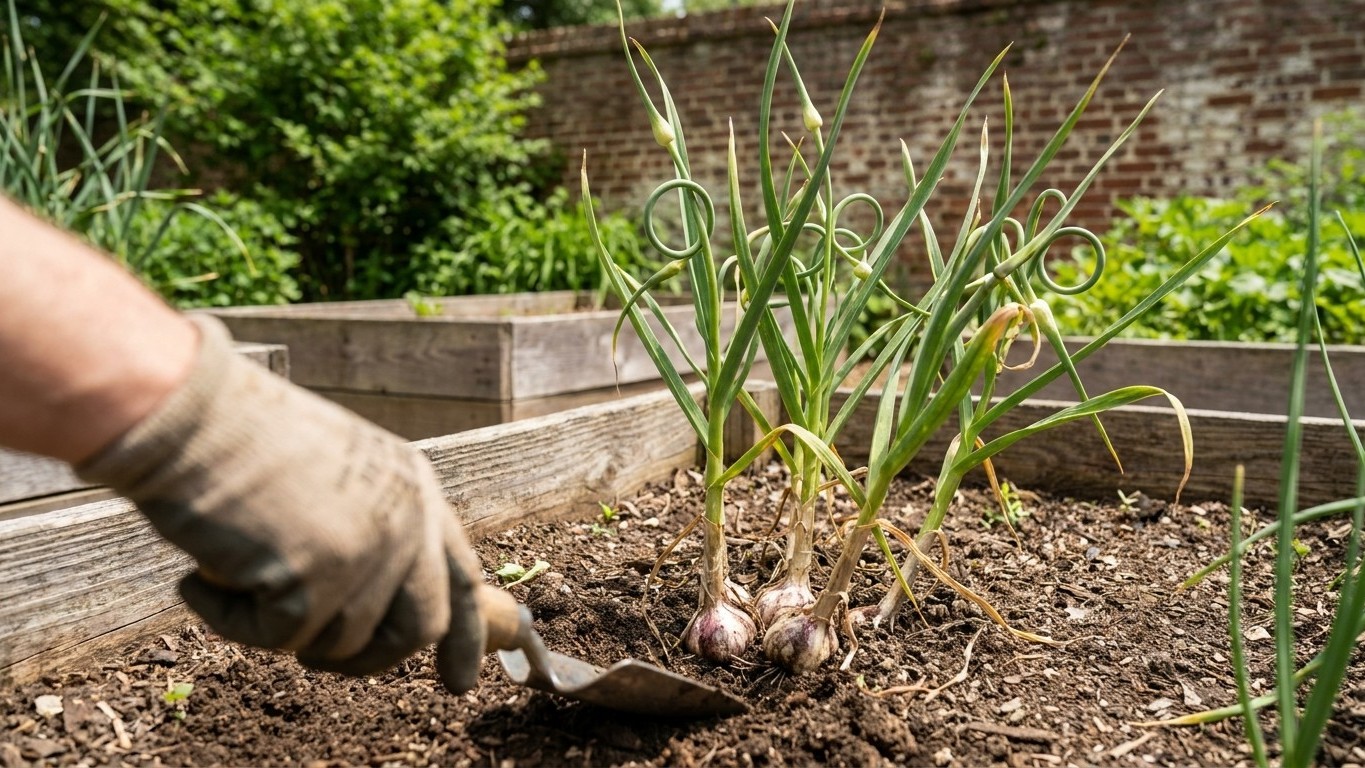

Mid October to early November is when garlic goes into the ground for most of Virginia, timed so roots get a solid grip before the soil turns cold. Walk your yard and find the low spots where frost settles first on a grass morning in October — that’s your real clock, not a date on a bag of seed garlic. Once you’ve spotted that, pull your county’s frost data and count back four to six weeks from it before you plant a single clove.
The short answer for Virginia

For growers near the coast, garlic goes in the ground mid October to early November, anchored on NOAA’s 1991-2020 climate normals for the Virginia Beach area (station USW00013769), which put the first fall frost between November 10 and November 24. That’s a two-week window, not a single day, because a frost date is a midpoint. In one year out of two, frost arrives later than the range suggests, so treating either end of it as a guarantee is a mistake in itself.
The date is not really about frost itself. Garlic roots grow in cool soil as long as the ground stays workable, so what matters is giving cloves several weeks of root-only growth before hard freezes stop things below ground. Plant too early and cloves push green shoots before the killing cold sets in. Plant too late and roots never get a proper grip before the soil turns cold, an outcome that shows up in spring as thin, uneven stands. If you haven’t prepped a bed yet, Growing Garlic in Virginia walks through soil amendment and site choice.
This is a coastal figure. NOAA’s data describes Virginia Beach specifically, the mildest corner of the state, and every other part of Virginia trends colder in fall, some of them by a lot. A grower in the Shenandoah Valley or the southwest highlands should treat mid October to early November as a starting point to move earlier from, not as a date fixed on the calendar.
Working it out for your own garden
The arithmetic behind the date is simple once you have a local frost figure to start from. Garlic wants roughly four to six weeks of soil temperatures cool enough to slow root growth without stopping it, and no real top growth, before the ground locks up for winter. Count backward from your area’s average first fall frost and you land on a planting window, not a single day.
The Virginia Beach example
Run the numbers for the coast and the logic is visible. NOAA’s 1991-2020 normals put the first fall frost in the Virginia Beach area between November 10 and November 24. Counting back four to six weeks from the early end of that range lands in early October. Counting Back From the late end lands in late October to early November. The overlap between those two calculations is exactly why mid October to early November is the window named for garlic here, rather than a single fixed date.
Your own garden will not match Virginia Beach exactly even if you live nearby. A few local details worth walking through before you commit cloves to the ground:
- Elevation cools a site. A garden a few hundred feet higher than the surrounding lowland tends to see its first frost earlier than the valley floor near it.
- Cold air drains downhill at night, so a bed at the bottom of a slope or in a hollow can frost weeks ahead of a bed on a gentle rise on the same property.
- Heavy clay holds cold and wet longer into fall than a raised bed or sandy loam, which changes how late the soil stays workable at all.
- A paved driveway, a south-facing wall or a dense neighborhood holds heat, and can push a garden’s effective frost date later than open countryside nearby.
None of these local effects show up in a single weather station’s normals. NOAA’s figures describe the station near Virginia Beach specifically, and a garden a few miles inland or a few hundred feet higher runs on its own schedule. Treat the calculated window as a first pass, then adjust it against what you actually see in your own yard: note when the first light frost touches low spots in the grass each October, and use that as your working data point going forward.
Where named varieties fall in this window
The planting window holds steady across the garlic varieties commonly grown in Virginia, whether softneck or hardneck. For a deeper comparison of flavor, storage life and clove size across these cultivars, see Garlic Varieties That Suit Virginia Winters.
| Variety | Type | Set-out window (Virginia) |
|---|---|---|
| Early Red Italian | Softneck | Mid October to early November |
| Inchelium Red | Softneck | Mid October to early November |
| Italian Late | Softneck | Mid October to early November |
| Lorz Italian | Softneck | Mid October to early November |
| Bavarian Purple | Hardneck | Mid October to early November |
| Blue Music | Hardneck | Mid October to early November |
| Chesnok Red | Hardneck | Mid October to early November |
| Duganski | Hardneck | Mid October to early November |
| Fall Festival | Hardneck | Mid October to early November |
| Georgian Crystal | Hardneck | Mid October to early November |
| Georgian Fire | Hardneck | Mid October to early November |
| German Red | Hardneck | Mid October to early November |
| German White | Hardneck | Mid October to early November |
| Ivan | Hardneck | Mid October to early November |
What changes across Virginia
Virginia is not one climate, and a garlic planting date should not be read off a single coastal figure. The parts of the state that turn cold early need cloves in the ground sooner than the Virginia Beach window suggests. The parts that stay warm longer into fall can wait without risk.
Where fall arrives early
The Blue Ridge and the far southwest counties see their first fall frost weeks ahead of the coast. Higher elevation cools the air faster once nights lengthen in September and October, and valleys tucked between ridgelines trap cold air overnight even before a widespread frost arrives anywhere else. A grower in these areas should plan to plant earlier than mid October, since waiting for a coastal calendar date risks setting cloves into ground that is already cooling toward its own local frost.
The Piedmont, the rolling country between the coastal plain and the mountains, sits in between the two extremes. Growers there should expect their own frost window to fall somewhere between the coast and the highlands, and should treat the Virginia Beach dates as a reference point, not a direct match.
Where fall arrives late
Tidewater Virginia and the immediate coastal strip, including the area the NOAA station describes, hold summer heat longest into fall thanks to the moderating effect of the Atlantic Ocean and the Chesapeake Bay. That’s why this region’s frost window, November 10 to November 24, runs later than most of the rest of the state. A coastal grower has more room to plant into late October or the first days of November without rushing cloves into soil still too warm to hold them dormant.
The lesson for the whole state is the same one extension agents repeat for every planting date: local conditions override a state-wide figure, and one weather station describes its own corner of Virginia, not the commonwealth end to end.
The mistakes this climate punishes
Virginia’s winters are cold enough that undercooling is not the real risk. University of Georgia Extension research (publication C854) shows garlic needs six to eight weeks below 40°F to split properly into cloves, and the coastal Virginia Beach area alone logs 17.4 weeks below that mark across a typical winter, well more than garlic requires. That settles the question growers ask most often about whether Virginia gets cold enough. It does, comfortably, everywhere in the state, including the mild coastal strip.
The mistakes that actually cost a crop here run the other direction.
Planting too early
Cloves set into warm September or early October soil push several inches of green top growth before real cold arrives. That growth doesn’t help the plant. It burns energy the clove needed to store below ground, and a hard freeze on exposed leaves can set the whole plant back heading into winter. Wait for the soil to cool rather than planting on a fixed calendar date regardless of that year’s weather.
Planting too shallow
A clove set an inch deep or less is vulnerable to frost heave once the ground cycles through repeated freezing and thawing, a real hazard given how many weeks of a Virginia winter sit below 40°F. Heaved cloves end up partly exposed, dry out, and often die before spring. Planting at proper depth and mulching once the ground cools protects against this specific and preventable failure.
Ignoring disease history in the bed
UC IPM’s guidelines for onion and garlic (UC ANR Publication 3453) list white rot as active across a 50 to 75°F soil temperature range, and Virginia’s fall planting months sit inside that range for six months of the growing season. That doesn’t mean white rot is guaranteed wherever garlic goes in the ground. It means the fungus behind it, Sclerotium cepivorum, isn’t excluded by climate the way a grower might hope, and infected planting stock or a bed with a history of diseased alliums carries that risk regardless of how carefully the calendar is followed. Buy cloves from a source that guarantees disease-free stock, and skip planting garlic in ground that has grown diseased onions, leeks or garlic before.
Checking this against your county
Check your own county’s numbers before you order cloves, since a date built for the coast can run weeks off for the Piedmont or the highlands. Virginia Cooperative Extension maintains local offices across the state at ext.vt.edu, and county agents there can supply frost data and soil conditions specific to your address rather than to one reference station.
That’s also the office to call about disease pressure in your area, seed stock recommendations, and soil testing before planting, none of which a single page written for a whole state can tell you with confidence for a garden it has never seen.
Common questions
Can I plant garlic in spring instead in Virginia?
You can, but expect smaller bulbs. Garlic needs a real stretch of cold weather to split into cloves properly, and a spring-planted crop misses most or all of that chilling period, so bulbs often stay small or fail to divide at all. Fall planting is the standard approach for this reason.
What if I miss the window and it’s already December?
Plant anyway if the ground is still workable, and mulch heavily right after. Roots will have less time to establish before hard winter sets in, so expect a somewhat weaker stand than a crop planted on schedule, but a late planting usually still outperforms skipping the year entirely.
Should I grow softneck or hardneck garlic in Virginia?
Either does fine here climate-wise, since the state’s winters clear the cold requirement for both types with room to spare. Softnecks generally store longer and skip the scape, while hardnecks tend to have larger, easier-to-peel cloves and produce a scape you can harvest separately. The choice comes down to storage needs and kitchen preference rather than anything the Virginia climate rules out.
Can I plant garlic from the grocery store?
You can, but it’s a gamble. Grocery store garlic is sometimes treated with a sprout inhibitor that keeps cloves from rooting well, and it carries an unknown disease history, which matters given that fungal diseases like white rot can persist in soil for years once introduced. Seed garlic sold specifically for planting is a safer bet for both germination and long-term bed health.
The Moon calendar is a separate, older custom: see when to plant garlic by the moon, written as tradition rather than fact.