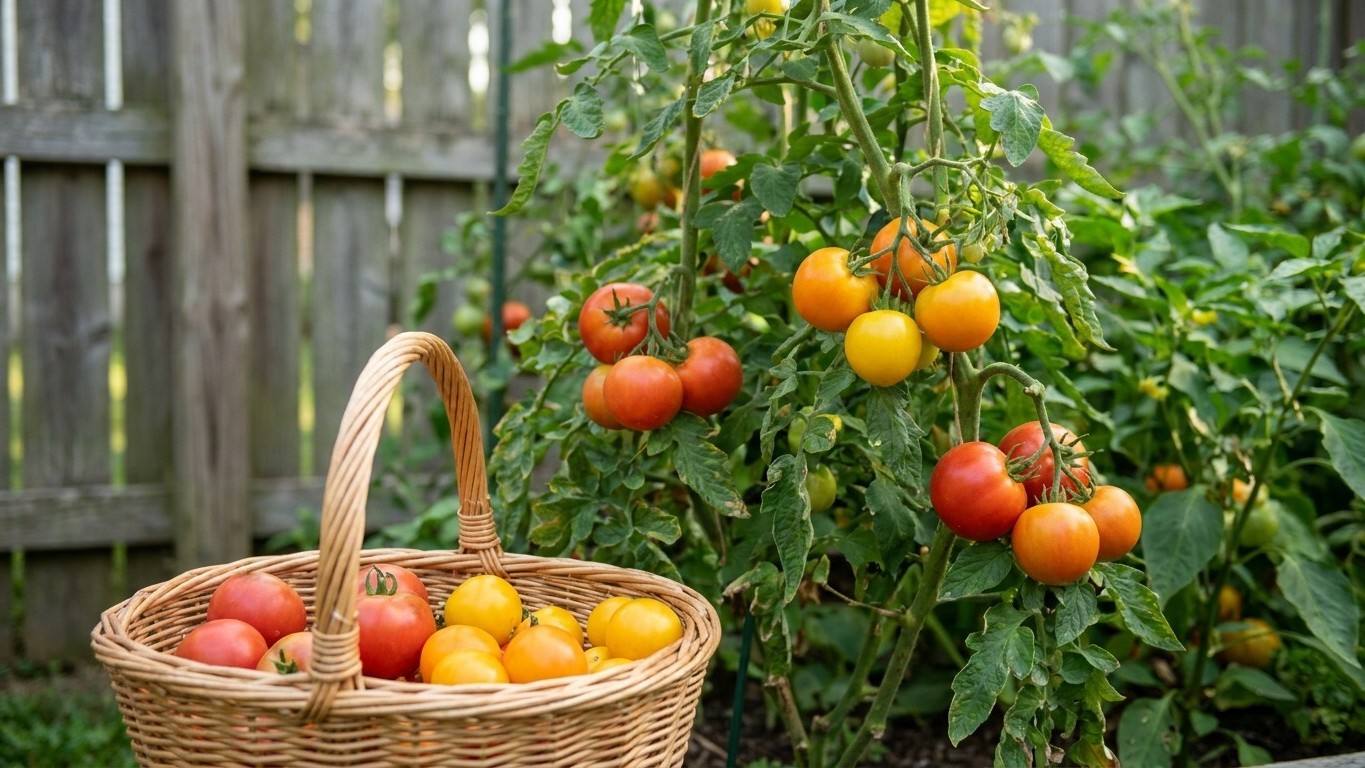

A ninety-day beefsteak planted the week after Delaware’s last frost is still hanging green when the October freeze reaches Wilmington. That’s the failure hiding behind most disappointing tomato harvests here: a variety whose maturity clock simply outlasts the frost-to-frost window it was given, no matter how good the soil or how diligent the staking. The fix isn’t a better planting date — it’s choosing days-to-maturity against the season you actually have, which runs shorter than the calendar suggests almost everywhere outside Wilmington itself.
What this comes down to in Delaware

Delaware’s growing season runs from NOAA’s last spring freeze window of April 3 to April 14 at Wilmington to the first fall freeze window of October 26 to November 7, also at Wilmington. NOAA’s own caution applies here too: suburban and rural gardens away from the airport station often see frost a week or two later in spring and earlier in fall, so treat these dates as a starting point rather than a guarantee for your yard. Inside that window, growing tomatoes in Delaware comes down mostly to matching each variety’s days to maturity against how much of that window is actually usable in your own garden.
The shortest-season varieties carry the largest margin before frost. The longest-season ones carry the least. That margin is the single most useful number when picking a variety for a garden with a shorter effective season than Wilmington’s.
Sakura

Sakura needs about 55 days from transplant, the shortest on this list, and its small red cherry tomatoes are built for eating fresh off the vine rather than canning. Set out mid April to late April and the catalogue math puts first ripe fruit in late June, leaving roughly 126 days of margin before Wilmington’s fall frost. That margin makes it one of the safest choices for a garden that runs colder or shorter than the reference city.
Sun Gold

Sun Gold matures in about 57 days and produces small orange cherry tomatoes with a sweet flavor that holds up well in salads and snacking. It shares the mid-to-late April transplant window and reaches first ripe fruit by late June, with about 124 days of margin before frost. Its resistance to Tobacco Mosaic Virus and Fusarium Wilt race 1 helps it hold up through a humid Delaware summer.
Supersweet 100

Supersweet 100 needs about 60 days and produces heavy clusters of small red cherry tomatoes meant for snacking rather than sauce. It reaches first ripe fruit by late June with roughly 121 days of margin before frost, and its resistance to Verticillium Wilt and Fusarium Wilt race 1 makes it a dependable choice in soil that has grown tomatoes for several years running.
Jasper

Jasper also needs about 60 days and produces small, glossy red cherry tomatoes on a vigorous vine. Its high resistance to Late Blight is the main reason to pick it over the other 60-day cherries here, since blight pressure builds fast in a humid Delaware August. First ripe fruit lands by late June, with about 121 days of margin before frost.
Amalfi

Amalfi needs about 68 days and produces oblong red plum tomatoes on a compact determinate bush, useful for a gardener who wants a defined harvest window for canning rather than a vine that keeps producing until frost. First ripe fruit arrives in early July, with roughly 113 days of margin before frost, and its intermediate resistance to both early and late blight is a real advantage given how often those two diseases turn up here.
Cherokee Purple

Cherokee Purple needs about 72 days and produces large, dusky pink-purple beefsteak tomatoes prized for slicing. It carries no listed disease resistance, so it depends more on spacing and airflow than the hybrids on this list to stay clean. First ripe fruit lands in early July, with about 109 days of margin before frost, plenty for the reference city but worth watching in a garden with a shorter season.
Big Beef Plus
Big Beef Plus also needs about 72 days and produces large red beefsteak tomatoes on a vigorous indeterminate vine, a straightforward slicing tomato for a gardener who wants size without giving up disease resistance. Its resistance to Gray Leaf Spot and Tomato Mosaic Virus, plus intermediate nematode resistance, makes it a steadier bet than Cherokee Purple where those problems have shown up before. First ripe fruit arrives in early July, with 109 days of margin before frost.
Tiren
Tiren needs about 75 days and produces oblong red plum tomatoes suited to sauce and canning. First ripe fruit lands in mid July with about 106 days of margin before frost, and its resistance to Verticillium Wilt, Tomato Mosaic Virus and Fusarium Wilt race 1 gives it more built-in protection than most paste tomatoes on this list.
San Marzano II
San Marzano II needs about 78 days and produces the long, narrow, pointed red paste tomatoes classic to Italian-style sauce. First ripe fruit arrives in mid July, with roughly 103 days of margin before frost, still comfortable for Wilmington but tighter than any of the cherry types above.
Amish Paste
Amish Paste needs about 85 days, the longest on this list, and produces medium-to-large red, oxheart-shaped tomatoes good for both sauce and slicing. First ripe fruit doesn’t arrive until late July, leaving about 96 days of margin before Wilmington’s fall frost, the tightest margin of any variety named here. In a garden that runs colder or shorter than the reference city, that margin is the one to watch.
| Variety | Days to maturity | Habit | First ripe (Wilmington) | Margin before fall frost |
|---|---|---|---|---|
| Sakura | 55 | Indeterminate | Late June | 126 days |
| Sun Gold | 57 | Indeterminate | Late June | 124 days |
| Supersweet 100 | 60 | Indeterminate | Late June | 121 days |
| Jasper | 60 | Indeterminate | Late June | 121 days |
| Amalfi | 68 | Determinate | Early July | 113 days |
| Cherokee Purple | 72 | Indeterminate | Early July | 109 days |
| Big Beef Plus | 72 | Indeterminate | Early July | 109 days |
| Tiren | 75 | Indeterminate | Mid July | 106 days |
| San Marzano II | 78 | Indeterminate | Mid July | 103 days |
| Amish Paste | 85 | Indeterminate | Late July | 96 days |
Working it out for your own garden
The method behind every date is simple arithmetic, and it works for a variety that isn’t on this list too. Start with NOAA’s 1991-2020 last spring freeze window for Wilmington, April 3 to April 14, and add roughly two to three weeks of warm-soil buffer before setting transplants outside, since tomato roots stall in cold ground even after the air stops freezing. That’s how the mid-April to late-April transplant window was built. The full breakdown, including what to do if your county’s soil warms slower than Wilmington’s, is in Tomato Planting Dates in Delaware: Counting Back From Your Frost Window.
A worked example
Take Sun Gold, at 57 days from transplant. Set it out anywhere in the mid-to-late April window, add 57 days, and the earliest fruit lands in June, comfortably inside the catalogue’s stated 124-day margin before Wilmington’s fall frost window of October 26 to November 7. Even a two-week delay in transplanting, from a cold spring or a late seedling order, still leaves well over three months of season on either side.
Now run the same math on Amish Paste, the longest-season variety named here at 85 days. Transplanted in the same mid-to-late April window, it reaches first ripe fruit in late July, with about 96 days of margin before frost, the smallest cushion of any variety named here. That margin still clears the season in a typical year at Wilmington, but a cold, wet spring that pushes transplanting back two or three weeks, or a garden that sits in a low frost pocket further inland, can erode it fast. That’s the line: a variety with a published days-to-maturity above roughly 80 days deserves a warmer, more sheltered spot and an on-time transplant, not a casual one.
The same logic works for figuring out which of Delaware’s tomato pests you’re dealing with partway through the season: match the timing of the damage to the pest’s known life cycle rather than guessing from the symptom alone.
What changes across the state
Every figure so far comes from the weather station at Wilmington, and Delaware is small but not uniform. The coast moderates temperature swings in a way the inland Piedmont does not: gardens near the Delaware Bay and the Atlantic beaches in Sussex County tend to see a later first fall frost than an inland spot at the same latitude, because the water holds heat into autumn. Inland and northern areas, including parts of New Castle County away from the airport station itself, can see frost arrive earlier than Wilmington’s own numbers suggest.
USDA’s Plant Hardiness Zone Map puts the state across zones 7a to 8a, and that spread alone shows the difference between the coldest and warmest corners of Delaware is real, even over a distance of well under a hundred miles. A zone 7a garden inland has a shorter effective season than a zone 8a garden near the coast, even though both sit under the same NOAA station’s frost-window figures on paper.
Elevation plays a smaller role here than in a mountainous state, since Delaware has very little of it, but low-lying spots still collect cold air on clear, still nights and can run a frost or two behind a slope or a raised bed just a few hundred feet away. Don’t treat Wilmington’s frost dates as a fixed line. Treat them as the number to adjust from, not the number to plant by.
The mistakes this state punishes

The most common mistake is treating a warm week in early April as the all-clear. NOAA’s own last-freeze window for Wilmington runs April 3 to April 14, which means a freeze is still statistically likely to fall inside that window itself, not just before it, and a run of 70-degree days in late March tells you nothing about the night after you transplant. Wait for the window to close in your own county, and check the soil, not just the air.
The second mistake is picking a variety by size or flavor alone without checking its days to maturity against the season. A gardener who wants Amish Paste‘s flavor for sauce but plants it a month late, from a cold spring or a delayed nursery run, is working with less than its 96-day margin and can lose the last fruit to an early fall freeze. If the season looks short, a 55-to-68-day variety like Sakura, Sun Gold, Jasper or Amalfi gives far more room for error.
The third mistake is ignoring pest timing because the plant looks fine early on. Some of Delaware’s tomato pests arrive on a schedule tied to temperature, not to the calendar page, and by the time the damage is obvious on the fruit itself, the insect responsible has often already moved on to its next generation. The full seasonal rundown, including what actually works against each one, is in Tomato Pests in Delaware: Which Ones Actually Show Up Here.
Checking this against your county
Every date and margin is built from a single NOAA weather station at Wilmington, and it’s a starting point, not an instruction for your specific yard. The University of Delaware Cooperative Extension keeps county-level guidance and can confirm how far your local frost dates typically drift from the airport station’s numbers, especially if you garden further south toward Sussex County or inland from the Piedmont. Before locking in a transplant date or a variety with a longer days-to-maturity number, it’s worth a visit to the University of Delaware Cooperative Extension to check what your county office has recorded for your immediate area.
Common questions
What happens if I plant later than the mid-to-late April window?
Every day you plant late pushes the first-ripe date back by roughly the same amount, since days-to-maturity counts from the transplant date, not the calendar date. A tomato that would have had 120 days of margin at Wilmington’s fall frost still likely finishes fine three or four weeks late, but a longer-season variety like Amish Paste, with only 96 days of margin at the earliest transplant date, has much less room to give.
Which of these is best for canning sauce?
The paste-type varieties on this list, San Marzano II, Tiren and Amalfi, along with Amish Paste, carry less water and more flesh than the beefsteak or cherry types, which is why they’re bred for sauce and canning rather than slicing fresh. Amalfi’s shorter 68-day season and determinate habit also make it easier to get a large batch ripe at once for a single canning day.
Do the disease-resistant varieties still get sick?
Resistance codes mean a variety fights off or tolerates a specific disease better than one without it, not that it’s immune. Big Beef Plus resists Gray Leaf Spot and Tomato Mosaic Virus at a high level, for example, but it can still develop other problems if it’s crowded, wet late in the day, or planted in soil that has grown tomatoes for several years running without a break.
Can I trust the days-to-maturity number on the seed packet exactly?
Treat it as an estimate rather than a guarantee. Catalogue days-to-maturity figures are usually measured from transplant under favorable conditions, and a cooler or cloudier stretch of summer here can push first-ripe fruit a week or so later than the packet suggests, which is exactly why the margins in the table above matter more than any single date.