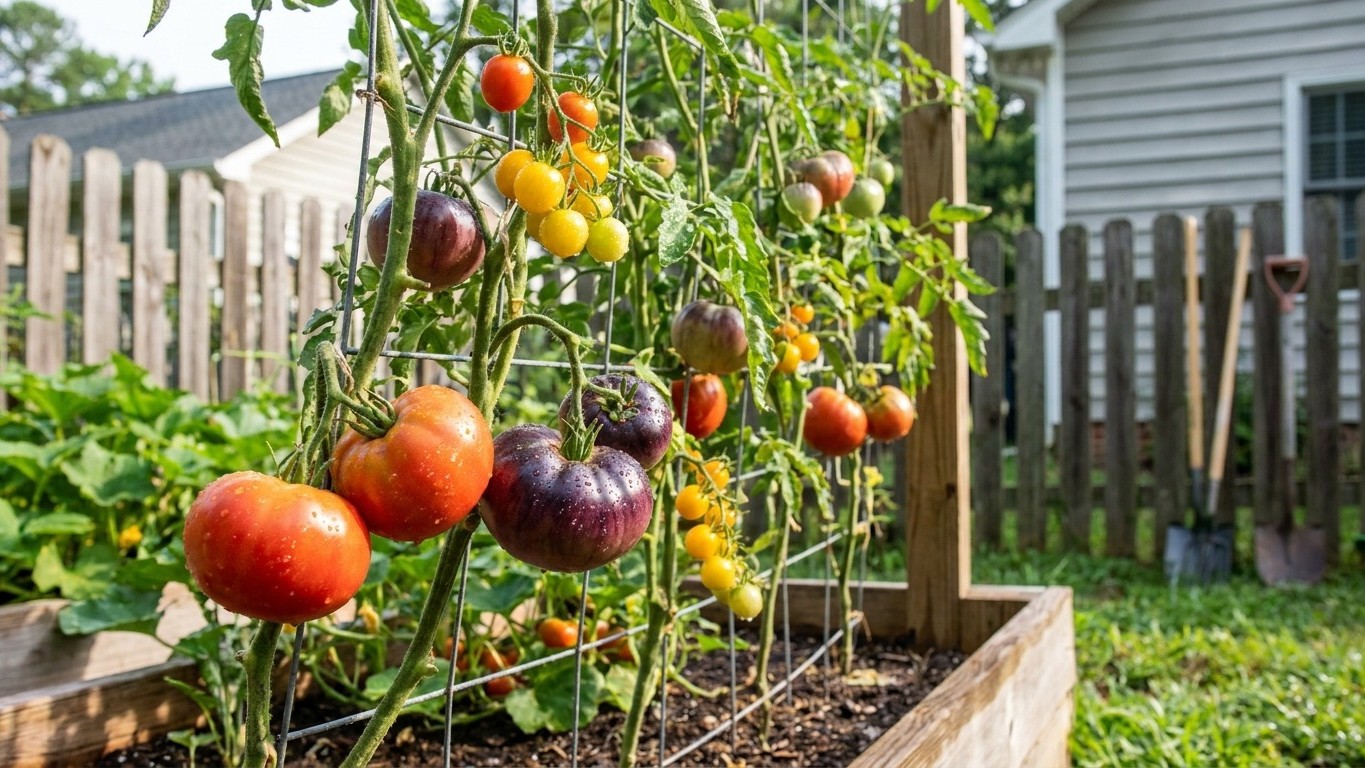

In and around Charlotte, NOAA’s NCEI 1991-2020 climate normals put the last spring freeze at March 23 to April 5 and the first fall freeze at October 30 to November 8, which leaves a frost-free window of roughly seven months. That’s long enough that even a slow-ripening 90-day heirloom finishes with weeks to spare. Pick your varieties by what you want on the plate, then check the days-to-maturity on the packet against your own county’s frost window before you commit the garden space.
What this comes down to in North Carolina

North Carolina’s frost-free stretch runs long enough that the usual “plant anything, it’ll ripen” advice mostly holds — except it hides the real tradeoff underneath. The difference isn’t whether a tomato survives here, it’s what you give up choosing one maturity date over another. A 50-day slicer buys you weeks of extra harvest and garden space; a 90-day heirloom asks you to nurse it through July’s disease pressure before it pays anything back. That’s the choice worth making deliberately, variety by variety.
What actually separates these varieties is risk and reward, not survival. A short-season cultivar gives you fruit weeks earlier and often a second flush before frost, while a long-season heirloom asks you to nurse the plant through the hottest, most disease-pressured stretch of summer before it pays off. Ordering these seven from shortest to longest days-to-maturity shows where the practical cutoff sits for your own patience and garden space, not just for the calendar.
Early Girl
Early Girl ripens in about 50 days from transplant, making it one of the fastest widely sold slicers on the market. The fruit is a modest, all-purpose red tomato good for sandwiches and salads rather than canning by the bushel. In a Charlotte-length season it isn’t a necessity, it’s a head start, giving you ripe tomatoes weeks before the slower varieties on this list even set fruit.
Sun Gold
Sun Gold matures in around 57 days and keeps producing small, intensely sweet cherry tomatoes right up until frost knocks the vine back. It’s an indeterminate type, so it keeps growing and fruiting all season rather than ripening in one flush, which suits the long Charlotte-area window particularly well.
Celebrity
Celebrity comes in around 70 days and carries VFN disease-resistance codes on most seed packets, meaning it was bred with some tolerance to verticillium and fusarium wilts and root-knot nematodes. It grows as a compact, determinate plant, so it fits smaller beds or containers and ripens most of its crop over a shorter stretch, which is useful if you’d rather can or freeze in batches.
Roma VF
Roma VF matures at roughly 75 days and is bred specifically for sauce and paste, with thick walls, dense flesh and few seeds. Its determinate habit means the harvest comes in waves rather than trickling all season, which lines up well with a single big canning session later in summer.
Better Boy
Better Boy is another 75-day cultivar, but it’s an indeterminate beefsteak type that keeps climbing and fruiting until frost rather than stopping at one flush. It also carries VFN resistance on most seed packets. It suits gardeners who want a big slicing tomato without waiting for a full-season heirloom.
Cherokee Purple
Cherokee Purple runs about 80 to 85 days and is grown for flavor rather than yield or shelf life, with a soft, dusky flesh that bruises easily. It’s an heirloom without built-in disease resistance, so it asks more of the gardener through a humid Piedmont summer, but the seven-month Charlotte-area window gives it plenty of room to finish.
Brandywine
Brandywine is the long end of the list, with catalogues listing anywhere from about 80 to 100 days depending on the strain and the seed source. It’s a big, ruffled pink-red beefsteak on a potato-leaf indeterminate vine, prized for flavor and slow to come in. It’s the variety most likely to test whether your particular county’s season is long enough, which is exactly what the next section works out.
Working it out for your own garden
Working the spring planting
Start with the two frost dates NOAA’s NCEI normals give for Charlotte: last spring freeze March 23 to April 5, first fall freeze October 30 to November 8. Subtract one range from the other and you get a frost-free window of roughly seven months. The arithmetic that matters is whether a cultivar’s catalogue days-to-maturity, counted from the transplant date, fits inside that window with a buffer for a slow spring. Take Early Girl at about 50 days: transplant anytime from March 23 to April 5 and the plant should begin ripening somewhere in the range of mid to late May, months ahead of the October 30 to November 8 fall freeze. Now take Brandywine at 90 to 100 days: the same March 23 to April 5 transplant window puts first ripe fruit somewhere from late June to mid July, still comfortably ahead of fall frost. On a normal spring planting, both finish with room to spare, and so does everything in between on the list above.
Where a long-season variety actually runs out of room
The seven-month window is generous enough that a single spring planting rarely fails for lack of time. Where the math turns against you is a second, succession planting aimed at a fall crop. Raising a tomato transplant from seed generally takes about six to eight weeks before it’s ready to go in the ground, and that time isn’t part of the days-to-maturity figure printed on the seed packet, which is counted from transplant. Add the two together and you get the real number of days you need to count backward from the first fall freeze. For Early Girl, six to eight weeks of seedling time plus 50 days totals roughly 92 to 106 days from seed, which still leaves enough of the summer to start a fall round and finish before the October 30 to November 8 freeze. For Brandywine, the same six-to-eight-week head start plus 90 to 100 days from transplant runs 132 to 156 days from seed. Counted back from the fall freeze window, that pushes the seed-starting date into spring, not summer, so a mid-summer succession sowing of Brandywine for a fall crop does not finish before frost, even though a spring-transplanted Brandywine finishes weeks early. For the full method of counting backward from your own frost window, see Tomato Planting Dates in North Carolina: Counting Back From Your Frost Window.
What changes across the state
The Charlotte figures above come from a single weather station in the Piedmont, and North Carolina’s elevation and distance from the coast move both frost dates by more than a week in either direction. The USDA’s Plant Hardiness Zone Map, using the 1991-2020 normals, spans zone 5b up in the mountains to zone 8b along the coast, which is a wide enough range that a variety comfortably suited to Charlotte’s season can be a stretch two hours west.
Head into the Blue Ridge Mountains and the growing season runs several weeks shorter on both ends, with a later last spring freeze and an earlier first fall freeze than the Charlotte normals show. That squeezes the margin for long-season heirlooms like Brandywine and pushes gardeners at elevation toward the shorter end of the list, favoring Early Girl, Sun Gold or Celebrity over anything rated past 80 days. Drop down to the coastal plain and the pattern reverses: the ocean’s moderating effect tends to push the last freeze earlier and the first fall freeze later than Charlotte sees, stretching the season and giving even a slow-ripening Brandywine a wider cushion.
None of this means you should borrow a specific date for another city. The Charlotte figures are a single reference point on a state-sized gradient, and the honest move is to treat them as a starting estimate, then adjust toward earlier or later, longer or shorter, based on whether you’re closer to the mountains, the coast, or sitting at meaningfully higher elevation than the Piedmont.
The mistakes this state punishes

The most common error isn’t picking a variety that’s too slow, it’s transplanting too early because a warm stretch fools you into thinking the frost risk has passed. Cold soil, not a mild afternoon, is what stunts or kills a young tomato plant, and NOAA’s Charlotte normals put the last spring freeze as late as April 5 in a typical year, well after the first warm week of spring often shows up. Wait for the window to actually close rather than reacting to one nice weekend.
The second mistake is filling the whole garden with long-season heirlooms like Brandywine and Cherokee Purple and ending up with nothing to harvest until midsummer. Mixing in at least one fast variety such as Early Girl or Sun Gold means you’re eating tomatoes while the slower ones are still filling out, and it gives you a fallback if disease or a bad stretch of weather takes out part of the planting.
The third is ignoring what shows up on the plant once the heat and humidity of a Piedmont summer set in. Disease and insect pressure follows a fairly predictable seasonal pattern here, and choosing resistant cultivars like Celebrity, Better Boy or Roma VF only helps if you also know what to watch for once fruit starts setting; for that, see Tomato Pests in North Carolina: Which Ones Actually Show Up Here.
Checking this against your county
Everything above is anchored to a single Charlotte weather station, and a state-wide figure is a starting point, not an instruction for your own yard. Before you commit a season’s worth of garden space to a long heirloom, check your own county’s frost history against the Charlotte range and adjust earlier or later as needed. NC State Extension maintains county offices and a statewide tomato guide built for exactly this kind of local variation, and it’s worth a call or a look at their published fact sheets before you finalize a planting date.
Common questions
Can I actually grow a 100-day tomato in North Carolina?
In the Charlotte area, yes, since NOAA’s NCEI normals give roughly seven months between the last spring freeze and the first fall freeze there, well more than 100 days. In the mountains, where the season runs shorter on both ends, a 90-to-100-day heirloom like Brandywine cuts the margin much closer, so check your county’s frost history first.
What’s the fastest tomato I can grow in NC?
Among widely sold varieties, Early Girl at about 50 days is one of the quickest slicers, and Sun Gold at around 57 days is close behind for cherry tomatoes. Seed catalogues do list a few varieties rated even faster, so check the packet’s days-to-maturity rather than assuming any one name is the fastest available.
Do I need disease-resistant varieties here?
It helps. Humid Piedmont summers put real pressure on tomato foliage, and cultivars like Celebrity, Better Boy and Roma VF carry VFN or VF resistance codes on the seed packet, meaning some tolerance to verticillium wilt, fusarium wilt and, for the VFN types, root-knot nematodes. Heirlooms like Cherokee Purple and Brandywine carry no such resistance, which doesn’t rule them out, it just means more attention during the season.
Should I choose determinate or indeterminate for a small garden?
Determinate types like Celebrity and Roma VF stay compact and ripen most of their crop over a shorter stretch, which suits containers or small beds and batch canning. Indeterminate types like Early Girl, Sun Gold, Better Boy, Cherokee Purple and Brandywine keep growing and fruiting until frost, which needs more staking and space but spreads the harvest out over the whole season.