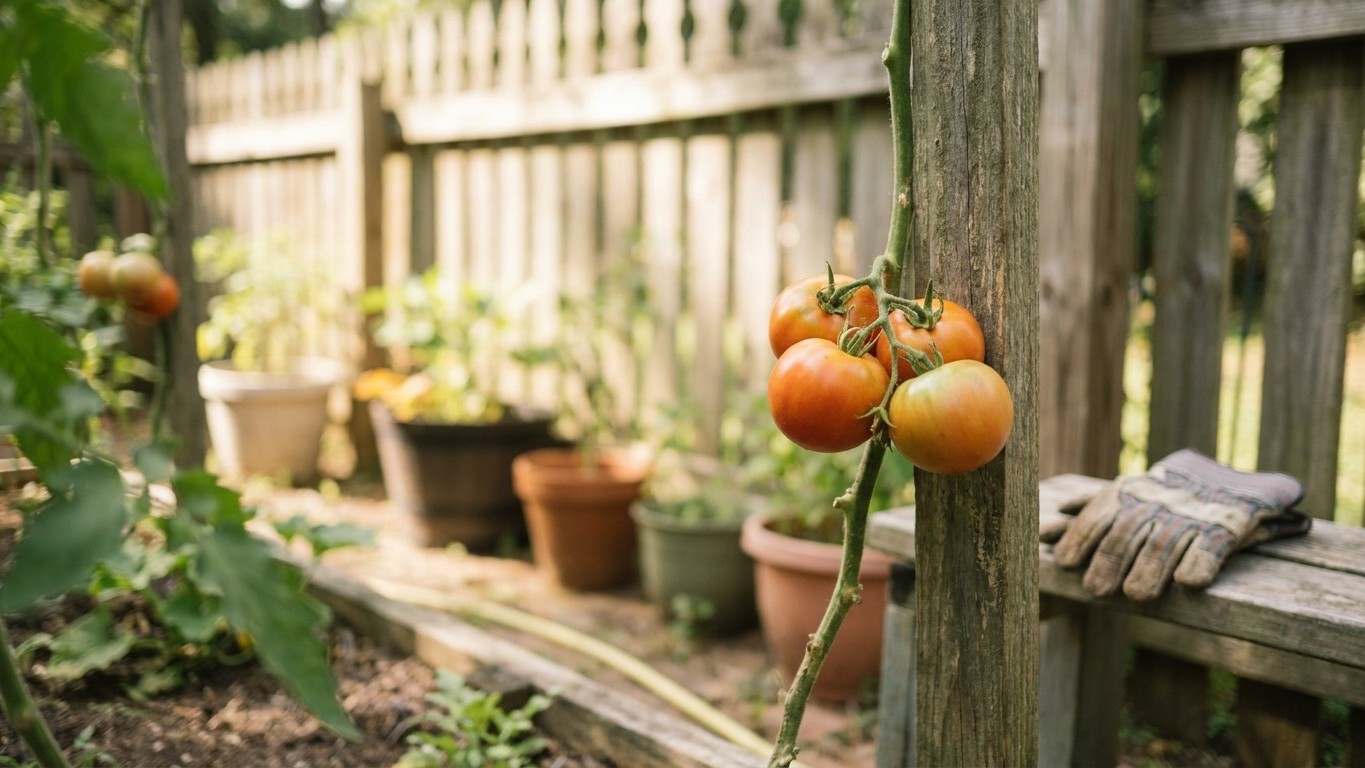

North Carolina’s tomato season starts around the last spring frost, which NOAA’s 1991-2020 climate normals for Charlotte put between March 23 and April 5. That window applies to the Piedmont around Charlotte: the Blue Ridge Mountains to the west run several weeks later, and the coastal plain warms up sooner. Right now, check your own county’s expected last frost through the NC State Extension office before you settle on a transplant date.
When to plant Tomatoes in North Carolina

Late January to late February is when North Carolina tomato growers near Charlotte need seed under lights indoors, six to eight weeks ahead of that region’s March 23 to April 5 frost window. Mountain gardeners shift everything later, matching the extra weeks their frost date lags behind the Piedmont. Get this start date wrong and you’re either babysitting leggy seedlings for a month or racing to catch up once the soil’s finally warm enough for transplants to take hold.
Starting seeds indoors
Tomato seed needs six to eight weeks indoors before it is ready to go out as a transplant. Counting back from Charlotte’s frost window of March 23 to April 5 puts seed starting somewhere in late January to late February for gardeners in that part of the state. If you garden in the mountains, push that start date later by roughly the same number of weeks your local frost date runs later than Charlotte’s. Sow seed about a quarter inch deep in a seed-starting mix, keep it warm and evenly moist, and give the seedlings strong light the moment they emerge so they don’t stretch and go leggy on the windowsill.
Hardening off and transplanting
Move transplants outside a week or so before your frost window closes, into a sheltered spot for just a few hours at a time at first. Add an hour or two of outdoor exposure daily over seven to ten days before leaving them out overnight. Do not set tomatoes into the garden before the local frost window has passed, even on a mild week in early March. A late cold snap after transplanting can set a plant back a month or kill it outright. Once danger has passed and the soil has had time to warm, usually about a week after the last frost date, move plants into their final bed. Gardeners further north in shorter-season states like Nebraska work from a much tighter transplant window and lean harder on quick-maturing cultivars for that reason, a difference laid out in our guide to growing tomatoes in Nebraska. For planting dates on other crops tied to the same Piedmont frost window, our North Carolina guides cover the rest of the vegetable garden.
Soil and site preparation
Tomatoes need a minimum of six to eight hours of direct sun to fruit well, more where you can give it. Pick the sunniest, most open spot on the property, and rotate away from beds where tomatoes, peppers, eggplant or potatoes grew the last two years, since those crops share several soil-borne diseases.
Working the bed before planting
Loosen soil to at least a shovel’s depth so roots can run down instead of sideways, and work in a couple inches of finished compost or aged manure a few weeks before you plan to transplant, so it has time to break down instead of tying up nitrogen just as young roots need it. Good drainage matters more than fertility: a bed that stays soggy after rain loses more plants to root rot than one that runs a little lean on nutrients. Raised beds or mounded rows solve a drainage problem outright where native soil is heavy clay, which is common through much of the Piedmont. Skip a blanket lime application unless a soil test says the pH needs it. The NC State Extension office runs soil tests and will tell you what your specific bed needs rather than guessing off a bag label.
Spacing and layout
Space indeterminate varieties, the type that keeps growing and producing until frost, about 24 to 36 inches apart in the row. Give determinate, bush-type varieties a little less, around 18 to 24 inches, since they stop growing once they set their main flush of fruit. Leave 3 to 4 feet between rows so you can move a hose, a wheelbarrow and yourself through without breaking foliage. Crowded plants stay wet longer after rain or watering, and that damp, still air between leaves is the single biggest driver of foliar disease in a home tomato patch.
Varieties that suit North Carolina
The trait that matters most for North Carolina’s long, hot growing season isn’t disease resistance on its own, it’s a variety’s ability to keep setting fruit once nighttime temperatures climb. Beyond heat tolerance, weigh days to maturity, whether the plant is determinate or indeterminate, and which diseases it resists, since Piedmont summers run humid enough to favor several common tomato pathogens.
Reading the catalog numbers
Days to maturity are counted from the transplant date, not from seed, and the number on the packet assumes average conditions. A 60-day cultivar transplanted within Charlotte’s March 23 to April 5 window would be expected to start ripening in the range of late May to early June, shifting a couple weeks either direction depending on how warm the season runs. A 78-day variety transplanted in that same window points to first ripe fruit sometime in June, again as a range rather than a fixed date, since heat, sun and soil moisture all move the count.
Cultivars by type
| Variety | Days to maturity | Type | Notable resistance |
|---|---|---|---|
| Sun Gold | 57 | Indeterminate | Tobacco Mosaic Virus, Fusarium Wilt race 1 |
| Sakura | 55 | Indeterminate | Nematodes, Tomato Mosaic Virus, Fusarium Wilt races 1 and 2 |
| Supersweet 100 | 60 | Indeterminate | Verticillium Wilt, Fusarium Wilt race 1 |
| Juliet | 60 | Indeterminate | Late Blight, Early Blight (Intermediate) |
| Jasper | 60 | Indeterminate | Late Blight (High), Early Blight (Intermediate) |
| Amalfi | 68 | Determinate | Nematodes, Late Blight, Early Blight (Intermediate) |
| Cherokee Purple | 72 | Indeterminate | None listed |
| Big Beef Plus | 72 | Indeterminate | Nematodes, Gray Leaf Spot, Tomato Mosaic Virus |
| Tiren | 75 | Indeterminate | Verticillium Wilt, Tomato Mosaic Virus, Fusarium Wilt race 1 |
| Granadero | 75 | Indeterminate | Nematodes, Verticillium Wilt, Tomato Mosaic Virus |
| San Marzano II | 78 | Indeterminate | None listed |
| Celebrity Plus | 78 | Determinate | Nematodes, Gray Leaf Spot, Tomato Mosaic Virus |
| Brandywine | 78 | Indeterminate | None listed |
| Amish Paste | 85 | Indeterminate | None listed |
For a short, reliable harvest of cherry tomatoes, Sun Gold, Sakura and Supersweet 100 all mature in under two months and carry strong disease resistance packages, useful given how much pressure humid Piedmont summers put on foliage. For slicers, Big Beef Plus and Celebrity Plus both carry resistance to gray leaf spot, a disease that shows up more in Southeastern humidity than in drier climates. Heirlooms like Cherokee Purple, Brandywine and Amish Paste carry no listed disease resistance, which is the trade a gardener makes for their flavor and size, so give them the best airflow and driest foliage you can manage.
What to plant alongside
Basil earns its place next to tomatoes more for kitchen convenience than for any proven pest effect. The research on basil actually repelling tomato pests is thin, but it shares water needs, stays low enough not to shade the plant, and you’ll use both together all summer anyway. Marigolds have better evidence behind them, since certain types measurably suppress root-knot nematodes in the surrounding soil, one of the few companion-planting claims with real research behind it.
Good neighbors and ones to avoid
- Marigolds: suppress root-knot nematodes in the surrounding soil, a useful backup given how many varieties above already carry nematode resistance.
- Borage and alyssum: draw pollinators and beneficial insects without competing much for root space.
- Carrots and onions: shallow-rooted and low, they fill space between rows without competing hard for water or light.
- Corn and potatoes: keep them away from the tomato bed. Corn draws in the same moth whose larvae become tomato fruitworm, and potatoes share several blight pathogens with tomatoes.
- Brassicas like cabbage and broccoli: compete for the same nutrients on a similar timeline and offer tomatoes nothing in return, so give them their own bed.
- Fennel: keep it well away from any vegetable bed. It releases compounds that slow the growth of many neighboring plants, tomatoes included.
None of these pairings replace crop rotation or disease-resistant cultivars as the main defense against soil-borne trouble. Companion planting nudges pest pressure a little in your favor. It doesn’t substitute for the spacing, airflow and variety choices that actually keep blight off the plant.
Watering, feeding and support
Water deeply and less often rather than a light daily sprinkle. A deep soak encourages roots to grow down into the soil profile instead of staying shallow near the surface, which makes the plant more resistant to the swings between wet and dry spells that Piedmont summers bring. In the ground, an established plant generally needs the equivalent of an inch or more of water a week, more during a stretch of high heat, delivered in one or two sessions rather than several light waterings. Container-grown plants dry out faster and often need checking daily once the weather turns hot. Water at the base of the plant, not over the foliage, since wet leaves sitting overnight are exactly the condition that lets early blight and other fungal disease take hold.
Mulch and feeding
Mulch with straw, shredded leaves or grass clippings once the soil has warmed, a few inches deep, pulled back an inch or two from the stem. Mulch holds soil moisture steady between waterings and keeps soil from splashing onto lower leaves during heavy rain, which is one of the main ways fungal spores travel up the plant. Feed with a balanced fertilizer at transplanting, then side-dress again once the first fruit sets and starts to size up. Avoid heavy nitrogen after that first side-dress: it pushes leafy growth at the expense of fruit and can delay ripening on a plant already carrying a full load.
Staking, caging and pruning
Indeterminate varieties need a stake or a tall cage, five to six feet, driven in at or before transplanting so you don’t damage roots later. Determinate varieties stay more compact and usually manage with a shorter cage. Remove suckers, the shoots that emerge in the joint between the main stem and a branch, on indeterminate types to keep the plant to one or two main leaders. Skip this on determinate types, since pruning them cuts into the one flush of fruit they’re built to produce.
Common problems

Most tomato failures trace back to water, heat or airflow rather than an exotic pathogen. Learning to read the symptom saves the season.
Diseases and physiological issues
- Blossom end rot: a flat, dark, leathery patch on the bottom of the fruit, caused by uneven watering interrupting calcium uptake rather than a lack of calcium in the soil. Fix the watering rhythm before reaching for a calcium spray.
- Fruit cracking: concentric or radial splits after heavy rain following a dry spell. Even moisture through mulch and steady watering cuts it down.
- Leaf curl: upward-curling leaves during a hot, dry stretch are usually just the plant’s own stress response, not disease. Curling paired with yellowing or mottling points instead to a viral infection, one reason the Tobacco Mosaic and Tomato Mosaic Virus resistance built into several catalog varieties is worth choosing.
- Wilt: sudden wilting of one side of the plant, or the whole plant, despite moist soil points to Fusarium or Verticillium wilt living in the soil. Once a bed is infected there’s no cure for that season’s plants. Resistant cultivars and rotation are the only real defense going forward.
- Poor fruit set: blossoms that form but drop without setting fruit are most often a heat problem. Once daytime and nighttime temperatures run high enough, tomato pollen loses viability and flowers abort even on a healthy plant.
Insect pests
Tomato hornworms, the large green caterpillar with white diagonal stripes and a horn on the tail end, can strip a plant of leaves in a couple of days. Hand-pick them off in the early morning when they’re easiest to spot. Stink bugs leave cloudy, hard spots under the skin where they’ve fed. Aphids and whiteflies cluster on the underside of leaves and stunt new growth, and a strong water spray or insecticidal soap knocks back a light infestation before it needs anything stronger.
Pests that actually show up in North Carolina
North Carolina’s state pest list for vegetable gardens is long, but only a handful of those insects actually target tomatoes. Striped cucumber beetle, cabbage looper, imported cabbageworm, fall webworm and hemlock woolly adelgid all appear in NC State Extension’s Extension Gardener Handbook, chapter 4 on Insects, but they feed on squash, cabbage-family crops, shade trees and hemlocks, not tomato plants. Skip those here and watch for the ones that do.
Corn earworm, also called tomato fruitworm, is the one to watch from fruit set through harvest. It bores straight into the fruit and keeps feeding inside, so the first sign is often a rotting cavity you find when you slice into what looked like a sound tomato. Check developing fruit every few days once it sets and pull damaged ones before the larva moves to the next. Bacillus thuringiensis (Bt) sprayed on young fruit and reapplied after rain is the standard control.
Thrips do less obvious direct damage but carry more risk. Tobacco thrips build up on foliage in April and May, and western flower thrips take over as the bigger concern in June and July because they spread tomato spotted wilt virus. Bronzed, stippled leaf undersides and twisted new growth are the visual tell. Reflective mulch and keeping nearby weeds down cut the population before it spreads virus, since once a plant shows spotted wilt symptoms there is no fixing it.
Japanese beetle shows up in mid-summer and skeletonizes leaves down to the veins, leaving a lace-like pattern visible from several feet away. Hand-picking beetles into soapy water in the early morning, while they’re still sluggish, keeps a light problem from turning into a heavy one. Store-bought traps tend to pull in more beetles than they remove.
Flea beetles do their worst in the first couple weeks after transplanting, riddling young leaves with small round shot holes. A floating row cover over new transplants until they’ve put on several true leaves gets plants past the window when this damage actually matters.
Harvest and end of season
Pick tomatoes once they’ve reached full color and give slightly to a gentle squeeze. Fruit that’s just starting to blush can finish ripening indoors at room temperature out of direct sun, a useful trick if raccoons, squirrels or a sudden storm threaten a fruit that’s almost there.
Storing what you pick
Keep ripe tomatoes on the counter, not in the refrigerator. Cold temperatures break down the compounds responsible for tomato flavor and turn the texture mealy, a change that doesn’t reverse once the fruit warms back up. Use or process fruit within a few days of full ripeness for the best flavor.
As the season winds down
North Carolina’s fall frost date isn’t a single figure for the whole state any more than the spring one is. Check with the NC State Extension office for the expected date in your county as nights start cooling. Pick everything showing any color once a frost is forecast, and bring in the full-size green fruit too, since it will often ripen slowly indoors wrapped in newspaper. Fruit that’s still small and hard rarely ripens well off the vine and is better used green, fried or pickled, than held back for ripening that won’t come.
Local help
Frost dates, soil test results and pest pressure all vary by county across North Carolina, from the mountains to the coastal plain. The NC State Extension service runs a local office in every county that can give you a frost date specific to your area, run a soil test, and confirm which pests are active near you this season. A five-minute call to your county office before you buy a single seed packet is the best return on time you’ll get all season.
Where to Go Next
Everything above works best once you’ve nailed down the details for your own yard. Start with the tomato planting dates guide, which counts back from NOAA’s 1991-2020 frost window—Charlotte’s last spring freeze runs March 23 to April 5, first fall freeze October 30 to November 8—so you know exactly when to get plants in the ground. Once your dates are set, check the guide to varieties that ripen in time, since that same frost-free window, roughly seven months, determines which tomatoes can actually mature before the cold comes back. And because North Carolina’s pest pressure follows that same seasonal clock, it’s worth reading up on which tomato pests actually show up here, so you’re watching for the right insects at the right point in the growing season rather than guessing. Together these three pages cover the timing, the plant choices, and the threats you’ll face—read them alongside this one and you’ll have the full picture for growing tomatoes successfully in North Carolina.
Common questions
Can I plant tomatoes earlier than the frost date if I cover them?
A row cover or a water-filled plant protector buys you a few degrees of frost protection, not immunity from one. It can let you set transplants out a bit ahead of the local frost window, but a hard freeze or a cover that blows off overnight can still kill the plant. Most gardeners find the risk isn’t worth the week or two gained.
Why are my tomato leaves turning yellow starting at the bottom?
Uniform yellowing that moves up the plant as it ages is usually just older leaves being shed as the plant redirects energy to fruit, and it’s normal in moderation. Yellowing paired with dark spots or a blotchy pattern points to a fungal disease like early blight instead, and those leaves should come off and go in the trash, not the compost pile.
Do I need more than one tomato plant to get fruit?
No. Tomato flowers are self-fertile and a single plant will set fruit on its own without a second plant nearby. Growing a few plants of different varieties mostly buys insurance against a stretch of heat or a disease taking out one plant’s crop, not better pollination.
Can I save seed from my Cherokee Purple to plant next year?

Yes, since Cherokee Purple is an open-pollinated heirloom and its seed breeds true to type season after season if it wasn’t cross-pollinated by another tomato variety nearby. Hybrids on the list above, marked as such in most catalogs, won’t reliably reproduce the parent plant from saved seed.
Is it too late to plant tomatoes if I missed the spring window?
Not necessarily. Many North Carolina gardeners set out a second round of transplants in early to mid summer for a fall crop, choosing a quicker-maturing cultivar and counting back from the fall frost date for their county through the NC State Extension office. The trade-off is that flowering and fruit set have to get through the hottest part of the summer first.