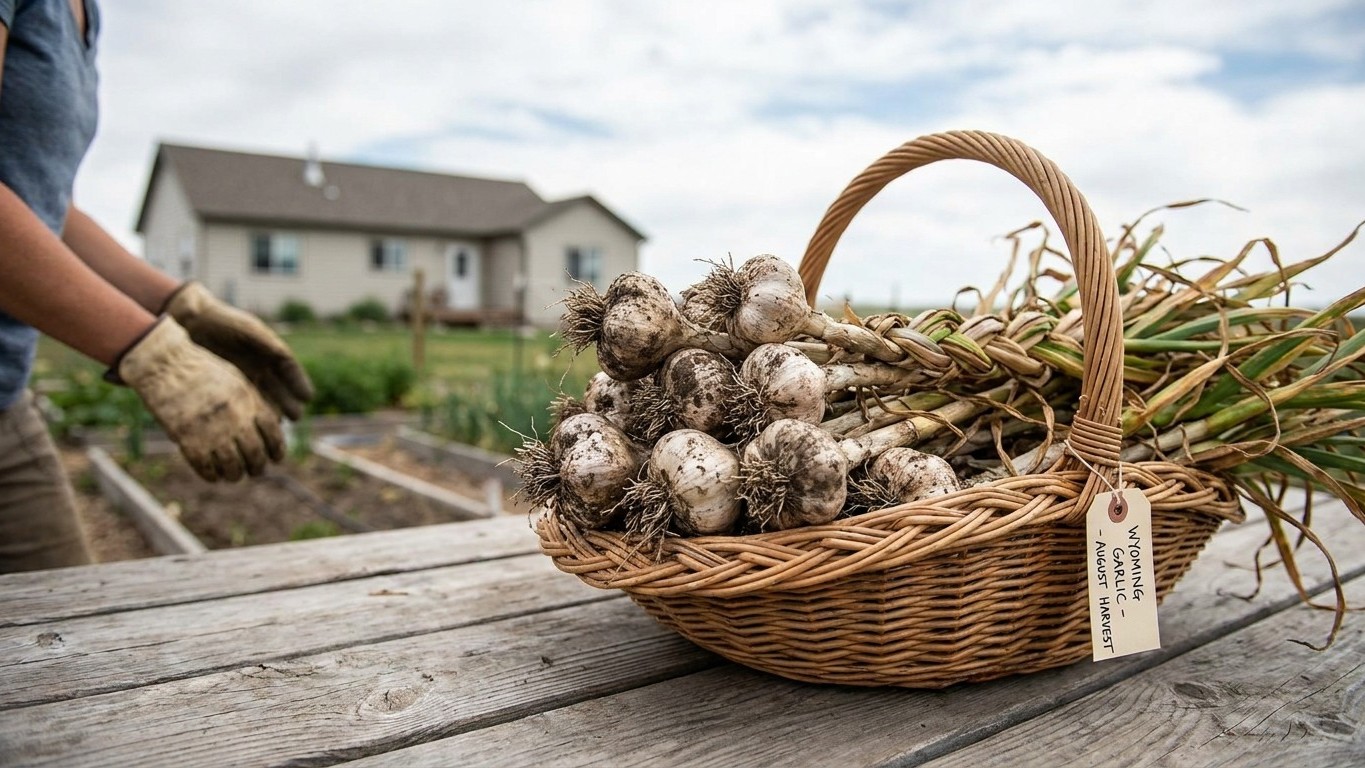

Plant garlic in Wyoming in early September to mid-September, a window built backward from the average first fall frost rather than fixed to the calendar. NOAA’s 1991-2020 Climate Normals put that frost at Cheyenne’s reference station between September 24 and October 5. The action to take now: if your garden sits above the elevation of the valley floor, plant on the early end of that window, since higher ground loses growing days faster than low ground does.
The short answer for Wyoming

Six weeks of cool soil, not the calendar, is what decides bulb size next July. Garlic planted in Wyoming needs that stretch to grow roots before the ground locks up, and counting backward from your first frost is how you find it. Here’s the catch: that frost date is only a midpoint. In plenty of years the freeze arrives before the average, so a clove tucked in on the “safe” date can end up rootless and small come harvest. Plant toward the early edge of the range, not the middle.
The reason garlic gets planted this early, rather than after frost like a spring bulb, is root growth. Cloves need weeks of cool, unfrozen soil to send down roots before winter locks the ground up. Plant too late and the clove sits in cold soil without anchoring itself, which costs you bulb size the following summer.
One thing to keep in mind: that frost window is a midpoint, not a safety net. NOAA’s normals describe the 30 to 70 percent probability band for a 32°F freeze, which means in a good share of years the first hard frost lands after October 5, and in others it lands before September 24. Plan for the early end of the range, not the late one.
- Softneck: Early Red Italian, Inchelium Red, Italian Late, Lorz Italian
- Hardneck: Bavarian Purple, Blue Music, Chesnok Red, Duganski, Fall Festival, Georgian Crystal, Georgian Fire, German Red, German White, Ivan
For the differences between these in flavor, storage life and clove count, see Garlic Varieties That Suit Wyoming Winters before you order cloves.
Working it out for your own garden
The arithmetic behind the window
Garlic wants roughly three to four weeks of root growth in cool soil before the ground freezes solid. Count backward three to four weeks from the earlier end of Cheyenne’s frost window, September 24, and you land in the last days of August. Count the same span back from the later end, October 5, and you land in mid-September. That spread, softened slightly toward the later side to account for the fact that most years don’t hit the earliest possible frost date, is exactly where the early-September-to-mid-September window for every cultivar on our Wyoming list comes from.
The same NOAA dataset flags something that changes this arithmetic for a lot of the state: a garden near Cheyenne’s elevation gets roughly 130 frost-free days a year, and ground higher than that can see frost in any month. That single fact is why elevation matters more than latitude here. A garden a thousand feet higher than Cheyenne doesn’t just get an earlier frost. It gets a shorter, less predictable window for the roots to do their work before winter, which argues for planting on the early side rather than waiting to see what September brings.
Steps to redo this for your district
- Find your nearest station’s average first fall frost date, not a statewide figure.
- Count back three to four weeks from the earlier end of that range for a conservative planting date.
- Push a week earlier if your garden sits noticeably higher than the surrounding valley floor.
- Push toward the later end only if your site is a low, sheltered pocket that historically frosts late.
Wyoming has no large lake and no coastline to soften these numbers the way they do in parts of the Midwest or Pacific Northwest, so elevation and local topography do almost all of the work of shifting a garden’s frost date away from the reference station.
What changes across Wyoming
Cheyenne’s frost data describes the high plains of the state’s southeast corner, and even that reference station sits at an elevation that already limits the frost-free season. Move into the mountain ranges, the Wind River Range, the Bighorns, the Snowy Range, and the growing season shortens further simply because cold air sits longer at altitude and frost can arrive in any summer month, not just fall.
Lower basins tell a different story, and not always the one you’d expect. River valleys and basin floors often trap cold air on clear, still nights, so a low-lying garden can frost earlier than a slope just above it even though the surrounding terrain runs milder overall. Elevation sets the general trend, but local cold-air drainage can override it on any given piece of ground. This is why a single number from one weather station can’t stand in for the whole state.
If you garden somewhere far from Cheyenne, whether that’s a high mountain valley or a lower eastern plains county, treat the September-to-mid-September window as a starting point to test against your own site’s frost history, not as a number to copy directly.
The mistakes this climate punishes
Underestimating the cold, and overestimating it
Wyoming winters run cold for a long stretch. Reference data compiled by the University of Georgia Extension (publication C854) puts a full winter season here at 30.4 weeks below 40°F, far more than the six to eight weeks garlic needs after planting to split into cloves. Chill is not the limiting factor in this state. The mistake this climate punishes isn’t planting a variety that needs more cold. It’s failing to protect cloves from the amount of cold that’s actually coming, through thin mulch or shallow planting that leaves them exposed to repeated freeze-thaw heaving over that long a stretch.
Disease pressure you can’t see by looking at the thermometer
Garlic diseases are tracked against soil temperature, not air temperature, and Wyoming’s air-temperature data still tells you something useful. Using UC IPM’s published guidelines (UC ANR Publication 3453), the mean air temperature at the reference station falls inside white rot‘s 50 to 75°F range in four months of the growing season, including September, the exact month most of this state’s garlic goes into the ground, with one of those months landing right at the pathogen’s optimum. Fusarium basal rot‘s range gets touched in two summer months, June and July, closer to harvest than to planting.
None of this means either disease is guaranteed, and it doesn’t mean the reverse either. A monthly average hides plenty of day-to-day swing, soil temperature lags air temperature by weeks, and one station can’t describe conditions on every property in the state. Neither disease is ruled out just because a monthly average sits outside its range. Infected seed stock carries Sclerotium cepivorum or Fusarium oxysporum f. sp. cepae wherever it’s planted, cold state or not. The practical response is to buy clean seed garlic from a source that tests for it and to avoid replanting cloves saved from a bed that showed stunted, yellowing plants the season before.
Planting outside the window in either direction
Planting well before early September, into soil that’s still warm from summer, gives diseases more active weeks before winter slows them down. Planting after mid-September cuts into the root-establishment time garlic needs before Cheyenne’s frost window opens on September 24. Either mistake is avoidable by working from the arithmetic above rather than a habit carried over from a different climate. If you’re new to the crop, review the soil prep and clove-sourcing basics in Growing Garlic in Wyoming before you commit to a planting date.
Checking this against your county
Cheyenne’s frost data is the only figure in this article, and it describes one station in one corner of a large state. For a planting window matched to your own county, the University of Wyoming Extension maintains local contacts and county-level guidance that can confirm or adjust the dates above. Call before you plant if you garden more than a short drive from Cheyenne, especially at elevation or in a known frost pocket, since a two-week shift in either direction changes how much root growth your cloves get before winter.
Common questions
Can I plant garlic in spring instead of fall in Wyoming?
You can, but expect smaller bulbs. Garlic planted in fall gets a long cold period to trigger clove division before it starts putting energy into leaves, and Wyoming’s long winter provides that in spades. Spring-planted garlic skips most of that cold exposure and often bulbs weakly or not at all.
What happens if I miss the mid-September cutoff?
You still have some room before the frost window opens. Planting into early October is possible, but the cloves get less time to root before the ground cools hard, so lean on a heavier mulch layer to buy them extra weeks of workable soil and expect a somewhat smaller crop than an early-September planting.
Do I need to mulch garlic cloves over a Wyoming winter?
Yes. The state’s winters run long and cold enough that unmulched cloves are exposed to repeated freezing and thawing near the soil surface, which can heave them out of the ground before they’ve rooted properly. A thick layer of straw or shredded leaves right after planting solves most of this.
Should I grow softneck or hardneck garlic in Wyoming?
Either type handles the state’s cold winters fine, since Wyoming’s chill hours run well past what any garlic cultivar needs. The choice comes down to kitchen use and storage: hardnecks like Chesnok Red or German Red tend toward bolder flavor and shorter storage, while softnecks like Inchelium Red typically store longer in a pantry.
If you follow the almanac, here is when to plant garlic by the moon. It is a tradition, not a proven method.