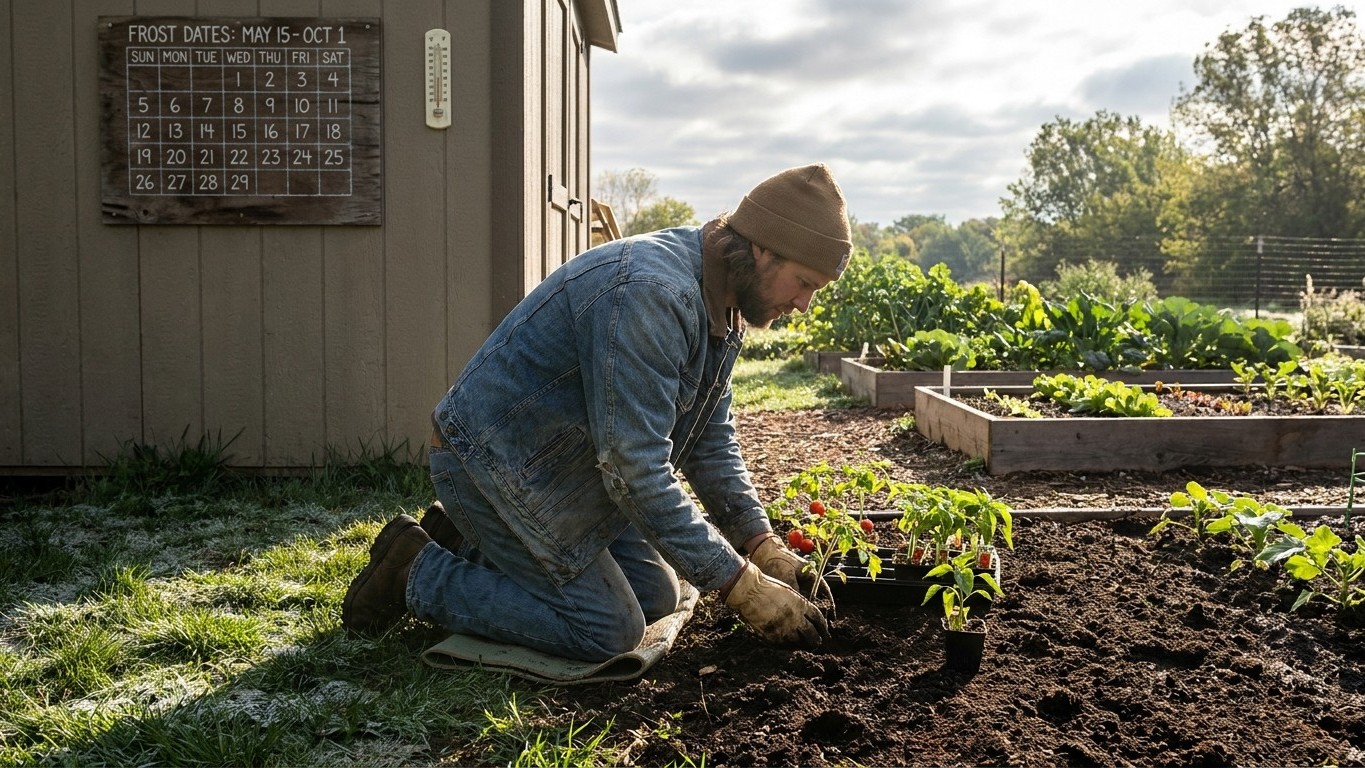

Minnesota gardeners work with a frost-free window that runs roughly from late April to mid-October in the mildest parts of the state, and considerably less everywhere else. That window, not enthusiasm or soil prep, is what decides which crops make sense here and which ones are asking for trouble.
How long your season really is

Start with three numbers. Minnesota spans USDA hardiness zones 3a to 5a, under the USDA Plant Hardiness Zone Map’s 2023 update, built from 1991-2020 normals. The average last spring frost falls between April 17 and April 30. The average first fall frost arrives between October 11 and October 23. Put those together and you get the number that actually matters: a frost-free window of somewhere around 165 to 185 days, depending on where in the state you garden.
That’s the figure that rules things in or out before you’ve even picked a variety. A 165-day window sounds generous until you subtract the weeks a seed needs to germinate, the transplant shock, and the days a slow-ripening crop needs at the tail end. Long-season crops, the ones bred for 100-plus frost-free days just to fruit, are a real gamble on the shorter end of that range, and Growing Peppers in Minnesota is a good example of a crop that demands careful timing to succeed, as does Growing Sweet Corn in Minnesota, another warm-season crop that needs the growing window managed carefully to reach harvest, and the same is true of Growing Pumpkins in Minnesota, a long-season vine crop that leaves little room for error once the season starts. By contrast, cool-season staples fare much better within this window, and Growing Potatoes in Minnesota shows how a crop matched to the state’s shorter frost-free range can be a far safer bet, much like Growing Carrots in Minnesota, Growing Parsnips in Minnesota, Growing Beets in Minnesota, Growing Spinach in Minnesota, and Growing Asparagus in Minnesota, five more cool-season crops that fit comfortably inside this window. Not impossible everywhere in the state, but not a safe default plan either.
Here’s the part that trips people up: those frost dates are averages, not guarantees. An average last frost of April 24, say, means half the years on record had frost after that date. By definition, half of all years run worse than average. Treat the last-frost date as the center of a bell curve, not a green light. Gardeners who plant tender seedlings the week of the average date are gambling on the favorable half of history repeating.
The range itself, April 17 to April 30 for spring and October 11 to October 23 for fall, tells you something else too: this is already a spread across the state, not one fixed day. The Twin Cities sit on the mild, southern edge of that spread. Head north and the window tightens from both directions, sometimes by two to three weeks. A planting calendar built around the state average can be badly wrong for a garden in Itasca County or along the Iron Range, and it also affects fall crop timing, including When to Carve a Pumpkin in Minnesota depending on how early frost arrives in a given region.
What the summer does to a garden here
Heat isn’t automatically a garden’s friend, and Minnesota’s summer numbers show why. The reference station at Minneapolis logs an average of 10.6 days a year at or above 90F. That’s not a huge number compared to states further south, but it’s enough to matter, because most warm-season vegetables have a ceiling. Tomato flowers routinely fail to set fruit once daytime highs push past roughly 90F for a stretch, and cool-season crops like lettuce and spinach bolt to seed in that same heat rather than staying in the leafy stage a gardener actually wants.
On the other end, the coldest month’s average daily minimum sits at 8.8F. That single figure is what decides whether a perennial planted here survives winter at all, and it’s a big part of why the state’s hardiness zones cluster in the 3a-5a range on the USDA map, a system built entirely around extreme minimum temperatures, not averages or record lows.
Put the heat days and the winter minimum side by side and a pattern shows up. Minnesota doesn’t offer one long, evenly warm growing season the way warmer states do. It offers a frost-free window bookended by cool shoulder seasons, with a shorter stretch of real heat in the middle, plus enough hot days to occasionally shut down cool-season crops and stress out heat-sensitive ones. Gardeners who plan around a single “growing season” mindset often get surprised twice a year: once when a late-spring cold snap stalls transplants, and again when a July heat spell drops tomato blossoms or bolts a lettuce bed that had been doing fine for weeks. Succession planting around both shoulder seasons, rather than one long summer push, tends to match what the climate here is actually offering.
What tends to go wrong in Minnesota
University of Minnesota Extension’s home garden pest list points to a handful of insects that show up reliably enough to plan around, rather than dozens worth memorizing. Japanese beetle is probably the most visible: it shows up in midsummer, skeletonizing leaves on everything from roses to raspberries, chewing the tissue between veins until foliage looks lace-thin.
Squash vine borer works earlier and more quietly. It targets squash and pumpkin vines starting in early to midsummer, and the first sign is often a healthy-looking plant that suddenly wilts at the base, the damage already done inside the stem before a gardener notices anything wrong. Squash bug tends to follow a similar timeline on the same crops, feeding on leaves and causing them to yellow and collapse.
Colorado potato beetle rounds out the list that matters most for vegetable gardeners, hitting potato foliage (and related crops like eggplant) from late spring through summer, with both the adult beetles and their larvae doing damage. One pest worth naming specifically because it’s Minnesota-distinctive: swede midge, first documented in the state in 2016, affecting brassica crops like cabbage and broccoli. It’s still narrow in range, limited so far to Hennepin and Ramsey counties, so it’s not a statewide concern the way the others are, but it’s worth knowing the name if you garden in that part of the Twin Cities metro. None of this is a spray schedule. It’s a heads-up on timing and symptoms so a gardener recognizes a problem early, then takes the specific plant and damage pattern to a county extension office for an actual identification and next step.
Where to check before you plant
Everything above is a state-level starting point, and Minnesota is a big enough state that a state-level average can miss badly at either edge. A hardiness range of 3a to 5a isn’t one zone, it’s several, and a frost date drawn from the Twin Cities’ reference station describes the mild southern part of the state, not the North Shore or the far northern counties, where both frost dates shift by weeks.
University of Minnesota Extension, the state’s land-grant extension service, is the next stop. It’s the outfit actually positioned to answer “does this apply to my county,” and it runs local offices built around county-level conditions rather than a single statewide number.
A planting calendar built for St. Paul can run three weeks too early or too late for a garden near the Canadian border, and no single article, this one included, can correct for that gap on its own. Before locking in a planting date, a frost-sensitive crop choice, or a pest treatment plan, a call or visit to the local county extension office is worth more than any statewide average. They know the local frost history, the local pest pressure, and the local soil quirks that a state-level figure simply can’t capture.
Where to Go Next for Specific Plants
Everything above is the climate logic; here’s where it plays out crop by crop. Start with growing garlic in Minnesota, where the point isn’t protecting the crop from cold but making sure it gets enough of it — NOAA’s 1991-2020 Climate Normals put Minneapolis’s first fall freeze between October 11 and October 23, and the state’s long, cold winters do exactly what garlic needs. Lawns face a different problem: heat, not cold, is what rules out the grass at the garden center, and Minnesota lawn care works from the fact that Minneapolis only manages ten days above 90°F in an average summer, so “lush lawn” on the bag means nothing if the seed can’t survive a Minnesota winter. And if you’ve ever lost a flat of transplants overnight, growing tomatoes in Minnesota explains why — a Minneapolis frost in early May can wipe out seedlings set out on a warm April weekend before the gardener even notices, and that timing mistake is the real cost of guessing instead of checking the dates. Each page works through its own planting dates, varieties, and local risks in the same way.