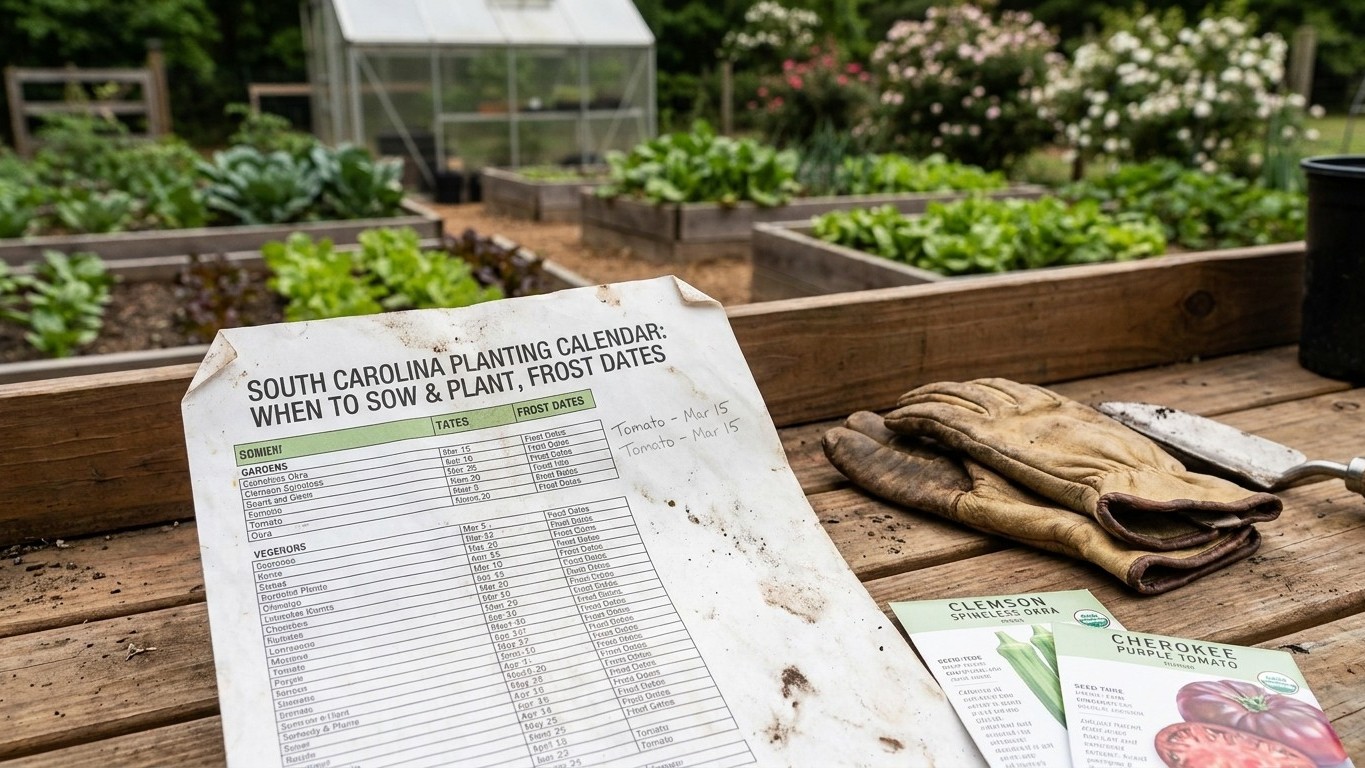

Charleston’s last frost lands between February 28 and March 17 — and that ten-day-plus swing is exactly why a statewide date will burn you if you plant by it instead of by your own spot on the map. Coastal ground near downtown Charleston runs a few days milder than even that window; head inland toward Greenville or Spartanburg and you lose real weeks off both ends of the season. So before a single seed goes in, check What to Plant in South Carolina in February and find where your location sits inside that window, not the calendar month.
The frost window in South Carolina

NOAA’s National Centers for Environmental Information puts the last spring freeze at Charleston between February 28 and March 17, based on 1991-2020 climate normals recorded at station USW00013880, the Charleston airport station. The same source puts the first fall freeze between November 20 and December 5, a window that shapes What to Plant in South Carolina in September as that fall freeze first comes into view, informs What to Plant in South Carolina in October as the season starts turning, guides What to Plant in South Carolina in November as that freeze date draws near, then What to Plant in South Carolina in December once the cool season sets in, and carries right on into What to Plant in South Carolina in January as the coldest stretch of the year settles in. Those two windows are the backbone of every planting decision that follows, and they describe the Charleston area specifically, not the state as a whole — a distinction that matters most right as that last frost date approaches and gardeners start asking What to Plant in South Carolina in March, a question that carries forward into What to Plant in South Carolina in April as the frost risk fades, on into What to Plant in South Carolina in May once the warm season is fully underway, through to What to Plant in South Carolina in June as summer heat builds, into What to Plant in South Carolina in July during the peak of the growing season, and on to What to Plant in South Carolina in August as that heat holds steady, before the cycle turns again toward What to Plant in South Carolina in June as the heat sets in, and straight through to What to Plant in South Carolina in July once the heat of summer settles in.
Coastal versus Upstate
Peninsular Charleston itself runs milder than the airport station these normals come from, so gardeners working close to downtown can often push both ends of the window by a few days without trouble. Head inland and uphill toward the Upstate and the picture flips. NOAA’s own caution on this station data says the Upstate runs several weeks tighter at both ends, meaning a later last frost in spring and an earlier first frost in fall. A gardener near Greenville or Spartanburg should treat the Charleston dates as a rough southern anchor, not a working number, and plan on losing real weeks of growing season on both sides.
What the growing season length means
Counting from the earliest possible last frost (February 28) to the latest possible first frost (December 5) gives a frost-free stretch of roughly 280 days. Counting the other direction, from the latest last frost (March 17) to the earliest first frost (November 20), gives closer to 248 days. That range, roughly 250 to 280 frost-free days near Charleston, is why coastal South Carolina can carry crops through to full maturity that a shorter northern season would cut off, and why a seed packet’s days-to-maturity number matters far more once you move inland toward the tighter Upstate window.
Cool-season crops
Peas, spinach, lettuce, the brassica family (cabbage, broccoli, kale, collards) and root crops like carrots and radishes all germinate in cool soil and shrug off a light frost that would kill a tomato outright. Their timing runs off the last spring frost window of February 28 to March 17 at Charleston, not off a calendar month, because setting a date relative to frost risk lands right whether the year runs early or late.
What goes in ahead of the frost
- Peas and spinach: direct sown well before the last frost, germinate readily in cold soil
- Lettuce and other loose-leaf greens: transplanted or direct sown ahead of frost, tolerant of a light freeze
- Brassica transplants (broccoli, cabbage, kale, collards): set out before the last frost date arrives
- Root crops (carrots, beets, radishes): direct sown ahead of frost, seedlings more tender than the crop itself
Not all of these tolerate cold equally. Peas and spinach shrug off a hard freeze and can go into the ground while real frost risk is still on the table. Lettuce and the brassica transplants handle a light frost but not a deep one, so a gardener setting them out toward the early edge of the Charleston window in late February is taking on more risk than someone who waits toward mid-March. Root crops split the difference: the seed itself tolerates cold soil, but the seedling that emerges from it is softer than the peas and spinach sown alongside it, so a late cold snap can still set it back even after germination.
Warm-season crops

Tomatoes, peppers, squash, beans and corn all need warm soil, not just frost-free air, to get going. Frost kills a warm-season seedling outright, but even a frost-free night in the 40s stalls a young tomato transplant for a week or more without killing it. That is why the working rule for warm-season crops is to wait until both frost risk and soil temperature have cleared, which in practice means planting closer to the back end of the Charleston last-frost window rather than right at its front edge.
Choosing a variety and counting back
Every days-to-maturity figure on a tomato seed packet is counted from the transplant date, not the seed-sowing date, and catalog numbers can run a week or two either way depending on how hot the season runs. Crossed against the Charleston frost window, a transplant set out mid to late March gives a long runway before the frost returns in November or December. The table below shows how that arithmetic plays out for several named varieties.
| Variety | Type | Days to maturity (from transplant) | Notable resistance | Set-out window | First ripe |
|---|---|---|---|---|---|
| Sakura | Indeterminate | 55 | Nematodes (I), Tomato Mosaic Virus (H), Fusarium Wilt 1,2 (H) | Mid to late March | Late May |
| Sun Gold | Indeterminate | 57 | Tobacco Mosaic Virus (H), Fusarium Wilt 1 (H) | Mid to late March | Late May |
| Supersweet 100 | Indeterminate | 60 | Verticillium Wilt (H), Fusarium Wilt 1 (H) | Mid to late March | Late May |
| Juliet | Indeterminate | 60 | Late Blight (I), Early Blight (I) | Mid to late March | Late May |
| Amalfi | Determinate | 68 | Nematodes (I), Late Blight (I), Early Blight (I) | Mid to late March | Early June |
| Cherokee Purple | Indeterminate | 72 | None listed | Mid to late March | Mid June |
| San Marzano II | Indeterminate | 78 | None listed | Mid to late March | Mid June |
| Celebrity Plus | Determinate | 78 | Nematodes (I), Gray Leaf Spot (H), Tomato Mosaic Virus (H) | Mid to late March | Mid June |
If you are raising your own transplants instead of buying them, count back six to eight weeks from that mid-to-late March set-out date. That puts indoor seed-starting somewhere in late January to mid-February for the Charleston area, earlier if you are aiming for the early edge of the window and later if you are waiting for the safer late-March date. Peppers follow roughly the same schedule as tomatoes. Beans, squash and corn skip the transplant step entirely and are direct sown once the same soil-warmth and frost conditions are met.
The fall planting window
South Carolina’s long season also supports a second round of planting: a fall crop of many of the same vegetables that went in during late winter. The trick is working backward from the first fall frost window of November 20 to December 5 at Charleston, rather than forward from midsummer.
Counting back from first frost
Take a sixty-day crop as an example. Counting sixty days back from the earliest fall frost (November 20) lands around late September, and counting sixty days back from the latest fall frost (December 5) lands around early October. That gives a rough fall planting window of late September into early October for a sixty-day crop near Charleston. It is worth adding another one to two weeks of buffer on top of that math, because growth slows as daylight and heat drop off through autumn well before an actual frost arrives.
Crops that improve after a light frost
Kale, collards, Brussels sprouts, carrots and spinach all convert stored starch to sugar once a light frost hits them, so a plant that rides out that first freeze often tastes better for it. That is one reason many South Carolina gardeners leave their fall greens standing through the first frost of the November 20 to December 5 window rather than rushing to pull everything beforehand. A light frost is not the same as the hard freeze that eventually ends the season, and most of these crops tolerate several rounds of the former before the latter finishes them off.
Reading a planting calendar properly
A single frost date for the whole state hides more than it reveals. Elevation matters: climb a thousand feet into the Upstate and the growing season compresses noticeably compared to the coastal plain. A city center holds heat overnight and can run its own effective frost date days later than open farmland ten miles away, the same urban-heat effect that makes downtown Charleston milder than its own airport station. None of that shows up in a single date range, which is one reason a Tennessee Planting Calendar: When to Sow and Plant, Frost Dates Included or a Massachusetts Planting Calendar: When to Sow and Plant, Frost Dates Included lists such different windows. Each is anchored to its own station and its own climate, not to South Carolina’s, and neither one substitutes for watching your own yard.
What to watch instead of the calendar
Watch the extended forecast in the week around your expected last frost rather than trusting the average alone, because a late cold snap can still arrive after an average date has passed. Keep a simple year-to-year log of what actually froze and when in your own garden. After two or three seasons that log will be a better guide than any regional average, including this one.
Local help
Clemson Cooperative Extension works from the same NOAA data and publishes county-level guidance that gets closer to your own backyard than a single Charleston-based range ever can. Since these numbers will not match a garden in Anderson or Georgetown County exactly, check the Clemson Extension office for your county before locking in a planting date, and ask about a soil test while you are at it, since pH and fertility shape timing as much as temperature does. Clemson’s county network also underpins the broader South Carolina guides on this site for crops and problems that go beyond frost dates alone.
Common questions
Can I just use an app that gives me an exact planting date for my zip code?
Treat it as a starting point, not a verdict. Many apps pull from the nearest large-airport station, which for South Carolina often means the same Charleston-area data used here, and they rarely account for your own elevation or local cold pockets. Cross-check whatever date an app gives you against Clemson Extension’s county-level guidance before you commit seed or money to it.
What if a late freeze already killed my tomato transplants?
Replant with a quicker variety rather than writing off the season. With roughly 250 to 280 frost-free days near Charleston most years, a 55-day tomato set out even a few weeks late still has plenty of runway to ripen fruit well before the first fall frost arrives.
Does South Carolina really support two tomato seasons in one year?
Not two full seasons back to back, but a long single season with room for a second wave. Some gardeners succession-plant a fast-maturing tomato in early summer specifically so it ripens before the fall frost window closes, effectively stacking a second harvest onto the tail end of the first.
My garden is in the Upstate. Do the Charleston dates in this article apply to me?
No, and using them directly will get you burned. NOAA’s own data flags the Upstate as running several weeks tighter on both ends than the Charleston station this article is built around, so treat every date here as too early for spring and too late for fall if you garden near Greenville or Spartanburg.
Is it fine to plant right on the last-frost date instead of waiting past it?
For cool-season crops, yes, that is exactly the point of the date. For warm-season crops it is riskier, because the Charleston window itself spans February 28 to March 17, and soil temperature usually lags behind air temperature at the early end of that range even once frost risk has technically passed.
Some gardeners layer an older custom on top of frost dates: planting by the moon, which we explain as almanac tradition, not fact.
Related guides
- North Carolina Planting Calendar: When to Sow and Plant, Frost Dates Included
- Georgia Planting Calendar: When to Sow and Plant, Frost Dates Included
- Tennessee Planting Calendar: When to Sow and Plant, Frost Dates Included