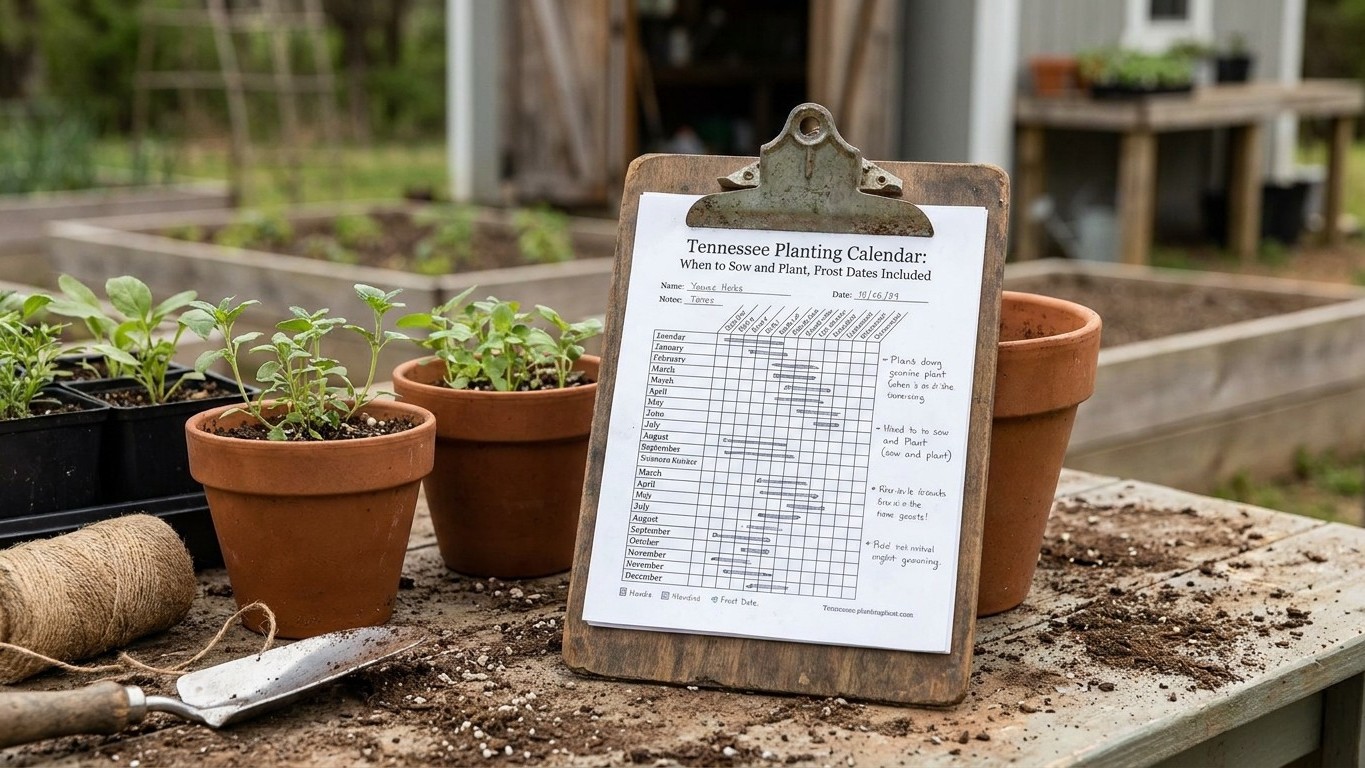

Tennessee’s planting date isn’t a day, it’s the gap between two freezes: last spring freeze somewhere March 31 to April 12, first fall freeze October 28 to November 8, and which end of that gap you plant on decides whether you gain two weeks of season or lose a tray of transplants to a cold night. That’s not a Nashville quirk, either — the Plateau runs later, West Tennessee runs earlier, and your county’s own numbers are what actually matter here. So before anything goes in the ground, pull your county’s frost dates and use those, not the statewide range, to set your dates below.
The frost window in Tennessee

NOAA’s 1991-2020 climate normals for the Nashville station put the last spring freeze between March 31 and April 12, and the first fall freeze between October 28 and November 8. That range exists because freeze risk is a probability, not a switch. Some years the last damaging cold snap comes in late March. Other years it lingers into the second week of April. Planning around the later end of the range costs you a week or two of season. Planning around the earlier end risks a transplant loss if a cold night sneaks in.
Subtract the two dates and you get a working season. Using the earliest last-frost date and the latest first-frost date gives roughly 222 frost-free days. Using the latest last-frost date and the earliest first-frost date gives roughly 199 days. So a realistic planning number for the Nashville area is a growing season of about 200 to 220 days, depending on the year. That’s long enough for two full plantings of most vegetables if you sequence them correctly, which the fall section below walks through.
These are Nashville figures. NOAA’s data explicitly notes that East Tennessee and the Cumberland Plateau run cooler and later in spring than the middle of the state. If you garden in Knoxville, Chattanooga’s higher elevations, or anywhere up on the Plateau, treat the Nashville window as a starting reference and expect your own last frost to land later, sometimes by a meaningful margin. West Tennessee, being lower and closer to the Mississippi, tends to warm a little earlier than Nashville in most years. County-level normals from the University of Tennessee Extension, linked further down this page, are the way to narrow that down for your own address. Earlier in the year, this guide on What to Plant in Tennessee in January covers what’s already underway during the deep-winter stretch. Before that window opens, this guide on What to Plant in Tennessee in February covers what can still go in during the late-winter, and further along the calendar, this guide on What to Plant in Tennessee in August covers what goes in as the season shifts toward the fall planting window, and at the other end of the season, this guide on What to Plant in Tennessee in October covers what goes in as that first fall freeze approaches, and further along the calendar, this guide on What to Plant in Tennessee in July covers what thrives once the heat sets in, and the guide on What to Plant in Tennessee in December covers the tail end of the previous season that sets up this whole cycle stretch, and once the frost window above has passed, this guide on What to Plant in Tennessee in May covers what to get into the ground once the season is fully underway stretch, and once the frost window above starts to close, this guide on What to Plant in Tennessee in March covers what can go in as the season stretch, and once the frost-free window is fully open, this guide on What to Plant in Tennessee in June covers what thrives in the warmer early-summer soil lull. Once your frost dates are set, this guide on What to Plant in Tennessee in April walks through what to get in the ground as that window opens. Once the summer crops are in and you’re planning your succession plantings, this guide on What to Plant in Tennessee in September covers what to get started as that season turns, and once you reach the fall side of the calendar, this guide on What to Plant in Tennessee in November lays out exactly what still goes in the ground as the first frost approaches.
Cool-season crops
Cool-season vegetables don’t wait for the last frost. Peas, spinach, lettuce, the brassica family (broccoli, cabbage, kale) and most root crops (carrots, beets, radishes, turnips) tolerate light frost and actually grow better in cool soil than in heat. The trick is timing them against your last-frost date, not against a fixed calendar month, because that date itself shifts with elevation and local geography as described above.
What goes in first
Peas and spinach are the most frost-hardy of the group and can go into the ground while the soil is still cold, several weeks ahead of the last frost date. Lettuce and the brassicas are a little less tolerant of hard freezes but still handle a light frost without damage, so they’re typically started a few weeks before the last-frost window rather than after it. Root crops fall in between: carrots and beets germinate slowly in cold soil but the seedlings themselves are frost-tolerant once up.
- Peas and spinach: most frost-hardy, plant earliest of the group
- Lettuce and brassica transplants: tolerate light frost, go in a few weeks ahead of the last frost
- Carrots, beets, radishes, turnips: slow to germinate in cold soil, frost-tolerant once established
- Onion sets and seed potatoes: also go in well ahead of the frost-free date
The failure mode with cool-season crops isn’t cold, it’s heat. Lettuce and spinach bolt to seed once temperatures climb, so the real deadline is how much cool weather remains before Tennessee’s spring heat sets in, not the frost date itself. Get these in the ground as early as your soil can be worked, meaning it crumbles rather than clumps when you squeeze a handful, and you’ll harvest before bolting becomes a problem.
Warm-season crops

Tomatoes, peppers, squash, beans and corn are killed outright by frost, so they go out after the last-frost window closes. But frost isn’t the only limit. Soil temperature matters as much as air temperature for these crops. Warm-season seed germinates poorly, or not at all, in cold soil, and transplants set into cold ground simply sit there instead of growing. Waiting a week or two past your last frost date, until the soil itself has warmed, usually outperforms rushing transplants out the moment the frost risk passes.
Counting back for indoor starts
For tomatoes, the transplant window built from the Nashville frost data runs mid April to late April, giving a comfortable buffer past the March 31-April 12 last-frost range. Tomato seed is typically started indoors six to eight weeks before that transplant date. Counting back six to eight weeks from a mid-to-late April transplant window lands you in early to mid March for starting seed indoors under lights. Peppers run on a similar clock but are slower to size up, so many gardeners start them slightly earlier within that same window.
Catalogue days-to-maturity figures are counted from the transplant date, not the seeding date, and they shift by a week or so depending on the season’s heat. Here’s how several catalogued tomato varieties line up against the Nashville frost window:
| Variety | Days to Maturity | Transplant Window | Approx. First Ripe | Margin Before Fall Frost |
|---|---|---|---|---|
| Sakura | 55 | mid to late April | mid June | ~130 days |
| Edox | 55 | mid to late April | mid June | ~130 days |
| Valentine | 55 | mid to late April | mid June | ~130 days |
| Glacier | 55 | mid to late April | mid June | ~130 days |
| Sun Gold | 57 | mid to late April | late June | ~128 days |
| Juliet | 60 | mid to late April | late June | ~125 days |
| Supersweet 100 | 60 | mid to late April | late June | ~125 days |
| Amalfi | 68 | mid to late April | early July | ~117 days |
| Cherokee Purple | 72 | mid to late April | early July | ~113 days |
| Big Beef Plus | 72 | mid to late April | early July | ~113 days |
| Tiren | 75 | mid to late April | early July | ~110 days |
| Granadero | 75 | mid to late April | early July | ~110 days |
| San Marzano II | 78 | mid to late April | mid July | ~107 days |
| Celebrity Plus | 78 | mid to late April | mid July | ~107 days |
Every variety in that table clears the Nashville frost window with well over 100 days of margin, which is the point of picking a mid-April to late-April transplant date rather than pushing earlier. If you garden on the Cumberland Plateau or in higher parts of East Tennessee, shift the whole table later by however much your local last frost runs behind Nashville’s. Squash, beans and corn follow the same basic rule as tomatoes: wait until the soil has warmed past the point of just clearing frost risk, since cold, wet soil rots bean and squash seed before it germinates.
The fall planting window
Working backward from the first fall frost is the same exercise as working forward from the last one, just in the other direction. NOAA’s normals put Nashville’s first fall frost between October 28 and November 8. To find a safe fall-planting date, take a crop’s days-to-maturity figure, add roughly two weeks as a buffer because growth slows as daylight shortens in late summer and early fall, and count backward from the earlier end of that frost window, October 28, to be conservative.
An example calculation
Say a fall broccoli variety lists 60 days to maturity. Add the two-week slowdown buffer and you’re planning for roughly 74 days of real growing time. Counting back 74 days from October 28 lands you in the second half of August as a seeding target. Counting from the later end of the frost window, November 8, pushes that back closer to early September. That’s the whole method: catalogue days-to-maturity plus a slowdown buffer, counted back from your local frost date range, not asserted as a fixed calendar day.
Some crops don’t just tolerate a light fall frost, they improve after one. Cold exposure converts starches to sugars in several cool-season vegetables, which is why gardeners deliberately leave them in the ground past the first frost rather than rushing to harvest.
- Kale and collards: sweeter and less bitter after a light frost
- Brussels sprouts: flavor improves noticeably after cold exposure
- Carrots and parsnips: root sugars increase after frost, especially left in the ground
- Spinach: fall-planted crops often overwinter under light mulch in milder years
This is also why a fall garden rewards planning more than a spring one. Spring planting works forward from a single frost date with the whole season ahead of you. Fall planting works backward from a hard deadline, and a week’s delay in seeding can mean the difference between a full harvest and a crop caught immature by the first freeze.
Reading a planting calendar properly
A statewide planting calendar, including this one, is built from a single reference station, in this case Nashville. That makes it a starting point, not an instruction specific to your yard. Tennessee’s geography spans river-bottom land in the west, the Highland Rim and Nashville Basin in the middle, and the Cumberland Plateau and Appalachian foothills in the east, and each of those settings shifts the frost dates in a different direction.
What actually varies
Elevation is the biggest factor. Higher ground cools faster at night and holds cold air longer into spring, which is why the Cumberland Plateau and the mountains of East Tennessee run behind Nashville’s frost dates, sometimes considerably. Urban areas work the other direction: pavement and buildings hold heat, so a garden in the middle of Nashville or Knoxville can run a few days ahead of a rural plot in the same county. Low-lying spots, the classic backyard “frost pocket” at the bottom of a slope, collect cold air on clear nights and freeze before the rest of the yard does, sometimes weeks past the average last-frost date for the region.
A late cold snap is the other thing no calendar can predict. NOAA’s frost dates are a 30 to 70 percent probability band, meaning a freeze outside that window is uncommon but not impossible. Gardeners in a very different climate, like New Hampshire’s short growing season covered in our New Hampshire planting calendar, watch for exactly this kind of late-season surprise, just against a much tighter margin. The mountainous parts of Tennessee share more with a neighboring state like Virginia in this respect than with Nashville, and our Virginia planting calendar covers a similar elevation-driven spread in frost dates.
The fix is observation, not a better calendar. Track your own soil temperature with a simple probe thermometer, note which mornings actually frost in your yard over a couple of seasons, and adjust the dates on this page to match what you’ve actually seen rather than what a regional average predicts.
Local help
For dates and soil advice specific to your county rather than the Nashville reference station used throughout this page, contact the University of Tennessee Extension. County offices run soil testing, keep local frost records, and can tell you how far your elevation or microclimate shifts the numbers above. It’s also worth browsing our broader Tennessee guides for crop-specific advice built on the same frost data used here.
Common questions
What planting zone is Tennessee?
Tennessee spans several USDA Hardiness Zones because of its range in elevation and latitude, from the Mississippi lowlands to the Appalachian mountains in the east. Check the USDA hardiness map for your specific county rather than assuming one zone covers the whole state, since the western and eastern ends of Tennessee can differ by a full zone or more.
Can I plant tomatoes in March in Tennessee?
Not as transplants outdoors. NOAA’s data puts Nashville’s last frost as late as April 12 in some years, and East Tennessee typically runs later still, so a March transplant risks a total loss. March is the right window for starting tomato seed indoors, not for setting plants outside.
Why did my seedlings stall after I transplanted them right on the frost date?
Cold soil is the usual culprit. Air temperature can clear the frost threshold while the ground several inches down is still too cold for warm-season roots to grow, so the plant sits without putting on new growth for a week or two. Waiting until the soil itself has warmed, not just the air, generally beats an early transplant date.
Is it too late to plant a fall garden if it’s already August?
It depends on the crop, not the calendar month. Fast-maturing greens and root crops can still work if you count their days-to-maturity plus a slowdown buffer back from your local first fall frost date and find you still have enough days left. Slower crops like broccoli need that math done earlier, closer to midsummer.
Do the frost dates on this page apply to my exact town?
Only approximately. These figures come from NOAA’s Nashville reference station, and the page notes throughout where East Tennessee, the Cumberland Plateau, and other regions diverge from it. Your county Extension office is the better source for a number tied specifically to your location.
Related guides
- Kentucky Planting Calendar: When to Sow and Plant, Frost Dates Included
- Virginia Planting Calendar: When to Sow and Plant, Frost Dates Included
- West Virginia Planting Calendar: When to Sow and Plant, Frost Dates Included