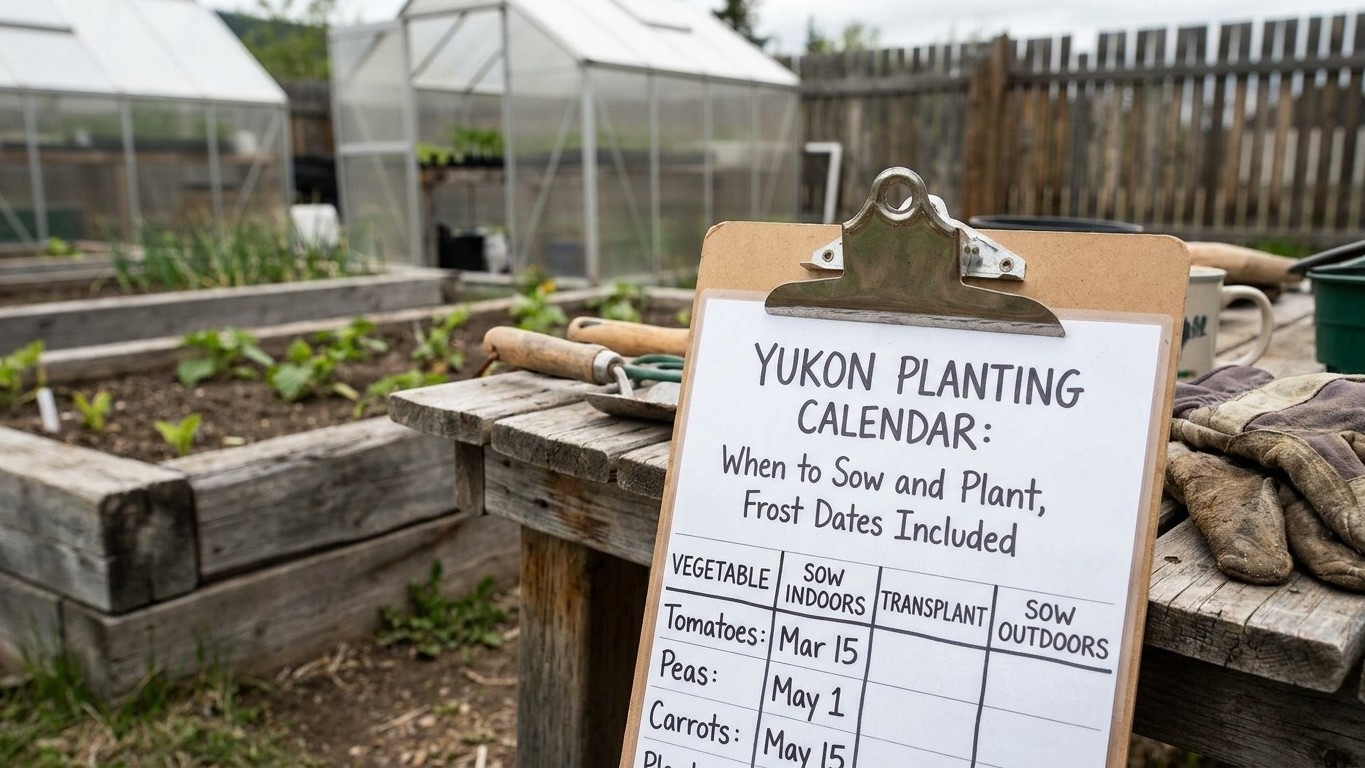

Yukon’s frost-free season runs, on average, from June 5 to August 25, according to Environment and Climate Change Canada’s 1981-2010 Canadian Climate Normals for the Whitehorse A station. That is a mean date, not a safe one: frost arrives later than June 5 in about half of all years on record. The one move that matters most right now is choosing tomato and pepper varieties that finish in 60 days or less from transplant, since anything slower runs out of summer before it ripens.
The frost window in Yukon

Every planting decision in Yukon starts with two dates. Environment and Climate Change Canada’s 1981-2010 Canadian Climate Normals for the Whitehorse A station put the average last spring frost at June 5 and the average first fall frost at August 25. Subtract one from the other and the frost-free season at Whitehorse runs to roughly 81 days, one of the shortest growing windows of any provincial or territorial capital in the country.
A mean, not a promise
Both figures are averages taken over a thirty-year record, not a guaranteed boundary. In roughly half the years in that record, the last spring frost at Whitehorse fell after June 5, sometimes well after it. Treat June 5 as the middle of a risk window rather than the day you can safely set out tomato starts. For guidance on getting an early start on cold-hardy crops while that risk window is still open, see What to Plant in Yukon in May, and for a closer look at what to prioritize once that window opens, see What to Plant in Yukon in June. Once the frost-free stretch is fully underway, see What to Plant in Yukon in July for what to keep planting through the height of summer. The same caution applies at the other end of the season: August 25 is a midpoint, and a first frost arriving two weeks early is well within normal variation, not a freak event. For guidance on wrapping up the season and getting late crops in before that frost hits, see What to Plant in Yukon in September, and once frost has settled in for good, see What to Plant in Yukon in October for what still makes sense to put in the ground. Once winter has fully taken hold, see What to Plant in Yukon in November for the few tasks still worth doing in the garden.
Whitehorse itself sits in one of the milder pockets of the territory, in a river valley that holds a bit more warmth than the surrounding hills. Communities at higher elevation, further north, or away from the moderating effect of the Yukon River tend to see their last frost arrive later in spring and their first fall frost arrive earlier, shortening the growing season further still. If you garden outside the Whitehorse area, use these dates as a reference point and adjust toward a shorter season rather than a longer one.
An 81-day average frost-free season limits which crops make sense as direct outdoor sowings and which need a head start indoors or under cover. It also means the margin for error is thin. A vegetable that needs 90 days from seed to harvest has no real path outdoors here without transplanting or season extension, whatever the long summer daylight does to speed things along. For guidance on the earliest tasks of the year, see What to Plant in Yukon in January, and for the key window when frost-tender transplants can safely go in, see What to Plant in Yukon in April, and for early-season tasks like starting seedlings indoors before the frost window opens, see What to Plant in Yukon in February, and once that window opens further, see What to Plant in Yukon in March. For a month-by-month breakdown of what to sow once the risk of frost eases, see What to Plant in Yukon in August, and for planning ahead during the depths of winter, see What to Plant in Yukon in December.
Cool-season crops
Cool-season vegetables are the ones that can go into the ground before the last frost has passed, because a light freeze does not kill them outright. In Yukon, where the average last frost at Whitehorse falls on June 5, that head start matters more than almost anywhere else in the country. These crops let you use the coldest, wettest weeks of spring productively instead of waiting them out.
What tolerates the cold and when
- Peas: sow as soon as the soil can be worked, typically several weeks before the last frost date, since germination is slow but the seedlings shrug off a light freeze.
- Spinach and lettuce: direct-sow two to three weeks ahead of the last frost date. Both bolt fast once summer heat and long daylight arrive, so an early start is what buys you a harvest before that happens.
- Brassicas such as cabbage, broccoli, and kale: start transplants indoors and set them out a couple of weeks before the last frost date. Young transplants handle a light frost far better than direct-sown seedlings would.
- Root crops such as carrots, beets, radishes, and turnips: direct-sow from a few weeks before the last frost date onward. Radishes are worth repeat sowings every couple of weeks since they finish so quickly.
The common thread is that none of these crops are betting on warmth. They germinate in cool soil, grow steadily in cool air, and in most cases actually suffer in the heat of a Yukon July more than they would from a late frost in May. That makes them the right crops to gamble on ahead of the average last-frost date, since the downside of an early sowing is a slower start, not a dead planting.
Where this timing gets tricky is soil moisture. Yukon soils that have been frozen all winter thaw and drain slowly, and working wet, cold ground compacts it and does more harm than a week’s delay would. Wait until a handful of soil crumbles rather than smears before you sow, even if that pushes you later than the frost-date math suggests.
Warm-season crops

Tomatoes, peppers, squash, beans, and corn all need warmth in the soil, not just in the air, before they will grow instead of merely surviving. Setting out warm-season transplants right at the average last frost date of June 5 often means putting them into ground that is still too cold to support real root growth, so most Yukon gardeners wait a further week or two past that date, until the ground itself has warmed rather than just the daytime air.
Counting back from the average frost date
The tomato varieties below are all counted from a mid-June set-out date, which allows for that extra week or two of soil warming past the June 5 average. Days to maturity are counted from transplant, as printed on the seed packet, and actual timing will shift by a week or so with the season you get. Matched against Whitehorse’s average first fall frost of August 25, the margin between first ripe fruit and frost ranges from as little as one day to as much as twelve, depending on the variety.
| Variety | Days to maturity | Type | Notable resistance | Margin before average fall frost |
|---|---|---|---|---|
| Sakura | 55 | Indeterminate | Nematodes, Tomato Mosaic Virus, Fusarium Wilt 1 & 2 | 12 days |
| Edox | 55 | Indeterminate | Nematodes, Tomato Mosaic Virus, Fusarium Wilt 1 & 2 | 12 days |
| Valentine | 55 | Indeterminate | Early Blight (intermediate) | 12 days |
| Glacier | 55 | Determinate | None listed | 12 days |
| Sun Gold | 57 | Indeterminate | Tobacco Mosaic Virus, Fusarium Wilt 1 | 10 days |
| Attracta | 58 | Indeterminate | Nematodes, Powdery Mildew, Tomato Mosaic Virus | 9 days |
| Supersweet 100 | 60 | Indeterminate | Verticillium Wilt, Fusarium Wilt 1 | 7 days |
| Juliet | 60 | Indeterminate | Late Blight, Early Blight (both intermediate) | 7 days |
| Jasper | 60 | Indeterminate | Late Blight (high), Early Blight (intermediate) | 7 days |
| Tidy Treats | 60 | Indeterminate | None listed | 7 days |
| Black Cherry | 64 | Indeterminate | None listed | 3 days |
| Cherry Bomb | 64 | Indeterminate | Late Blight (high), Early Blight (intermediate) | 3 days |
| Defiant PhR | 65 | Determinate | Late Blight, Verticillium Wilt (both high), Early Blight (intermediate) | 2 days |
| Kuzco | 66 | Determinate | Verticillium Wilt, Alternaria Stem Canker (both high), Gray Leaf Spot (intermediate) | 1 day |
A one- or two-day margin, as with Kuzco and Defiant PhR, is not a safe bet outdoors in the open. It works only if you are prepared to cover plants at the first sign of a cool night in late August, or if you are growing under a low tunnel or in a greenhouse that buys extra weeks on both ends of the season. The 55-day varieties, Sakura, Edox, Valentine, and Glacier, carry enough buffer to ripen a real harvest even in a year where frost arrives ahead of the August 25 average.
If you are starting these from seed indoors rather than buying transplants, count back six to eight weeks from your mid-June set-out date, which lands the sowing date somewhere in late April to early May depending on the variety and how much growing-on time your setup allows. Peppers generally want an earlier start than tomatoes from the same seed packet, since they germinate and grow more slowly in the first few weeks.
The fall planting window
Working backward from the average first fall frost of August 25 at Whitehorse tells you the last realistic date to start something new outdoors. Take the days to maturity for whatever you’re planting, add a couple of weeks for the slower growth that comes with cooling soil and shortening days in late summer, and count back from August 25. Whatever date that lands on is your outside limit for a direct-sown fall crop, and it is earlier than most gardeners expect.
Second plantings and crops that improve with cold
Quick-maturing crops such as radishes, spinach, and leaf lettuce are the ones with any real room in that window. Sown by mid-summer, they can still finish well ahead of the August 25 average, and because they are the same cool-tolerant crops discussed for spring, a light frost at the tail end of their growth does them no harm. A crop that needs 60 or more days to finish, sown after the solstice, is racing a clock it is likely to lose.
Some vegetables are worth leaving in the ground for the frost itself rather than rushing to harvest ahead of it. Kale, carrots, parsnips, and Brussels sprouts all convert starches to sugars when nighttime temperatures drop, and a light touch of frost, not a hard freeze, improves their flavor rather than damaging them. Leaving root crops in the ground under a thick mulch after the top growth has died back can extend harvest well past the August 25 average, as long as the ground underneath hasn’t frozen solid.
The risk in Yukon’s fall window is less about a single frost event and more about the compounding effect of shortening daylight. Growth slows well before the first frost actually arrives, so a crop that looks like it has three weeks left by the calendar may need closer to four in practice. Build that slowdown into your count-back math rather than treating days-to-maturity figures as fixed.
Reading a planting calendar properly
A single set of frost dates for the whole territory is a starting point, not an instruction. Whitehorse’s climate normals describe one river valley, and Yukon covers a huge range of elevation, latitude, and terrain between its communities. A calendar built around Whitehorse’s June 5 last frost can be genuinely misleading for a garden at higher elevation or further from the moderating effect of open water, where the safe planting window opens later and closes earlier than the territory-wide average suggests.
The same problem shows up everywhere planting calendars get published. A guide written for the Alabama planting calendar describes a frost-free season stretching close to nine months in places, which makes Yukon’s roughly 81-day window look almost like a different kind of gardening altogether. Even a calendar for a more moderate continental climate like the one in the Kansas planting calendar assumes a spring warm-up and fall cool-down pattern that doesn’t map cleanly onto a territory where the sun barely sets in June and the season can end abruptly in late August.
What to watch instead of the date
Local microclimates matter more than the average suggests. A south-facing slope, a spot sheltered from wind, or the heat radiating off a gravel driveway or foundation wall can all push effective frost dates a week or two earlier or later than a nearby open field. The most reliable approach is to keep your own record: note the date of your last spring frost and first fall frost in your own yard for a few years running, and let that local record override the territory-wide average once you have it.
A late cold snap after what looks like a settled warm stretch is the scenario that catches gardeners out most often. Keep row cover or an old bedsheet on hand through the first couple of weeks after you set out warm-season transplants, since a single cold night can undo weeks of head start.
Local help
For soil testing, county-level frost data, and planting advice tailored to your specific community, Agriculture and Agri-Food Canada is the place to start, since Yukon’s own agricultural department does not currently offer a reliable page for this kind of lookup. Get a soil test before you guess at fertilizer needs, particularly if you’re gardening in a spot with a short history of cultivation, since Yukon soils vary widely in texture and organic matter from one valley to the next.
For more on gardening elsewhere in the territory, our other Yukon guides cover related tasks in more depth.
Common questions
Can I actually grow tomatoes outdoors in Yukon?
Yes, with the right varieties and a mid-June set-out date, but the margin is thin. Fast varieties like Sakura, Edox, Valentine, and Glacier finish with about twelve days to spare before the average first fall frost at Whitehorse, while slower ones like Kuzco leave almost none. Many Yukon gardeners still grow tomatoes under a low tunnel or in an unheated greenhouse to widen that margin.
Is the June 5 last frost date safe to plant by?
No, treat it as the middle of a range rather than a green light. Environment and Climate Change Canada’s normal is a thirty-year average, and frost has fallen after June 5 in roughly half of those years on record. Wait for your own soil and local signs, not just the calendar date, before setting out anything frost-tender.
What if I garden outside Whitehorse, further north or at higher elevation?
Expect a shorter season than the Whitehorse figures suggest. Higher and more northerly parts of the territory tend to see the last spring frost later and the first fall frost earlier, which narrows the already tight frost-free window. Lean toward the fastest-maturing varieties on the list and build in extra margin rather than assuming Whitehorse’s dates apply directly to your garden.
Do I need to start everything indoors given how short the season is?
No, not everything. Cool-season crops like peas, spinach, lettuce, and root vegetables do fine direct-sown, since they don’t need the extra head start. Warm-season crops such as tomatoes, peppers, and many squash varieties benefit from starting indoors six to eight weeks before your mid-June set-out date, since they need every bit of the short season to ripen.
What happens if frost hits before my tomatoes are ripe?
Pick everything showing any color as soon as frost is forecast, since green tomatoes picked before a hard freeze will often still ripen indoors on a windowsill. A light frost damages foliage before it ruins fruit that’s already on the vine, so a fast harvest ahead of a forecast cold night can save most of a crop that would otherwise be lost.
Related guides
- British Columbia Planting Calendar: When to Sow and Plant, Frost Dates Included
- Northwest Territories Planting Calendar: When to Sow and Plant, Frost Dates Included
- Alabama Planting Calendar: When to Sow and Plant, Frost Dates Included