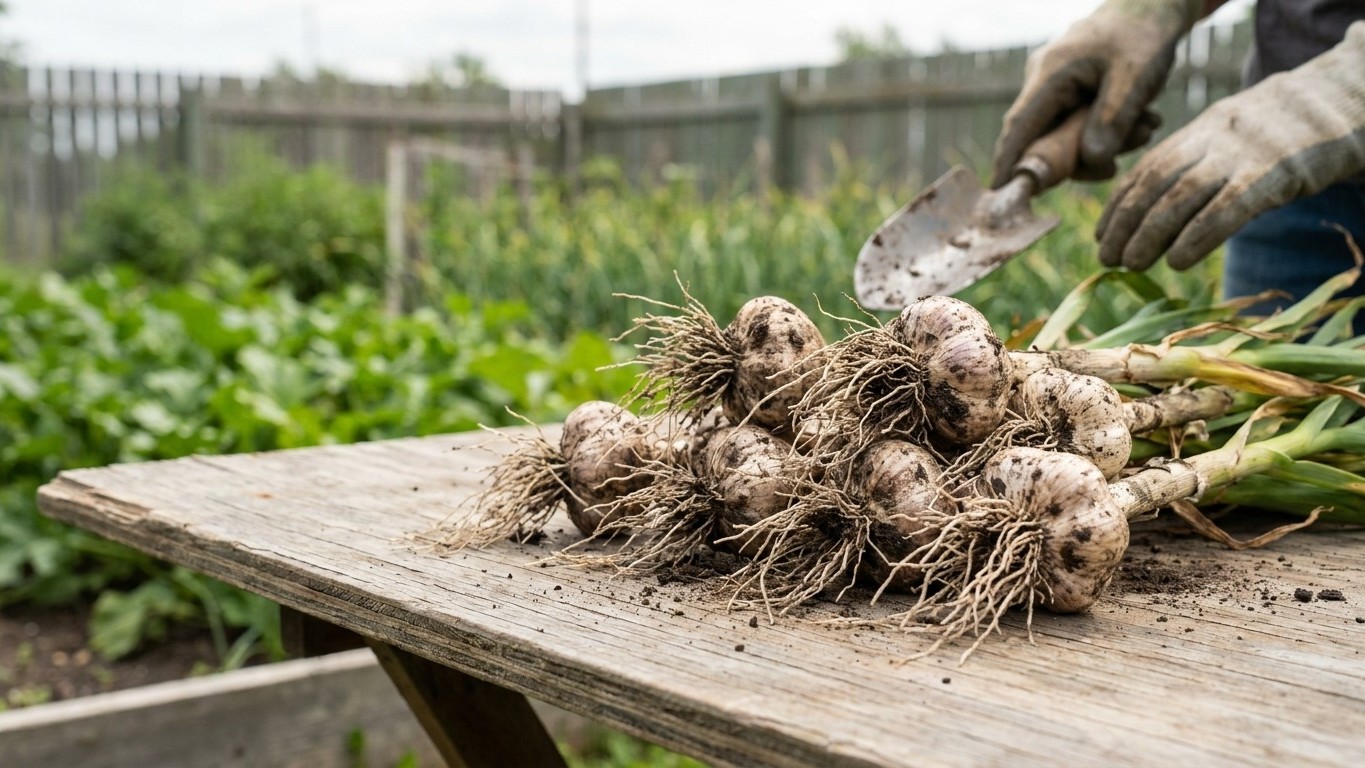

Yes. Manitoba’s winters run long and cold enough to vernalize garlic without any help from a refrigerator, and Environment and Climate Change Canada’s 1981-2010 climate normals for Winnipeg Richardson International Airport put the mean first fall frost at September 22, months before the ground itself finally thaws in spring. Plant your cloves in early September, timed against that date, so they root into cool soil before freeze-up but don’t push much leaf growth before the snow arrives.
Will garlic get the cold it needs in Manitoba

Vernalization: the six-to-eight week rule
September 22 is the mean date of Winnipeg’s first fall frost, and that single number tells you almost everything about growing garlic here. Garlic only needs six to eight weeks of cold to vernalize properly, and Manitoba’s ground stays frozen or near-frozen for months past that date, straight through to spring thaw. Cold is never the problem in this province. The real questions are which variety suits your soil and when exactly to get cloves in the ground.
Manitoba clears it without effort. The mean first fall frost of September 22, from Environment and Climate Change Canada’s Winnipeg Richardson International Airport normals, marks only the start of the cold season here, not its extent. From that date through the following spring thaw, the ground stays frozen or near-frozen for a stretch that dwarfs the six-to-eight week minimum. Cold is never the limiting factor for a Manitoba garlic crop. Growers in a similarly cold northern Plains state face the same arithmetic, as laid out in Growing Garlic in South Dakota: Planting Dates, Varieties and Winter Cold, and with that much cold to spare, the real decision for local gardeners becomes choosing among the Garlic Varieties That Suit Manitoba Winters.
What to do if your site runs mild
The one exception worth naming is a genuinely sheltered microclimate: a raised bed against a heated foundation wall, a downtown courtyard with reflected heat, or ground kept unusually warm by deep snow cover arriving very late. In those specific spots, a grower might reasonably wonder whether cloves are getting enough exposure. The fix doesn’t require guesswork. Chill cloves in a paper bag in the refrigerator for four to six weeks before planting if you suspect your site runs warm, or simply plant a softneck variety, which tolerates a shorter cold period than a hardneck does. For the overwhelming majority of Manitoba gardens, neither workaround is necessary. Skipping planting altogether because you’re worried about cold is the one option that actually costs you a crop.
When to put the cloves in
Reading the frost date correctly
The frost date is not a planting deadline, and it’s not a safe cutoff either. See the full garlic Planting dates Manitoba for exact timing. Environment and Climate Change Canada’s figure of September 22 for Winnipeg Richardson International Airport is a mean drawn from the 1981-2010 normals, which means in roughly half of all years, the actual first frost falls later than that date, sometimes considerably later. Treat it as the midpoint of a window, not a green light to plant right up until it arrives.
What you’re actually managing is the gap between two events: the soil needs to stay warm enough for roots to establish, but not so warm that the clove sends up real top growth before winter locks the ground down. That balance points to a planting window a few weeks ahead of the mean frost date, which is why every variety worth growing here, from Duganski to Inchelium Red, gets set out in early September rather than waiting for October. Get cloves in too early and you risk leafy top growth that winterkills; too late and roots don’t have time to grab hold before the ground freezes solid.
What shifts the window
The Winnipeg Richardson International Airport station describes conditions at one point on the map, and Manitoba is not one climate. Northern and upland districts run their cold season weeks ahead of Winnipeg’s normals, so a grower near Thompson or up in the Interlake highlands should expect an earlier onset of hard frost, not a later one. A large body of water works the opposite way. Ground close to Lake Winnipeg or Lake Manitoba holds heat longer into fall, which can push the practical planting window a little later than the provincial average would suggest. Elevation matters too: low-lying frost pockets chill down faster than surrounding higher ground on a still, clear night. None of this changes the six-to-eight week vernalization math from the section above. It only shifts when, locally, the clock on that cold season actually starts.
Which types suit Manitoba
Hardneck and softneck garlic are not interchangeable here, and the choice isn’t really about taste. It’s about how much winter a variety expects and how long the resulting bulb will keep in storage. Hardneck garlic wants a genuine cold season to perform well, producing a central woody scape and fewer, larger cloves arranged in a single ring. Softneck garlic tolerates milder winters, skips the scape, and reliably stores far longer in a pantry or root cellar, often eight months or more against a hardneck’s four to six.
Given how comfortably Manitoba clears the vernalization threshold discussed above, hardneck varieties are the safer default for most of the province, and the catalogue backs a long list of them: Bavarian Purple, Blue Music, Chesnok Red, Duganski, Fall Festival, Georgian Crystal, Georgian Fire, German Red, German White, and Ivan. All of them go into the ground in early September, per the arithmetic worked through above.
Softneck varieties are not off the table. They still get all the cold they need here and reward the grower with much longer storage life, which matters if you’re growing enough to eat through the winter. The catalogue names Inchelium Red and Lorz Italian alongside Early Red Italian and Italian Late, all set out on the same early-September schedule as the hardnecks. In a warmer state like Maryland, where winters rarely deliver that depth of cold, softneck cultivars dominate for exactly the opposite reason, as covered in Growing Garlic in Maryland: Planting Dates, Varieties and Winter Cold. In Manitoba, softneck is a legitimate choice for storage life, not a concession to a mild winter.
- Hardneck (wants real cold, larger cloves, shorter storage): Bavarian Purple, Blue Music, Chesnok Red, Duganski, Fall Festival, Georgian Crystal, Georgian Fire, German Red, German White, Ivan
- Softneck (tolerant of milder winters, much longer storage): Early Red Italian, Inchelium Red, Italian Late, Lorz Italian
Soil and bed preparation
Drainage comes first
Garlic sits in the same patch of ground for roughly ten months, through fall rain, a hard winter, and spring thaw, and standing water will rot a clove long before any soilborne disease gets the chance. If water pools on a bed for more than a few hours after rain, build it up before you plant, not after. A raised bed four to six inches above the surrounding grade solves most drainage problems outright. Many gardens in the Red River Valley sit on heavy clay that drains slowly, and that soil type is exactly where raised beds or generous compost amendment pay off most.
Work compost or well-rotted manure into the bed a few weeks ahead of planting, not the same day. Garlic wants a fertile, loose soil to push roots into quickly once the cloves go in, and freshly turned ground with undecomposed organic matter can actually rob nitrogen from the crop in its first weeks. Break up clumps so the bed is workable to a full fork’s depth, and clear out perennial weed roots now. A weed that gets established alongside an overwintering clove has all winter and all spring to build a root system before you can get back into the bed to deal with it.
Skip fresh manure applied right before planting. It’s a common shortcut that introduces both a nitrogen imbalance and, on operations where livestock share ground with vegetables, a real risk of contamination. If you test soil pH, garlic performs best in a range close to neutral, and any adjustment with lime or sulfur needs time to work into the soil, which is another reason bed prep happens weeks ahead rather than the afternoon you plant.
What the climate here favours, and what it does not
UC IPM’s Pest Management Guidelines for Onion and Garlic, UC ANR Publication 3453, publish soil temperature ranges for the main garlic diseases, and those thresholds are worth checking against Manitoba’s air temperature pattern, with one caveat stated plainly: the published figures are soil temperatures, and what follows are air temperatures, which lag behind and swing less than the air does. A month’s mean air temperature landing inside a disease’s range is a tendency toward conditions that pathogen likes, never a diagnosis and never a prediction that infection will occur.
With that caveat in place, white rot‘s published range of 50-75°F overlaps Manitoba’s growing-season air temperature in four months, September, May, June and July, including one month sitting at the pathogen’s actual optimum. That’s the widest window of the four diseases tracked, and it’s also the one to take most seriously if you’re sourcing seed garlic from an unfamiliar grower, since white rot survives in soil for years once introduced. Fusarium basal rot‘s range of 59-90°F overlaps in two months, June and July, a narrower but real window during the warmest stretch of the growing season.
Two other diseases essentially don’t find their preferred conditions here. Southern blight‘s published optimum of 86-95°F never lines up with any month’s mean air temperature in this territory, and pink root‘s optimum of 75-85°F does the same. Neither absence means those diseases are impossible. Both pathogens travel on infected seed stock and can survive in soil regardless of climate, so a clean, reputable seed source matters more than the temperature record does. What the climate here does is tilt the odds toward white rot and Fusarium basal rot as the two worth watching, and away from southern blight and pink root as the two least likely to find the conditions they favor.
| Disease | Pathogen | Published range | Months in range here |
|---|---|---|---|
| White rot | Sclerotium cepivorum | 50-75°F | 4 (Sept, May, June, July), 1 at optimum |
| Fusarium basal rot | Fusarium oxysporum f. sp. cepae | 59-90°F | 2 (June, July) |
| Southern blight | Sclerotium rolfsii | 86-95°F (optimum) | 0 |
| Pink root | Setophoma terrestris | 75-85°F (optimum) | 0 |
Getting it through the winter
This is the section where a Manitoba garden diverges hardest from a mild-winter one. A clove planted an inch too shallow, or left unmulched into a winter with thin snow cover, can heave right out of the ground as freeze-thaw cycles work the soil, exposing roots to killing cold and desiccating wind. Mulch is not optional here the way it might be further south.
Lay mulch once the ground has started to cool but before a hard freeze sets in, so you’re insulating soil that’s already heading toward winter rather than trapping summer warmth against the clove. Clean straw or shredded leaves both work, applied in a layer thick enough that you genuinely can’t see soil through it. The goal is even insulation from ground temperature swings, not smothering, so keep it loose rather than compacted or matted.
Come spring, pull the mulch back gradually once new shoots are visible and pushing up, rather than stripping the bed the first mild day. Wet, matted straw sitting directly over emerging leaf tips can rot them before they get any real growth going. A partial pull-back, leaving a thin layer to moderate spring soil temperature swings, is usually the better call in a climate where a late-season cold snap is still a real possibility after the first shoots appear.
Harvest and curing here
Reading the plant, not the calendar
Lift garlic by the look of the leaves, not by counting days from planting. The reliable signal is roughly the lower third to half of the leaves turning brown and dying back while the upper leaves are still green. Pull a test bulb or two before committing to the whole bed. A bulb that’s ready shows well-formed, separated cloves under a skin that’s still intact, not a fused mass that hasn’t divided, and not cloves that have already started splitting apart in the ground, which signals you waited too long.
Curing in this climate
Curing is where a lot of an otherwise good crop gets lost, and a humid stretch of summer weather doesn’t cure garlic the same way a dry one does. Move bulbs out of direct sun immediately after lifting and into a shaded space with real airflow, not a closed shed or a pile on a tarp where humidity builds up around the bulbs. A single layer on a screen, or bulbs hung in loose bundles with space between them, cures far more reliably than a heap. Give it two to three weeks minimum before trimming roots and tops, and don’t rush it just because the outer wrapper looks dry. The neck and the cloves underneath take longer to fully dry down than the papery skin suggests, and garlic put into storage before it’s fully cured is garlic that molds in the bag by midwinter.
Local help
County-level frost dates, soil testing, and seed source recommendations are exactly the kind of detail that varies within Manitoba itself, and they’re worth checking before you commit a bed. Manitoba Agriculture is the right first call for that kind of local detail, and the department’s site is at gov.mb.ca/agriculture.
Getting the Timing Right
Everything else about growing garlic in Manitoba — the variety you pick, the mulch you use, how it survives the winter — comes to nothing if the cloves go into the ground at the wrong moment. Manitoba clay is unforgiving that way. Cloves pushed into the soil too late in October sit in cold, locking ground without ever putting down roots, and what struggles up in spring is thin, uneven, or simply absent. Go the other direction and plant too early in August chasing warm, workable soil, and you invite a different set of problems, since the cloves sprout too soon and burn through the energy they need for spring growth.
The way around both mistakes is to stop guessing and start counting backward from a fixed point. That’s the whole approach laid out in counting back from the first frost to find your Manitoba planting date, which walks through how to turn your local frost date into an actual day on the calendar to get the cloves in the ground. If you’ve read this far into growing garlic here, that’s the next page worth reading before you plant anything.
Common questions
Can I plant garlic in spring instead of fall in Manitoba?
You can plant in spring, but don’t expect the same crop. Garlic needs that cold period to divide into cloves, and a spring-planted clove that missed the fall cold window will often just round up into a single undivided bulb instead. Fall planting, timed against the first fall frost, is what produces a proper head of cloves here.
My garlic sprouted before the ground froze. Did I plant it too early?
Probably. A few inches of green leaf poking through before a hard freeze usually survives fine under mulch, but substantial top growth going into winter uses up energy the clove needed for root and bulb development instead. If this happens two years running, shift your planting date a week or so later within the early-September window.
Do I need to refrigerate garlic cloves before planting in Manitoba?
No, and doing so is unnecessary extra work for almost every Manitoba garden. The province’s winter already delivers far more cold than the six-to-eight week minimum garlic needs to vernalize. Refrigeration before planting is a workaround for warm-climate growers, not a Manitoba requirement.
Why did my garlic come up as one round bulb instead of separate cloves?
That’s called rounding, and it means the clove didn’t get enough cold before or during its growth cycle. In Manitoba this is rare given the length of the winter, so check instead whether you planted very late, used seed stock that was already compromised, or accidentally lifted a plant a full year early.
Is it too late to Plant Garlic if I miss early September?
Not automatically, but the margin shrinks fast. Since the first fall frost normal at Winnipeg sits at September 22 and falls later in roughly half of all years, you can push planting somewhat past early September and still get roots established. Waiting into October leaves less room for error if that year’s frost arrives on the early side of normal.