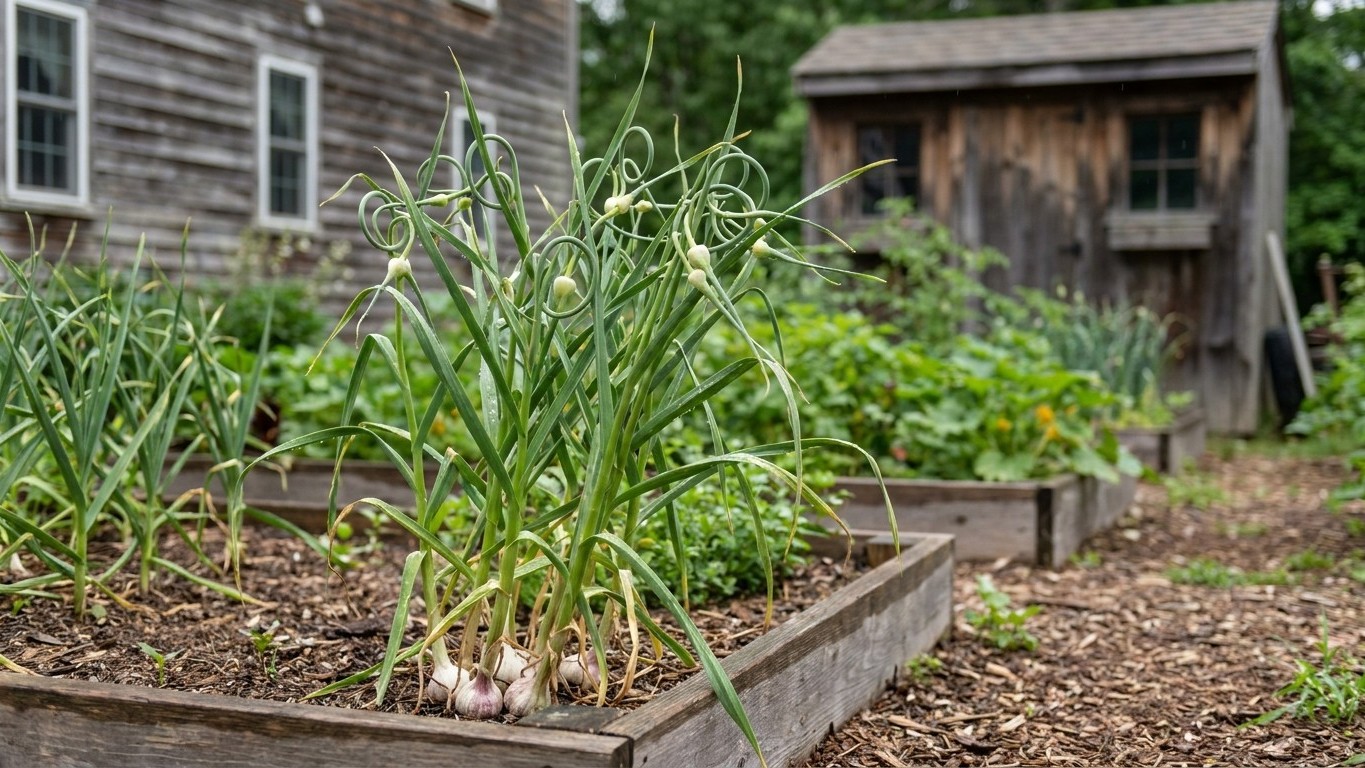

One rounded bulb, no cloves worth peeling — that’s what a mild or short winter leaves behind when garlic never got its chill. Massachusetts growers rarely see that failure, but plant too late, or dig too early out of impatience, and you can still manufacture it yourself. The cold here is reliable; what trips people up is timing the planting so the clove actually sits through enough of it before spring growth takes over.
Will garlic get the cold it needs in Massachusetts

Garlic is not planted like other vegetables. It goes into the ground in fall so a real spell of cold can split each clove into the cluster of cloves that becomes next summer’s bulb. Skip that cold, or cut it short, and you lift one rounded, undivided bulb instead of a head of cloves worth cooking with.
The six-to-eight week threshold
University of Georgia Extension publication C854 puts the requirement at six to eight weeks of temperatures below 40°F before a clove divides properly. Massachusetts clears that bar without much argument. December through February runs cold across every county here, from the Connecticut River Valley to the outer Cape, and a run of six to eight weeks below 40°F sits closer to the winter minimum than the maximum in a typical Massachusetts year. Growers in every part of the state, including its mildest coastal towns, can count on enough cold to trigger clove division in a normal winter. That’s a very different starting point from a warm-winter state like Texas, where growers often have to supply that chill artificially, as covered in our guide to growing garlic in Texas.
The coastal exception
NOAA’s 1991-2020 Climate Normals, recorded at Logan Airport, show the mildest fall frost timing in Massachusetts, and that same station sits at the mild end of the state’s winter range generally. Growers on Cape Cod, the Islands, and the immediate Boston waterfront still see enough cold most winters, but a stretch of unusually mild weather is more plausible there than inland. If you garden in one of those milder pockets and want insurance, two options actually work: refrigerate seed cloves for several weeks before planting, separate from apples or other ethylene-producing produce, or lean on a softneck variety, which tolerates a shorter or less consistent cold spell better than a hardneck does. Choosing the right cultivar matters here too, and our guide to Garlic Varieties That Suit Massachusetts Winters can help you pick one suited to these milder coastal pockets. For the great majority of Massachusetts gardens, though, from the Berkshires to the North Shore, winter alone does the job and no refrigeration step is needed.
When to put the cloves in
Knowing When to Plant Garlic in Massachusetts gives cloves enough time in the ground before the cold sets in, and enough of fall needs to grow roots before the ground freezes solid, but it shouldn’t push much green top growth before winter sets in. Plant too early and the plant wastes energy on leaves that a hard freeze will only knock back. Plant too late and roots never establish, leaving a clove to heave out of loose soil over the winter.
Working back from first frost
NOAA’s 1991-2020 Climate Normals put the first fall freeze at Boston’s Logan Airport, the state’s warmest station, somewhere between November 3 and November 14, a window rather than a single date. Treat the midpoint of that window, roughly the first week of November, as a reference point, not a guaranteed date, since the freeze arrives earlier some years and later in others, and Logan itself runs later than almost anywhere else in Massachusetts. Working back from that reference point, garlic goes into the ground three to six weeks ahead of the first freeze, which lands in mid to late October for the Boston area, matching the set-out window given for every variety named in this guide. That gives roots four to six weeks to establish in soil that’s cooling but not yet frozen.
What shifts the window locally
Move inland or to higher ground and the whole window shifts earlier. The Berkshires and the hill towns of Franklin and Worcester counties see their first frost well ahead of the coast, so gardeners there should plant on the early side of the range rather than the late side. The reverse holds near the immediate coastline and around Cape Cod Bay, where the ocean holds heat into November and pushes the practical planting window later than it would run even a few miles inland. A large lake or reservoir has a similar, smaller moderating effect nearby, and a low frost pocket, the kind of low spot where cold air pools on still nights, will frost earlier than the surrounding land regardless of the regional average. Watch your own ground rather than a calendar date built for Boston’s waterfront. If frost is already forming on grass in your yard by mid-October, plant on the early side, whatever the regional window says.
Which types suit Massachusetts
Hardneck garlic needs a real winter to perform well. It produces a stiff central stalk, the scape, and fewer, larger cloves arranged around that stalk, and it wants sustained cold to develop properly. Softneck garlic, the type usually sold as braiding garlic, tolerates a milder or shorter winter and stores for months longer than most hardnecks once cured. In a cold, snow-covered New England winter, that trade-off tips toward hardneck for most Massachusetts gardens, though softneck still earns a place where long storage matters more than scapes.
Why hardneck fits most of the state
For most of Massachusetts, hardneck varieties are the safer default because the state’s winters reliably supply the sustained cold hardnecks need, and the scapes they throw in early summer are a bonus crop worth harvesting on their own. Georgian Crystal and Georgian Fire (both hardneck) share a Republic of Georgia lineage but differ noticeably in heat, and growing them side by side is a good way to compare. German Red and German White (both hardneck) are widely grown porcelain-type garlics known for a small number of very large cloves, which makes peeling faster at the cutting board. Bavarian Purple, Chesnok Red, Duganski, Blue Music, Fall Festival, and Ivan round out the hardneck options worth trying in a Massachusetts bed, each with its own clove count and heat level worth comparing over a couple of seasons. All of these share the same set-out window for this region, mid to late October, since that window is set by frost timing rather than by the variety itself.
Softneck still has a place
Softneck garlic still works in Massachusetts, particularly for gardeners who want braids or who need bulbs to last well past midwinter in storage. Inchelium Red and Lorz Italian are softneck varieties that hold up in storage far longer than any hardneck will. Early Red Italian and Italian Late round out the softneck list here, both worth a trial row alongside a hardneck for comparison. The same cold-driven logic decides variety choice in the colder Midwest too: a Michigan grower faces a similarly hardneck-favoring winter and makes largely the same call, a comparison laid out in our guide to growing garlic in Michigan.
Soil and bed preparation
Garlic sits in the same bed for eight to nine months, through freeze-thaw cycles, spring rain, and early summer heat, so bed prep matters more here than for a crop that’s in the ground for eight weeks. Drainage comes first: a clove sitting in saturated soil over a wet winter rots before any disease organism even gets involved, and heavy clay that holds water through a Massachusetts thaw is the single most common reason a garlic bed fails outright. Raised beds or ridged rows solve this on any soil that stays wet, and even a few inches of elevation above the surrounding grade makes a real difference across a winter with repeated freeze-thaw cycles.
Amending, testing, and rotating
- Improve drainage with raised beds or ridged rows on any soil that stays wet
- Work in finished compost or well-rotted manure before the ground closes up for the season
- Test soil pH and add lime if the reading calls for it
- Rotate away from onions, leeks, and any bed that grew garlic itself in recent years
Garlic feeds over a long season, and the bed won’t get another chance to be amended once the ground freezes, so work in compost or well-rotted manure before planting rather than waiting for spring. Avoid a spot that grew onions, leeks, or garlic itself in the last few years. Rotating away from the allium family cuts down on the buildup of soil-borne pathogens that specifically target this crop group, a concern covered in more detail in the next section. A soil test through your local extension office will tell you exactly how much lime to add, which is a more reliable answer than guessing from a bag of garden lime bought off the shelf, since Massachusetts soils, especially in wooded or long-unlimed gardens, often run more acidic than garlic prefers. Break up compacted soil to a full spade’s depth so roots can move down ahead of winter, and rake the bed to a fine, level tilth before planting individual cloves.
What the climate here favours, and what it does not
UC IPM’s Pest Management Guidelines for onion and garlic, UC ANR Publication 3453, publish temperature ranges for the soil-borne pathogens that do the most damage to allium crops, and those ranges give a way to read what Massachusetts’s climate favors without pretending to predict any specific infection. One caution applies to every figure below: the published ranges are soil temperatures, and the figures here are monthly mean air temperatures, which run warmer by day and cooler by night than soil sitting a few inches down. A month with a mean air temperature inside a pathogen’s range describes a tendency, not a diagnosis, and a month outside a range never means the disease is impossible, only that it’s less active.
Where the pressure sits
White rot, caused by Sclerotium cepivorum, has a published range of 50 to 75°F and is the disease Massachusetts’s climate favors most. Five months of the growing season, September, October, and May through July, fall inside that range by mean air temperature, including one month at the pathogen’s published optimum. That’s the widest window of any disease covered here, and it lines up with spring and fall, the two seasons when Massachusetts air, and likely the soil beneath it, sits in that comfortable middle range for weeks at a stretch.
Fusarium basal rot, caused by Fusarium oxysporum f. sp. cepae, has a published range of 59 to 90°F. Three months, September, June, and July, land inside that window, concentrated at the start and end of the growing season rather than through a long continuous stretch of it.
Southern blight and pink root sit at the opposite end. Southern blight‘s published optimum, 86 to 95°F, and pink root’s published optimum, 75 to 85°F, are ranges that no month of the Massachusetts growing season reaches by mean air temperature. That does not mean either disease is impossible here: both pathogens survive fine in Massachusetts soil, and infected seed stock or a genuinely hot stretch of weather can still trigger an outbreak. It means the state’s climate doesn’t push either disease toward its most aggressive phase the way it does with white rot.
| Disease | Pathogen | Published range | Months in range (growing season) |
|---|---|---|---|
| White rot | Sclerotium cepivorum | 50-75°F | 5, incl. 1 at optimum |
| Fusarium basal rot | Fusarium oxysporum f. sp. cepae | 59-90°F | 3 |
| Southern blight | Sclerotium rolfsii | 86-95°F (optimum) | 0 |
| Pink root | Setophoma terrestris | 75-85°F (optimum) | 0 |
Getting it through the winter
Mulch is what keeps a Massachusetts winter working for a fall-planted clove instead of against it. Lay mulch after the ground has cooled but before it freezes hard: straw, shredded leaves, or salt marsh hay all work, and the goal is an even, insulating layer that keeps soil temperature more stable through the freeze-thaw cycles a Massachusetts winter throws at bare ground. Repeated freezing and thawing, more than the cold itself, is what heaves a shallow-planted clove up out of the soil and exposes it to drying wind and hard freezes it wasn’t built to survive.
Depth, mulch, and the spring pullback
Planting depth matters as much as mulch here. A clove planted too shallow has a shorter column of soil holding it in place, and it’s the shallow ones that end up sitting loose on top of the ground by February after a few freeze-thaw cycles have worked them free. Firm the soil down over each clove at planting time and don’t skip the mulch layer even in a mild-looking fall.
Come spring, pull mulch back gradually rather than all at once, and time it to when new green shoots are visibly pushing up looking for light, not to a date on the calendar. Leave a thin layer in place rather than clearing the bed to bare soil, since a late spring freeze can still nip exposed shoots, and mulch left in place also suppresses the early flush of weeds that compete with garlic during its main growth period. Massachusetts spring often brings one more cold snap after the first mild week, and a bed cleared too early has no buffer against it. Snow cover, when it falls and stays, actually helps rather than hurts: a consistent snowpack insulates the bed better than bare frozen ground and keeps soil temperature more stable than an open winter with repeated freeze-thaw swings and no snow to buffer it.
Harvest and curing here
Garlic planted in fall is harvested the following summer, and the leaves tell you when far more reliably than any date on a calendar. Lift the bulbs when the bottom third to half of the leaves have browned and died back while the upper leaves are still green, not once the whole plant has collapsed. Pull too early and the bulb hasn’t filled its cloves out. Wait until every leaf is brown and the papery wrapper that protects each bulb starts to split, letting soil and moisture in and shortening its storage life before it ever reaches the kitchen. Dig, don’t pull: loosen soil well to the side of the row with a fork before lifting, since a bulb pulled straight up by the stalk in heavy, still-damp early summer soil often tears its wrapper or snaps its neck.
Curing is where a Massachusetts summer makes its own demands. A humid stretch, common in a New England July, slows curing down and raises the risk of mold setting in on bulbs stacked too close together. Cure in a shaded, airy spot with good airflow, never in direct sun: a garage, barn, or covered porch with a fan running works better than a sunny driveway. Spread bulbs in a single layer or hang them in loose bunches rather than piling them, and give the process three to four weeks before trimming roots and stalks and moving bulbs into storage. In a dry summer, curing moves faster and the same airy, shaded setup still applies, but check bulbs more often, since faster curing narrows the window between cured enough and dried out before it’s trimmed. Either way, the wrapper should feel papery and dry, and the neck should feel tight, before a bulb is ready to store.
Local help
Frost timing, soil conditions, and disease pressure all vary across a state as geographically varied as Massachusetts, from the Berkshires to the Islands, and the figures here are anchored to the Boston area alone. For planting dates adjusted to your county, a soil test before you amend the bed, or help identifying a disease if one shows up, contact UMass Extension, the state’s land-grant extension service, which can connect you with the office covering your county.
Common questions
Can I still Plant Garlic in spring if I missed the fall window?
Not with good results. Garlic needs sustained cold after planting to divide into cloves, and a spring-planted clove skips most or all of that cold, so you’ll likely lift a single undivided round instead of a head of cloves. If you miss the fall window, hold the seed stock in the refrigerator and plan on the following October instead.
Do I have to cut the scapes off hardneck garlic?
Cutting the scape, the curling stalk that appears in early summer on hardneck varieties, redirects the plant’s energy into bulb growth rather than the stalk. It’s not strictly required, but most growers cut it, and the scapes themselves are edible and worth cooking with. This has nothing to do with pollination since garlic is grown from cloves, not seed.
Can I plant garlic cloves from the grocery store?
You can, but it’s a gamble. Grocery store garlic is often treated to slow sprouting, may carry soil-borne disease from wherever it was grown, and its variety and cold history are unknown, so it may not perform the way a named seed-stock variety will in a Massachusetts winter. Seed garlic sold specifically for planting is the safer bet.
How many cloves should I expect from one bulb?
It depends heavily on the variety rather than on anything you do in the garden. Hardneck types generally produce fewer, larger cloves arranged in a single ring around the stalk, while softneck types produce more, smaller cloves in multiple rings. Save your biggest cloves from this year’s harvest as next year’s seed stock, regardless of variety.
What if the ground already froze before I got my garlic planted?
If the ground is frozen solid, you can’t plant into it, and forcing cloves into hard soil damages them without giving roots any chance to establish. Watch for a winter thaw and get cloves in during a soft-ground spell if one comes, accepting that a late start means less root development going into the rest of winter, or hold the stock refrigerated and treat it as next year’s seed instead.