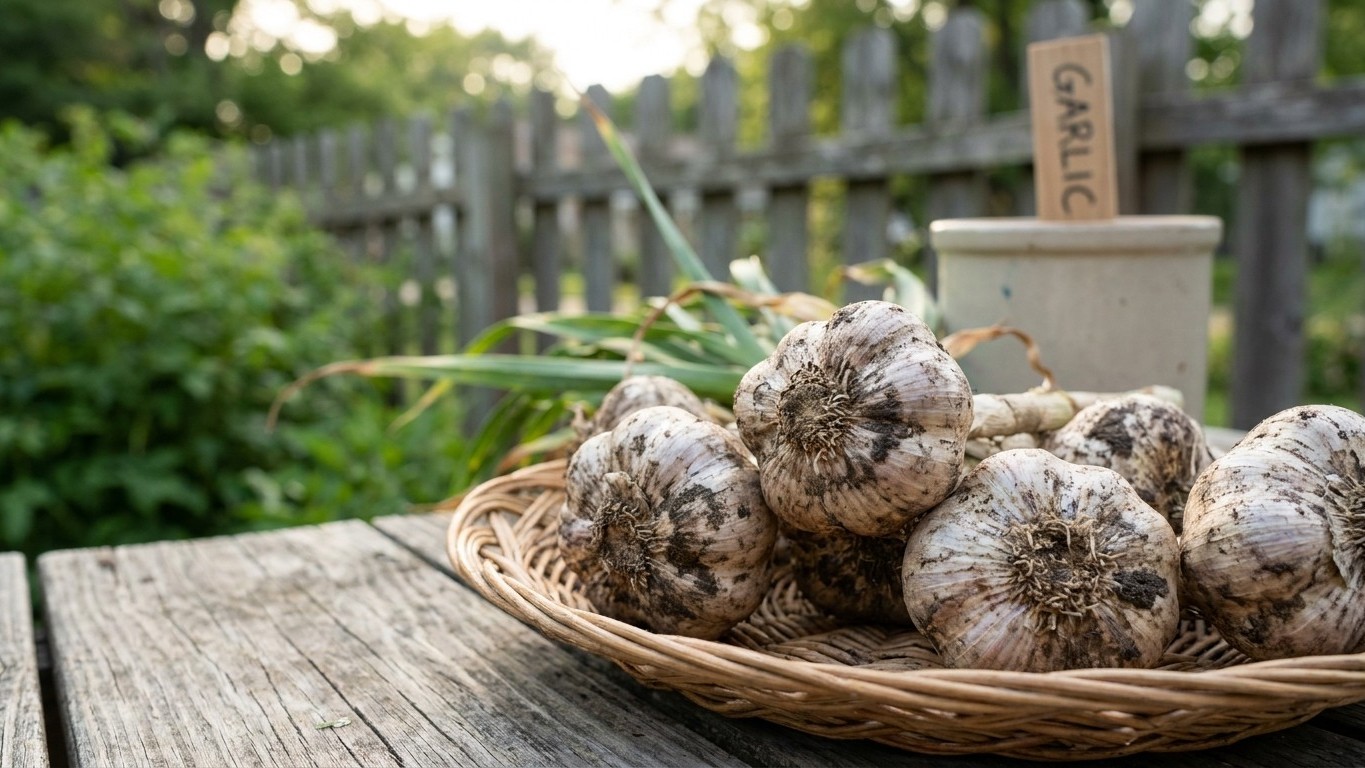

Illinois garlic planted in November comes up small and split next July, if it comes up at all. The cloves sit in cold soil without enough weeks to grow roots before the ground locks up, so the plant spends spring catching up instead of bulking. That failure traces back to one bad guess about frost timing — treating late October cold snaps as the planting cue instead of the deadline behind it. The fix isn’t a firmer date. It’s counting backward correctly.
The short answer for Illinois

For most of the state, garlic goes into the ground early October through mid-October. That window holds for every clove-planted variety sold into this territory, softneck or hardneck, because the rooting requirement is the same across garlic: only bulb size, wrapper color and clove count change by cultivar.
The anchor for that window is NOAA’s NCEI 1991-2020 Climate Normals for the Chicago area, which puts the first fall freeze at 32°F at October 24 to November 3. That figure is a probability band, not a fixed date. NOAA’s normals describe the period when a 32°F freeze becomes 30% to 70% likely at that station, which means it shifts from year to year, and in roughly half of all years frost shows up later than this range, not earlier. Garlic doesn’t need to go in right before that freeze arrives. It needs enough weeks of soil warmth to build a root system while the top stays dormant, which is why the planting window sits ahead of the frost date rather than pressed against it.
Before locking in a cultivar, it helps to know the differences between hardneck and softneck types laid out in Garlic Varieties That Suit Illinois Winters, since scape formation, storage life and cold tolerance vary even though the planting date does not.
| Variety | Type | Set-out window |
|---|---|---|
| Early Red Italian | Softneck | Early October to mid-October |
| Inchelium Red | Softneck | Early October to mid-October |
| Italian Late | Softneck | Early October to mid-October |
| Lorz Italian | Softneck | Early October to mid-October |
| Bavarian Purple | Hardneck | Early October to mid-October |
| Blue Music | Hardneck | Early October to mid-October |
| Chesnok Red | Hardneck | Early October to mid-October |
| Duganski | Hardneck | Early October to mid-October |
| Fall Festival | Hardneck | Early October to mid-October |
| Georgian Crystal | Hardneck | Early October to mid-October |
| Georgian Fire | Hardneck | Early October to mid-October |
| German Red | Hardneck | Early October to mid-October |
| German White | Hardneck | Early October to mid-October |
| Ivan | Hardneck | Early October to mid-October |
If you’ve already prepared your bed, this date is the last step before the crop goes dormant for winter. If not, back up to Growing Garlic in Illinois for bed prep, spacing and clove selection before you plant.
Working it out for your own garden
The Chicago-area figure is a starting point, not a rule for the whole state. NOAA’s NCEI station sits near O’Hare, close enough to Lake Michigan’s moderating edge that the wider suburbs and the rest of northern Illinois often see their first freeze a week or two earlier than that airport reading, and rural gardens away from pavement and open water tend to sit on the early side of that gap as well.
Counting backward from your own frost date
Garlic wants roots before it wants anything else. A clove planted into still-warm soil spends several weeks pushing out a root system, then slows down and goes dormant once the soil cools past a certain point, spending winter underground as roots and a dormant bud rather than green leaves. The common rule growers use is to count back several weeks from the expected first fall frost to find the planting window. Starting from NOAA’s October 24 to November 3 band for the Chicago area, that count-back lands in the same early-to-mid October range used across every cultivar in the table above, though your own count could land a few days to either side depending on how your local frost timing compares to that reference station.
Reading the caveat NOAA already built in
A first-frost date from a climate normal is a midpoint, not a safe line. It describes when a 32°F freeze becomes likely, not guaranteed, so treating November 3 as a hard deadline misreads the data. The same logic runs the other way: planting in early October rather than waiting until the frost window arrives isn’t about beating a deadline, it’s about giving roots the weeks they need regardless of when the freeze itself finally lands.
What changes across Illinois
Illinois runs roughly 400 miles north to south, and its fall cooling doesn’t happen on the same schedule from Rockford to Cairo. The northern tier, including the Chicago metro and the counties along the Wisconsin border, generally cools into frost earlier in the season than the rest of the state, both from latitude and from the loss of Lake Michigan’s summer-stored warmth once the wind shifts inland. Central Illinois, the flat prairie ground around cities like Springfield and Bloomington, has no large lake or river nearby to slow the temperature swing, so it tends to track closer to a straight seasonal cooldown without the lag a big body of water can add.
Southern Illinois, down toward the Ohio River and the Shawnee Hills, sits at a noticeably lower latitude and typically holds its growing season later into the fall than the northern counties do. None of this changes what garlic needs once it’s in the ground. It changes when the ground stops being workable and when the plant’s root-growth window closes for the year, which is exactly why a single frost figure from one Chicago-area station can’t be read as a statewide date. NOAA’s own data is collected at one reference point, and the agency’s normals explicitly describe conditions at that station, not a blanket figure for every county between it and the Mississippi.
Local relief matters too, even in a state as flat as Illinois. Low-lying fields that collect cold air overnight, river-bottom ground, and gardens tucked against open windbreaks all cool faster on a still, clear night than a similar plot a few hundred yards away on higher ground. If your garden has flooded or frosted earlier than neighboring properties in past years, treat that as local evidence and lean toward the earlier end of the planting window rather than the later one.
The mistakes this climate punishes
Two mistakes account for most of the failed garlic beds in this region, and they sit at opposite ends of the calendar.
Planting on the wrong side of the window
- Planting too early pushes hardneck varieties like German Red or Duganski into visible green growth before winter, and that growth gets frost-killed, weakening the bulb that forms the following summer.
- Planting too late, especially chasing a warm stretch into November, leaves cloves without enough rooting time before the soil hardens, and a shallow root system going into winter means a smaller, more heat-stressed bulb by harvest.
- Planting too shallow lets Illinois’s freeze-thaw cycles heave cloves partway out of the ground over winter, which exposes them to drying and cold injury even if the original planting date was right.
- Skipping mulch in a season that turns out cold leaves the crown more exposed to temperature swings than a mulched bed, particularly on the state’s heavier clay soils, which hold water and then freeze harder than a lighter loam.
Seed stock is a climate mistake too
According to the University of California’s Integrated Pest Management guidelines for onion and garlic, UC ANR Publication 3453, white rot (caused by the fungus Sclerotium cepivorum) is active across a published soil temperature range of 50°F to 75°F, and Illinois’s growing season spends several months inside that range going by mean air temperature at a reference station, including one month sitting right at the pathogen’s published optimum. Fusarium basal rot, caused by Fusarium oxysporum f. sp. cepae, has a published range of 59°F to 90°F that overlaps a comparable stretch of the season. Those figures describe soil temperature, not the air readings used to estimate them here, and a monthly average hides a lot of day-to-day swing, so neither range proves the disease is active in any given Illinois garden. What it does mean is that planting stock matters more than the calendar: both pathogens travel in infected bulbs and persist in soil for years once introduced, so grocery-store garlic or bulbs from an unknown source are a bigger risk here than a week’s error in planting date.
Checking this against your county
The Chicago-area figures in this article come from one NOAA reference station, and Illinois Extension is the resource built to translate that kind of statewide climate data down to county level. Before you finalize a planting date, check the Illinois Extension office for your county, since local offices often track frost records and garden calendars specific to their own area rather than the nearest major airport. If your county office doesn’t publish a frost date directly, ask for the nearest agricultural weather station’s data instead of relying on the Chicago figure by default.
Common questions
What happens if I plant garlic too early in Illinois?
Hardneck varieties especially will push visible green shoots before the ground freezes, and that top growth gets damaged or killed by the first hard frost. The bulb usually survives, but it starts spring already weakened, which tends to show up as a smaller harvest.
Can I Plant Garlic in November if I missed the October window?
You can try, but the clove has less time to grow roots before the soil cools past the point where growth mostly stops. Since NOAA’s frost window is a midpoint and roughly half of all years see frost arrive later than November 3 at the Chicago-area station, a late planting sometimes gets away with it, but you’re relying on a mild tail-end of the season rather than a plan.
Do I need to mulch garlic over an Illinois winter?
Most growers in this region mulch with straw or chopped leaves after planting, mainly to buffer the freeze-thaw cycles that come with the state’s clay-heavy soils rather than to keep the ground from freezing at all. Mulch also helps if a hard freeze arrives well ahead of NOAA’s typical window in a colder-than-normal year.
Can I Plant Garlic in spring instead of fall in Illinois?
You can, but expect smaller bulbs. Garlic needs a sustained cold period to divide properly into cloves, and a fall planting gets that naturally over winter, while spring-planted garlic often forms only a single round bulb or a noticeably smaller head by summer.
The Moon calendar is a separate, older custom: see when to plant garlic by the moon, written as tradition rather than fact.