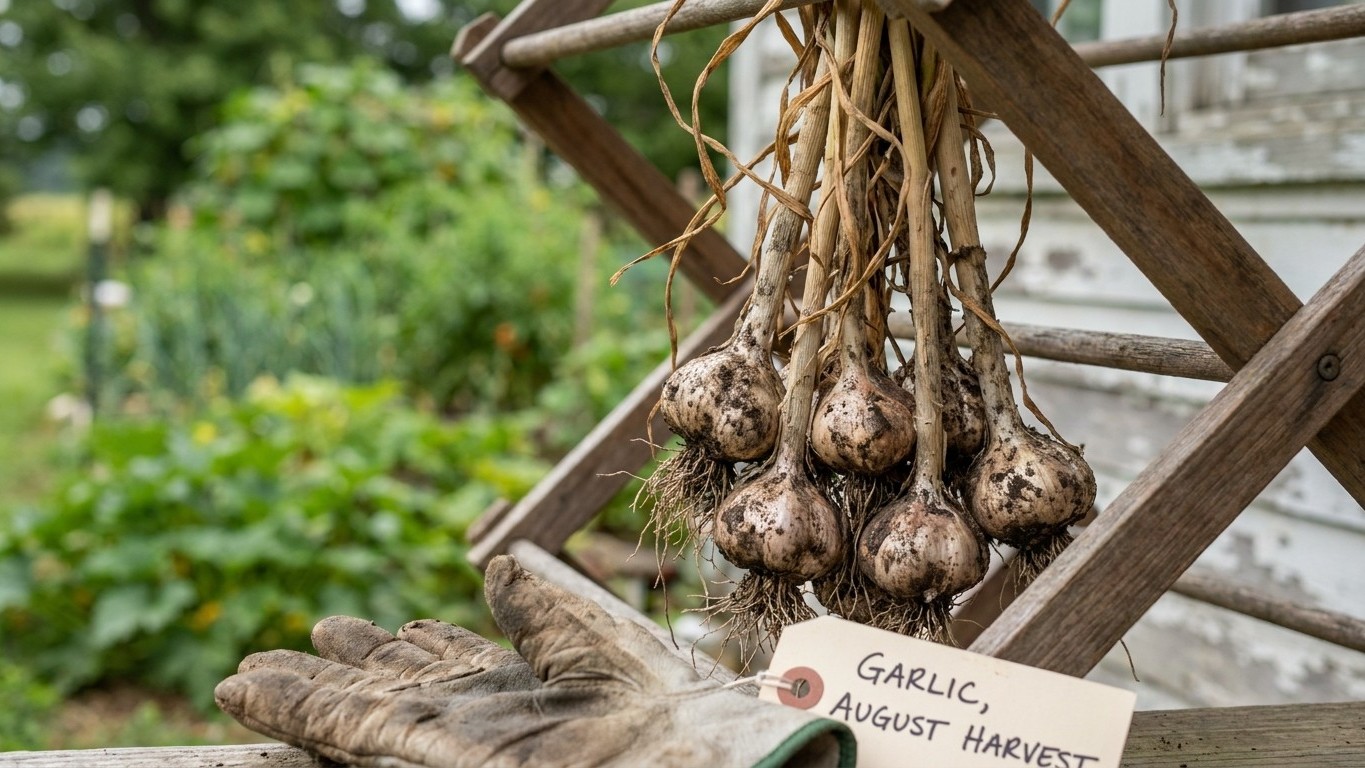

October 21 to October 30 is the stretch when Indianapolis usually gets its first hard freeze, and that window is what sets everything else here. Garlic wants three to five weeks of cool-soil root growth before the ground locks up, so counting backward from that freeze date lands you at the end of September into early October. Softneck or hardneck, the math doesn’t change — only the frost date does, and it’s a range, not a promise.
The short answer for Indiana

For most Indiana gardens, late September to early October is the planting window for garlic cloves, whether you’re growing a softneck or a hardneck type. That figure is anchored on the first fall freeze at Indianapolis, which NOAA’s National Centers for Environmental Information puts at October 21 to October 30 in its 1991-2020 climate normals. Garlic needs roughly three to five weeks of root growth in cool soil before a hard freeze locks the ground, so counting back from that late-October window lands you at the end of September into the first days of October.
Why the date is a range, not a single day
That date is a range for a reason. NOAA’s figure is a probability band: the chance of a 32°F freeze climbs from 30 percent to 70 percent as the window moves from October 21 toward October 30. It is a midpoint, not a guarantee. Purdue Extension makes a similar point about its spring frost data, noting there’s still roughly a 10 percent chance of a freeze even after the published date, a reminder that any single frost figure describes likelihood rather than certainty. Treat October 21-30 as the middle of a spread, not a hard deadline you can plan against to the day.
Every cultivar shares the same window
Every variety in Indiana’s usual planting lineup, softneck and hardneck alike, uses that same late-September-to-early-October set-out window, because the decision is about soil cooling, not the days-to-maturity figure printed on a seed catalogue. The table below lists the varieties by neck type.
| Variety | Type | Set-out window |
|---|---|---|
| Early Red Italian | Softneck | Late September to early October |
| Inchelium Red | Softneck | Late September to early October |
| Italian Late | Softneck | Late September to early October |
| Lorz Italian | Softneck | Late September to early October |
| Bavarian Purple | Hardneck | Late September to early October |
| Blue Music | Hardneck | Late September to early October |
| Chesnok Red | Hardneck | Late September to early October |
| Duganski | Hardneck | Late September to early October |
| Fall Festival | Hardneck | Late September to early October |
| Georgian Crystal | Hardneck | Late September to early October |
| Georgian Fire | Hardneck | Late September to early October |
| German Red | Hardneck | Late September to early October |
| German White | Hardneck | Late September to early October |
| Ivan | Hardneck | Late September to early October |
For a full rundown of how these varieties actually perform through an Indiana winter, including which hardnecks size up best, see Garlic Varieties That Suit Indiana Winters.
Working it out for your own garden
The Indianapolis figure is a reference point, not a statewide rule. NOAA’s freeze data comes from a single weather station, USW00093819, at the Indianapolis airport, and Indiana runs nearly 300 miles from its northern border on Lake Michigan down to the Ohio River. If you garden outside Marion County, redo this arithmetic with your own first-frost expectation before trusting the late-September date outright.
The three-step calculation
The logic behind the window is simple enough to run yourself:
- Find your local first-fall-freeze expectation. Purdue Extension’s county offices carry this kind of localized detail, and it’s worth checking rather than assuming the Indianapolis figure applies to your yard.
- Count back three to five weeks from that date. That stretch gives cloves enough time to root before the ground locks up, without pushing so much top growth that an early hard freeze burns back the leaves.
- Adjust for anything that changes how your ground holds heat: full sun versus a shaded bed, sandy soil versus heavy clay, and whether the garden sits in a low spot that collects cold air on clear nights.
Run that math against Indianapolis’s October 21-30 window and you land in late September to early October, which is exactly why every cultivar in the table above carries the same set-out range.
Soil temperature matters more than the calendar date, even though the calendar is the easiest stand-in for it. Garlic roots best once soil has cooled past summer’s heat but before it turns cold enough to stall root growth outright. A thermometer pushed a few inches into the bed on planting morning tells you more than a date on a page, especially in a fall running warmer or cooler than usual.
Local geography moves the underlying frost date more than most gardeners expect. A large body of water holds heat and delays the first freeze for ground close to its shore, while low-lying land away from that moderating effect can see frost weeks ahead of the regional average. Elevation works in reverse: a garden on a hilltop often stays a few degrees warmer overnight than one in a valley bottom nearby, because cold air drains downhill and pools. None of that shows up in a single airport reading, which is exactly why the Indianapolis figure is a starting point rather than an answer.
What changes across Indiana
Indiana’s frost timing is not one number, and the state’s geography explains most of the spread. The same NOAA data used for the Indianapolis figure carries a caution that southern Indiana runs both an earlier last spring frost and a later first fall frost than the north, a gap put at a fortnight or more compared with the state’s northern counties.
Southern counties run later into fall
That means gardeners in counties like Posey, Vanderburgh or Harrison, down along the Ohio River, typically have real breathing room past the early-October end of the Indianapolis-derived window before their own ground freezes hard. A grower there planting on the later edge of the range is taking less of a gamble than the same date would represent farther north.
Northern counties and the Lake Michigan shore
The far north tells the opposite story. Counties bordering Lake Michigan, and the higher ground running down through the state’s northern tier, tend to see their first hard freeze arrive earlier than the Indianapolis normal suggests, even as the lake itself moderates the immediate shoreline a little. A grower in LaPorte or Steuben County working strictly off the Indianapolis figure risks planting too late, since the window calculated for the capital may already sit at the edge of what their own soil allows.
No backyard matches an airport weather station exactly, and a garlic bed at the bottom of a slope, or behind a tree line that blocks air movement, can see its first freeze well ahead of an open bed a few miles away. None of this changes the underlying method. It only changes which end of the late-September-to-early-October range you should lean toward.
The mistakes this climate punishes
Two mistakes account for most of the failed garlic beds in Indiana, and they sit on opposite ends of the calendar.
Planting too late
Wait past the early-October edge in a year that turns cold fast, and cloves go into the ground without enough time to root before a hard freeze locks the soil. A clove that hasn’t rooted by winter is far more likely to heave out of loose ground during the freeze-thaw cycles Indiana winters run through repeatedly, especially without mulch to buffer the swings. Rooting, not top growth, is the goal of fall planting, and it takes weeks a late clove doesn’t get.
Planting too early
The opposite mistake shows up in a mild fall. Set cloves in while soil is still warm, and hardneck types especially can push visible green growth well before winter dormancy sets in. That growth is exposed to whatever hard freezes eventually arrive, and a plant that spent its early energy on leaves rather than roots goes into winter weaker for it. Hardnecks also need a real stretch of cold to form bulbs properly the following summer, a separate requirement from getting the planting date itself right.
Soilborne disease and where it fits
Timing intersects with disease risk in ways that have nothing to do with frost. According to the UC IPM Pest Management Guidelines for onion and garlic, UC ANR Publication 3453, white rot, caused by the fungus Sclerotium cepivorum, is active across a published 50-75°F range, and Indiana’s growing-season air temperatures fall inside that range in five separate months, including both September and October, the exact window garlic goes into the ground. Fusarium basal rot, caused by Fusarium oxysporum f. sp. cepae, overlaps a 59-90°F range that also touches September.
Three caveats matter here. Those thresholds are published as soil temperatures, not the air readings behind the count above, and soil lags air by weeks and swings far less than air does. A monthly average sitting inside a disease’s range does not mean every day that month favors it, since a month averaging in the 60s still holds days in the 40s and days in the 80s. And a temperature range outside these windows never means the risk is zero. Both fungi persist in soil for years once introduced, mainly through infected planting stock, which is why the real defense is buying certified, disease-free seed garlic rather than planting bulbs of unknown origin from a grocery shelf.
Checking this against your county
The Indianapolis-based window covers the state’s center, but Indiana’s counties span enough latitude and lake influence that your own county’s extension office is worth a call before you finalize a planting date. Purdue Extension maintains local offices and county-level resources that account for the frost variation.
Start with Purdue Extension for county-specific frost and soil detail, and cross-check it against the groundwork already laid out in Growing Garlic in Indiana, which walks through bed prep and clove selection before you reach the point of setting a date.
Common questions
Is it too late to Plant Garlic if I missed the fall window?
Garlic can go in as late as the soil stays workable, but bulbs from a late planting tend to run smaller because roots had less time to establish before winter. If you’ve genuinely missed the whole window, a very early spring planting can still produce something, though it won’t size up the way a properly fall-planted crop does.
Do hardneck and softneck varieties need different planting dates in Indiana?
No. Every variety on the catalogue list, from softnecks like Inchelium Red to hardnecks like Chesnok Red, shares the same late-September-to-early-October set-out window. The difference between the two types shows up in storage life and cold tolerance, not in when you put them in the ground.
What happens if I plant garlic too shallow in Indiana clay?
Shallow-planted cloves are the ones most likely to heave out of the ground during winter freeze-thaw cycles, since heavy clay expands and contracts more than looser soil as it freezes and thaws repeatedly. Plant deep enough that the clove sits solidly below the frost-heave zone, and add a mulch layer on top to buffer the temperature swings further.
Can I use grocery store garlic instead of seed garlic?
You can, but it raises your risk of introducing soilborne disease like white rot, since grocery bulbs carry no guarantee about where they were grown or whether they came from clean stock. Certified seed garlic costs more per clove but it’s the more reliable route, especially since white rot can persist in soil for years once it takes hold.
If you follow the almanac, here is when to plant garlic by the moon. It is a tradition, not a proven method.