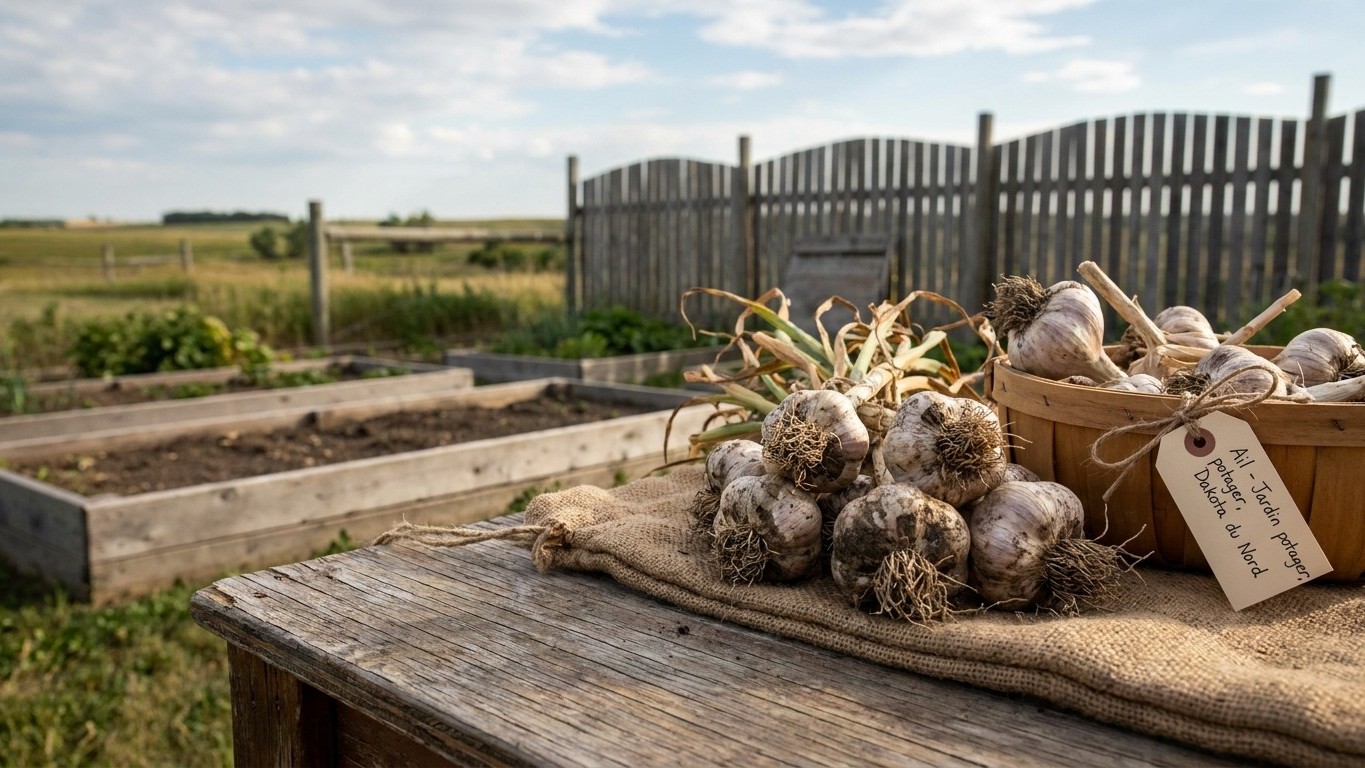

Fargo’s average first freeze lands somewhere between September 25 and October 5, and that narrow week is what pulls the garlic-planting calendar into early-to-mid September. Cloves need three to five weeks of unfrozen soil to push roots before the ground shuts down, but not so long that green shoots poke up and get killed by winter. The frost date itself is unreliable — it slides a week or more either direction almost every year — so the safer move is planting toward the earlier edge of that window rather than the later one.
The short answer for North Dakota

Garlic goes into North Dakota ground in early September to mid September, whichever of the fourteen common cultivars you’re planting. That window is anchored on the first fall frost, and NOAA’s NCEI puts it at September 25 to October 5 for Fargo, based on the 1991-2020 climate normals. This guide assumes you’ve already picked a bed and worked the soil, a step covered in Growing Garlic in North Dakota. Planting three to five weeks ahead of that frost gives cloves enough time to grow roots before the ground locks up, without pushing green top growth that winterkills.
A frost date is a midpoint, not a deadline
That frost figure is not a guarantee. In roughly one year out of every two, the first freeze at Fargo arrives after October 5, and in the other half it arrives before September 25. Treat the range as the middle of a spread, not a line you can plant right up against, and lean toward the earlier end of the planting window if you’re at all unsure.
North Dakota’s winter more than covers the cold garlic needs to divide into cloves. University of Georgia Extension bulletin C854 sets that requirement at six to eight weeks below 40°F, and the Fargo station spends an average of 30.4 weeks a year in that range, well over four times the minimum. This is one of the few places where winter itself is the least of a garlic grower’s worries. The bigger risk is the calendar: get cloves in the ground too late relative to the September-October frost window and they never build the root system that carries them through the cold.
| Variety | Type | Set out |
|---|---|---|
| Early Red Italian | Softneck | Early to mid September |
| Inchelium Red | Softneck | Early to mid September |
| Italian Late | Softneck | Early to mid September |
| Lorz Italian | Softneck | Early to mid September |
| Bavarian Purple | Hardneck | Early to mid September |
| Blue Music | Hardneck | Early to mid September |
| Chesnok Red | Hardneck | Early to mid September |
| Duganski | Hardneck | Early to mid September |
| Fall Festival | Hardneck | Early to mid September |
| Georgian Crystal | Hardneck | Early to mid September |
| Georgian Fire | Hardneck | Early to mid September |
| German Red | Hardneck | Early to mid September |
| German White | Hardneck | Early to mid September |
| Ivan | Hardneck | Early to mid September |
If you’re still weighing flavor, storage life and clove size against each other, Garlic Varieties That Suit North Dakota Winters goes deeper on each of these fourteen.
Working it out for your own garden
The three-to-five-week rule is the arithmetic behind the early September to mid September window, and it’s worth doing yourself rather than just taking the answer on faith. Start with the reference figure: NOAA’s 1991-2020 climate normals put Fargo’s first fall freeze at September 25 to October 5. Count back three weeks from the early end of that range and you land in early September. Count back five weeks from the late end and you still land in September, at the latest the middle of the month. That overlap is why the window holds regardless of where inside the frost range your own year happens to fall.
Adjust for your own ground, not just the calendar
Fargo’s figure comes from one weather station in the Red River Valley, sitting in open, paved terrain that holds heat longer than most gardens do. NOAA’s own caution on these normals is that suburban and rural sites typically see the first fall frost earlier than an airport station shows, sometimes by one to two weeks. If your garden sits in a low spot where cold air pools, or well north or west of Fargo, treat the whole window as arriving sooner and get cloves in by early September rather than waiting for the middle of the month.
Soil matters as much as air temperature. Garlic roots need workable, unfrozen ground, and heavy clay in the Red River Valley holds moisture and cools slower in fall than the sandier soils common farther west. A grower on Fargo clay loam can lean toward the later half of the window; a grower on light, fast-draining soil should lean earlier, since that ground loses its warmth faster once nights turn cold.
None of this changes the six-to-eight-week cold requirement for clove division. That number comes from sustained winter soil temperature, not from planting date, so getting the window right is about root establishment before freeze-up, not about hitting some magic number of chilling days. Once cloves are in and mulched, the region’s winter takes care of the rest on its own.
What changes across North Dakota
Fargo sits in the Red River Valley, at low elevation on the state’s eastern edge, and its frost figure is the one NOAA actually measures. Every other part of North Dakota is an estimate built off that number, adjusted for what’s different about the ground underneath it.
Where frost runs early
The Turtle Mountains and the higher ground around the Killdeer Mountains in western North Dakota sit at meaningfully greater elevation than Fargo. Elevation cools air faster after sunset, so gardens there typically see frost arrive on the early side of the range, or before it. Growers in that country should plan to have garlic in the ground by early September rather than waiting for the window’s midpoint. The area around Devils Lake and the northern tier of counties near the Canadian border tends to run cooler too, both from latitude and from open, wind-exposed terrain that lets cold air move in early.
Southeastern North Dakota, close to Fargo’s own latitude and at similar low elevation, tracks the reference figure most closely of anywhere in the state. The Missouri River corridor through the south-central counties moderates temperatures somewhat, the way a large river valley does, and gardens right along it can run a few days behind the Fargo date rather than ahead of it.
None of these are figures NOAA publishes for those specific towns. They describe the direction the frost date moves, not a new number to plant by, and the only way to know your own date with any confidence is to track your own garden’s frost history over a few seasons or check with a local source, which the next section covers.
The mistakes this climate punishes
Two mistakes account for most failed garlic beds in this climate, and both are timing errors rather than variety errors.
Planting too early lets cloves push green top growth before winter arrives. That growth doesn’t survive a hard freeze, and a plant that spends its stored energy on leaves that die back in October has less left over to build roots. Planting too late is the more common error and the more costly one: cloves set into cold, near-frozen ground in late October don’t have time to grow the root system that anchors them and feeds the bulb through winter. A clove with no roots by freeze-up is a clove that heaves out of the ground over winter and dries out on the surface before spring.
Depth and mulch matter more here than in a milder state
Shallow planting is the other repeat offender. Cloves set less than a couple of inches deep in Red River Valley clay are far more exposed to the freeze-thaw cycles that heave garlic out of the ground over a North Dakota winter than cloves set deeper and covered with a heavy mulch layer. Straw or leaf mulch put down after the ground starts to cool insulates the root zone and evens out surface temperature swings; skipping it is a bigger risk here than in a state with a shorter, milder winter.
Seed stock is the mistake that has nothing to do with timing at all. White rot, caused by the fungus Sclerotium cepivorum, and Fusarium basal rot, caused by Fusarium oxysporum f. sp. cepae, both travel in infected cloves rather than waiting for the right weather to appear. UC IPM’s guidelines for onion and garlic (UC ANR Publication 3453) put white rot’s active range at 50-75°F and Fusarium basal rot’s at 59-90°F, both measured in soil. Based on air temperature at the Fargo station, North Dakota’s growing-season mean falls inside white rot’s range in four months, September, May, June and July, and inside Fusarium basal rot’s range in three, September, June and July. Air temperature isn’t soil temperature, and a monthly average hides plenty of swing between a cold night and a warm afternoon, so treat this as a possibility rather than a forecast. Neither disease needs a warm state to take hold. An infected clove carries the pathogen into cold ground as well as warm ground, so the real defense is buying certified or visibly clean seed stock and culling anything with soft, discolored flesh or a fuzzy white fungal mat before it goes into the ground.
Checking this against your county
Fargo’s frost figures are the only ones NOAA publishes in detail for this territory, but they’re not the only ones that matter to your own planting date. The North Dakota State University Extension service tracks local conditions county by county and is the right place to check before locking in a date for a garden well outside the Red River Valley. If you gardened here last year, your own notes on when the ground first crusted with frost are worth more than any published normal, since they already account for your yard’s low spots, tree cover and soil.
Common questions
What happens if I miss the September window and it’s already October?
Plant anyway rather than waiting until spring. A clove with even three or four weeks of root growth before hard freeze does better than one held over and planted in spring, though you should expect a smaller bulb at harvest since it had less time to establish. Push the planting depth to the deeper end and add extra mulch to make up for the shorter root period.
Does it matter if I plant hardneck or softneck garlic this far north?
Not for winter survival. North Dakota’s cold season easily clears the chilling requirement either type needs to divide into cloves, and both are on the same early September to mid September schedule. Hardneck types tend to be the traditional choice in cold-winter states because they’re generally considered more forgiving of harsh winters, but softnecks like Inchelium Red and Lorz Italian still perform here with a solid mulch layer.
My area had a hard freeze before mid September. Did I miss my chance?
No, but don’t wait for the calendar window to catch up. If your own garden has already seen a hard freeze earlier than the Fargo range, that’s a sign your local frost date runs ahead of the reference figure, and you should have planted at the start of September rather than the middle. Get cloves in as soon as the ground is workable rather than holding out for a specific date.
Can I plant garlic from the grocery store instead of buying seed garlic?
You can, but it carries more risk than it saves. Grocery garlic is often treated to slow sprouting, and its growing history is unknown, which makes it a poor way to check for the soft rot or fungal mat that signal white rot or Fusarium basal rot. Certified seed garlic from a supplier who can tell you where and how it was grown is worth the extra cost, especially in a bed you plan to replant for years.
If you follow the almanac, here is when to plant garlic by the moon. It is a tradition, not a proven method.