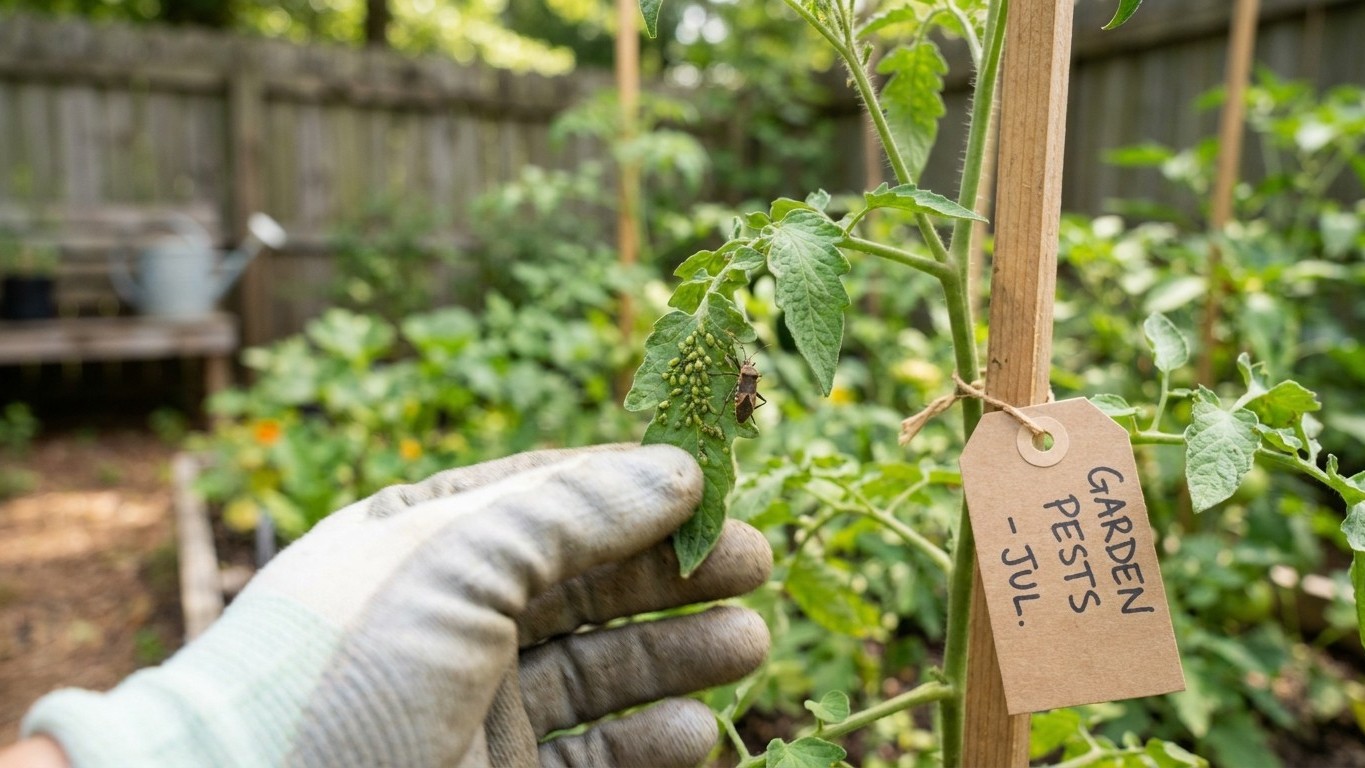

The Alabama Cooperative Extension System names ten insects as the pests that matter most in home vegetable gardens: aphids, Corn earworm in Alabama, stink bugs, the Leaffooted bug in Alabama, Squash vine borer in Alabama, Cowpea curculio in Alabama, the Mexican bean beetle in Alabama, spotted cucumber beetle, Imported cabbageworm in Alabama and cabbage looper, and Spider mites in Alabama. Pressure runs from early spring aphids through late-summer leaffooted bug swarms on tomatoes and peas. Start checking the undersides of leaves and new growth weekly as soon as seedlings go in the ground, before any one pest gets a head start.
What Alabama gardens actually deal with

Ten pests do most of the damage in Alabama vegetable gardens, and which one you’re fighting depends on the week — aphids first, then beetles and worms through summer, leaffooted bugs late. Warm winters here rarely kill enough eggs, so a colony that looks minor in April can be a real infestation by June, and one bug you ignore in May often opens the door for the next. Walk your rows now and turn over a handful of leaves near the new growth — that’s where the first sign always shows up, before it spreads to the rest of the plant.
Aphids

The Aphids in Alabama that gardeners spot are small, soft-bodied insects about 1/16 inch long, pale green, clustering thickly on new growth and leaf undersides. Both nymphs and adults suck sap, curling and yellowing leaves and leaving sticky honeydew that draws sooty mold. A hard water spray knocks down light infestations, and insecticidal soap handles heavier ones, since aphids are soft-bodied and go down fast to contact treatments.
Spotted cucumber beetle

The Spotted cucumber beetle in Alabama that gardeners find is yellow-green, about 1/4 inch, with twelve black spots across the wing covers. They chew ragged holes in leaves and flowers of cucumbers, squash, and melons, while the larvae gnaw roots underground. Row covers over young seedlings keep adults off until flowering starts, and hand-picking in early morning, when beetles are sluggish, cuts numbers fast.
Imported cabbageworm and cabbage looper

The cabbageworm is a velvety green caterpillar around an inch long with a faint yellow stripe down its back. The looper is pale green and moves by arching into a loop, since it lacks a middle set of legs. Both chew large, irregular holes in cabbage, broccoli, and collard leaves. Bacillus thuringiensis (Bt) sprays kill the caterpillars without harming most beneficial insects and are the standard first response for both.
Mexican bean beetle

Adults look like oversized, copper-colored ladybugs with sixteen black spots, about 1/4 inch long. Both the adults and the yellow, spiny larvae skeletonize bean leaves from the underside, leaving lace-like foliage behind. Check leaves for the orange egg clusters and crush them, because hand removal early in the cycle beats most sprays for this one.
Squash vine borer

The adult is a wasp-mimicking moth with an orange and black body, but the damage comes from the larva, a cream-white grub with a brown head that tunnels into the base of squash and zucchini stems. A vine that wilts suddenly, after looking fine the day before, is the giveaway. Slitting the stem to remove the grub, or wrapping stem bases before egg-laying starts, works far better than any spray once the borer is already inside.
Spider mites

Barely visible without a hand lens, spider mites show up as tiny moving specks, pale yellow to red, on leaf undersides. They cause fine stippling that fades leaves to bronze or gray, and heavy infestations spin visible webbing between leaves. Hot, dry weather favors this pest, and a forceful water spray or insecticidal soap knocks numbers down without wiping out the predatory mites that keep them in check.
Cowpea curculio
A small, dark grayish-black weevil about 1/4 inch long, with the curved snout typical of weevils. Adults puncture cowpea and southern pea pods to feed and lay eggs, leaving small dark scars, and the larvae hollow out developing seeds inside. Because the damage happens inside the pod, timing controls to bloom and early pod set matters more than treating after the fact.
Corn earworm (tomato fruitworm)
The moth lays eggs on corn silks or tomato foliage, but the caterpillar does the damage, striped lengthwise in green, brown, or pink and up to 1 1/2 inches long, boring into corn ear tips or tomato fruit. Look for chewed silks and frass at the ear tip, or a single clean entry hole in a tomato. A few drops of mineral oil on fresh silks discourages egg-laying, and picking off damaged ear tips salvages the rest of the ear.
Stink bugs
Shield-shaped, brown or green, about 1/2 inch long, with nymphs that are rounder and often marked in orange and black. They pierce fruit and pods to feed, leaving cloudy, discolored spots on tomatoes and pitted scars on beans and peas. Gardeners in neighboring states deal with the same feeding pattern, as covered in Garden Pests in Arkansas: What Shows Up, When, and How to Stop It. Hand-picking into soapy water works here, since stink bugs move slowly once disturbed.
Leaffooted bug
Grayish-brown, about 3/4 to 1 inch, with a flattened, leaf-shaped flange on each hind leg that gives the pest its name. Adults and nymphs cluster on stems and developing fruit, and their feeding leaves the same cloudy spots and dimpling as stink bug damage, worst late in the season on tomatoes and cowpeas. Because this one builds up as the season runs on, checking plants for clusters through late summer catches it before numbers get out of hand.
Telling damage apart

Reading the damage correctly saves a wasted spray. Chewed leaf edges with ragged, irregular holes point to a beetle or caterpillar feeding at night or in early morning. Fine, dusty stippling that fades a leaf to bronze or gray, especially paired with webbing, means spider mites rather than a leaf disease. Sudden wilting of one vine while the rest of the plant looks fine is a classic sign of squash vine borer working inside the stem, not root rot or underwatering. Sticky residue on leaves, often followed by black sooty mold, means aphids or another sap-feeder has been at work, not a fungal infection on its own.
- Ragged holes with chewed margins: a beetle or caterpillar, check for the insect itself nearby
- Stippled, bronzed foliage with fine webbing: spider mites, worse in hot, dry stretches
- Sudden single-vine wilting: squash vine borer or a stem-boring insect, not a watering problem
- Sticky leaves with black mold: aphids or another sap-sucking pest, treat the insect first
- Cloudy, sunken spots on ripening fruit: stink bug or leaffooted bug feeding, not a disease
Watering faults tend to affect a plant evenly, whole leaves yellowing from the bottom up or entire beds wilting on a hot afternoon, while insect and disease damage usually starts in patches. If damage is symmetrical across the whole plant, suspect water or nutrients before you suspect a pest. If it is patchy, clustered on new growth, or accompanied by an insect you can actually see or feel, treat it as a pest problem and identify the culprit before choosing a control.
When each one shows up
The seasonal rhythm
The Alabama Cooperative Extension System, working from observations near Huntsville, describes pest pressure as running from spring through late summer, with different pests peaking at different points along that stretch. Aphids build from early spring onward, arriving as soon as tender new growth appears on transplants and seedlings. Flea beetles peak in spring as well, chewing tiny shot-holes in young leaves before most other pests are even active. As the season moves into midsummer, squash vine borer, cowpea curculio, and corn earworm become the ones to watch on their respective crops, tracking bloom and fruit set more closely than the calendar. Leaffooted bug becomes the dominant pest on high-value vegetables like tomatoes and peas late in the season, and grasshoppers do their worst damage in late summer as populations peak and food elsewhere dries up.
Because these patterns come from the Huntsville area, timing will run earlier in south Alabama’s warmer counties and later in the cooler northeast. Watch plant stage rather than the calendar: aphids show up on tender new growth whenever it appears, squash vine borer activity tracks with the first flush of squash blooms, and leaffooted bug numbers build as fruit starts sizing up on tomatoes and peas, regardless of the exact date on the calendar. A gardener who checks new growth and developing fruit weekly through the growing season will catch each pest close to when it actually starts, rather than relying on a fixed schedule that may not match the local site.
What actually works
Prevention first
Most of the pests on this list are easier to prevent than to cure once numbers build. Crop rotation breaks the cycle for soil-dwelling stages like cucumber beetle larvae, since moving cucurbits to a different bed each year keeps them from emerging straight into a fresh host crop. Timing plantings to avoid a pest’s peak, such as getting squash in early enough to set fruit before vine borer moths are laying heavily, reduces exposure without any spray at all. Floating row covers physically block egg-laying adults from ever reaching seedlings, though they need to come off once flowers open so pollinators can reach the blooms. Leaving some flowering herbs and weeds at the garden edge feeds the lady beetles, lacewings, and parasitic wasps that eat aphids and caterpillar eggs before they become a problem.
- Rotate cucurbits, beans, and brassicas to a different bed each year
- Cover seedlings with row cover until flowering starts, then remove it
- Leave flowering borders for predatory and parasitic insects
- Check the undersides of leaves weekly rather than waiting for visible damage
Targeted intervention, and what to skip
When prevention isn’t enough, match the control to the pest’s stage. Bacillus thuringiensis (Bt) kills caterpillars like cabbageworm and corn earworm without harming bees or beneficial beetles. Insecticidal soap and a forceful water spray handle soft-bodied pests like aphids and spider mites. Hand-picking still works well for beetles and larger caterpillars, since most of these insects move slowly enough to catch. Garlic sprays, marigold borders, and ultrasonic repellers have no real evidence behind them for any of these pests, and relying on them usually just buys the insect more time to build numbers while the gardener assumes it’s handled.
What control costs
Cost here means both money and the time spent walking the garden, and the two trade off against each other depending on the method. Hand-picking costs almost nothing but soapy water and a few minutes a day, and it has to be repeated as often as new pests show up, which for fast-breeding insects like aphids can mean daily checks during peak season. Row covers and other barriers cost more upfront, for the fabric and hoops, but need almost no repeat attention once installed correctly, aside from removing them at flowering. Biological controls, meaning encouraging predatory insects or applying Bt, sit in the middle: Bt needs reapplication every week or two during an active caterpillar problem, while beneficial insects, once established, keep working with no ongoing cost at all. Sprays targeting sucking or chewing insects generally need the most frequent repeat applications of any method, since they only kill what’s present on the day they’re used and do nothing to pests that hatch afterward.
| Method | Money cost | Time cost | Repeat frequency |
|---|---|---|---|
| Hand-picking | Lowest | Daily during peak season | As often as pests are visible |
| Row covers / barriers | Moderate upfront | Low after installation | Once per season, plus removal at bloom |
| Biological controls (Bt, beneficials) | Low to moderate | Moderate | Every 1-2 weeks for Bt, ongoing for beneficials |
| Sprays (soap, other contact controls) | Low to moderate | Moderate | Frequent, after rain or new hatches |
For a home garden, hand-picking combined with row covers is the cheapest overall approach, since it avoids repeat purchases and works on most of the pests in this list without any chemical input at all. Sprays make sense as a backup for infestations that get ahead of hand control, not as the first line of defense.
Local help
The Alabama Cooperative Extension System tracks pest outbreaks around the state and will identify a specimen if you bring or send one in through your county office. Their Vegetable Garden Insects guide (IPM-1305), available through the extension’s main site, is the reference this article draws its pest list and seasonal patterns from. If you garden elsewhere in the state, other Alabama guides on this site cover regional differences in more detail than a single statewide list can.
Dig Deeper Into Specific Pests
Once you know the general rhythm of pest pressure in an Alabama garden, it helps to zoom in on the ones that actually cause trouble season after season. Take the stink bug guide, for instance. It walks through why these pests show up from spring through late summer in the first place, arriving as soil warms after the last frost and sticking around until tomatoes, peppers, and beans finish fruiting. That timing matters, because it tells you exactly when to start watching your plants closely instead of waiting until damage is obvious. Rather than treating every pest problem as one big undifferentiated fight, it’s worth reading up on the specific culprits like this one so you know what you’re actually dealing with, when it tends to arrive, and what steps make a real difference. Think of this hub as the overview and pages like the stink bug guide as the detailed field notes you’ll want on hand once you spot something crawling on your squash or clustering on your tomato stems.
Common questions
How do I know if it’s a bug or a disease doing the damage?
Look for the insect itself first, on the leaf underside, at the stem base, or inside the fruit. Insect damage is usually patchy and irregular, with chewed edges, holes, or visible frass, while disease damage tends to show as spots, discoloration, or wilting that spreads more evenly across a plant.
Do ladybugs actually eat aphids in a real garden, or is that overstated?
They do, along with lacewing larvae and several parasitic wasps, and a garden with a healthy predator population often controls light aphid infestations without any spray at all. The catch is that broad insecticides kill the predators along with the pest, so spraying too early can make future outbreaks worse.
Is it worth buying a spider mite treatment before I even see webbing?
No, treating before mites show up wastes product and can knock back the predatory mites that would otherwise keep populations low. Wait for the stippling or webbing to appear, then treat, rather than spraying preventively on a schedule.
My tomatoes have small holes but I never see any bugs. What’s going on?
Corn earworm and leaffooted bug both leave holes without leaving an obvious insect behind, since the caterpillar bores in and hides, and the bug feeds and moves on quickly. Check for frass or a single clean entry hole for earworm, and look for cloudy, sunken spots typical of leaffooted bug feeding, since gardeners in drier climates like Garden Pests in Utah: What Shows Up, When, and How to Stop It deal with a different mix of hole-leaving pests entirely.