
North Carolina’s tomato pests arrive on a schedule set by the state’s growing season, which NOAA’s 1991-2020 climate normals put at a last spring frost of March 23 to April 5 and a first fall frost of October 30 to November 8 near Charlotte. That gives roughly seven months of pest pressure building from cool, damp spring soil into hot, humid summer and back down again. Check young transplants for the earliest arrivals as soon as they go in the ground, since the first few weeks after that spring frost window are when the season’s first pest shows up.
What this comes down to in North Carolina

Flea beetles hit North Carolina tomatoes first, usually within days of setting out transplants, riddling young leaves with tiny round holes before the plant has a chance to establish. Aphids follow soon after, clustering on new growth and leaving curled leaves coated in sticky honeydew. These two show up on nearly every planting in the state, season after season, while other pests come and go depending on weather, location, and what’s growing nearby.
Flea beetles

These show up first, often within days of setting out transplants, while plants are still small and tender. Damage looks like dozens of tiny round holes punched through the leaf, sometimes enough to make a young leaf look like it was hit with birdshot. Floating row cover over transplants until they’ve hardened off is the most reliable fix, since heavy feeding on seedlings can stall growth before the plant ever gets going.
Aphids

Aphids follow close behind flea beetles, clustering on new growth and the undersides of leaves as soon as tender shoots appear. Look for curled, yellowing leaves and a sticky residue called honeydew, sometimes with a black sooty mold growing on top of it. A strong water spray knocks down light infestations, and insecticidal soap handles the rest; heavy aphid pressure early in the season is usually a sign plants went in too crowded or too shaded, since aphids favor soft, sheltered growth.
Tomato hornworm

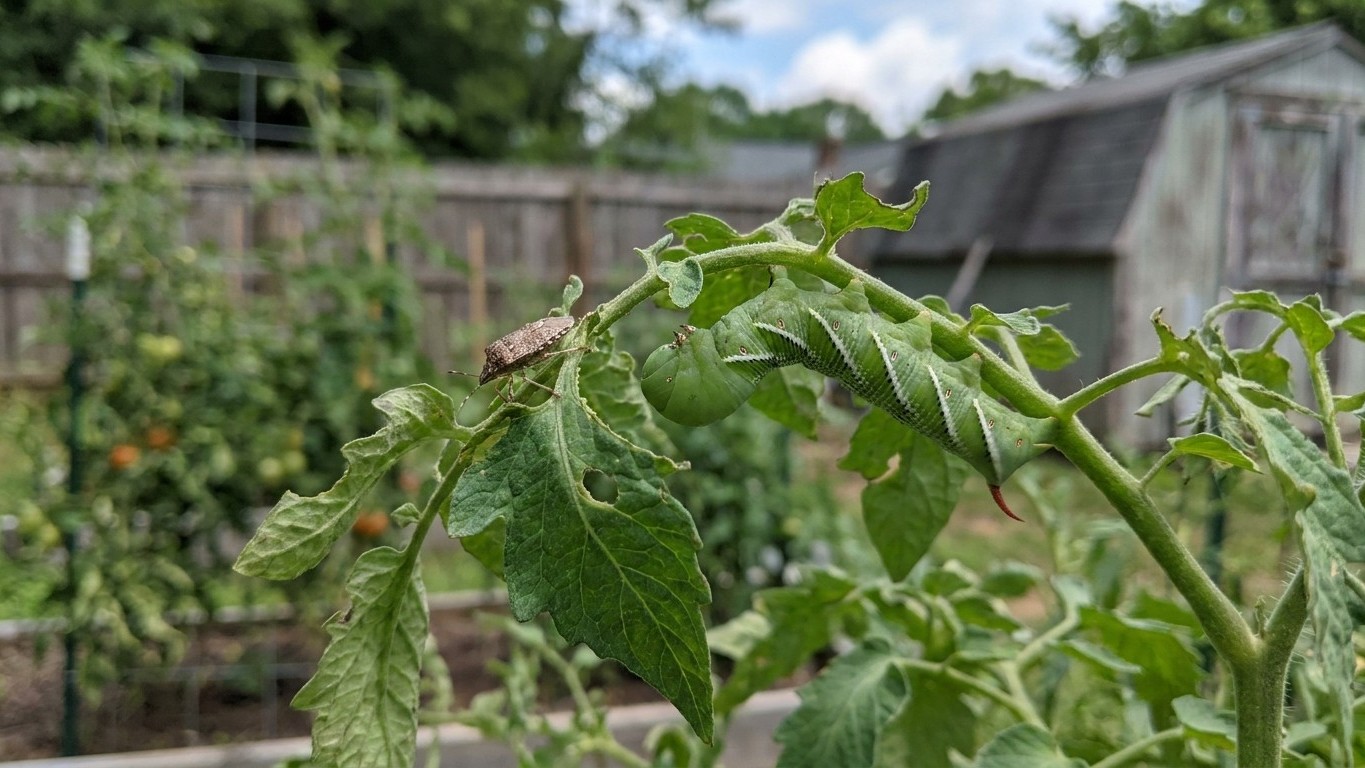
Hornworms show up once plants are well established and putting on heavy foliage, typically as summer heat sets in. They’re easy to miss because their green color blends with the leaves, and the first sign is often stripped stems and dark green droppings on the ground below. Hand-picking works fine on a small planting; for anything larger, Bacillus thuringiensis (Bt) sprayed on foliage targets the caterpillar stage without harming much else.
Stink bugs

Stink bugs move in as fruit starts to size up, drawn to the ripening tomatoes themselves rather than the foliage. Their feeding leaves pale, cloudy spots under the skin that turn hard and discolored as the fruit ripens, a symptom sometimes called cloudy spot. Populations often build along field edges and near other host plants, so scouting the perimeter of the tomato patch catches them before they move deeper in.
Tomato fruitworm

Fruitworm, the same species known as corn earworm on sweet corn, arrives around the same point in the season as stink bugs and goes straight for the fruit, boring a clean entry hole near the stem end. Unlike hornworm damage, you rarely see the caterpillar on the outside of the plant. The fruit itself is the evidence. Removing and destroying infested fruit promptly keeps the population from finishing its life cycle in your garden.
Two-spotted spider mites

Mites show up last, during the hottest, driest stretches of summer, when their populations explode fastest. The leaves develop a fine, dusty stippled look before bronzing and drying out entirely in bad cases. A forceful spray of water on the undersides of leaves, repeated every few days, disrupts them better than most sprays, since mite outbreaks are almost always a drought-stress problem first and a pest problem second.
Working it out for your own garden
The fastest way to identify what you’re looking at is to match the damage pattern, the plant part affected, and the point in the season against the list above rather than guessing from the insect alone, since several of these pests are easy to miss entirely and are diagnosed from what they leave behind.
| Pest | Typical timing | Plant part hit | Tell-tale sign |
|---|---|---|---|
| Flea beetles | Right after transplanting | Young leaves | Small round shot holes |
| Aphids | Early to mid season | New growth, undersides of leaves | Curled leaves, sticky honeydew |
| Tomato hornworm | Mid summer | Foliage and stems | Stripped stems, dark droppings below |
| Stink bugs | Mid to late summer, as fruit sizes up | Fruit | Pale cloudy spots under the skin |
| Tomato fruitworm | Mid to late summer | Fruit | Clean bored hole near the stem end |
| Two-spotted spider mites | Hot, dry stretches of summer | Leaves | Fine stippling, bronzing, faint webbing |
Tying scouting to your own frost window
Start scouting for flea beetles the week you transplant, whenever that falls inside or after the last-frost range NOAA’s normals give for your area, since that first pest arrives on the plant’s schedule, not the calendar’s. From there, each successive pest on the list tends to appear a few weeks after the last, so a garden transplanted at the early end of the window will generally see each pest a bit sooner than one planted at the late end. If you’ve already worked out your own transplant date using the state’s tomato planting calendar, count forward from that date rather than from the frost window itself, since a few weeks’ difference in planting shifts the whole pest sequence with it.
What changes across the state
The pest sequence above holds statewide, but the pace of it does not, since North Carolina spans USDA Hardiness Zones 5b to 8b according to the USDA Plant Hardiness Zone Map, from the coldest high mountain valleys to the mildest coastal counties. In the mountains, cooler nights and a later spring frost slow the whole sequence down, often pushing flea beetle and aphid pressure back by several weeks compared to the Piedmont, and giving fewer generations of fast-breeding pests like aphids and spider mites time to build before frost ends the season.
Along the coast, the opposite happens. Warmer nights and a longer frost-free stretch let pest populations cycle through more generations before the season ends, which is part of why stink bugs and fruitworm pressure can run heavier and later into fall in eastern counties than inland. Humidity plays a role too: the coastal plain’s damp air favors aphids and fungal issues that ride along with heavy aphid feeding, while the drier microclimates found at higher elevations in the mountains tend to favor spider mite outbreaks whenever a dry spell hits.
None of this changes which pests show up, only when and how hard. A gardener in the mountains should expect the same lineup as one near Charlotte, just stretched later and compressed into a shorter window, while a coastal gardener should expect it stretched earlier and drawn out longer.
The mistakes this state punishes

The costliest mistake tied specifically to this climate is treating the first warm stretch after winter as the all-clear to transplant, then losing tender seedlings to a late cold snap, since NOAA’s 1991-2020 normals put the last spring freeze near Charlotte anywhere from March 23 to April 5, a range wide enough that an early warm week means nothing. Seedlings set out too early sit stressed in cold soil for weeks, and stressed transplants are exactly what flea beetles and aphids target first.
The second mistake is choosing a long-season variety without checking whether the state’s frost-to-frost window actually covers its full days-to-maturity figure. That calculation belongs on the state’s tomato varieties guide, but the pest consequence is real here too. A plant still carrying green fruit into the last weeks before the first fall frost, which NOAA’s normals put at October 30 to November 8 near Charlotte, is fruit sitting on the vine through the exact stretch when stink bugs and fruitworm pressure peaks.
The third is skipping early-season scouting because nothing looks obviously wrong yet. Flea beetle shot holes and light aphid clusters are easy to write off as cosmetic, but letting either get established on a young plant sets up worse trouble once the plant is carrying fruit and harder to treat without risking the crop.
Checking this against your county
Everything above is anchored to Charlotte, and Charlotte is Piedmont: the mountains run later, the coastal plain earlier, and pest timing shifts accordingly. Before you plan a spray schedule around any of it, check with your county office of the North Carolina Cooperative Extension, run through NC State Extension, for local pest reports and the specifics of your own growing area. If you haven’t yet settled on what and when to plant, the state’s overview of growing tomatoes in North Carolina is the right place to start before working the pest calendar in against it.
Common questions
Do I need to spray for pests every week just in case?
No, routine spraying without a confirmed pest does more harm than good, since it kills off the ladybugs, lacewings and parasitic wasps that would otherwise keep aphids and hornworm eggs in check. Scout first, identify what you’re actually looking at, then treat.
Why are my tomatoes fine one week and full of holes the next?
That sudden jump usually means a pest that was building quietly, like aphids or spider mites, finally crossed a threshold where the damage became visible all at once. Check the undersides of leaves regularly rather than just glancing at the tops, since that’s where most early feeding happens unseen.
Are Japanese beetles a tomato pest here?
Japanese beetles are a well-known nuisance on many garden plants in the state, but they’re not one of the pests that consistently target tomato foliage or fruit the way the ones above do. If you’re seeing skeletonized leaves on tomatoes specifically, look closer for hornworm or flea beetle damage before assuming it’s beetles.
Can I tell hornworm damage apart from deer or rabbit damage?
Yes, hornworm feeding leaves ragged, chewed edges high in the plant along with dark droppings on the soil below, while deer and rabbits tend to strip whole seedlings or lower branches close to the ground. If the damage is concentrated near the top of an established plant, it’s almost always the caterpillar, not a mammal.