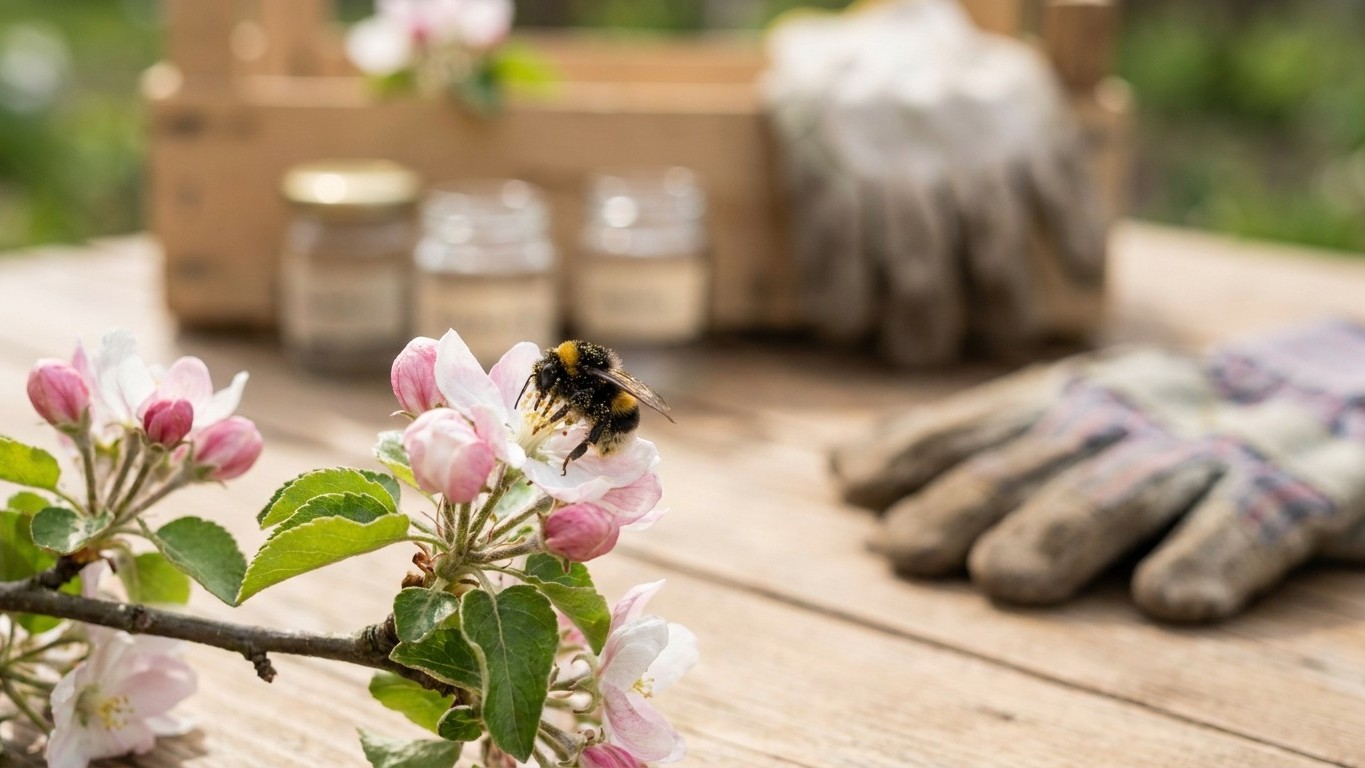

Your apple tree can flower beautifully all spring and still hand you an empty basket, and the reason is almost always the same: it needs pollen from a genuinely different variety blooming at the same time, since its own pollen can’t fertilize its own blossoms. So before you plant a second tree, or wonder why the one you have never sets fruit, go find out what bloom group it’s in. That single fact, checked now, decides whether next spring’s flowers turn into apples or just fall to the ground.
Why it matters
An apple tree can bloom heavily and still set no fruit. Most varieties are self-incompatible: their own pollen won’t fertilize their own flowers, so bees and other pollinators have to carry pollen in from a different variety before the blossoms turn into fruit instead of dropping. Get this wrong and you find out at the worst possible time, after a full season of watching flowers open and fall with nothing behind them.
The moment that decides it is bloom, the week or so when the flowers are fully open and pollinators are moving between trees. Everything before that, dormancy, green tip, pink, is the tree getting ready. Everything after, petal fall, is too late to fix a mismatch for that year. That’s why the variety pairing has to be sorted out at planting time, not once the trees are already in the ground and flowering past each other.
Clemson HGIC groups common apple varieties into three bloom bands, A, B and C, based on how early or late each one flowers relative to the others. Two varieties from the same group, or from adjacent groups, overlap enough to cross-pollinate reliably in most years. A pairing pulled from A and C, the two ends of the range, is the riskiest combination to plan around, since their bloom windows may barely touch.
Four widely planted varieties complicate this further. Jonagold, Mutsu, Stayman and Winesap carry sterile pollen. According to Clemson HGIC, the University of Georgia Extension (Circular 740) and USU Extension, each of these can be pollinated by a neighboring tree but cannot pollinate one in return; Jonagold pollination is a good illustration of this one-way limitation in practice, Stayman pollination follows the same one-way pattern and needs a compatible neighbor to bear fruit, and Jonathon pollination shows a similar pairing challenge worth checking before you plant, while Winesap pollination demonstrates the same one-way limitation on the fourth variety, and What Pollinates Mutsu, and What Cannot covers the same restriction for the third, and knowing What Pollinates Golden Delicious, and What Cannot helps if you’re pairing i, much as understanding What Pollinates Red Delicious, and What Cannot helps with another widely planted varietyt with one of these sterile-pollen varieties; Snapp Staymen pollination shows how a Stayman sport inherits this same sterile-pollen limitation, and looking at What Pollinates Autumn Crisp, and What Cannot rounds out the picture of how bloom-group mismatches play out across different varietiestation, and looking at What Pollinates Jerseymac, and What Cannot shows how a self-incompatible early-season variety fits into this same bloom-group logictation, and What Pollinates Rome Beauty, and What Cannot lays out the same one-way constraint for another popular varietytation, and What Pollinates Golden Supreme, and What Cannot is worth checking too before settling on a planting combinationtation, and What Pollinates Cameo, and What Cannot lays out a similar compatibility puzzle worth checking before you commit to a pairing, and looking at What Pollinates Akane, and What Cannot rounds out the picture of which varieties can give pollen and which can only receive ittation, and looking at What Pollinates Northern Spy, and What Cannot is worth doing as well, since it clarifies which varieties can serve as a reliable partner for a tree that is often mismatched by bloom timing alonetation, and What Pollinates Cortland, and What Cannot is worth checking too, since Cortland’s own bloom timing and pollen compatibility follow a different set of rules entirelytation, and What Pollinates Suncrisp, and What Cannot is worth checking too, since it lays out exactly which neighbors will and won’t get the job donetation, and What Pollinates Empire, and What Cannot lays out a comparable compatibility puzzle worth checking for that popular varietytation, and looking at What Pollinates Candy Crisp, and What Cannot helps clarify which neighbors can actually complete the job for a self-incompatible varietytation, and SnowSweet pollination offers another useful case for matching a compatible bloom-group partner before plantingtation, and looking at Yates pollination offers another useful comparison for how a compatible neighbor choice, and Sansa pollination is worth checking too when picking a partner tree for these one-way pollinators plays out, and Yellow Transparent pollination is worth checking too since it blooms early and needs the right partner nearby, and Priscilla pollination rounds out the picture with yet another variety-specific case worth checking before plantinganges the outcome. A garden holding only two of these four, with nothing else in bloom range, sets no fruit on either tree no matter how well their bloom timing lines up, and checking Ozark Gold pollination requirements can help you pick a reliable companion for the group. Other varieties bring their own quirks too; Arkansas Black pollination is a good example of a case where, and checking Mollie’s Delicious pollination requirements is equally worthwhile before settling on a pairing, and Sweet Sixteen pollination is another variety worth checking before settling on a pairing bloom timing alone doesn’t guarantee a reliable match, Crimson Crisp pollination has its own r, and Topaz pollination is worth checking as well before settling on a pairingequirements worth checking too, Braeburn pollination is another variety worth checking close, and Prima pollination follows similar rules worth reviewingly before you count on it as a match, Anna pollination follows its own set of rules as well, and Paula Red pollination is worth a look too before you settle on a pairing, as well, and Idared pollination is worth a look too before you finalize your pairingell, and Honeycrisp pollination is worth reviewing given how often it’s planted as a first treeell, and Granny Smith pollination is yet another case where checking bloom group and pairing in advance pays off, as well, and Gold Rush pollination is worth reviewing befoell, and Gala pollination is worth reviewing too before you finalize your pairingell, and Fuji pollination is well, and Fortune pollination is worth a look before you rely on it as a pairingell, and Earligold pollination is worth a look too before you finalize your pairingell, and McIntosh pollination is worth a quick check too since its bloom timing has its own considerations, well, and Lodi pollination is worth a look too before you finalize your pairingell, and Jonamac pollination is worth a look for the same reason, and Acey Mac pollination follows a similar pattern worth confirming before you rely on ie reason, and Ginger Gold pollination follows its own ear, and Zestar pollination is worth a look as wellly-season timing that’s worth confirming, and Dorsett Golden pollination is worth a look too, since it’s a common low-chill choice that gardeners often pair incorrectly.
When to do it
Bloom group only tells you the order varieties flower in relative to each other, never a date. Clemson HGIC’s groups shift earlier or later depending on the local climate, but a variety in group A blooms before a variety in group C wherever it’s grown. That relative order is the fact you can rely on. The actual week is something you read off your own trees each spring, not off a chart.
Reading the stage on the tree
The stages to watch, in order, are dormancy, green tip, pink, bloom and petal fall.
- Dormancy: bare wood, no green showing, buds tight and small.
- Green tip: the first sliver of green leaf tissue pushes out of the bud scales.
- Pink: unopened flower buds swell and show pink color before the petals separate.
- Bloom: petals are fully open and pollinators are moving between flowers.
- Petal fall: petals drop and small green fruitlets appear at the base of the flower.
Pollination happens only during the bloom stage. If your group A variety reaches full bloom and drops its petals before your group C variety even reaches pink, there was no overlap that year, whatever the catalog groups suggested on paper. This is more likely in a spring with a fast, warm run-up to bloom, which compresses the whole sequence and can widen the gap between an early and a late variety instead of narrowing it. Watching the actual stage on both trees, rather than assuming the printed group guarantees overlap, is the only way to confirm a pairing is working before you’re depending on it for a harvest.
How to do it

Match the bloom groups
Start with the variety you already have, or the one you most want to grow, and look up its bloom group. Clemson HGIC (1350) sorts common varieties into three groups:
| Bloom group | Varieties |
|---|---|
| A (earliest) | Anna, Dorsett Golden |
| B (mid-season) | Fuji, Gala, Ginger Gold, Granny Smith, Jerseymac, Mollie’s Delicious, Mutsu, Red Delicious, Yates |
| C (latest) | Arkansas Black, Golden Delicious, Jonagold, Ozark Gold, Priscilla, Rome Beauty, Stayman |
Pick a second variety from the same group or the one next to it. A group B variety paired with another group B selection, or with a group A or group C variety, has a good bloom overlap in most springs. Two varieties pulled from opposite ends, group A with group C, are the pairing most likely to miss each other in a compressed spring.
Check for sterile pollen before you commit
Look up whether either variety you’re considering is one of the four with sterile pollen: Jonagold, Mutsu, Stayman or Winesap. Per Clemson HGIC, UGA Extension (Circular 740) and USU Extension, each of these needs pollen from a different variety and cannot supply pollen back. If your planned two-tree planting is Jonagold and Stayman, both sitting in bloom group C at the same time, neither one can pollinate the other and you’ll get flowers with no fruit behind them. Add a third variety with fertile pollen from the same group, Golden Delicious or Rome Beauty, and the pairing works.
Plant for size and access
Tree size at maturity comes from the rootstock, not the variety, so a pollinizer tree can be a different size than your main tree without affecting pollination at all. USU Extension lists mature heights running from about 8-12 feet on M.9 up to 35-40 feet on a seedling rootstock, with M.26 and G.11 at 12-15 feet, G.30 and M.7 at 18-20 feet, M.106 at 25-30 feet and MM.111 at 30-35 feet. A full rundown of what each rootstock does to canopy size and root spread is worth reading before you decide where to place a second tree, covered in Apple Rootstocks: What Decides the Size of Your Tree. If space is tight, growing both varieties as an espalier against a wall or fence keeps two compatible varieties within a few feet of each other, which removes any question about pollinators reaching both trees during the same bloom window.
What goes wrong
Two sterile-pollen varieties, and nothing else
The most expensive mistake is planting only two trees, both drawn from the sterile-pollen list: Jonagold, Mutsu, Stayman and Winesap. The trees can look perfect at bloom, heavy with open flowers and full of bees, and still finish with almost no fruit. The damage doesn’t show until well after petal fall, when the fruitlets that should be swelling have dropped instead, and by then there’s no fixing that year’s crop.
Bloom groups that don’t actually overlap
A group A and a group C variety are compatible in the sense that either one can pollinate the other, but their bloom windows sit at opposite ends of Clemson HGIC’s range. In a spring that warms quickly, the early variety can finish blooming before the late one even reaches pink, and the overlap that exists on paper never happens on the tree. Group B varieties, sitting in the middle, make a safer bridge if you already own an A and a C selection and don’t want to remove either.
Buying a young tree without checking its bloom group at all is the other common version of this mistake. A nursery tag that lists a harvest month tells you nothing about bloom timing, and two varieties that ripen months apart can still bloom in the same week, or not.
Mistaking rootstock for a pollination fix
A dwarfing rootstock changes how tall the tree gets and how soon it starts fruiting, not whether it needs a pollinizer. Planting an M.9 tree at 8-12 feet next to a full-size seedling tree at 35-40 feet, both per USU Extension, still requires the two varieties to bloom at overlapping times. Size has no bearing on compatibility.
What changes where you are
The order of Clemson HGIC’s bloom groups holds everywhere apples are grown: a group A variety flowers before a group C variety whether the season is short and cool or long and mild. What moves is the calendar date attached to each stage, and how much time separates group A from group C in a given spring. A short, cool spring stretches that gap out, giving A and C more room to overlap even though they sit at opposite ends of the range. A fast, warm run-up compresses it and can close that overlap down to nothing.
Frost risk during bloom
Open flowers are also more vulnerable to a late freeze than the bud stages before them, and a freeze that hits during bloom can wipe out that year’s crop regardless of how well the two varieties are paired. How late that freeze risk runs, and how many chill hours a given winter reliably delivers, are both local figures that vary from one county to the next. Check your local extension service for the frost dates and chill-hour numbers specific to your area before you finalize a variety pairing, rather than relying on a bloom group chart alone.
The basics of siting and choosing rootstock and variety together are covered in Growing Apples, worth reading alongside the bloom group chart if you haven’t picked your first tree yet.
Common questions
Do I need two apple trees, or will one produce fruit on its own?
Most apple varieties need a second, different variety blooming nearby to set fruit at all. A lone tree, however healthy, typically blooms and drops its flowers without a pollen source from a genetically different variety.
Both of my trees are in the same bloom group. Is that a problem?
No, matching bloom groups is what you want, since it means the two varieties are likely to have their flowers open at the same time. The only exception is if both varieties happen to be sterile-pollen types, Jonagold, Mutsu, Stayman or Winesap, in which case matching timing still won’t produce fruit.
How far apart do the two varieties need to be planted?
Closer is generally better, since it puts less distance between the two trees for pollinators to cover on a single trip. There’s no single figure that applies everywhere, so check with your local extension service for guidance suited to your site and pollinator activity.
Does a wild or ornamental crabapple nearby count as a pollinator?
It can, if it blooms at the same time as your named variety, but you usually won’t know its bloom group unless it’s a documented cultivar. An unidentified seedling tree is a gamble rather than a plan, and it’s safer to pair your tree with a named variety whose bloom group you can actually look up.