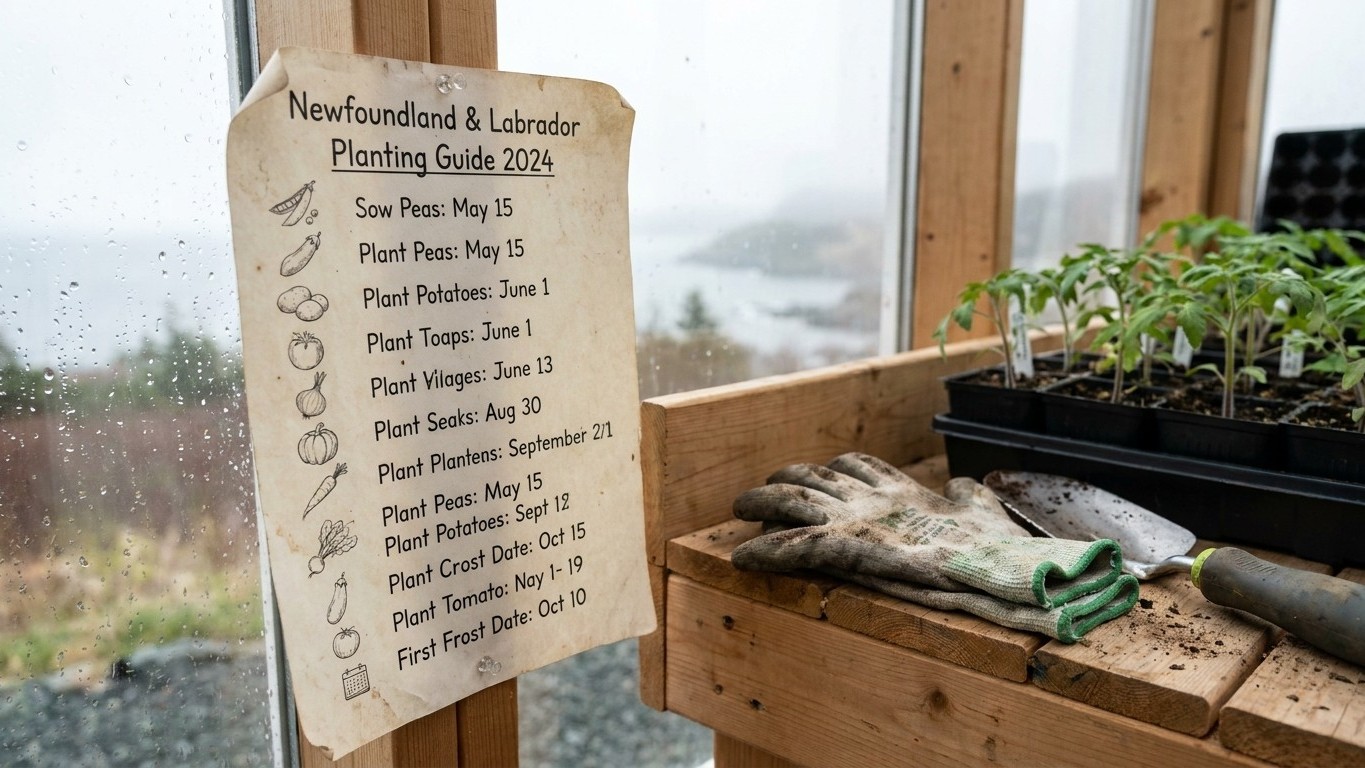

May 30 marks the average date the last spring frost lets go of St. John’s, but half the years on record push past it, sometimes well into June. That single date, paired with an October 17 average for the first fall frost, sets a frost-free stretch of roughly 140 days — generous by Newfoundland and Labrador standards, but still a mean, not a guarantee. What you plant, and when, depends on reading that gap correctly rather than trusting the calendar alone.
The frost window in Newfoundland and Labrador

Two dates anchor every planting decision in this province: the mean last spring frost and the mean first fall frost, both measured at St. John’s by Environment and Climate Change Canada’s 1981-2010 Canadian Climate Normals. At that station, the mean last spring frost falls on May 30 and the mean first fall frost falls on October 17. Subtract one from the other and the interval works out to about 140 days, the mean frost-free season at St. John’s, on the milder end of what the province experiences.
Treat May 30 as the midpoint of a window, not a finish line. Environment and Climate Change Canada’s figure is a mean date, not a probability threshold. In roughly half of the years in the 1981-2010 record, frost at St. John’s arrived after May 30, so a gardener who plants tender crops on May 31 every year will lose a seedling tray to frost about as often as not. The safer habit is to watch the extended forecast through the first two weeks of June and hold the last of the warm-season transplants back until a frost-free stretch looks settled, rather than counting down to a date on a chart.
The same caution runs the other direction in fall. October 17 is also a mean, so an early frost some years will arrive well ahead of it, especially inland or at higher elevation, and the frost-free season of about 140 days can run shorter than that in a cold year.
St. John’s sits on the Avalon Peninsula, moderated by the Atlantic, and its frost dates are the mildest reference point in the province. Move inland, north along the Northern Peninsula, or into Labrador, and the frost-free season shrinks: interior and northern districts see their last frost weeks later in spring and their first frost weeks earlier in fall than the Avalon coast does. No station-level figure for those districts appears in the federal normals used here, so treat the St. John’s dates as a starting point and adjust toward a shorter season the farther you garden from the coast. For guidance on easing into the season before that spring window opens, see What to Plant in Newfoundland and Labrador in March, for getting an early sta, and once that window arrives, see What to Plant in Newfoundland and Labrador in Mayrt once it does, see What to Plant in Newfoundland and Labrador in April, and once the season is in full swing, see What to Plant in Newfoundland and Labrador in June full swing, check What to Plant in Newfoundland and Labrador in July, or, for the indoor seed-starting work that comes even earlier in the season, What to Plant in Newfoundland and Labrador in February, and for the crops that suit the province’s coldest stretch once frost has settled in for good, see What to Plant in Newfoundland and Labrador in Decembert the later end of that frost-free stretch, see What to Plant in Newfoundland and Labrador in Augustt this transitional stretch, see What to Plant in Newfoundland and Labrador in September, and for what comes after the season closes out, What to Plant in Newfoundland and Labrador in January covers the start of the next planning cycle the frost closes in, What to Plant in Newfoundland and Labrador in November, and for a month-by-month breakdown of what comes next, see What to Plant in Newfoundland and Labrador in October, when the first fall frost typically closes out the season. Gardeners working an even shorter, colder season further north can see how that plays out in the Northwest Territories planting calendar, where the frost-free window narrows even further and nearly every crop is grown from transplant rather than direct seed.
Cool-season crops
Cool-season crops go into the ground while frost is still a real possibility, because they tolerate the cold that would kill a tomato seedling outright. Peas, spinach, lettuce, brassica transplants and most root crops belong on this list, and their timing is set relative to the mean last frost of May 30 at St. John’s, not to a fixed calendar date.
- Peas and fava beans: sow as soon as the soil can be worked, well ahead of the last frost, since it is germination that needs warmth, not the seedling.
- Spinach and lettuce: direct-sow or set out transplants while nights are still cool, since both bolt to seed once summer heat and long daylight set in.
- Brassica transplants (cabbage, broccoli, kale): start indoors and move hardened-off seedlings out ahead of the last frost, since a light frost rarely does more than nip the outer leaves.
- Root crops (carrots, beets, turnips): direct-sow into cool soil and thin once seedlings are established, rather than transplanting.
The reason these crops can go out before the frost window closes comes down to what frost actually damages. A hard freeze ruptures plant cells, and warm-season crops with soft, high-water tissue collapse. Cool-season crops carry tougher cell walls and more structural sugars in their leaves, so a light frost, the kind common through the earlier part of the window before May 30, causes cosmetic damage at worst. That tolerance is why working backward from the last frost date, rather than forward from a January seed catalogue, is the more reliable planning method: it tells you how much frost risk a given sowing date still carries, whichever crop you are planting.
Hardening off matters even for these cold-tolerant crops. A seedling raised indoors or under cover has softer growth than one that has spent a week outside in open air, so give brassica and lettuce transplants several days outdoors in filtered light before they go into open ground, even if you are planting them weeks ahead of the last frost. Carrots and beets skip this step entirely since they are sown directly where they will grow, and a second, smaller sowing of lettuce a few weeks after the first stretches the harvest before the summer heat pushes it to bolt.
Warm-season crops

Tomatoes, peppers, squash, beans and corn are killed outright by frost, so the mean last frost date is only the first hurdle. The bigger constraint is soil temperature: warm-season crops planted into cold, wet soil sit and rot rather than grow, even on a night with no frost risk at all. That is why the tomato transplant dates in the table below fall in mid-June, roughly two weeks after the mean last frost of May 30, giving the soil time to warm rather than marking a frost cutoff.
Counting back from the transplant date
Seed packets for tomatoes typically call for starting indoors six to eight weeks before the transplant date. Counting back from a mid-June set-out puts the indoor sowing window in late April to early May for most of the varieties below, though the exact week shifts with how warm your seed-starting setup runs. Peppers, which grow more slowly from seed than tomatoes do, are usually started earlier still, and both crops need consistent bottom heat to germinate reliably this early in the year.
Days-to-maturity figures on a seed packet are counted from the transplant date, not from seed, and they assume the steady warmth of an average season. A cool, cloudy August will push first ripe fruit later than the catalogue number suggests, so treat the figures below as a planning range rather than a fixed date.
| Variety | Days to Maturity | Set Out | First Ripe | Margin Before Oct 17 Frost |
|---|---|---|---|---|
| Sakura | 55 days, indeterminate | mid June | early August | about 71 days |
| Sun Gold | 57 days, indeterminate | mid June | early August | about 69 days |
| Supersweet 100 | 60 days, indeterminate | mid June | mid August | about 66 days |
| Juliet | 60 days, indeterminate | mid June | mid August | about 66 days |
| Amalfi | 68 days, determinate | mid June | mid August | about 58 days |
| Cherokee Purple | 72 days, indeterminate | mid June | late August | about 54 days |
| Big Beef Plus | 72 days, indeterminate | mid June | late August | about 54 days |
| Celebrity Plus | 78 days, determinate | mid June | late August | about 48 days |
| San Marzano II | 78 days, indeterminate | mid June | late August | about 48 days |
The margin column matters more here than in a longer-summer state. In a place like Idaho, where the frost-free season runs long enough to ripen almost any tomato with room to spare, a 78-day variety like San Marzano II is a routine choice. In Newfoundland and Labrador, the same variety leaves roughly seven weeks of margin before the mean first fall frost, workable but leaving far less room for a cool, late summer to eat into it. Shorter varieties such as Edox and Valentine, both 55 days from transplant like Sakura, or the determinate Glacier, carry more slack and are the safer bet for a garden that runs cooler than St. John’s.
Squash, beans and corn follow the same logic without a named cultivar list here: wait until both the frost risk has passed and the soil has warmed, then direct-sow rather than transplant where the crop resents root disturbance, as beans and squash generally do. Corn germinates poorly in cold soil in particular, and is worth delaying past the tomato transplant date rather than rushing in alongside it.
The fall planting window
Working backward from the mean first fall frost of October 17 at St. John’s, per Environment and Climate Change Canada, tells you the last safe date to start a fall crop rather than a date to stop gardening. Take the days-to-maturity printed on the seed packet, add roughly two extra weeks to account for the slower growth of shortening, cooler fall days, and count back from October 17 to find the sowing window.
That buffer matters more here than it would earlier in the season. A crop sown in July or August is growing into shrinking daylight, and growth that took a matter of weeks in June’s long, warm days can easily take half again as long in September’s shorter, cooler ones. Skipping the buffer is the most common way a fall planting calendar comes up short.
Crops that improve after a light frost
Several cool-season crops actually taste better after a touch of frost, because cold triggers the plant to convert stored starches into sugars as a natural antifreeze. Kale, brussels sprouts, carrots and parsnips all fall into this group, and gardeners who leave root crops in the ground under a layer of mulch past the first light frost, rather than rushing to pull them, are often rewarded with a sweeter harvest. This only holds for a light frost. A hard freeze that penetrates the ground will still damage or kill these crops, so the mulch is doing real work, not just tidying the bed.
Fast-maturing greens like spinach and lettuce, sown a second time in mid-to-late summer, can also fill the last weeks of the season before October 17, since their maturity time is short enough to fit even after the two-week buffer is subtracted. Brassica transplants set out for a fall crop, by contrast, need to go in earlier in summer given their longer time to maturity, so they are usually the first fall planting decision to make, not the last.
Reading a planting calendar properly
A provincial planting calendar built on one weather station is a starting point, not an instruction to follow blindly. The St. John’s frost dates describe one location on the Avalon Peninsula, and Newfoundland and Labrador is not one climate. Elevation, distance from the coast, and local terrain all shift the frost window in ways a single set of normals cannot capture.
What actually differs from yard to yard
A garden a few hundred feet higher than the valley floor around it will see frost, sometimes weeks, before a garden lower down, because cold air is denser than warm air and drains downhill overnight. Coastal fog and the moderating effect of the Atlantic push the Avalon’s frost dates later in spring and later in fall than inland districts see, while Labrador’s more continental climate runs on a shorter, colder season altogether. A paved yard in the middle of St. John’s, surrounded by asphalt and buildings that hold the day’s heat, often runs milder overnight than a rural garden a short drive away, which is one more reason a single station’s average will not match every yard it is applied to.
A late cold snap after what looked like a settled warm stretch is the single most common way a calendar-based planting date goes wrong. The fix is not a better calendar. It is a soil thermometer and a habit of checking the forecast rather than the date on a chart. Push a thermometer a couple of inches into the bed before setting out warm-season transplants, and keep a simple log of your own garden’s first and last frost each year. After two or three seasons, that log will tell you more about your specific plot than any provincial average can.
Local help
For county-level frost dates and soil testing tuned to your specific district, contact Newfoundland and Labrador’s Department of Fisheries, Forestry and Agriculture, the province’s extension service. Its staff can offer guidance particularly for Labrador and interior districts running well behind the Avalon Peninsula’s dates. Browse more Newfoundland and Labrador guides on this site for crop-specific advice once your local frost window is confirmed.
Common questions
Is May 30 a safe date to plant in Newfoundland and Labrador?
No. May 30 is the mean last spring frost recorded at St. John’s by Environment and Climate Change Canada, which means frost arrives after that date in roughly half of all years on record. Treat it as the middle of a window and wait for a settled, frost-free forecast before setting out tender transplants.
Does this frost date apply to Labrador too?
Not directly. The May 30 and October 17 dates come from the St. John’s A station on the Avalon Peninsula, and Labrador’s more continental climate runs a shorter, colder season with its own frost pattern. Contact the province’s Department of Fisheries, Forestry and Agriculture for district-level guidance if you garden in Labrador or another interior district.
Can I direct-sow tomatoes instead of starting them indoors?
It’s risky here. With a mean frost-free season of about 140 days at St. John’s, and less elsewhere in the province, direct-sown tomato seed rarely has time to reach fruiting size before the first fall frost, so starting seed indoors six to eight weeks before the mid-June transplant date is the more reliable approach.
Why do seed packets give a days-to-maturity number that doesn’t match my own harvest?
Catalogue figures assume steady, average warmth from the transplant date onward, and a cool or cloudy stretch will push the actual harvest later than the number on the packet. Use the figure to compare varieties and estimate a range, not to predict a specific ripening day.
What if I get a frost warning after I’ve already planted my tomatoes?
Cover them. A light bedsheet, row cover, or overturned bucket held off the foliage will usually protect a transplant through one cold night, though it won’t help against a hard, prolonged freeze. Uncover again the next morning once temperatures rise, since covers left on too long trap heat and can cook seedlings in direct sun.
Some gardeners layer an older custom on top of frost dates: planting by the moon, which we explain as almanac tradition, not fact.
Related guides
- Quebec Planting Calendar: When to Sow and Plant, Frost Dates Included
- Northwest Territories Planting Calendar: When to Sow and Plant, Frost Dates Included