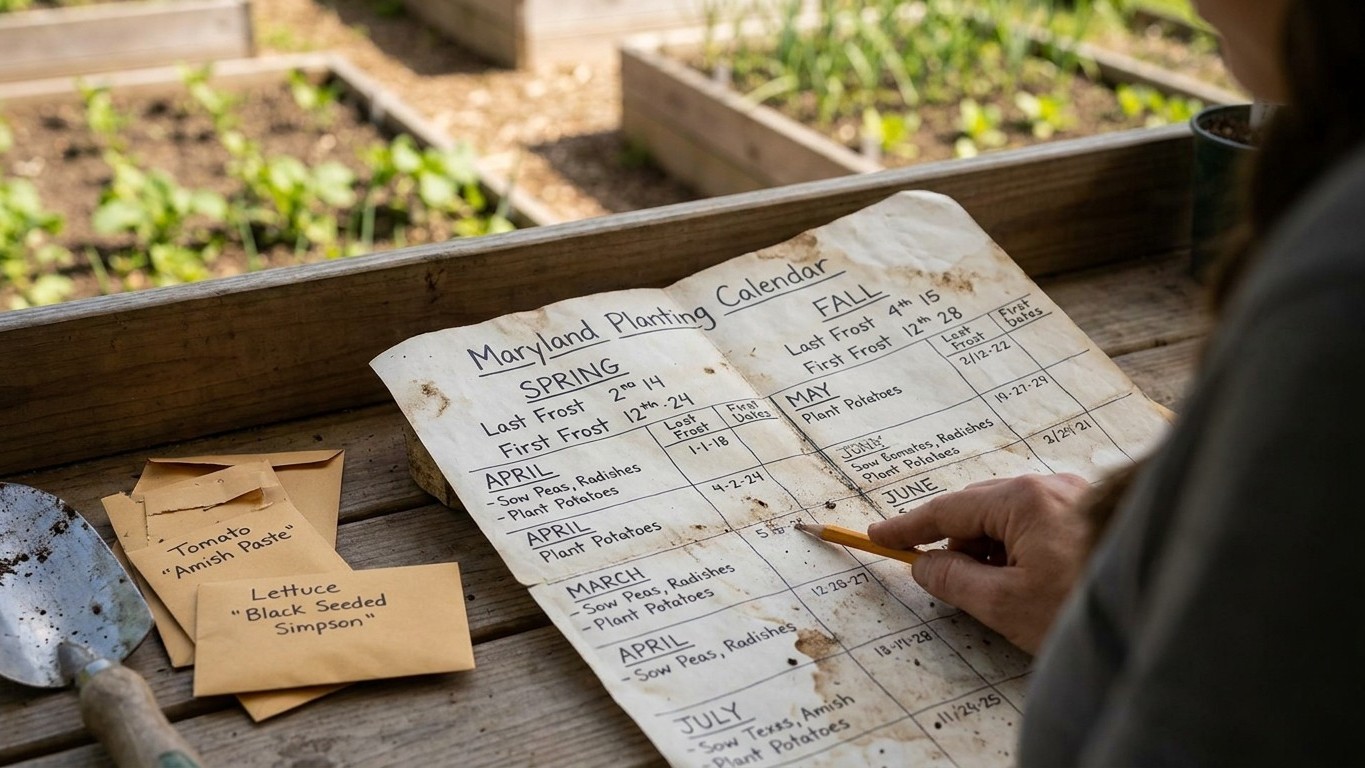

Maryland’s last frost isn’t one date — Baltimore’s runs anywhere from April 3 to April 16, and where you fall in that window depends on how your own yard has behaved the past few springs. That’s the number everything else in this state gets scheduled around: peas and spinach counting backward from it, tomatoes waiting a week or two past it — see What to Plant in Maryland in May for that stretch, and What to Plant in Maryland in June for the warm-season push that follows — and western counties or the Eastern Shore shifting it further still. So before you touch a seed packet, pick your target day inside that stretch based on your garden’s actual history, not the calendar’s average.
The frost window in Maryland

Every planting date in this state traces back to two numbers. NOAA’s NCEI 1991-2020 climate normals, measured at the Baltimore station, put the last spring freeze at April 3 to April 16 and the first fall freeze at October 26 to November 5. Those are 30 to 70 percent freeze-probability bands, not fixed calendar days, which is why they’re written as ranges rather than a single date. A late cold snap outside that window is still possible in any given year.
Do the arithmetic and Baltimore’s frost-free stretch runs somewhere between roughly 193 days (from the latest last frost, April 16, to the earliest first frost, October 26) and about 216 days (from the earliest last frost, April 3, to the latest first frost, November 5). That’s a long season by East Coast standards, long enough to grow a full round of cool-season crops, a full warm-season crop, and often a second cool-season planting in fall — see What to Plant in Maryland in February for the earliest indoor starts and cold-frame work, What to Plant in Maryland in August for keeping that momentum going through peak summer, What to Plant in Maryland in September for that late-summer transition, What to Plant in Maryland in October for that transitional stretch, What to Plant in Maryland in November for what the season looks like as it winds down, and What to Plant in Maryland in December for the dormant-season tasks that follow.
These figures are anchored to Baltimore and don’t hold everywhere in the state. Western Maryland, meaning Garrett and Allegany counties, sits at real elevation and runs its last frost weeks later in spring and its first frost weeks earlier in fall, which shortens the growing season noticeably compared to the numbers above. The Eastern Shore, by contrast, tends to run milder, with an earlier last frost and a later first one, stretching the frost-free window longer than Baltimore’s. Maryland’s growing season is also nowhere near as long as a warmer state’s: Mississippi’s planting calendar shows a frost-free stretch that runs months beyond Baltimore’s on both ends, while a northern state like Wisconsin’s planting calendar closes its own window much earlier in fall. Maryland sits in the middle of that spread, which is exactly why a calendar built for Ohio or Georgia won’t transfer here — planning actually starts well before the frost window opens, with What to Plant in Maryland in January covering the earliest indoor and prep work, What to Plant in Maryland in March picking up as the cool-season crops go in, and by midsummer the focus shifts to what’s covered in What to Plant in Maryland in July, and for the specifics of what actually goes in the ground once that frost window opens, see What to Plant in Maryland in April.
Cool-season crops
Cool-season vegetables tolerate a light frost, and several actually need cold soil to germinate well, so they go in the ground before the last frost date rather than after it. Peas and spinach are the classic direct-sown examples. Both can handle a frost that would kill a tomato seedling outright, and both germinate poorly once soil warms into the range warm-season crops prefer.
Timing peas, spinach, and roots
Work back four to six weeks from Baltimore’s last-frost window of April 3 to April 16, and direct sowing of peas and spinach lands somewhere in mid-February to mid-March, with the earlier end of that only realistic once the soil has thawed and can be worked. Carrots, beets, and radishes follow a similar logic: sow them three to four weeks before the last frost, since their germination is what’s slow in cold soil, not their frost tolerance once up.
Lettuce and brassica transplants, meaning broccoli, cabbage, and kale started indoors or bought as starts, generally go into the ground two to three weeks before the last frost, which for Baltimore’s range puts that transplant date somewhere in late March. Direct-sown kale and mustard greens can go in on roughly the same schedule as lettuce.
- Peas and spinach: direct sow four to six weeks before the last frost
- Carrots, beets, radishes: direct sow three to four weeks before the last frost
- Lettuce, broccoli, cabbage, kale transplants: set out two to three weeks before the last frost
All of these dates shift later by a couple of weeks in Garrett and Allegany counties, where the last frost itself runs later, and earlier by roughly the same margin on the Eastern Shore. If a stretch of unusually warm February weather tempts an early sowing, remember that the freeze probability NOAA reports for early April is still 30 to 70 percent, meaning a frost after that date is common, not exceptional.
Warm-season crops

Tomatoes, peppers, squash, beans, and corn are killed outright by frost, so the last-frost date is a floor, not a target. Soil temperature matters as much as air temperature here. Warm-season transplants set into soil that’s still cold from winter will sit and sulk, or rot outright, even if the air hasn’t dropped below freezing in weeks. Most gardeners in the Baltimore area wait one to two weeks past the last frost before setting out tomatoes and peppers, which lands the transplant window in mid to late April given NOAA’s April 3 to April 16 last-frost range.
Counting back for indoor starts
If you’re starting tomato or pepper seed indoors rather than buying transplants, count back six to eight weeks from that mid-to-late-April transplant target. That puts the seed-starting date somewhere in mid-February to early March, with the exact week depending on where in the transplant range you’re aiming and how quickly a particular variety germinates.
Squash, beans, and corn are usually direct-sown after the soil has warmed further, generally a bit later than tomato transplant time, since their seed rots in cold, wet soil rather than just sitting dormant.
Catalogue days-to-maturity figures are counted from transplant, not from seed, and they shift by a week or so with the weather in a given year. Here’s how several tomato varieties, all suited to a mid-to-late-April transplant date in the Baltimore area, line up against the fall frost window on the other end of the season:
| Variety | Days to maturity | Type | First ripe | Margin before fall frost |
|---|---|---|---|---|
| Sakura | 55 | Indeterminate | Late June | 124 days |
| Edox | 55 | Indeterminate | Late June | 124 days |
| Valentine | 55 | Indeterminate | Late June | 124 days |
| Glacier | 55 | Determinate | Late June | 124 days |
| Sun Gold | 57 | Indeterminate | Late June | 122 days |
| Supersweet 100 | 60 | Indeterminate | Late June | 119 days |
| Juliet | 60 | Indeterminate | Late June | 119 days |
| Amalfi | 68 | Determinate | Early July | 111 days |
| Cherokee Purple | 72 | Indeterminate | Mid July | 107 days |
| Big Beef Plus | 72 | Indeterminate | Mid July | 107 days |
| Tiren | 75 | Indeterminate | Mid July | 104 days |
| Granadero | 75 | Indeterminate | Mid July | 104 days |
| San Marzano II | 78 | Indeterminate | Mid July | 101 days |
| Celebrity Plus | 78 | Determinate | Mid July | 101 days |
All fourteen varieties finish with a comfortable margin before Baltimore’s first fall frost, which is why nearly any of them works in a Maryland garden as long as the transplant goes in on schedule. A shorter-season pick like Sakura or Edox simply gives you a longer harvest window and a second chance if a late frost or a cool, wet spring pushes your transplant date back.
The fall planting window
Fall planting dates are calculated backward from the first fall frost rather than forward from summer, and the arithmetic has one extra step that spring planting doesn’t need. Take the crop’s days to maturity, add roughly two weeks of margin because fall growth slows as daylight shortens and temperatures drop, then subtract that total from NOAA’s first-fall-frost window of October 26 to November 5.
Working the calculation
A fall broccoli or cauliflower planting that needs around nine to ten weeks from transplant to harvest, plus that two-week margin, needs roughly eleven to twelve weeks of growing time before the frost window opens. Counted back from October 26 to November 5, that lands the transplant date somewhere in mid-August, with the earlier end of that safer given how wide the freeze-probability band is. Fast crops like radishes, spinach, and lettuce have far more slack and can go in through September in most of the state.
Several crops actually taste better after a light frost touches them. Kale, collards, Brussels sprouts, and carrots left in the ground convert starches to sugars when temperatures drop, which is why a lot of Maryland gardeners deliberately leave a fall carrot bed unharvested until after the first freeze rather than rushing it in October. Spinach behaves the same way, turning noticeably sweeter once nights get cold.
Western Maryland’s earlier fall frost means all of these fall sowing dates need to move earlier by a couple of weeks compared to the Baltimore-based calculation above, while Eastern Shore gardeners generally get a few extra weeks of slack on the back end.
Reading a planting calendar properly
A state-wide calendar, including this one, is a starting point built from one weather station’s thirty-year average. It cannot know what your particular yard does. Elevation changes the picture more than almost anything else in Maryland: Garrett County’s mountains run a genuinely different climate from the Baltimore-Washington corridor, and even within a single county a low-lying field that collects cold air overnight will frost weeks earlier than a slope fifty feet above it.
Urban heat matters too. A rowhouse garden in Baltimore or a dense suburb tends to run a bit warmer than the open countryside NOAA’s station data represents, which can push the practical last frost a few days earlier than the official normal. None of that shows up in a single number, which is exactly why the NOAA figures on this page are given as ranges rather than dates. Read our broader Maryland guides for more on how the state’s geography splits into these different growing zones.
The most useful habit a gardener can build is watching their own ground instead of trusting the calendar alone. Push a soil thermometer into the bed where warm-season crops are going, check a ten-day forecast before committing tender transplants, and keep a simple log of the date of the last frost you actually saw each spring. After two or three years that log will tell you more about your own garden’s timing than any state-wide average can.
Local help
NOAA’s climate normals give you the state’s general shape, but county-level frost dates, soil test results, and locally adapted variety trials come from a closer source. The University of Maryland Extension keeps that data by county and runs a soil testing program that’s worth using before you commit to a fertilizing plan for the season. Find your county office and current recommendations at extension.umd.edu, and use it as the tie-breaker whenever this page’s Baltimore-based numbers don’t match what you’re seeing in your own yard.
Common questions
Is it too late to plant tomatoes if I missed the mid-April window?
No, tomatoes can go in through May and still finish well before Baltimore’s first fall frost of October 26 to November 5. A shorter-season variety like Sakura or Edox at 55 days from transplant gives the most cushion if you’re starting late.
Can I plant before the last frost date if the forecast looks warm?
You can for cool-season crops like peas, spinach, and brassica transplants, which tolerate a light frost. For tomatoes, peppers, and other tender crops, a warm stretch in March or early April is not a reliable signal, since NOAA’s own data puts a 30 to 70 percent chance of frost still occurring across that whole window.
Why did my seeds rot instead of sprouting?
Cold, wet soil is the usual cause, especially for squash, beans, and corn sown too soon after the last frost date passed on the calendar. These crops need the soil itself to have warmed, not just the air, so waiting an extra week or two after transplanting tomatoes is often the fix.
Does the planting calendar change for raised beds or containers?
Raised beds and containers warm up faster than ground soil in spring, sometimes by a week or more, so you can often push warm-season sowing slightly earlier than the in-ground dates on this page. They also cool faster in fall, which can shorten the tail end of the fall planting window.
What if I live in Western Maryland and these dates feel too early?
That’s expected. Garrett and Allegany counties sit at higher elevation and run both a later last frost in spring and an earlier first frost in fall than the Baltimore-based figures here, which shortens the whole season and shifts every date in this calendar later on the spring end and earlier in fall. Check with your local University of Maryland Extension office for numbers specific to your county.
Related guides
- Delaware Planting Calendar: When to Sow and Plant, Frost Dates Included
- Pennsylvania Planting Calendar: When to Sow and Plant, Frost Dates Included
- Mississippi Planting Calendar: When to Sow and Plant, Frost Dates Included