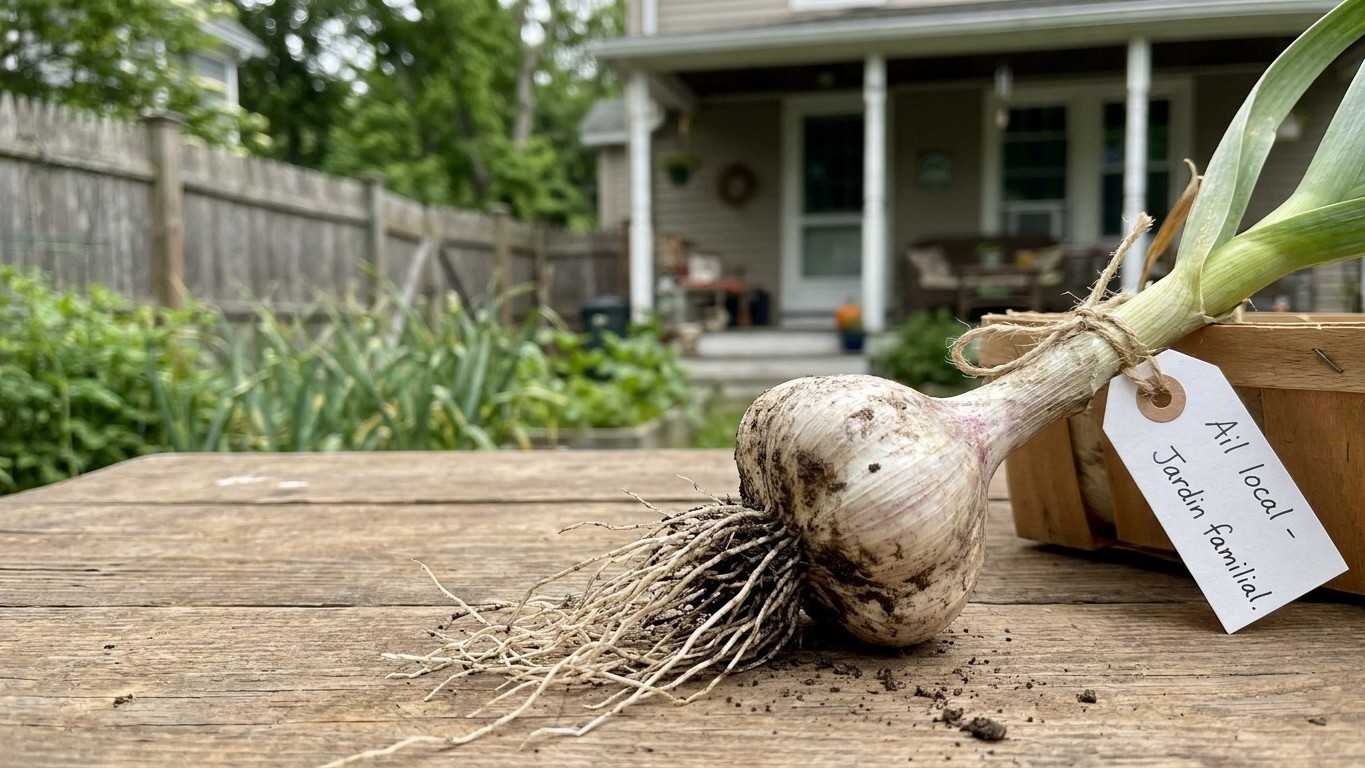

Six to eight weeks below 40°F — that’s the whole game. Garlic won’t split into cloves without a real stretch of cold sitting on it through winter, and a clove that misses that window just comes up as one round, undivided bulb come July. Connecticut isn’t in doubt here. Even Bridgeport, the mildest corner of the state, drops into that cold well before Thanksgiving and stays there for months, so the question isn’t whether your winter qualifies — it’s which variety and which planting week make the most of it.
Will garlic get the cold it needs in Connecticut

What the six-to-eight week threshold means
Garlic clove division runs on cold. A clove planted in fall needs a sustained stretch of chilling to trigger the split into individual cloves inside the bulb. Skip that step and the plant lifts one round, undifferentiated bulb the following summer instead of a proper head. University of Georgia Extension bulletin C854 lists the requirement at six to eight weeks with temperatures below 40°F, and that figure is the one to check any winter against before deciding what to plant.
Connecticut clears it. NOAA’s 1991-2020 climate normals put the first fall frost at Bridgeport, the mildest station in the state, between October 28 and November 10. That reading comes from a shoreline station on Long Island Sound, the warmest pocket of Connecticut weather. Once cold sets in even there, the state as a whole settles into a winter that holds well below 40°F for stretches measured in months rather than weeks from December onward, and inland and northwest Connecticut, which freeze earlier in fall and thaw later in spring than the shoreline, bank even more of that cold than the coastal figure implies. A gardener within sight of the Sound is working the state’s shortest, mildest winter and still clears the UGA threshold with room to spare, and checking When to Plant Garlic in Connecticut confirms just how much margin is available, margin that also shapes why growers rely on Garlic Varieties That Suit Connecticut Winters when deciding what to plant. A gardener in Litchfield County or the northern hills is nowhere near the margin.
If your seed cloves come up short
That means the two workarounds extension services suggest for growers short on chill, refrigerating seed cloves for several weeks before planting, or falling back on a softneck type bred for mild winters, are not something Connecticut needs as a matter of regional climate. Growers further south with genuinely marginal winters, such as those growing garlic in Delaware, lean on those workarounds routinely. Keep the option in your back pocket anyway. A bulb stored somewhere warm over winter, a bed tucked against a heated foundation wall, or one unusually mild season can still leave an individual planting short of chill in a way the regional average never predicts. If a bulb comes up round and undivided the summer after a mild winter, that is the diagnosis, and holding next year’s seed stock at 35-40°F for four to six weeks before planting fixes it without changing anything else about how the crop is grown. Buying seed garlic grown regionally, from a New England or upstate New York source rather than a warm-climate one, also keeps that chilling response intact from one generation to the next.
When to put the cloves in
Working back from the frost date
Anchor the planting date on the ground going cold, not on a spot on the calendar. NOAA’s 1991-2020 normals put the first fall frost at Bridgeport at October 28 to November 10, and that range, not a single date inside it, is the fact to work from. Garlic needs enough time in the ground before that freeze to grow roots, but not so much time that it pushes a lot of green top growth heading into winter. Cloves that root without much leaf are the ones that come through cold weather cleanest.
The set-out window for the varieties in this guide runs early October to mid October, which puts planting roughly three to five weeks ahead of the Bridgeport frost range. That gap gives roots time to establish in soil that is still workable while keeping top growth minimal before the freeze arrives. Inland and northwest Connecticut, where frost lands earlier than the coastal date, effectively shorten that gap unless planting also moves earlier, since the ground there starts cooling and locking up sooner than it does near the shoreline.
What shifts the window
A few things move this window from one garden to the next. Elevation matters: a hillside bed a few hundred feet higher than the valley floor cools faster in the evenings and holds frost pockets longer into the morning. Distance from Long Island Sound matters just as much, since the water moderates fall temperatures for towns close to the coast and that moderation fades quickly moving inland. A gardener on a north-facing slope or in a low frost pocket should plant toward the early end of the window; a gardener on a protected, south-facing bed near the shoreline has more room to plant later within it.
Which types suit Connecticut
Hardneck and softneck garlic split on winter cold, and Connecticut’s is real. Hardneck types need a genuine cold season to perform, and they reward it with a stiff central scape, larger and easier-to-peel cloves, and the complex flavors most cooks associate with good garlic. Softneck types tolerate mild winters, skip the scape, and store considerably longer in a pantry or root cellar. Since Connecticut’s winter comfortably clears the chilling threshold discussed above, this is hardneck territory, and most of the named varieties below reflect that. Softneck still has a place here for the storage life it offers, just not as the default choice.
| Variety | Type | Set-out window |
|---|---|---|
| Early Red Italian | Softneck | Early October to mid October |
| Inchelium Red | Softneck | Early October to mid October |
| Italian Late | Softneck | Early October to mid October |
| Lorz Italian | Softneck | Early October to mid October |
| Bavarian Purple | Hardneck | Early October to mid October |
| Blue Music | Hardneck | Early October to mid October |
| Chesnok Red | Hardneck | Early October to mid October |
| Duganski | Hardneck | Early October to mid October |
| Fall Festival | Hardneck | Early October to mid October |
| Georgian Crystal | Hardneck | Early October to mid October |
| Georgian Fire | Hardneck | Early October to mid October |
| German Red | Hardneck | Early October to mid October |
| German White | Hardneck | Early October to mid October |
| Ivan | Hardneck | Early October to mid October |
Hardneck varieties for real winters
Among the hardnecks, Duganski and German Red are the varieties most often chosen for straightforward cold hardiness and easy peeling, while Chesnok Red and Georgian Crystal are picked as much for flavor as for winter performance. Blue Music, Georgian Fire, Bavarian Purple, German White, Fall Festival and Ivan round out the hardneck list, and all share the same set-out window since none of them are being pushed against a chilling shortfall here.
Softneck varieties for storage
The softnecks, Early Red Italian, Inchelium Red, Italian Late and Lorz Italian, are worth a row for anyone who wants garlic on the counter into late winter rather than gone by January. They still go in on the same early to mid October schedule as the hardnecks. The trade-off is flavor and clove size rather than winter survival, since Connecticut’s winter suits either type.
Soil and bed preparation
Drainage comes first
Garlic sits in the same patch of soil from October through the following summer, and it spends the coldest months of that stretch doing nothing but sitting there with roots in the ground. Standing water is the fastest way to lose a garlic bed, well ahead of any disease, because a clove that sits waterlogged through a January thaw rots before spring growth ever starts. Raised beds or ridged rows solve this on heavy clay soils. A bed that puddles visibly after a hard rain needs correcting before cloves go in, not after.
Fertility and pH
Work compost or well-rotted manure into the bed a few weeks ahead of planting, giving it time to settle rather than sitting fresh against the cloves. Garlic wants loose, well-drained soil with a near-neutral pH, and a basic soil test through the local extension office will tell you where a given bed actually stands rather than leaving it to guesswork. Correct pH with lime or sulfur according to that test result, not a blanket rule, since soils vary widely from one Connecticut yard to the next.
- Clear the bed of the previous crop’s residue before amending it.
- Work compost in two to three weeks ahead of planting, not the same day.
- Test pH and correct it before cloves go in rather than after.
- Break up compacted subsoil under a raised bed so winter water has somewhere to go.
What the climate here favours, and what it does not
What stays in range
UC IPM’s Pest Management Guidelines for onion and garlic (UC ANR Publication 3453) list temperature ranges for the fungi and bacteria that trouble this crop, and those thresholds are worth checking Connecticut’s climate against. The thresholds are given as soil temperature, and soil lags air and swings less over the course of a month, so treat this as a tendency rather than a season-by-season forecast. White rot, caused by Sclerotium cepivorum, has a published range of 50-75°F, and Connecticut’s mean air temperature falls inside that range in five months of the growing season: September, October, May, June and July. Fusarium basal rot, caused by Fusarium oxysporum f. sp. cepae, has a published range of 59-90°F, and the state’s mean air temperature falls inside it in four months: September, May, June and July.
What stays out of range
Two other diseases stay outside their published windows here. Southern blight, caused by Sclerotium rolfsii, has a published optimum of 86-95°F, and no month of Connecticut’s growing season reaches a mean air temperature that high. Pink root, caused by Setophoma terrestris, has a published optimum of 75-85°F, and the same is true there. Neither of those figures means the disease is impossible, only that it runs less active outside its optimum. Both pathogens travel on infected sets and in contaminated soil regardless of climate, so buying clean seed stock and rotating beds away from prior onion or garlic ground still matters even where the temperature math is favorable.
Getting it through the winter
Mulch timing and depth
Lay mulch after the ground has cooled but before it freezes hard, once the cloves have had a few weeks to root but before deep cold sets in. A loose material, straw or shredded leaves, laid on thickly does two things: it slows the freeze-thaw cycling that heaves a shallow-planted clove up out of the soil over winter, and it buffers the sharpest cold snaps enough to protect the root system. A clove that gets heaved partway out sits exposed to drying wind and hard freezes it was never meant to face, and it rarely recovers cleanly even if you push it back down by hand.
Pulling mulch back in spring
Connecticut’s winter is enough to make this mulch layer worth the effort rather than optional. Gardeners in a genuinely harsher cold climate, the kind found growing garlic in Northwest Territories, deal with heave and winterkill on another order of magnitude and mulch accordingly heavier and earlier. Connecticut’s winter sits well short of that extreme, but it is far from mild enough to skip mulch altogether. Pull the mulch back, or thin it substantially, once new green growth pushes up in spring, since a thick mat over emerging shoots slows them down and holds excess moisture right at the point where rot gets started.
Harvest and curing here
Reading the leaves
Lift garlic by what the plant is telling you, not by a date on a calendar. The general signal across garlic varieties is that the lower leaves have gone brown and dry while several upper leaves are still green, since each leaf corresponds to a wrapper layer around the bulb and a plant stripped down too far in the leaves has already lost the wrappers that protect it in storage. Pull a test bulb or two and check that the cloves have filled out and separated distinctly before committing to a full harvest.
Curing in a humid summer
Connecticut summers run humid enough that curing takes real airflow, not just time. Bad curing loses a crop that survived the whole winter fine, because a bulb that goes into storage with moisture still trapped in its neck and wrappers molds from the inside out weeks later. Cure in a shaded, airy spot, a garage or open shed with a fan running rather than a closed room, and leave the bulbs with tops and roots intact for several weeks until the outer wrappers are fully papery and the necks have tightened down hard. Only then trim tops and roots and move the crop to storage.
Local help
County-level frost dates, local soil testing and variety trial results are all better sourced locally than from a single coastal weather station. UConn Extension (extension.uconn.edu) runs county offices across the state and can point you to a soil test kit and the closest thing to a local planting calendar for your specific town, which matters more the further you garden from the Long Island Sound shoreline.
Common questions
Can I Plant Garlic in spring instead of fall in Connecticut?
You can plant in spring, but expect small, undivided or poorly-formed bulbs, since the crop misses the fall-to-winter chilling period that triggers clove division and has far less time to bulk up before summer heat shuts growth down. Fall planting, in the early to mid October window discussed above, is the standard approach here for a reason.
What happens if I plant garlic too early in October?
Cloves planted at the very start of the window, or ahead of it, can push more top growth than is ideal before the ground gets cold, and that green growth is more exposed to hard freezes later in fall. It is rarely fatal on its own, but the plant is better off putting that early energy into roots instead of leaves.
Do I need to remove garlic scapes on hardneck varieties?
Cut the scape once it curls, on hardneck types like Duganski or Chesnok Red, since leaving it on redirects the plant’s energy into the scape rather than the bulb. Softneck varieties do not produce a scape at all, so this step only applies to the hardneck side of the list.
Can I use grocery store garlic as seed stock?
You can, but it is a gamble. Grocery garlic is often grown in a much milder climate, sometimes treated with a sprout inhibitor, and rarely labeled by variety, so you have no way to know whether it carries the chilling response and hardneck or softneck characteristics discussed above. Seed garlic sold specifically for planting, ideally grown in a similarly cold region, removes that uncertainty.
Why did my garlic come up as one round bulb with no cloves?
That is the classic sign of insufficient chilling. It usually traces back to seed stock that spent winter somewhere too warm, a planting site with unusual heat retention, or a genuinely mild winter, rather than to anything wrong with the planting technique itself.