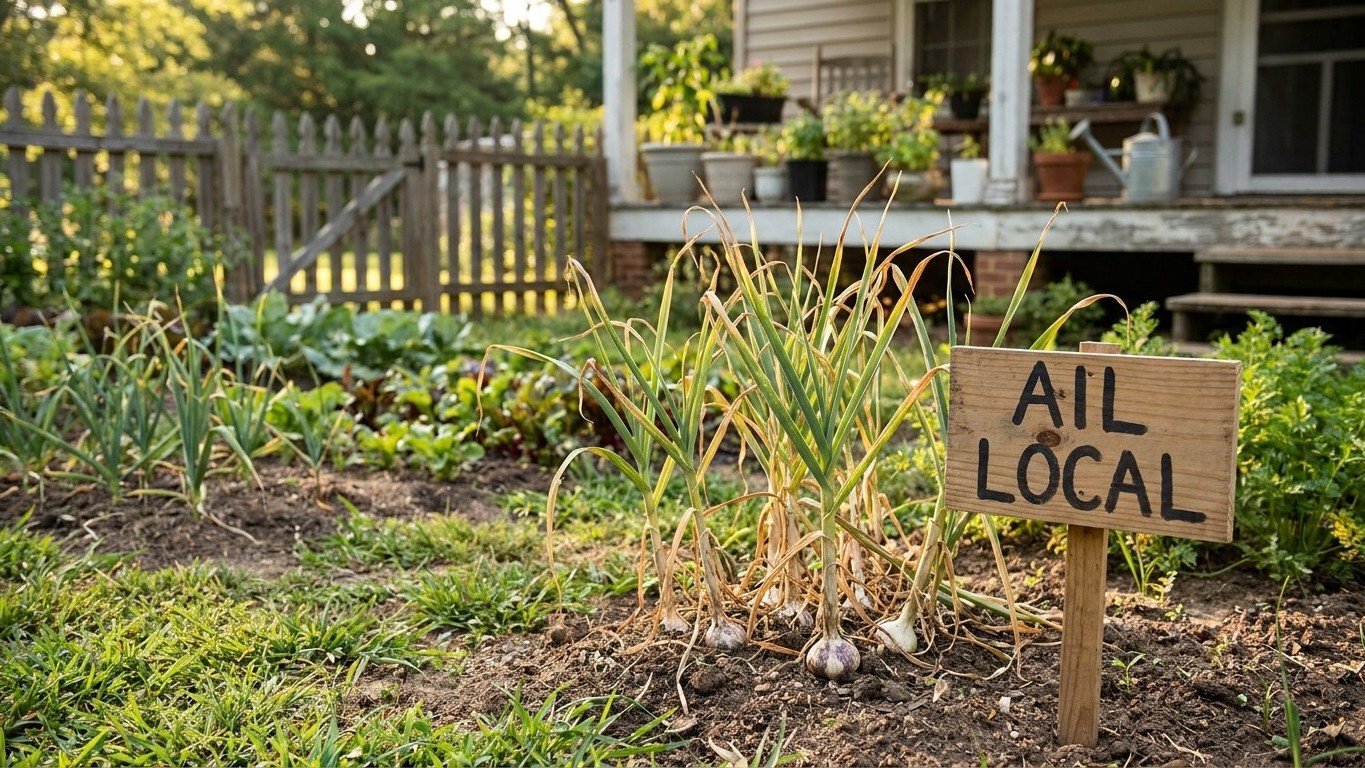

Alabama’s winters run too mild in most of the state for hardneck garlic to bulb the way it does further north, so softneck varieties like Inchelium Red and Lorz Italian are the more reliable choice for most gardens. NOAA’s 1991-2020 climate normals, measured at the Huntsville station, put the first fall freeze between November 2 and November 16, and garlic in this catalogue goes into the ground mid to late October so cloves can root before real cold arrives. Start with a softneck, get it in the ground before that frost window opens, and check your own county’s numbers before you commit to a date.
The short answer for Alabama

Garlic planted in autumn here is lifted the following summer, and the variety you choose in October decides how well it bulbs next June. Alabama’s winters are mild enough, especially south of the Tennessee Valley, that softneck varieties generally outperform hardnecks because they need less sustained cold to trigger clove division. Early Red Italian, Inchelium Red, Italian Late and Lorz Italian are the softnecks in this catalogue, and all four are set out mid to late October.
The hardnecks on the list, including Bavarian Purple, Blue Music, Chesnok Red, Duganski, Fall Festival, Georgian Crystal, Georgian Fire, German Red, German White and Ivan, share the same October set-out window but carry more risk in the state’s warmer counties, where winter may not deliver enough chilling for a full head to form.
All of these go in the ground mid to late October, which lands one to four weeks ahead of Huntsville’s NOAA-measured first freeze window of November 2 to November 16. That frost date is a midpoint, not a guarantee. In roughly one year out of two, the first freeze at Huntsville falls after November 16, and in the other half it falls before November 2. Planting on the early side of the October window gives roots more time to establish regardless of which way that year breaks.
| Variety | Neck type | Set-out window |
|---|---|---|
| Early Red Italian | Softneck | Mid to late October |
| Inchelium Red | Softneck | Mid to late October |
| Italian Late | Softneck | Mid to late October |
| Lorz Italian | Softneck | Mid to late October |
| Bavarian Purple | Hardneck | Mid to late October |
| Blue Music | Hardneck | Mid to late October |
| Chesnok Red | Hardneck | Mid to late October |
| Duganski | Hardneck | Mid to late October |
| Fall Festival | Hardneck | Mid to late October |
| Georgian Crystal | Hardneck | Mid to late October |
| Georgian Fire | Hardneck | Mid to late October |
| German Red | Hardneck | Mid to late October |
| German White | Hardneck | Mid to late October |
| Ivan | Hardneck | Mid to late October |
Working it out for your own garden
The Huntsville figures come from one weather station, and NOAA’s own normals data covers a single reporting point at that airport. If you garden anywhere else in Alabama, treat November 2 to November 16 as a starting reference and adjust from there, not as your actual planting deadline.
The arithmetic to redo at home
Start with your county’s own average first frost date, which your local extension office can usually supply more precisely than a statewide guide can. Then count backward to mid or late October, the catalogue’s set-out window for every variety in this list. If your county’s frost date sits close to Huntsville’s November 2 to November 16 range, that gives you roughly one to four weeks of root growth before the ground turns cold, depending on exactly where in each range you land.
If your frost date runs earlier than Huntsville’s, because you’re at higher elevation or further north, shift your own planting toward the early half of the October window rather than the late half. If it runs later, because you’re near the coast or a large body of water, you have more slack, but planting too early into still-warm soil isn’t free either, since it can push top growth before winter rather than root growth, which leaves the plant more exposed when a freeze does arrive. The planting calendar for Alabama garlic walks through this backward count in more detail if you want to work from your own county’s frost data instead of Huntsville’s.
Suburban and rural gardens typically see frost earlier in fall than the airport station does, often by one to two weeks, and more at elevation. A garden on a ridge or in a low frost pocket can run a full two weeks ahead of or behind a valley garden ten miles away. None of this shows up in a single climate normal, which is exactly why the Huntsville figure has to be treated as a reference point rather than a rule.
What changes across Alabama
North Alabama, including the Tennessee Valley around Huntsville and the higher ground of Sand Mountain, sits closer to the Appalachian foothills and tends to cool off earlier in fall than the rest of the state. This is the part of Alabama where hardneck varieties like German Red or Duganski have the best odds of getting the chilling they need.
Central Alabama, through the Black Belt and the Piedmont, runs milder than the Tennessee Valley but colder than the far south. This middle band is where the choice between softneck and hardneck matters most, since either can work depending on how a given winter plays out, but neither is a sure thing every year.
South Alabama, from the Wiregrass down to the Gulf Coast around Mobile, has the mildest and latest frosts in the state. This is the region where hardneck garlic is most likely to disappoint, because the sustained cold that triggers clove separation may simply not arrive most winters. Softneck varieties, and Inchelium Red in particular, tend to be the dependable choice this far south.
No single number covers all three regions at once. A grower in Baldwin County and a grower in Madison County are gardening in different climates even though both are in Alabama, and county-level extension data will always beat a state-level guess.
The mistakes this climate punishes
Chill deficit on hardnecks
The single most common failure in this state is planting a hardneck variety in a county that doesn’t get cold enough, long enough, to divide the bulb properly. The result is a head with only two or three oversized cloves instead of a full one. If you’re south of the Black Belt and want to try Blue Music or Georgian Crystal anyway, refrigerating seed cloves for several weeks before planting is the usual workaround, since it substitutes cold storage for cold ground.
Planting too late or too shallow
Garlic set out after Huntsville’s NOAA-measured frost window has less time to root before the ground turns cold, and a thin root system going into winter means a weaker plant coming out of it in spring. Planting too shallow compounds the problem in north Alabama especially, where freeze-thaw cycles through winter can heave a shallow clove partway out of the soil. A few inches of mulch after planting helps buffer that swing.
Disease risk from uncertified seed stock
Alabama’s fall and spring air temperatures line up with the ranges where two serious garlic pathogens are active, according to the University of California‘s IPM guidelines for onion and garlic, UC ANR Publication 3453. White rot, caused by Sclerotium cepivorum, has a published range of 50 to 75°F, and Alabama’s growing-season air temperature falls inside that range in six months of the year, September through November and March through May, including two months at the pathogen’s published optimum. Fusarium basal rot, caused by Fusarium oxysporum f. sp. cepae, has a published range of 59 to 90°F, which Alabama’s air temperature also falls inside for six months, overlapping September, October, April through July.
These are soil-temperature thresholds being compared against air temperature, and a monthly average hides a lot of day-to-day swing, so this is a measure of possibility, not a forecast of infection. Neither pathogen appearing in this range means your garden already has it. What it does mean is that planting uncertified garlic, including bulbs from a grocery store, is the way these pathogens usually arrive, and once white rot is established in a bed it can persist in the soil for years. Buying seed garlic from a supplier that tests for it is cheap insurance against a problem with no easy cure.
Checking this against your county
The Alabama Cooperative Extension System keeps county-level guidance that will match your own conditions more closely than a single statewide reference can, and it’s worth a call or a look at their site before you settle on a planting date. If you haven’t worked through the basics of the crop yet, Growing Garlic in Alabama covers that ground.
Common questions
Can I just plant garlic from the grocery store?
You can, but it’s a gamble. Grocery store garlic is rarely labeled by variety, isn’t bred or tested for disease, and is one of the more common ways white rot and Fusarium basal rot get introduced into a home garden bed.
What if I miss the October planting window?
You can still plant into November if you’re ahead of your local frost, but the later you go, the less time cloves have to root before cold weather slows growth. If your county’s frost date runs later than Huntsville’s November 2 to November 16 range, you likely have more room than a Huntsville-area gardener would.
Do I need to refrigerate hardneck garlic before planting in Alabama?
It helps, especially south of the Black Belt. Chilling seed cloves in the refrigerator for several weeks before planting can make up for a winter that doesn’t get cold enough for long enough to trigger proper clove division.
How deep should I plant the cloves here?
Deep enough that freeze-thaw cycles in a north Alabama winter don’t heave the clove out of the ground. A shallow planting is one of the more avoidable losses in this climate, and a layer of mulch after planting adds a buffer against those temperature swings.