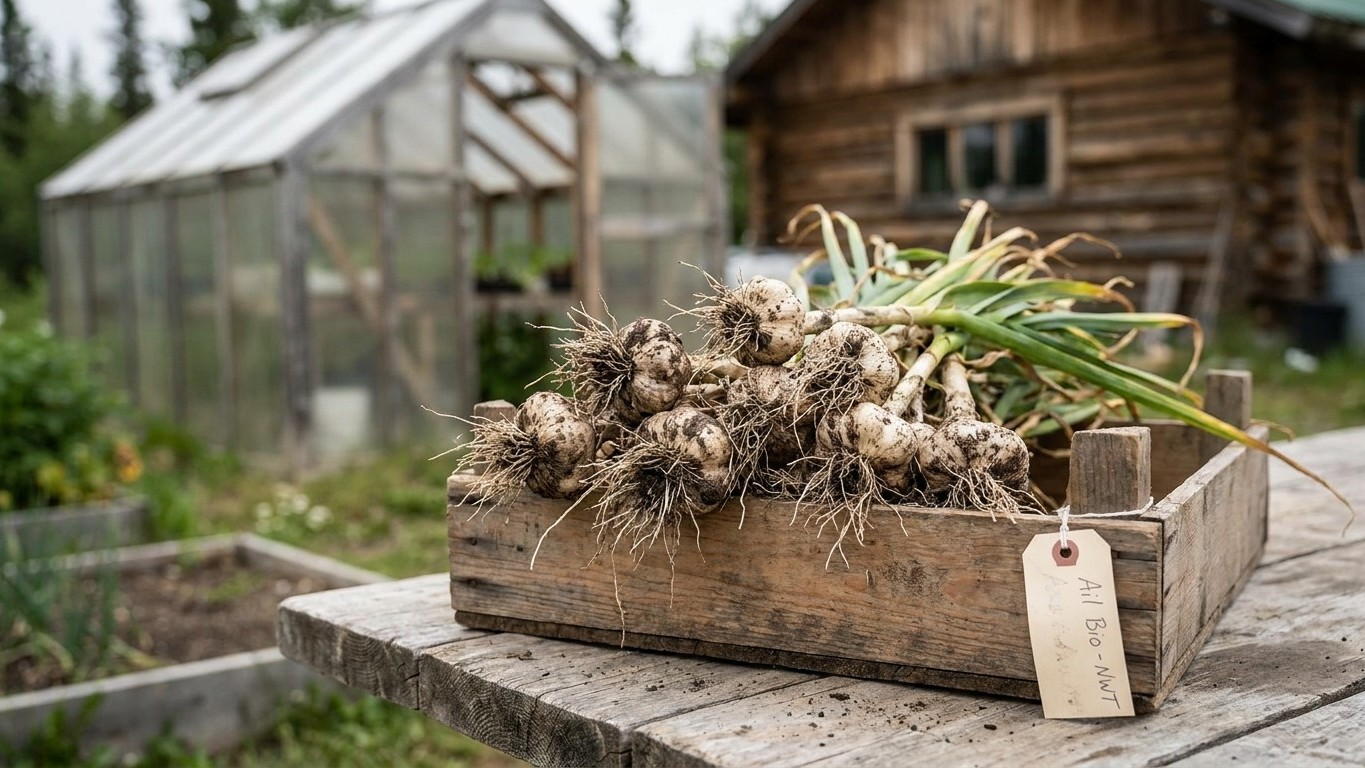

Garlic grows well in Northwest Territories, and the territory’s long, dark winter gives it far more chilling than it needs to split into cloves. Environment and Climate Change Canada’s 1981-2010 Climate Normals put the mean first fall frost at Yellowknife A on September 18, a date that only marks the start of a cold season running months longer than garlic’s minimum requirement. Get cloves into the ground several weeks before that date, mulch them heavily, and let the territory’s winter do the rest.
Will garlic get the cold it needs in Northwest Territories

Garlic is not like a tomato that just wants warmth. A clove planted in fall has to sit through a real cold spell before it will divide into a full head the following summer. Skip that cold, and the plant lifts one round, undivided bulb instead of the ring of cloves you were expecting. University of Georgia Extension publication C854 sets the benchmark growers use across North America: garlic needs roughly six to eight weeks with soil temperatures below 40°F to trigger that division, a requirement that shapes the Garlic Varieties That Suit Northwest Territories Winters growers choose to plant.
The vernalization math
Northwest Territories does not come close to falling short of that number, it overshoots it by a wide margin. Environment and Climate Change Canada’s Yellowknife A normals put the mean first fall frost at September 18, and that date is only the opening act. Once real cold sets in across the territory it holds for months, not weeks, long before spring thaw returns the soil to workable condition. A clove planted here in autumn is guaranteed far more chilling than the UGA threshold calls for, whatever corner of the territory it sits in.
Compare that with a place like Nova Scotia, where coastal winters run mild enough that some growers genuinely have to check whether their soil holds long enough below 40°F, a question covered in our Nova Scotia garlic guide. Growers there sometimes refrigerate cloves for several weeks before planting to fake a winter, or lean on softneck types bred to need less chill. Neither trick is necessary in Northwest Territories. The territory’s cold season never falls short of what garlic asks for, in Yellowknife’s immediate area or in the colder districts further from it. The real risk here runs the other direction: cold arriving on unrooted cloves before they’ve had a chance to establish, which is a timing problem, not a chilling one, and it’s the subject of the next section.
When to put the cloves in
Garlic planted too early pushes green top growth that a hard freeze then damages. Planted too late, the cloves never root before the ground locks up, and a clove sitting loose in cold soil all winter is far more likely to rot or heave out than one with an established root system underneath it. The trick is threading a narrow gap between those two mistakes, and When to Plant Garlic in Northwest Territories shows that gap sits ahead of the fall frost, not after it the way it does in milder climates.
Reading the frost window
Environment and Climate Change Canada’s 1981-2010 Climate Normals put the mean first fall frost at Yellowknife A on September 18. Treat that figure as a midpoint, never a safe date: by definition, in roughly one year out of every two, the actual first frost falls later than September 18, and in the other half it falls earlier. The catalogue set-out guidance for the varieties listed below in this territory is late August, which works out to roughly three weeks ahead of that mean frost date. That gap gives the clove time to put down roots into cooling soil while the ground is still workable, rather than waiting for the post-frost cooldown the way growers further south can afford to.
That window shifts with local geography. Communities at higher elevation or further from the moderating effect of open water should expect the ground to firm up sooner, and should lean toward the earlier edge of the window rather than the later one. A large body of water like Great Slave Lake holds heat into the fall and can lag the cooling of inland soil by days to a couple of weeks nearby, though Yellowknife’s own reading already reflects some of that lake effect. None of this changes the basic order of operations: plant while the soil still allows a spade to go in easily, not after it has started to resist one.
Which types suit Northwest Territories
Garlic splits into two broad camps, and the split matters more here than almost anywhere else in the catalogue. Hardneck garlic sends up a stiff central stalk, produces a curling scape you cut off in early summer, and generally wants a real winter to perform well. Softneck garlic skips the scape, braids easily, and tends to store for much longer in the pantry, which matters in a territory where fresh produce is not always close at hand.
Hardneck vs softneck at a glance
Northwest Territories’ winter plays to hardneck garlic’s strengths. The deep, sustained cold this territory delivers, well beyond what the crop’s vernalization requirement calls for, is exactly the condition hardneck types evolved under, and it tends to reward them with larger cloves and stronger scapes than they’d produce in a milder climate. Among the varieties in our catalogue, Bavarian Purple, Blue Music, Chesnok Red, Duganski, Fall Festival, Georgian Crystal, Georgian Fire, German Red, German White and Ivan are all hardnecks and all reasonable choices for this climate.
Softneck varieties still work here, and their far longer storage life is a real advantage in a place where the growing season closes early and the next fresh crop is a long way off. Early Red Italian, Inchelium Red, Italian Late and Lorz Italian are the softneck options in our catalogue, and all will divide properly under this territory’s winter cold, unlike in the mild-winter states where softneck is often the only safe bet. This is a different set of trade-offs than growers face in a high, dry climate like Colorado, where the choice between types leans more on summer heat and water than on winter cold, a contrast laid out in our Colorado garlic guide.
| Variety | Type | Set-out timing |
|---|---|---|
| Early Red Italian | Softneck | Late August |
| Inchelium Red | Softneck | Late August |
| Italian Late | Softneck | Late August |
| Lorz Italian | Softneck | Late August |
| Bavarian Purple | Hardneck | Late August |
| Blue Music | Hardneck | Late August |
| Chesnok Red | Hardneck | Late August |
| Duganski | Hardneck | Late August |
| Fall Festival | Hardneck | Late August |
| Georgian Crystal | Hardneck | Late August |
| Georgian Fire | Hardneck | Late August |
| German Red | Hardneck | Late August |
| German White | Hardneck | Late August |
| Ivan | Hardneck | Late August |
Soil and bed preparation
Drainage comes before anything else. A garlic clove sits in that bed through the entire winter and into the following summer, and standing water around it will rot the clove long before any disease organism gets involved. If your site holds water after rain or snowmelt, build a raised bed or mound the rows, especially where the soil sits over a shallow active layer above permafrost, a common condition across much of the territory that keeps water from draining away as deeply as it would further south.
Getting the bed ready
Work compost or well-rotted organic matter into the bed a few weeks before planting rather than the same day, so it has time to settle rather than leaving loose pockets around the clove. Avoid fresh manure at planting time. Fresh manure carries excess nitrogen that pushes soft top growth right before winter, which is the opposite of what a clove needs going into a freeze, and it can also introduce or feed soil pathogens that garlic is already exposed to.
Loosen the soil to a full spade’s depth so roots and the developing bulb aren’t fighting compacted ground, and rake out clumps and rocks so the bulb forms a clean, even shape rather than splitting around an obstruction. Garlic prefers a fertile, well-drained loam and does not tolerate soggy, heavy clay left unamended. If you’re not sure what you’re working with, a soil test through your territorial extension service, covered later in this article, will tell you more than guessing will.
What the climate here favours, and what it does not
UC IPM’s Pest Management Guidelines for Onion and Garlic, UC ANR Publication 3453, publish the soil temperature ranges that drive several major garlic diseases. Weighing Northwest Territories’ growing-season air temperatures against those published ranges gives a rough read on which diseases this climate tends to favor, though it’s an imperfect comparison worth stating plainly: those thresholds are soil temperatures, and the figures used here are air temperatures, and soil lags air by weeks and swings far less. A monthly average also hides a lot: a month that averages within a disease’s range still holds plenty of days on either side of it.
What the numbers show
- White rot (Sclerotium cepivorum): mean air temperature falls inside the published 50-75°F range in two months of the growing season, June and July, with one of those months landing at the pathogen’s published optimum.
- Fusarium basal rot (Fusarium oxysporum f. sp. cepae): mean air temperature falls inside the published 59-90°F range in one month, July.
- Southern blight (Sclerotium rolfsii): no growing-season month reaches the published 86-95°F optimum, so the disease runs less active here, not absent.
- Pink root (Setophoma terrestris): no growing-season month reaches the published 75-85°F optimum, again less active rather than ruled out.
None of this is a forecast, and it is not a reason to relax on sourcing clean planting stock. Both white rot and Fusarium basal rot can travel into a garden on infected seed garlic regardless of what the local climate does, and a cold territory offers no immunity against a pathogen introduced on a diseased clove. What the numbers do tell you is that Northwest Territories’ brief, cool summer gives white rot and Fusarium basal rot a narrower opening than a longer, hotter growing season would, and gives southern blight and pink root essentially no window at their preferred temperatures at all.
Getting it through the winter
Once the cloves are in and the bed is settled, mulch is what carries them from a cooling fall into a frozen winter without damage. Lay a thick, insulating layer of clean straw or hay over the bed once the ground has begun to cool but before it freezes solid, so the mulch traps the last of the soil’s warmth rather than sealing in cold air. In a territory where hard freeze follows the first frost quickly, waiting too long to mulch gives you a much narrower margin than gardeners further south have.
Mulch: when and how much
- Mulch generously right after planting, well before the ground locks up for the season.
- Keep the layer in place through winter rather than removing it once it’s down.
- Pull mulch back gradually in spring, once new growth is visibly pushing and the risk of it smothering shoots outweighs the risk of a late cold snap.
Heaving is the main failure mode mulch protects against: repeated freeze-thaw cycling can work a shallow-planted clove partway out of the soil, exposing it to drying wind and cold injury it wasn’t built to handle. Northwest Territories’ winter tends to run cold and sustained rather than cycling repeatedly through freeze and thaw the way a milder, more variable climate does, which reduces heaving risk somewhat, but a clove planted at a shallow depth is still vulnerable in the weeks before consistent snow cover sets in and takes over as natural insulation.
Harvest and curing here
Forget the calendar and watch the plant instead. Garlic is ready to lift when roughly half the leaves have died back and turned brown while the upper leaves are still green, not when every leaf has collapsed. Pulling too early means underdeveloped cloves with loose, papery wrappers that won’t store well. Waiting until the whole plant has browned off risks the bulb splitting open in the ground or the wrapper deteriorating to the point where the cloves separate and go moldy in storage.
Reading the leaves
Lift bulbs by loosening the soil with a fork rather than pulling on the stalk, which tends to snap the neck away from the bulb. Once out of the ground, cure the bulbs whole, with roots and tops still attached, in a shaded, dry space with good airflow for several weeks before trimming, cleaning or braiding them. A short, cool growing season like this one means there’s little slack at the back end. Get bulbs out of the field and into a dry curing space promptly once the leaves signal readiness, rather than leaving them in the ground hoping for a few more days of bulking, which risks losing the crop to an early fall cooldown right when curing conditions matter most.
Local help
County-level planting dates, frost variation across the territory and soil testing are all better answered locally than by any general guide. Northwest Territories’ Department of Industry, Tourism and Investment runs the territory’s agriculture services, and is the right first call for growers who want figures specific to their own community rather than to Yellowknife alone.
Common questions
Can I Plant Garlic in spring instead of fall in Northwest Territories?
You can, but expect smaller bulbs. Garlic planted in spring misses most of the cold period that triggers clove division, and the short growing season here doesn’t leave much time to make up the difference before the plant has to bulk up and mature. Fall planting, timed ahead of the first frost, is the reliable route in this climate.
Do I need to refrigerate my seed garlic before planting here?
No. Refrigerating cloves is a workaround growers in mild-winter climates use to simulate a cold period their soil won’t provide naturally. Northwest Territories already delivers far more cold than garlic’s vernalization requirement, so that extra step isn’t necessary here.
My garlic came up with green growth before winter. Is that a problem?
Some top growth before freeze-up is normal and generally survives under a good mulch layer. A lot of lush green growth usually points to planting too early or too much nitrogen going into the bed at planting time, and it does leave the plant a bit more exposed if a hard cold snap arrives before snow cover builds up.
How long will my garlic keep once it’s cured?
It depends on the type more than anything else. Softneck varieties like Inchelium Red or Lorz Italian generally outlast hardneck types in storage, which is one reason they’re worth growing here even though hardnecks suit the climate slightly better. Curing thoroughly before storage matters as much as the variety does.
Is white rot something I need to worry about in this climate?
It’s a real risk in the two warmest months of the growing season, June and July, when air temperatures sit within the range UC IPM publishes for the pathogen, but a cold climate offers no protection if the pathogen arrives on infected seed garlic. Buy clean planting stock and avoid replanting cloves from a bed with a history of stunted or yellowing plants.