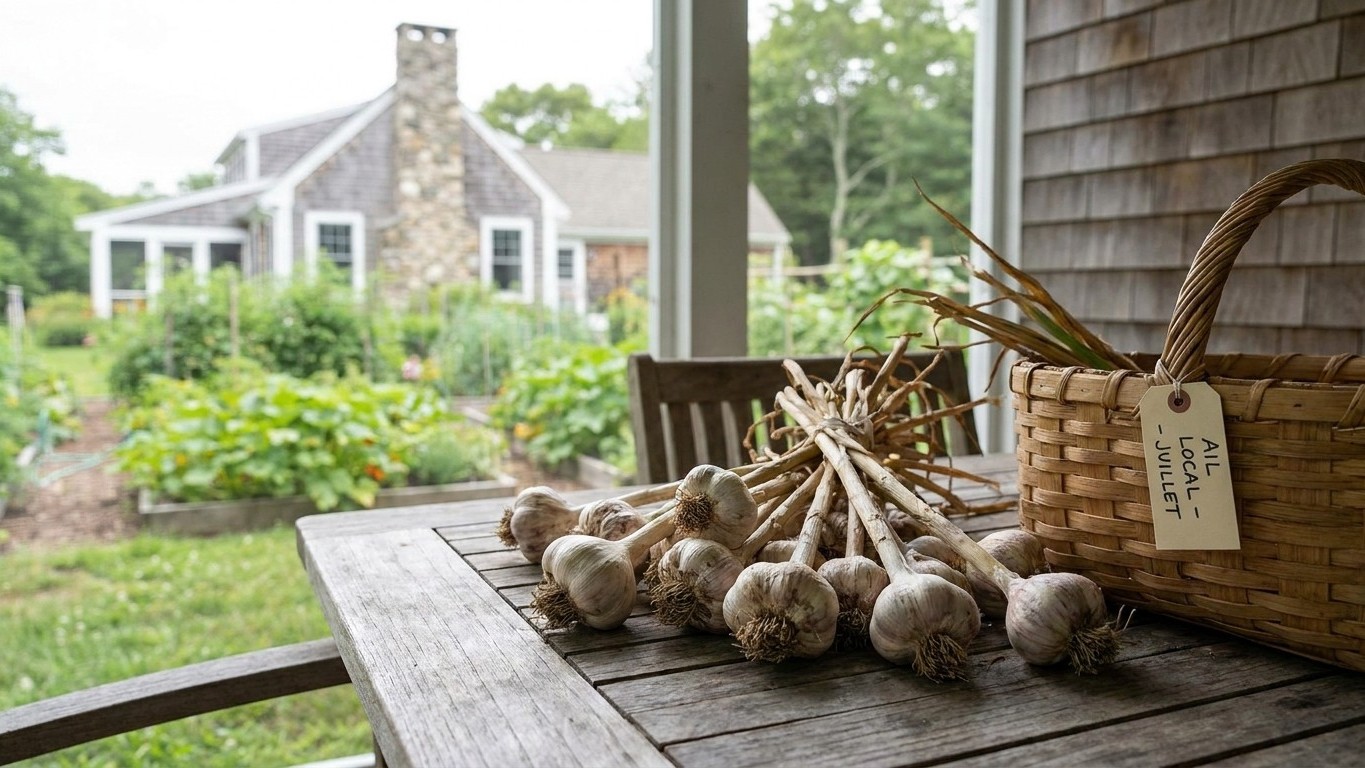

Rhode Island winters do something most gardening advice never mentions: they hand garlic far more cold than the crop actually asks for. A clove needs six to eight weeks below 40°F to split into a proper bulb instead of staying a single misshapen round. Kansas growers sometimes watch that threshold nervously. Here, the mean temperature sits below 40°F for over 26 weeks a year — triple the requirement, coast to inland. That surplus changes which decisions actually matter for this state.
Will garlic get the cold it needs in Rhode Island

Garlic is not like most vegetables you plant and wait on. A clove that misses its cold spell stays a clove. There is no internal split, no ring of separate cloves, just one round bulb at harvest that looks more like a shrunken onion than a head of garlic. University of Georgia Extension, in publication C854, sets the requirement at six to eight weeks with soil temperatures below 40°F after planting, before the plant can put that cold to use and divide.
How Rhode Island measures up
Rhode Island clears that bar without effort. NOAA’s National Centers for Environmental Information, using its 1991-2020 climate normals for the station near Providence, counts 26.1 weeks a year with mean temperatures below 40°F. That is more than three times the minimum garlic needs, and it holds even allowing for the difference between the airport thermometer and a garden a county or two away. Growers comparing states side by side will find useful context in growing garlic in Saskatchewan, where the cold arrives harder and earlier, and in growing garlic in Kansas, where some winters run close to the minimum garlic actually requires. Rhode Island sits well clear of that edge case, coast to inland.
That comfortable margin means the two usual workarounds, pre-chilling cloves in a refrigerator for six to eight weeks or falling back on a softneck type bred for mild winters, are not something this state needs for cold alone. Growers weighing which type to plant can consult Garlic Varieties That Suit Rhode Island Winters. The one situation where these workarounds still matter here is a mulch layer piled on too early and too thick, insulating the ground enough that cloves never feel the full cold snap they need. Wait until the ground has started to cool before mulching heavily, and Rhode Island’s ordinary winter does the rest of the job on its own.
When to put the cloves in
Anchor this on the first fall frost, not on a page of the calendar. NOAA’s 1991-2020 normals put the first fall freeze near Providence at October 24 to November 3, a nine-day range rather than a single date, and gardens outside the Providence area often see that first frost a week or two earlier, especially inland and at elevation. For a fuller breakdown of these dates by region, see When to Plant Garlic in Rhode Island.
Reading the window correctly
Garlic wants to go into the ground with enough time to root before the soil locks up, but not so much time that it pushes real top growth before winter arrives. In practice that puts planting for the varieties covered below in the early October to mid October window, roughly two to three weeks ahead of the frost midpoint. Cloves set in that window root through the remaining mild weeks, then sit quietly once the ground cools, with just a sliver of shoot showing by the time hard frost hits.
A few things push that window earlier or later than the reference date suggests. Coastal towns near Narragansett Bay, moderated by the water, tend to hold their first frost later than the Providence figure. Inland valleys and higher ground, including parts of northern and western Rhode Island, cool faster and can see frost arrive at the early edge of NOAA’s range or ahead of it. If you garden on a hillside or in a known frost pocket, lean toward the earlier half of the October planting window rather than the later half.
Planting too early is the bigger risk in this climate, more than planting a little late. A clove that pushes several inches of green growth before winter locks up spends stored energy on leaf tissue that then dies back in a hard freeze, leaving less in reserve for spring. A clove planted right at the edge of the window roots just enough to anchor itself, then waits.
Which types suit Rhode Island
Hardneck garlic needs real winter to perform. It wants a stretch of hard cold to trigger clove formation, and it sends up a scape in early summer that a softneck never bothers with. Softneck garlic tolerates a wide range of winters, mild or cold, and makes up for its lower demands with braidable stems and a longer shelf life in storage. Given the margin NOAA’s data shows for winter cold in this state, hardneck is not a gamble here. This climate favors hardneck over softneck, since Rhode Island’s cold season runs well past what a hardneck bulb needs to split.
Where softneck still earns a place
That does not rule softneck out. A grower who wants garlic that keeps into late winter, or who plans to braid a harvest for market or gifting, has good reason to plant softneck varieties instead, and the state’s cold is in no way wasted on them either. Both types on the approved list here go in the ground on the same early October to mid October schedule, calculated from the same frost window discussed above.
- Hardneck: Bavarian Purple, Blue Music, Chesnok Red, Duganski, Fall Festival, Georgian Crystal, Georgian Fire, German Red, German White, and Ivan.
- Softneck: Early Red Italian, Inchelium Red, Italian Late, and Lorz Italian.
Within the hardneck group, growers who want a stronger, more complex flavor for roasting tend toward purple-stripe types like Chesnok Red and German Red, while porcelain types such as German White and Georgian Crystal keep a little longer in storage than most other hardnecks, though still nowhere near a softneck’s shelf life. Among softnecks, Inchelium Red is an artichoke type known for a milder flavor, and Lorz Italian is prized for a large bulb size. None of these traits change the planting date. All of them go in during the same early to mid October window this climate calls for.
Soil and bed preparation
Garlic spends eight or nine months in the ground here, through freeze, thaw, and the wet stretches in between, so drainage matters more than fertility at planting time. A bed that holds standing water after a fall rain will rot cloves over the winter long before white rot or any other disease gets the chance. If your soil is heavy clay, build a raised bed or at least a mounded row, a few inches above grade, before you plant.
Work compost or well-rotted manure into the bed two to four weeks ahead of planting, giving it time to settle and start feeding the soil rather than sitting as a raw layer against the cloves. Clear the bed of the previous crop’s roots and any allium volunteers from past seasons, since leftover onion or garlic plants can carry over the same soil pathogens discussed below.
Testing before you plant
A soil test taken in late summer, ahead of the October planting window, gives lime or other amendments time to take effect before the cloves go in. Garlic tolerates a range of soil pH but does best in soil that is neither strongly acidic nor alkaline. Rather than guess, send a sample through the University of Rhode Island’s Cooperative Extension, discussed in more detail below, so any correction has weeks to work into the soil before planting.
Plant cloves root-down, about two inches deep, spaced roughly six inches apart in rows a foot or so apart. Depth matters as much as spacing in this climate: a clove set too shallow is the one most likely to heave out of the ground during a winter freeze-thaw cycle, a problem covered in the mulch section below.
What the climate here favours, and what it does not
UC IPM’s guidelines for onion and garlic, UC ANR Publication 3453, publish the temperature ranges that let four major garlic diseases develop, and comparing those ranges against the mean air temperatures Rhode Island’s growing season actually sees shows where the real pressure lies. One caution up front: UC IPM’s published thresholds are soil temperatures, and the figures below are air temperatures, which lag and swing less than the air above them. A month with the right average air temperature is a tendency toward disease pressure, not a diagnosis.
Reading the disease table
| Disease | Pathogen | Published range | Months in range here (Sept-July) |
|---|---|---|---|
| White rot | Sclerotium cepivorum | 50-75°F | 5 months (Sept, Oct, May, June, July), 1 at optimum |
| Fusarium basal rot | Fusarium oxysporum f. sp. cepae | 59-90°F | 3 months (Sept, June, July) |
| Southern blight | Sclerotium rolfsii | 86-95°F (optimum) | 0 months in optimum |
| Pink root | Setophoma terrestris | 75-85°F (optimum) | 0 months in optimum |
White rot is the one to watch most closely in this climate. Its published range overlaps five months of the growing season, the shoulder months of fall as well as spring and early summer, including one month that lands right at the pathogen’s optimum. Fusarium basal rot has a narrower overlap, three months, mostly at the edges of the season. Neither count means the disease is present in your soil. Sclerotium cepivorum and Fusarium oxysporum survive as resistant structures in soil for years and only cause a problem once introduced, most often on infected seed stock.
Southern blight and pink root are the better news here. Neither reaches its published optimum temperature during any month of Rhode Island’s growing season, going by these mean air figures, which means both are less active in this climate than they would be somewhere with hotter summers. Less active is not the same as impossible: both pathogens can still turn up in infected planting stock or soil moved in from elsewhere, and a cool climate does not disinfect a bed. The practical takeaway is to buy clean seed garlic from a source that inspects for these pathogens, and to avoid planting garlic or onions in the same bed year after year regardless of what the temperature count suggests.
Getting it through the winter
Mulch timing
Mulch is what keeps a shallow-planted clove in the ground and an unmulched one from heaving out of it. Once the soil has cooled and taken its first hard frost, lay down a loose four to six inch layer of straw or shredded leaves over the bed. Laid earlier, that mulch traps warmth the clove needs to lose in order to complete its cold requirement, the same mistake described above. Laid too late, after the ground has already frozen solid, it does little good for a season that has already started.
Why cloves heave, and how to stop it
Freeze-thaw cycles, not the deep cold itself, are what push cloves out of the ground over winter. Each time the soil surface freezes and thaws, it expands and contracts, and a clove sitting shallower than the recommended two inches can walk its way upward until part of it sits exposed to the air. An exposed clove tip dries out and is far more vulnerable to winter injury than one still covered by soil and mulch. Mulch buffers that freeze-thaw cycling by keeping the soil surface at a steadier temperature than open ground would hold.
Pull the mulch back partway once the ground has thawed for good in spring and the first green shoots are visible, but do not remove it entirely. A thinner layer left in place through spring keeps weeds down and holds soil moisture as the plant puts on the bulk of its growth. Pulling every scrap of mulch away exposes bare soil to spring weed germination that then competes directly with the garlic for the rest of the season.
Harvest and curing here
Lift garlic by what the leaves are doing, not by a date on the calendar. When the lower third to half of the leaves have browned and dried while four to six leaves up top are still green, the bulb has stopped sizing up and is ready to come out of the ground. Pulling too early leaves cloves undersized with underdeveloped skins. Waiting too long, past the point where nearly all the leaves have died back, risks the bulb splitting its wrapper open in the ground, which cuts its storage life sharply.
Curing in a humid summer
Rhode Island’s growing season runs humid enough by midsummer that curing takes real airflow, not just time. Hang or lay bulbs, roots and tops still attached, in a shaded spot with a fan or strong cross-breeze rather than a still, damp shed. Good airflow matters more than warmth during curing: a hot, stagnant space encourages mold on the outer wrapper before the inner layers have finished drying, and mold at this stage can ruin a bulb that survived the whole growing season without trouble.
Curing generally takes a few weeks before the necks are fully dry and the wrappers have tightened down around the cloves. Only trim roots and tops, and move bulbs to storage, once the neck feels dry and papery all the way through rather than soft or green. A bulb stored too soon, while any moisture remains in the neck, is the most common way a good harvest goes soft in storage a month or two after it looked perfectly cured.
Local help
County-level frost dates, soil test results, and current disease advisories all vary across a state as geographically mixed as Rhode Island, from the coast around Narragansett Bay to the hills of the northwest corner. The University of Rhode Island Cooperative Extension is the right first call for a soil test kit, a planting calendar adjusted to your specific town, and current pest alerts for alliums. Bring your bed’s history with you, especially whether onions, garlic, or other alliums have grown there before.
Common questions
Can I Plant Garlic in spring instead of fall in Rhode Island?
Not with any real success. Garlic planted in spring misses the long cold stretch it needs to divide, so you end up with a single round bulb rather than a head of cloves. Treat garlic as a fall-planted, summer-harvested crop here and order seed garlic well ahead of the October window.
What if I miss the October planting window?
Get cloves into the ground as soon as you can rather than waiting for next year. A clove planted later than mid October still roots and overwinters in most seasons, it just has less time to establish before the ground cools, so plant a little deeper and mulch a bit heavier than you would for an on-time planting.
Do I need to cut the scapes off my hardneck garlic?
Yes, if you want the largest possible bulb. Hardneck varieties send up a curling flower stalk, the scape, in early summer, and cutting it once it curls redirects the plant’s energy into bulb size instead of that stalk. The cut scapes are also edible, with a mild garlic flavor good for cooking.
Can I grow garlic from bulbs bought at the grocery store?
You can, but it carries more risk than buying certified seed garlic. Grocery garlic is often treated to prevent sprouting, may not be suited to a Rhode Island planting date, and carries an unknown disease history, which matters given how long soil pathogens like Sclerotium cepivorum can persist once introduced. Certified seed garlic from a known grower costs more per clove but avoids all three problems.
Why did my garlic come up as one round bulb instead of separate cloves?
That bulb never got the cold it needed to split, most likely from mulching too early, planting too late for the ground to cool properly before deep winter, or storing seed garlic somewhere too warm before planting. Given how far Rhode Island’s winter cold exceeds the minimum garlic requires, this is almost always a timing or mulching issue rather than a climate one.