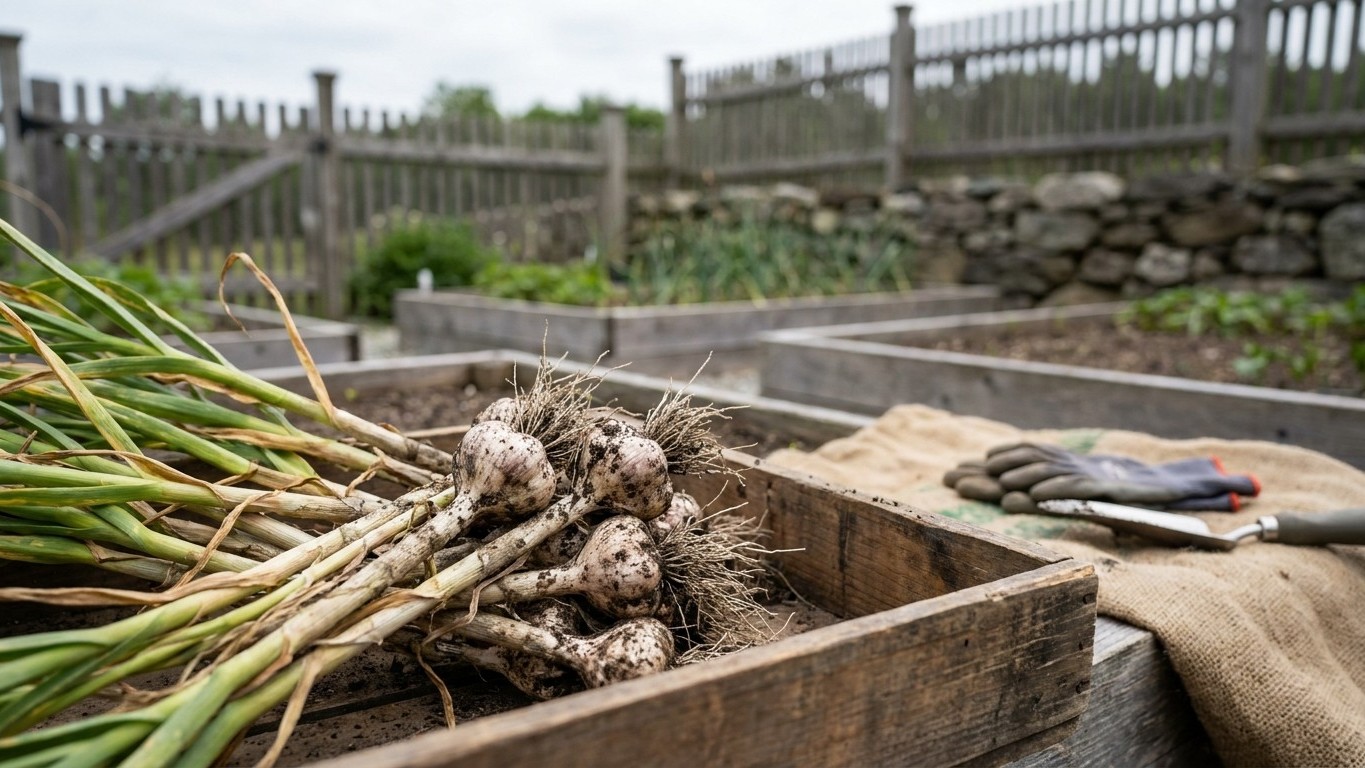

Mid to late September is the planting window that matters in Maine, whether you’re tucking in softneck or hardneck cloves. That range isn’t arbitrary — it’s counted backward from Portland’s first fall frost, which NOAA’s climate normals place somewhere between October 9 and October 21, a probability band rather than a hard deadline. Garlic tops laugh off frost. What they can’t do is grow roots once the soil goes cold, so those September weeks are really about banking underground growth before the ground shuts down for winter.
The short answer for Maine

Plant Garlic in Maine from mid September to late September. That’s the set-out window for every cultivar in the list below, softneck and hardneck alike, because the timing question in this climate isn’t about which variety needs more or less cold. It’s about giving roots enough time to grow before the ground freezes solid.
The window is anchored on the first fall frost, and Portland’s is the only local figure firm enough to cite here. NOAA’s 1991-2020 climate normals put it between October 9 and October 21, a range built from the years when a 32°F freeze had somewhere between a 30 and 70 percent chance of occurring on any given day. That’s not a switch that flips on a fixed date. It’s a probability band, and the midpoint of it is not a safe date to plan around. In one year out of two, the first freeze at that station lands later than the range suggests, sometimes well into November.
Garlic tops shrug off a light frost, so the September window isn’t about beating the freeze itself. It’s about getting cloves rooted, ideally with a little top growth showing, before soil temperatures drop far enough to stop root activity for the season. Mid to late September in Portland’s climate leaves roughly two to five weeks before that October frost window opens, which is the margin that matters. For the full lineup and where each variety fits your kitchen, see Garlic Varieties That Suit Maine Winters.
| Variety | Type | Set-out window in Maine |
|---|---|---|
| Early Red Italian | Softneck | Mid September to late September |
| Inchelium Red | Softneck | Mid September to late September |
| Italian Late | Softneck | Mid September to late September |
| Lorz Italian | Softneck | Mid September to late September |
| Bavarian Purple | Hardneck | Mid September to late September |
| Blue Music | Hardneck | Mid September to late September |
| Chesnok Red | Hardneck | Mid September to late September |
| Duganski | Hardneck | Mid September to late September |
| Fall Festival | Hardneck | Mid September to late September |
| Georgian Crystal | Hardneck | Mid September to late September |
| Georgian Fire | Hardneck | Mid September to late September |
| German Red | Hardneck | Mid September to late September |
| German White | Hardneck | Mid September to late September |
| Ivan | Hardneck | Mid September to late September |
Working it out for your own garden
The mid-to-late-September window works for a garden near Portland, since that’s where NOAA’s climate normal is actually measured. This assumes you already have a bed prepped and cloves separated, steps covered in Growing Garlic in Maine. Redo the arithmetic below for your own site rather than borrowing Portland’s date outright.
Counting back from your own frost date
Take mid September, around the 15th, as one end of the window and late September, around the 30th, as the other. Match the earlier planting date against the earlier end of Portland’s frost range, October 9, and you get about three and a half weeks of root-growing time before frost. Match the later planting date against the later end of the range, October 21, and it’s closer to three weeks. The tightest combination possible, a late September planting meeting an early October frost, leaves as little as one week, which is one reason growers lean toward the early half of the window rather than the late half when they’re not sure how the season is running.
Do that same math with your own town’s frost history in place of Portland’s. If your site’s records show the first frost running two weeks later than Portland’s, most commonly along the immediate coast, you can shift your own planting window two weeks later and still land in that same rough gap. If your records show frost arriving two weeks earlier, common inland and to the north, shift the window two weeks earlier instead.
Why the cold accumulation isn’t the limiting factor
It’s tempting to assume a colder winter needs an earlier planting date to bank enough chilling, but that’s not the constraint here. The University of Georgia Extension, in publication C854, sets garlic’s cold requirement for splitting into cloves at six to eight weeks of soil temperatures below 40°F. Maine’s own winter delivers an average of 30.4 weeks below 40°F across the growing season, measured at the same reference station used for the frost dates above, which is roughly four times what the crop actually needs. The planting date in this state was never about accumulating enough cold. It’s entirely about the root-establishment window before the ground freezes hard enough to stop growth, which is the two to five weeks discussed above, not the months of cold that follow it.
Elevation, a large lake, and direct coastal exposure can each shift the practical planting date by roughly two weeks in either direction. A garden sitting in a low frost pocket, where cold air drains downhill and settles overnight, can see frost weeks ahead of a garden a few hundred feet higher on the same hillside. A plot within a mile or so of a large lake often stays a degree or two warmer into October than a plot the same distance from open fields, because the lake releases stored summer heat slowly. None of these effects show up in a single climate normal from one coastal station, which is exactly why local frost records matter more than the state-level range.
What changes across Maine
Portland’s frost window describes the coastal midsection of the state, and it sits at the mild end of Maine’s range. NOAA’s own data carries a caution worth repeating directly: inland and northern Maine run substantially later in spring and earlier in fall than the coast does, which compresses the whole growing season from both ends at once.
Where the season runs shorter
Aroostook County, in the far north, typically sees its first fall frost arrive well ahead of Portland’s window in a given year, and its last spring frost lags well behind. A grower there working from the mid-to-late-September planting range should lean toward the early half of it, since the margin before hard freeze is thinner than it is on the coast.
The western mountains around Rangeley and Bethel lose growing season to elevation rather than latitude alone. Cold air drains downhill and pools in valley floors on clear, still nights, so a garden sitting low can catch frost weeks before a garden a few hundred feet higher on the very same slope. Local frost history matters more than a glance at elevation on a map.
Coastal stretches Down East, from Penobscot Bay toward the Canadian border, get some buffering from the ocean’s stored summer heat. That can push the first frost later than Portland’s own window in a mild year, though the effect is inconsistent from year to year and isn’t something to plan a planting date around on its own.
Large inland lakes, Moosehead and Sebago among them, create a smaller version of the same effect on the ground closest to shore, holding warmth into early fall and delaying frost by days to a couple of weeks compared with fields a short distance away from the water.
The mistakes this climate punishes
Maine’s winter is cold enough, for long enough, that the classic mismatch of planting a tender variety into a mild winter barely applies here. The University of Georgia Extension’s cold requirement for garlic to split into cloves, six to eight weeks below 40°F, is dwarfed by Portland’s average of 30.4 weeks below that threshold across the season. Every cultivar in the table above, hardneck or softneck, gets far more chilling than it needs in an ordinary Maine winter. Variety choice in this state is about flavor, storage life and clove size, not about whether the cold is sufficient.
Too shallow, too late, or both
The mistake that actually costs a crop here is planting too late or too shallow for roots to establish before the ground locks up. Cloves set in the last days of the window, or after it closes, spend the remaining weeks pushing roots instead of any top growth, and a shorter root system going into winter means a smaller bulb the following summer. Cloves planted too shallow, especially without mulch, are more exposed to frost heave once freeze-thaw cycles start in the topsoil, which can work a clove partway out of the ground over winter and leave it to dry out.
- Planting after the late-September end of the window without adding extra mulch to compensate for the lost root time
- Setting cloves at a shallow depth, which leaves less soil buffering against frost heave through the winter
- Skipping mulch on an open, wind-exposed site, where soil temperature swings faster than in a sheltered garden
- Saving cloves from a soft, discolored or rotted bulb as next year’s seed stock, regardless of when they go in the ground
That last point matters more than it looks. UC IPM’s guidelines for onion and garlic, UC ANR Publication 3453, list white rot, caused by the fungus Sclerotium cepivorum, as active across a 50 to 75°F soil temperature range. Measured at a single Maine reference station, mean air temperatures, not soil, which lags behind air and swings less, fall inside that band in four months of the growing season, including September, the planting month, and two of those months sit at the fungus’s published optimum. That’s a monthly average, not a forecast for every day inside it, and one station doesn’t describe conditions statewide. None of it means white rot is guaranteed in a Maine garden, and a reading outside the range never means the disease is impossible either, since infected planting stock carries it wherever it’s planted. Fusarium basal rot follows a comparable pattern, active across three months of the same season. Buying certified, disease-free seed garlic and rotating out of any bed that’s grown onions or garlic recently does more for a crop than any adjustment to planting date.
Checking this against your county
Portland’s frost data is the only figure in this piece with a named source behind it, and it describes one coastal station. If you garden in Aroostook, in the western foothills, or anywhere more than a few miles inland, don’t stretch that range over your own soil without checking it first. UMaine Extension maintains county offices that track local frost history and can tell you how your town compares with the coastal normal used here. Find your county’s office through the UMaine Cooperative Extension directory before committing to a date, especially in a year running noticeably warm or cold ahead of schedule.
Common questions
Can I Plant Garlic in spring instead of fall in Maine?
You can, but expect smaller bulbs. Garlic needs a stretch of cold to divide into cloves properly, and a fall-planted crop gets that cold naturally over winter while building roots at the same time. A spring-planted clove misses most of that root-building window and often bulbs up small and less reliably.
What if I miss the late September window entirely?
Planting into early or mid October is still possible, but the roots get less time before the ground freezes, and a lighter root system going into winter tends to mean a smaller bulb the following summer. If you’re planting late, go a little deeper than usual and add extra mulch to slow the freeze and buy the roots a few more days.
Do I really need to mulch garlic over a Maine winter?
Yes, mulch is worth doing. A layer of straw or shredded leaves over the bed moderates the freeze-thaw cycles in the topsoil that cause frost heave, which is what pushes shallow cloves partway out of the ground. It also helps hold soil moisture into next spring’s growth spurt.
Should I plant hardneck or softneck garlic in Maine?
Either does well here, since Maine’s winter supplies far more cold than either type needs to divide into cloves. The choice comes down to what you want in the kitchen and in storage. Hardneck types like Chesnok Red or German Red tend to have bolder flavor and produce a scape, while softneck types like Inchelium Red generally store longer in a cool, dry pantry.
If you follow the almanac, here is when to plant garlic by the moon. It is a tradition, not a proven method.