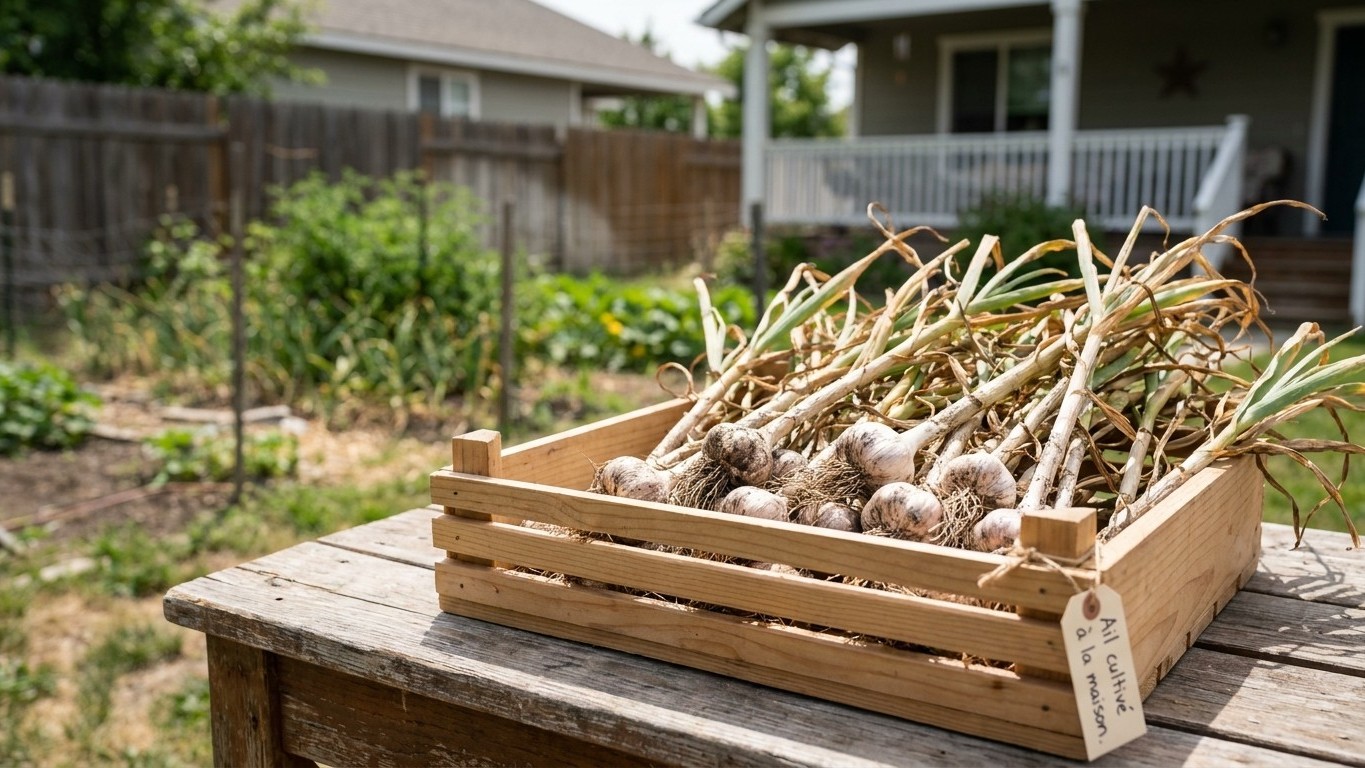

Idaho gives garlic all the cold it needs to split into cloves, and then some. NOAA’s 1991-2020 climate normals for the Boise-area station (USW00024131) put the first fall freeze between October 7 and October 21, and the region logs far more sustained cold afterward than the six to eight weeks of sub-40°F weather that University of Georgia Extension’s publication C854 says a clove needs to divide into a full head. Plant hardneck cloves in mid-to-late September so roots take hold before the ground locks up, and pick a variety suited to real winter cold rather than one bred to tolerate a mild one.
Will garlic get the cold it needs in Idaho

Garlic does not grow like a normal bulb. A clove planted in the ground needs a stretch of cold before it will divide into the cluster of cloves that makes a head. Skip that cold and the plant grows a single round, undivided bulb instead of the papery-wrapped cluster you expect at harvest.
How much cold Idaho actually delivers
University of Georgia Extension’s publication C854 puts the requirement at six to eight weeks of soil temperatures below 40°F after planting. Idaho does not just clear that bar, it clears it by a wide margin: the region measured here logs 26.1 weeks below 40°F, more than three times the minimum a clove needs to split. That figure comes from one reference dataset, and it runs in weeks rather than days, but the margin is wide enough that a grower anywhere in the state, from the low valleys around Boise to the higher benches and mountain valleys elsewhere, is very unlikely to fall short of what garlic needs.
The practical risk in Idaho is not too little cold. In the coldest parts of the state, especially at elevation, the more common problem is a shallow-planted clove pushed out of the ground by freeze-thaw heaving, or a young shoot that emerges too early and takes frost damage before spring growth resumes in earnest. Both are planting-depth and mulch problems, not cold-requirement problems, and the winter section further down covers the fix.
Where a grower does need to think about the chilling period is if the seed stock came from a warm-climate supplier, or was stored somewhere heated over the fall before going in the ground. Cloves that never see sustained cold before planting, or that go in so late they only catch part of the chilling season, are the ones that bolt into a single round bulb rather than a divided head.
The two workarounds other regions rely on, refrigerating cloves before planting to fake the cold, or leaning on a softneck type that tolerates a shorter chilling period, are not necessary in Idaho. The climate does the vernalizing on its own. Plant on schedule, choose from the Garlic Varieties That Suit Idaho Winters, and the chilling takes care of itself.
When to put the cloves in
Garlic wants to go into the ground while soil is still workable but cool enough that the clove roots without pushing much leaf growth above the surface. Knowing When to Plant Garlic in Idaho takes the guesswork out of timing that window. NOAA’s 1991-2020 climate normals for the Boise-area station (USW00024131) place the first fall freeze in a range from October 7 to October 21, a two-week span that any given year’s freeze could land anywhere within. Plan around that whole window rather than a single date, especially since it describes conditions near Boise and not the state at large.
Counting Back From the freeze
Cloves need roughly three to five weeks of rooting-in time before soil turns too cold for root growth, which is why the catalogue-calculated planting window for every variety listed below lands in mid to late September for this territory. That gives roots time to establish while soil is still workable, without leaving enough warmth for top growth that would then get nipped by the first freeze.
This window shifts with elevation and terrain in ways a single Boise-area station cannot capture. Higher benches, mountain valleys, and ground farther from the moderating effect of a river or reservoir cool down earlier and harder than the valley floor near Boise. A grower at elevation should plan toward the early side of the window, or even ahead of it, and should treat the Boise-derived range as a starting point to adjust rather than a fixed date to copy.
If your county extension office publishes a local frost record, use that instead of the Boise figure, since one low-valley station does not describe conditions across a state with Idaho’s range of elevation. Where no local figure is available, watching the soil directly is more useful than watching the calendar: plant once soil has cooled noticeably from its late-summer high but before it freezes hard, and you’re on schedule almost anywhere in the state.
Which types suit Idaho
Winter is what decides between hardneck and softneck garlic here, not flavor preference. Hardneck varieties send up a flowering stalk called a scape, form a single ring of large, easy-to-peel cloves, and need a real winter chill to perform well. Softneck varieties skip the scape, form more and smaller cloves, tolerate milder winters, and store for much longer after harvest.
Why hardneck leans favor Idaho
With Idaho’s winters running as cold as measured here, hardneck garlic is the safer default across most of the state, especially at elevation and away from the moderating effect of the Boise valley. Growers dealing with comparably cold winters, including those covered in Growing Garlic in Illinois: Planting Dates, Varieties and Winter Cold, reach the same conclusion for the same reason: a long, hard winter is exactly what a hardneck head wants.
From the closed list of varieties available for this territory, hardneck options include Bavarian Purple, Blue Music, Chesnok Red, Duganski, Fall Festival, Georgian Crystal, Georgian Fire, German Red, German White, and Ivan. All are set out in the same mid-September to late-September window calculated from the Boise-area frost dates above.
- Bavarian Purple, hardneck
- Blue Music, hardneck
- Chesnok Red, hardneck, a common choice for baking whole heads
- Duganski, hardneck
- Fall Festival, hardneck
- Georgian Crystal, hardneck
- Georgian Fire, hardneck, notably spicy raw
- German Red, hardneck
- German White, hardneck
- Ivan, hardneck
Softneck types still have a place, particularly for growers wanting a longer-storing braid garlic or planting in the mildest low-valley pockets near Boise. Early Red Italian, Inchelium Red, Italian Late, and Lorz Italian are all softneck varieties on the approved list, set out in that same mid-to-late-September window.
Soil and bed preparation
Garlic sits in the same bed for nine to ten months, through freeze, thaw, and spring rain, so the bed has to drain well before a single clove goes in. Standing water over winter rots cloves faster than any disease will, and a bed that puddles after fall rain needs raised rows or amended drainage before planting, not after.
Working the bed before planting
Loosen the soil to a full spade’s depth several weeks ahead of the mid-to-late-September planting window, breaking up compaction so roots can push down before winter sets in. Work in a couple of inches of finished compost or well-rotted manure across the bed. Garlic is a heavy feeder over its long season, and a bed built up before planting has to carry that fertility through fall root growth, winter dormancy, and the following summer’s bulking without a mid-season feed being practical once the ground is frozen or crusted.
Raised beds or ridged rows help in the parts of the state with heavier clay soils, lifting the root zone above standing water and warming slightly faster once spring growth resumes. In sandier, fast-draining soils common in parts of the Snake River plain, drainage matters less and moisture retention becomes the bigger question, worth checking with a soil test before assuming either problem applies to your ground.
Set cloves root-down at the depth given for the variety chosen, then cover with soil before mulching. Getting depth right matters more in a cold-winter state like Idaho than in milder regions, since a shallow clove is the one most likely to heave out of the ground when soil freezes and thaws repeatedly over winter.
What the climate here favours, and what it does not
The following comes from UC IPM’s Pest Management Guidelines for Onion and Garlic, UC ANR Publication 3453, which lists the temperature ranges several major garlic diseases need to develop. Those published thresholds are soil temperatures, while the figures below are monthly mean air temperatures for this territory. Soil lags air by weeks and swings far less, so a month with a favorable mean air temperature is a tendency toward risk, not a measured infection.
Where the risk concentrates
- White rot (Sclerotium cepivorum): mean air temperature falls inside the published 50-75°F range in five months of the growing season, September, October, April, May, and June, including one month at the published optimum. This is the widest window of the four diseases tracked here.
- Fusarium basal rot (Fusarium oxysporum f. sp. cepae): mean air temperature falls inside the published 59-90°F range in four months, September, May, June, and July.
- Pink root (Setophoma terrestris): mean air temperature falls inside the published 75-85°F optimum in one month, July.
- Southern blight (Sclerotium rolfsii): no month of the growing season has a mean air temperature inside the published 86-95°F optimum.
White rot’s five-month window is the one worth taking seriously here, since it spans both the fall planting period and the bulk of spring growth. That does not mean the disease is present. It means the temperature conditions that let it develop, where its sclerotia are already established in the soil, occur across much of Idaho’s garlic season. Buying certified disease-free seed stock and avoiding ground with a known history of allium crops does more to prevent white rot than any temperature range does on its own.
Southern blight‘s optimum range never shows up in the mean air temperatures tracked here, which is the reassuring side of this list, though a hot microclimate or an unusually warm summer could still push soil temperatures into range locally. Pink root’s window is narrow, just the one month, and mainly a late-summer concern for the tail end of a slow-curing crop rather than a planting-season risk.
Getting it through the winter
Mulch is what keeps a planted clove from heaving out of frozen ground over an Idaho winter, and it goes on after the ground has cooled but before a hard freeze locks it up, around the same weeks the first fall freeze arrives in the Boise-area range given above. A layer of straw or shredded leaves several inches deep insulates the soil surface enough to slow the freeze-thaw cycling that pushes shallow-planted cloves upward.
Depth and timing matter more here than in mild climates
Growers in comparably cold winter climates, including those covered in Growing Garlic in Ontario: Planting Dates, Varieties and Winter Cold, rely on the same heavy mulch approach for the same reason: a shallow clove without mulch is a clove that gets heaved to the surface by repeated freezing and thawing, exposing it to cold air and drying wind it was never meant to face. Once heaved, a clove rarely recovers fully even if pushed back into the ground by hand.
Leave the mulch in place through the coldest months. Pull it back gradually in spring once new green shoots are visible and the hardest freezes have passed, since mulch left too thick too long traps excess moisture against the emerging shoot and invites rot right at the point new growth is most vulnerable. In the coldest parts of the state, at higher elevation, err on the side of leaving mulch a little longer rather than pulling it too early.
Snow cover, where it falls reliably, adds its own insulation on top of mulch and is generally a benefit rather than a risk, since a consistent snowpack keeps soil temperature more stable than bare frozen ground exposed to wind.
Harvest and curing here
Garlic tells you when it’s ready by its leaves, not by a date on the calendar. Lift bulbs once the lower third to half of the leaves have browned while the upper leaves are still green, typically in mid to late summer the year after planting. Pulling too early gives small, papery-thin bulbs that don’t store, while waiting until every leaf has died back risks the wrapper splitting and cloves separating in the ground.
Curing in Idaho’s dry summer air
Idaho’s summers run dry across most of the state, which works in a garlic grower’s favor at curing time. Bulbs cure by hanging or laying them somewhere shaded, dry, and well ventilated for several weeks, until outer wrappers turn papery and necks tighten completely. In a dry climate like this one, airflow does most of the work, and the main risk is direct sun scalding bulbs rather than humidity trapping moisture in the neck.
In the wetter pockets of the state, or during an unusually humid stretch, a fan run through the curing space helps prevent the neck rot that a slow, damp cure invites. Don’t wash bulbs before curing. Soil brushed off once the wrapper has fully dried comes away far more easily than mud scrubbed off a fresh-pulled bulb, and washing before curing introduces moisture right when the bulb most needs to dry out.
Once cured, trim roots and stems, and store hardneck bulbs at cool room temperature out of direct light. They’ll generally hold for a shorter stretch than the long-keeping softneck types on the approved list here, which is the tradeoff for hardneck’s better cold performance in the ground.
Local help
County-level planting dates, soil test results, and current disease pressure vary across a state as large and as elevation-diverse as Idaho. The University of Idaho Extension office serving your county is the best source for figures more specific than the Boise-area numbers used throughout this guide, and can also test soil drainage and fertility before you commit a bed to nine months of garlic.
Common questions
Can I plant garlic in spring in Idaho instead of fall?
Not with any of the varieties on this list. Garlic goes in the ground in fall, roots over winter, and lifts as a bulb the following summer. A spring-planted clove skips the cold period it needs to divide and usually produces a small, undivided bulb.
What happens if I miss the mid-to-late-September window?
You can still plant into early October in most of the state and get a usable crop, though roots will have less time to establish before the ground cools hard. Planting much later than that, especially at elevation, raises the risk of a clove that hasn’t rooted before winter sets in.
Do I need to refrigerate my cloves before planting here?
No. That trick exists for growers in mild-winter climates who don’t get enough natural cold. Idaho’s winters already deliver far more chilling than garlic needs, so pre-chilling cloves adds a step without adding a benefit.
Can I plant garlic from the grocery store?
You can, but it’s a gamble. Grocery garlic is often treated to slow sprouting, isn’t identified by variety, and may carry disease that a certified seed source has been checked for. Given how long a clove sits in the ground here, certified seed stock is the safer bet.
Why did my garlic only grow one big round clove instead of a full bulb?
That’s a sign the clove never got the cold it needed to divide, usually because it was planted too late in the season, stored somewhere warm before planting, or came from stock that was never properly vernalized. It’s rarely a soil or fertility problem.