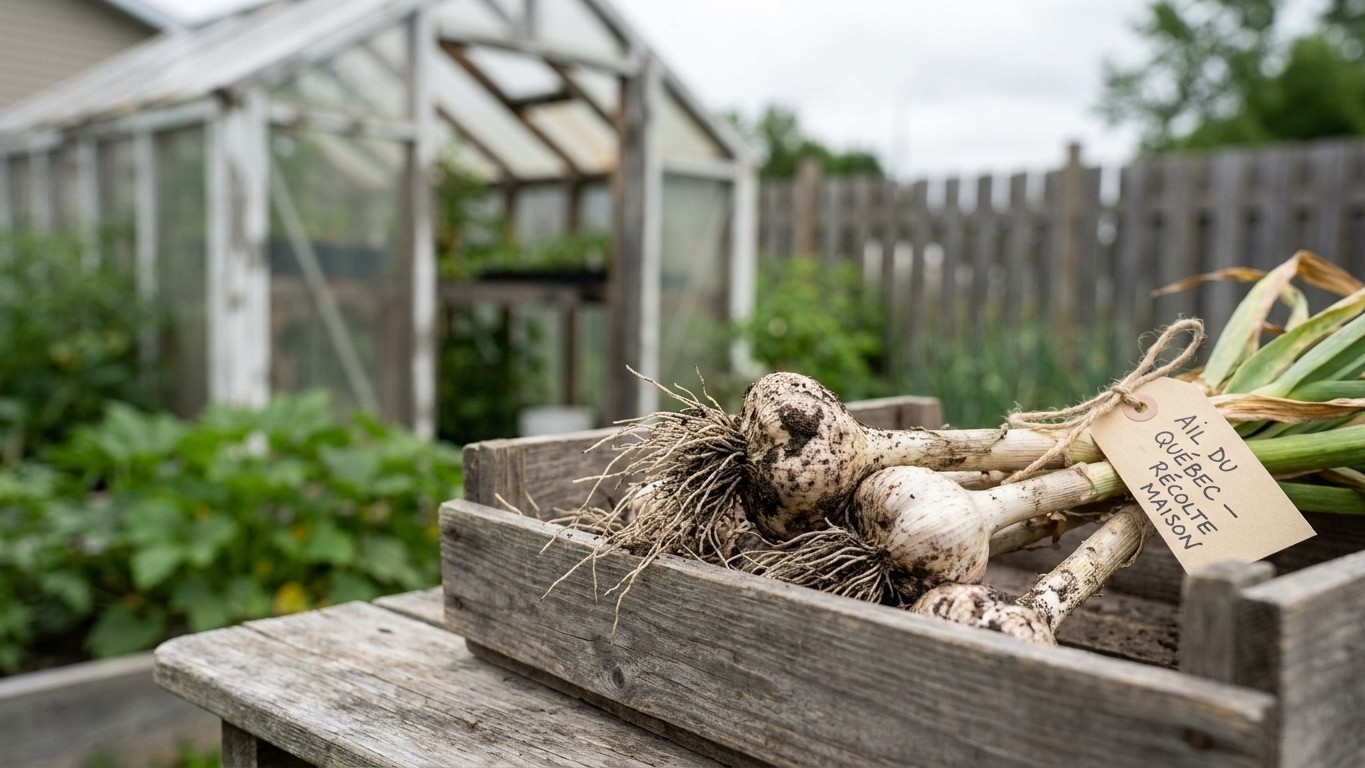

Garlic goes into the ground in Quebec in mid-September, timed against the average first fall frost of October 5 recorded at Montreal/St-Hubert A under Environment and Climate Change Canada’s 1981-2010 Canadian Climate Normals. That October date is a midpoint, not a guarantee: frost lands later than it in roughly half of all years, and earlier in the rest. Pick your cultivars now, separate the cloves, and have mulch on hand so you can plant the moment the mid-September window opens.
The short answer for Quebec

Plant Garlic in Quebec in mid-September. That target is set against the average first fall frost of October 5, the figure Environment and Climate Change Canada publishes for the Montreal/St-Hubert A station in its 1981-2010 Canadian Climate Normals. Mid-September puts cloves in the soil about three weeks ahead of that average frost date, enough time for roots to establish while the soil is still warm, without pushing top growth that a hard freeze would then cut down.
Treat October 5 as a midpoint, not a deadline. Environment Canada’s figure is a mean pulled from three decades of records: in roughly half of those years the first frost arrived after October 5, and in the other half it came earlier. A planting date anchored on a mean has to leave slack on both sides, which is why growers here count back three to four weeks rather than aiming at the exact date.
Which cultivars use this date
That mid-September window is the same for every garlic sold as planting stock in the province, softneck or hardneck, because the trigger is falling soil temperature and shortening daylight, not a cultivar’s days-to-maturity the way it would be for a tomato.
- Softneck: Early Red Italian, Inchelium Red, Italian Late, Lorz Italian
- Hardneck: Bavarian Purple, Blue Music, Chesnok Red, Duganski, Fall Festival, Georgian Crystal, Georgian Fire, German Red, German White, Ivan
For a closer look at how these differ once they’re growing, see Garlic Varieties That Suit Quebec Winters.
Working it out for your own garden
The three-week gap between mid-September and the October 5 average frost date is the number to reuse, not the date itself. Environment and Climate Change Canada’s Canadian Climate Normals list a mean first-frost date for named weather stations, not for every backyard. Montreal/St-Hubert A is the reference used here because it’s a long-running station with a full 1981-2010 normal period, but it describes the climate of the Monteregie plain around Montreal, not the whole of Quebec.
To rework this for your own garden, find the nearest station with a published normal, note its mean first-frost date, and count back roughly three weeks from it. If your nearest station’s average frost date falls later in October than Montreal’s, your planting window slides later by the same margin. If it falls earlier, in September, plant earlier by that margin instead. The arithmetic stays the same wherever you garden: subtract about three weeks from the mean first-frost date, then treat the result as the middle of a window rather than a single day, because the frost date itself is only a midpoint.
Local features that shift the window
Elevation, a large lake and a coastline all change how fast the ground cools in the fall, and any one of them can move the effective planting window by roughly two weeks in either direction from what a flat inland site would show. A garden on a hillside above a valley floor cools faster on clear nights, because cold air is heavier than warm air and drains downhill to pool below it. A garden close to a large body of water, or within reach of a river’s moderating effect, holds heat longer into the fall and can push the safe window later. Neither effect shows up in a single station’s normal, so a grower on a slope or a shoreline has to nudge the date by feel and by watching their own soil, not by reading a weather station forty kilometers away.
What changes across Quebec
Montreal’s frost normal is a reasonable stand-in for the Monteregie plain and the milder stretch of the St. Lawrence lowlands around it, but the province runs much colder and much milder than that elsewhere, and the planting calendar has to move with it.
Regions that run colder
Saguenay-Lac-Saint-Jean and Abitibi-Temiscamingue sit further north and further from the moderating mass of the St. Lawrence, so their growing season closes earlier and garlic should go in ahead of the Montreal-based window, not on it. The Eastern Townships and the higher ground of the Appalachian foothills cool faster after sundown than the lowlands do, for the same reason a hillside garden cools faster than a valley floor: cold air drains downhill, so elevation alone can push a hillside garden’s effective frost date ahead of a valley garden only a few kilometers away.
Regions that run milder
The Gaspe Peninsula and the Bas-Saint-Laurent sit close to the Gulf and the lower St. Lawrence estuary, which moderates the swing between day and night temperatures, though their more northerly latitude and exposure to Atlantic weather work against that effect. Closer to Montreal, the Monteregie and the western Outaouais valley tend to hold onto fall warmth a little longer than districts further from the river’s influence.
Treat Montreal’s October 5 average as the reference point for the milder end of the province, and shift planting earlier, not later, the further your garden sits from the St. Lawrence lowlands.
The mistakes this climate punishes
Quebec’s winter is long and hard enough that under-chilling is never the risk. The University of Georgia Extension, in publication C854, counts 30.4 weeks below 40°F for this kind of climate, which clears the six to eight weeks garlic needs after planting to split into cloves several times over. The mistakes that actually cost a crop here are about exposure and timing, not cold.
Planting too late or too shallow
Cloves set out after the mid-September window has closed don’t have time to grow the root system that anchors them before the ground locks up. A poorly rooted clove is far more likely to heave out of the soil during the freeze-thaw cycles of an open winter, and once a clove sits on the surface it dries out or freezes outright. Depth and a heavy mulch matter more here than in a milder climate. A thin scattering of straw that would be adequate further south is not enough insulation against a Quebec winter, and it needs to go down the same day as planting, not a week later once the forecast turns.
Choosing the wrong neck type for the site
Softneck cultivars such as Early Red Italian and Italian Late can be grown successfully in Quebec, but they are the less forgiving choice on an exposed or thinly mulched site. Hardneck cultivars such as German Red, Duganski and Chesnok Red have the longer track record in cold-winter gardens across the province. The choice matters most on a windswept or low-lying site with thin snow cover, since snow itself is the best insulation a clove can get, and matters far less in a sheltered garden that reliably holds a blanket of snow all winter. For the planting and mulching steps that come before any of this, see Growing Garlic in Quebec.
Ignoring disease risk because the climate seems to rule it out
A cold winter does not clear a garden of garlic disease, and it’s worth being precise about what the climate does and does not do here. The UC IPM Pest Management Guidelines for Onion and Garlic, UC ANR Publication 3453, publish temperature ranges for the main soil-borne diseases. Checked against Quebec’s monthly mean air temperatures, four months of the growing season, September, May, June and July, fall inside the 50-75°F range published for white rot, and three months, September, June and July, fall inside the 59-90°F range for Fusarium basal rot.
| Disease | Pathogen | Published range | Months in range (Sept-July) |
|---|---|---|---|
| White rot | Sclerotium cepivorum | 50-75°F | 4 |
| Fusarium basal rot | Fusarium oxysporum f. sp. cepae | 59-90°F | 3 |
| Southern blight | Sclerotium rolfsii | 86-95°F (optimum) | 0 |
| Pink root | Setophoma terrestris | 75-85°F (optimum) | 0 |
Three qualifications matter more than the count itself. The published thresholds are soil temperatures, and the figures above use air temperature, which lags soil and swings wider in both directions. A monthly mean sitting inside a range does not mean the whole month was spent there: a month averaging 60°F can still run from 45 to 80 on individual days. And a count of zero months for southern blight and pink root means their optimum conditions rarely occur here, not that the diseases are absent from Quebec soil. Every one of these pathogens travels on infected seed stock, so the surest protection is buying certified or trusted planting stock rather than counting on a cold winter to do the job for you.
Checking this against your county
Montreal/St-Hubert A is one weather station, and the figure it gives is a fair anchor for the milder end of the province, not a promise for every county. Quebec’s Ministere de l’Agriculture, des Pecheries et de l’Alimentation (MAPAQ) publishes regional growing information that goes further than a single climate normal can, and it’s worth checking against your own MRC before locking in a date. Visit MAPAQ for guidance closer to your own county, especially if you garden well north or east of the Monteregie plain.
Common questions
Can I still Plant Garlic in Quebec in October?
You can, but you’re working against the calendar rather than with it. Cloves planted after the mid-September window still have a chance to root if the fall stays mild, since the October 5 frost date from Environment Canada is only a mean and some years run warmer, but a late-planted clove has far less margin if an early cold snap follows instead.
What happens if I plant garlic too early, in August?
Cloves planted while the soil is still warm from summer can push top growth before winter arrives, and that green growth gets knocked back hard once a real frost hits. It doesn’t usually kill the plant outright, but it wastes energy the clove would otherwise put into roots and bulb development the following spring.
Do I need to mulch garlic in Quebec winters?
Yes, and heavier than you’d think if you’re used to a milder climate. A loose layer of straw a few inches deep protects against the frost heaving that a long freeze-thaw winter causes, and it should go down at planting time, not weeks later once the ground has already started to cool.
Should I plant hardneck or softneck garlic in Quebec?
Hardneck cultivars such as German Red, Chesnok Red and Duganski have the longer track record in cold-winter Quebec gardens, particularly on exposed sites. Softneck cultivars like Inchelium Red and Lorz Italian can still do well in a sheltered garden with reliable snow cover or a heavy mulch, so the site matters as much as the cultivar you choose.
The Moon calendar is a separate, older custom: see when to plant garlic by the moon, written as tradition rather than fact.