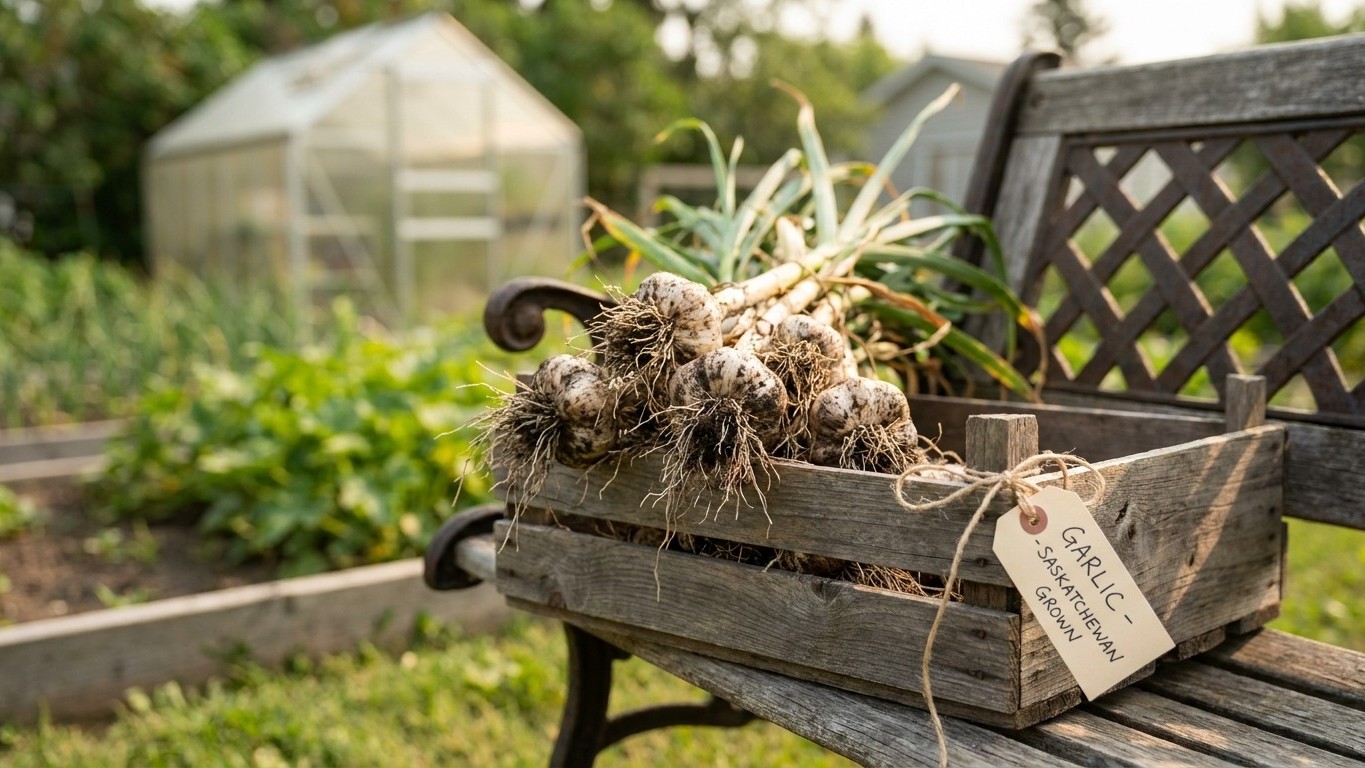

Saskatchewan’s winters run cold enough, over 34.8 weeks a year below 40°F by University of Georgia Extension’s count, to satisfy garlic’s need for six to eight weeks of chill, so hardneck types like German Red and German White thrive across the province. Environment and Climate Change Canada’s 1981-2010 climate normals put the average first fall frost at the Saskatoon SRC station at September 18, and cloves need roughly three weeks of root growth ahead of that date to settle in. Set garlic out in late August, whichever variety you choose.
The short answer for Saskatchewan

Garlic can handle whatever Saskatchewan throws at it, and yes, it grows well here — German Red and German White in particular settle into this cold and thrive on it. Get cloves into the ground in late August, and root growth has time to take hold before the soil locks up for winter. Whatever variety catches your eye, that same late-August window is the one thing to build your planting day around.
| Type | Variety | Set out | Notable trait |
|---|---|---|---|
| Hardneck | German Red | Late August | Stiff central scape, sharp cured flavor |
| Hardneck | German White | Late August | Large cloves, reliable scape |
| Hardneck | Chesnok Red | Late August | Purple-striped wrapper, good roasted |
| Hardneck | Duganski | Late August | Deep purple wrapper, stores well for a hardneck |
| Hardneck | Bavarian Purple | Late August | Streaked purple bulb wrapper |
| Hardneck | Blue Music | Late August | Blue-tinged clove skins, large bulbs |
| Hardneck | Georgian Crystal | Late August | White wrapper, milder for a hardneck |
| Hardneck | Georgian Fire | Late August | Sharp, hot cured flavor |
| Hardneck | Fall Festival | Late August | Fewer, larger cloves per bulb |
| Hardneck | Ivan | Late August | Consistent scape production |
| Softneck | Inchelium Red | Late August | No scape, braids well, long storage |
| Softneck | Lorz Italian | Late August | No scape, long storage |
| Softneck | Early Red Italian | Late August | No scape, cures early |
| Softneck | Italian Late | Late August | No scape, cures later in the season |
Hardneck and softneck differ mainly in what happens above ground and in storage, not in whether they survive here. Hardnecks send up a stiff scape and generally keep sharper flavor through a hard freeze, while softnecks skip the scape and often store a few extra months in a root cellar. Given Saskatchewan’s winters favor both types once they’re planted on time, the choice mostly comes down to what the cook in the house wants on the shelf.
Working it out for your own garden
This section assumes you’ve already settled planting depth and mulch thickness, which Growing Garlic in Saskatchewan covers in more detail. What’s left is timing, and that starts with one number: Environment and Climate Change Canada’s 1981-2010 climate normals put Saskatoon SRC’s average first fall frost at September 18. That figure is a mean, not a promise. In roughly half of all years the actual frost lands later than that date, and in the other half it lands earlier, so treat September 18 as the middle of a window, not a line you can plant right up to.
Working backward from that midpoint, garlic wants about three weeks of active root growth in soil that hasn’t frozen yet, which is where late August comes from for every cultivar on this list. Push planting into mid-September and you’re betting on the milder half of the frost distribution rather than the average one. Push it earlier, into July or early August, and cloves can put up top growth before winter, wasting stored energy the bulb needs later. If you’ve already built out a full planting calendar counting back from the first frost, this window should look familiar, since it comes from the same Saskatoon SRC figure.
Redoing the math for your own district
Saskatoon SRC is one weather station, and a garden fifty or a hundred miles away can run on its own local pattern. Redo this calculation with your own numbers rather than borrowing Saskatoon’s outright.
- Find the average first fall frost for the Environment and Climate Change Canada station nearest your garden.
- Count back roughly three weeks from that date for a target planting window.
- Move a week earlier if your garden sits in a low spot, a valley bottom, or anywhere cold air pools overnight.
- Move a week later if the bed is sheltered, south-facing, and tends to run warmer than open ground nearby.
None of these local shifts change how much total cold the winter delivers. The 34.8 weeks below 40°F figure describes the season as a whole, and every district in the province clears the six-to-eight-week vernalization requirement several times over. What moves is only the date cloves should go in the ground, not whether the winter will be cold enough once they’re there.
What changes across Saskatchewan
The Saskatoon SRC figures anchor this whole page, but Saskatchewan isn’t one climate. The province stretches from open prairie in the south to the edge of the boreal forest in the north, and that distance changes when frost shows up and how fast the ground hardens once it does.
North of Saskatoon, toward Prince Albert and the forest fringe, the growing season tends to close earlier than the Saskatoon SRC average would suggest, since days shorten and air cools faster at that latitude. Garlic set out on a Saskatoon schedule that far north risks going into ground that’s already cooling toward its hard freeze, so growers there generally lean toward the earlier end of any planting window rather than the later end.
South and west of Saskatoon, in the drier, more open country around Swift Current, the season tends to hang on a little longer into fall, though the higher ground of the Cypress Hills works against that by cooling the air compared to the surrounding plain. Low-lying river valleys along the North and South Saskatchewan Rivers collect cold air overnight and can see frost settle in before the open ground nearby does, the same frost-pocket effect that shows up in any bottomland garden regardless of province.
None of this changes which cultivars will grow. Every variety on the list above is hardy enough for the coldest parts of the province once it’s in the ground on time. What changes is the calendar each grower should work from, which is exactly why the arithmetic above, not a single fixed date, is the tool worth keeping.
The mistakes this climate punishes
Two mistakes account for most of the failed garlic beds in this climate, and neither is about picking the wrong variety.
Planting on the wrong clock
The first is timing and depth together: planting too late for roots to establish, or planting too shallow so the freeze-thaw cycle heaves cloves toward the surface over winter. A clove planted in mid-September instead of late August may never build the root mass it needs before the ground locks up. A shallow-planted clove, even one planted on time, can work its way loose during a mild spell in January or a thaw in March. Depth and timing matter more here than which cultivar you chose, because a hardy variety planted wrong still fails.
Trusting seed stock you haven’t checked
The second mistake is planting garlic that’s already carrying disease, and Saskatchewan’s own temperatures don’t do much to stop it once it’s introduced. UC IPM’s Pest Management Guidelines for onion and garlic (UC ANR Publication 3453) list white rot‘s active range as 50 to 75°F in soil, and this territory’s air temperature falls inside that range for four months of the growing season, including one month right at the fungus’s optimum. That’s an air reading standing in for a soil one, and soil lags air and swings less, so treat it as a caution rather than a forecast. A cold winter does not mean the disease is impossible: infected planting stock carries Sclerotium cepivorum into a garden regardless of climate, and one weather station never describes a whole province. Fusarium basal rot‘s 59 to 90°F range is met for two months of the same season. Buying certified, disease-free seed garlic and staying out of any bed that has grown onions or garlic recently matters more in a climate like this than any amount of soil treatment after the fact.
Checking this against your county
A garden in a different county, at a different elevation, or closer to a large body of water runs on its own schedule. For a planting date and variety recommendation tuned to your specific county, check with Saskatchewan’s provincial agriculture extension service, which can point you to local trial data and county-level frost records that a province-wide figure can’t capture. Treat everything above as the starting arithmetic, not the final word for your own soil.
Common questions
Can I plant garlic in spring instead of fall in Saskatchewan?
You can, but expect smaller bulbs. Garlic needs sustained cold to split into cloves, and a spring-planted crop misses most of the season University of Georgia Extension’s six-to-eight-week cold requirement is built around. Fall planting lets a winter that averages 34.8 weeks below 40°F do that work before the plant has to think about bulking up.
What if I miss the late-August window?
Get cloves into the ground as soon as you can into September, ideally before Environment and Climate Change Canada’s Saskatoon SRC average first frost date of September 18. That date is a midpoint, so roughly half of years give you extra weeks and half take them away, and a late-planted clove still beats no clove at all as long as the ground isn’t frozen solid.
Do I need to mulch garlic over a Saskatchewan winter?
Yes, and it matters more here than in a milder state. Bare soil sees deeper freeze-thaw cycling that can heave shallow-planted cloves right out of the ground over winter. A loose layer of straw or shredded leaves settles that risk without changing the cold-hours count the bulbs need to split.
Is elephant garlic an option here?
Elephant garlic behaves more like a leek relative than true garlic when it comes to hardiness. Stick to the named hardneck and softneck varieties above until you’ve confirmed local performance with the provincial extension service.