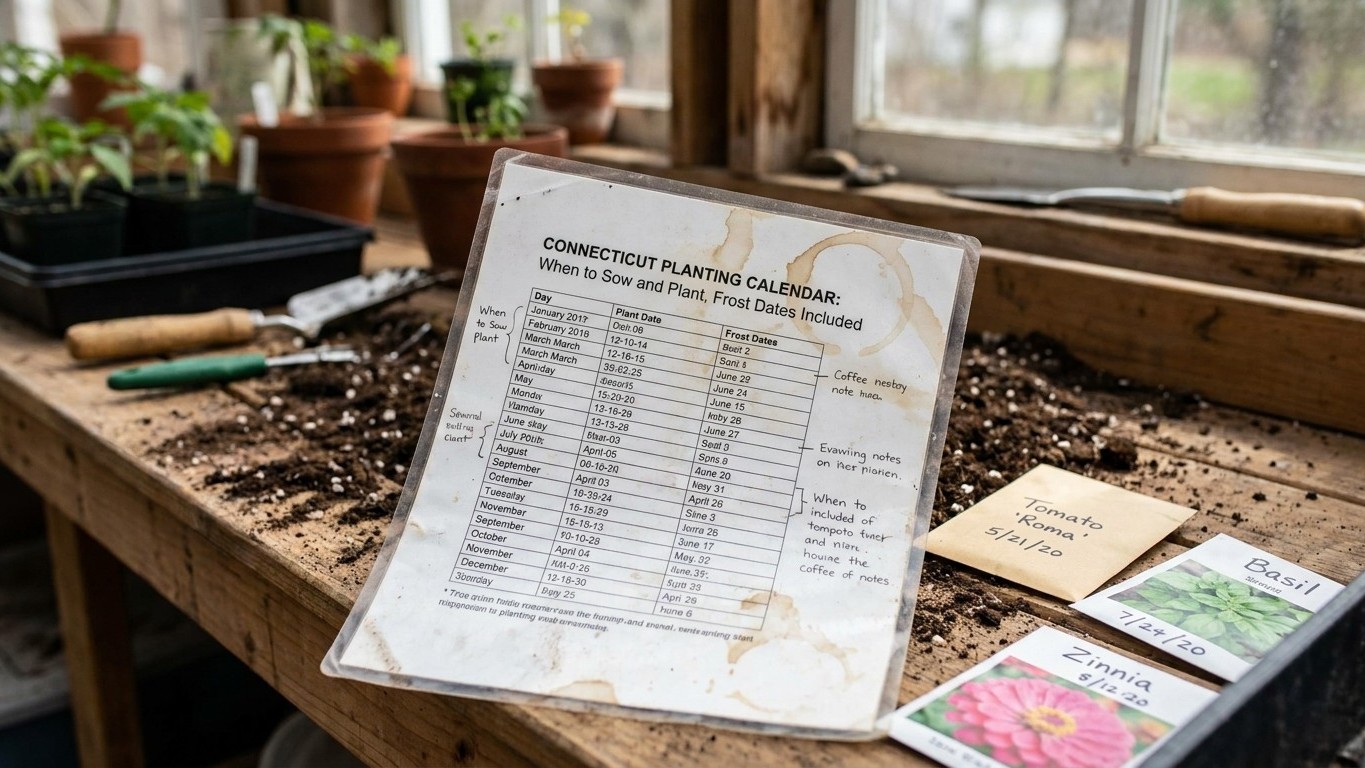

Connecticut’s last spring frost doesn’t fall on one date—it lands somewhere between April 2 and April 12, and the first fall frost hits between October 28 and November 10, both shifting with how close you sit to Long Island Sound. That’s not a hedge; it’s the actual shape of the season, and treating it as a single fixed date is how seedlings end up dead in the ground. Before you sow anything, find where your town falls inside that spread, because everything else in this calendar is built on top of it.
The frost window in Connecticut

NOAA’s National Centers for Environmental Information calculate frost dates as a probability band, not a single switch that flips from winter to summer. At the Bridgeport station (USW00094702), the 30 to 70 percent freeze-probability band for spring puts the last 32°F freeze between April 2 and April 12. The same method puts the first fall freeze between October 28 and November 10. Those two windows are what everything else in this calendar hangs off.
Bridgeport sits on Long Island Sound, and that water is the mildest thing going for Connecticut gardeners. The Sound holds heat into fall and delays the first hard freeze along the immediate coast, while the same water keeps spring cool and slows soil warming in April. Move inland, gain elevation, or head toward the Litchfield Hills in the northwest corner of the state, and both ends of the season tighten: spring frost lingers later, and fall frost arrives earlier. NOAA’s data is specific to the Bridgeport station, so treat it as the mild end of the state’s range rather than a number that applies everywhere.
What the window means for season length
Counting from the later edge of the spring window (April 12) to the earlier edge of the fall window (October 28) gives a conservative frost-free season of roughly 199 days near the coast. Counting from the earlier spring date to the later fall date stretches that to about 222 days in the best case. That range, not a single number, is the honest answer to how long the Connecticut growing season runs, and inland gardens should expect a shorter version of it on both sides. Once the season is underway, it’s worth checking What to Plant in Connecticut in June to see what’s on track mid-season, and as that season winds down, it’s worth checking What to Plant in Connecticut in September for what to get in before the shorter days set in, then What to Plant in Connecticut in October before moving on to What to Plant in Connecticut in December once the year winds all the way down, then What to Plant in Connecticut in November to see what can still go in before the year’s final frost, and then ahead to What to Plant in Connecticut in January once the new cycle begins.
Cool-season crops
Cool-season vegetables tolerate a light frost and actually suffer in the heat that comes later in summer, so they go into the ground well before the last spring frost date rather than after it. Peas, spinach, lettuce, and the brassica family (kale, broccoli, cabbage) all germinate in cold soil and shrug off a frost that would kill a tomato seedling outright.
The usual rule of thumb for direct-sown peas and spinach is four to six weeks ahead of the last spring frost. Counted back from Bridgeport’s April 2 to April 12 window, that puts sowing in the mid-February to mid-March range, with the pace picking up further by the time you reach What to Plant in Connecticut in Mayh range—see What to Plant in Connecticut in March for the specifics of that window.h range—for a full breakdown of what to start that early, see What to Plant in Connecticut in Februaryh range, and if you’re planning further out, see What to Plant in Connecticut in August for what follows once the summer crops wind downh range, well ahead of summer crops covered in What to Plant in Connecticut in July, which follows once the soil has fully warmed.h range, with a broader look at What to Plant in Connecticut in April filling in what follows once the frost window closes.h range for the mildest coastal gardens, and later still where the ground stays frozen longer. The real trigger isn’t the calendar date at all: it’s whether the soil is workable, meaning it crumbles rather than clumps when you squeeze a handful. Working wet clay soil to satisfy a date on a calendar does more harm than waiting another week.
Lettuce and the brassicas are usually started as transplants a few weeks before the frost date and set out two to three weeks before it, since young plants tolerate cold better than seed does in unpredictable early spring soil. Root crops like carrots and beets go in by direct seed, timed similarly to peas, and both improve in flavor when they mature in cool rather than hot weather. None of these crops need to wait for the last frost to pass. Waiting costs you the cool window they actually want.
Warm-season crops

Tomatoes, peppers, squash, beans, and corn are the opposite case: a light frost kills them outright, and even frost-free cold soil stalls their growth or rots the seed before it germinates. Soil temperature, not the calendar date of the last frost, is the real gate here. Bean and corn seed wants soil in the 60s Fahrenheit to germinate reliably, and tomato and pepper transplants sulk if the soil is still cold even weeks after the frost date has technically passed.
Setting tomatoes out after the frost window
For transplanted crops like tomatoes, the practical move is to add one to two weeks of soil-warming buffer on top of Bridgeport’s April 2 to April 12 last-frost window before setting plants outside, landing most transplant dates in mid to late April for the milder parts of the state. Gardeners further south don’t have to wait nearly as long: Maryland’s frost-free window opens weeks earlier than Connecticut’s, which is why the same tomato variety gets planted and picked on a very different schedule there.
Catalogue days-to-maturity figures are counted from the transplant date, not from seed, and they shift by a week or two depending on the season’s warmth. Working from a mid-April to late-April transplant window, several catalogue varieties line up as follows for Connecticut gardens:
| Variety | Days to maturity | Type | Set out | First ripe | Margin before fall frost |
|---|---|---|---|---|---|
| Sakura | 55 | Indeterminate | Mid to late April | Mid June | ~130 days |
| Edox | 55 | Indeterminate | Mid to late April | Mid June | ~130 days |
| Valentine | 55 | Indeterminate | Mid to late April | Mid June | ~130 days |
| Glacier | 55 | Determinate | Mid to late April | Mid June | ~130 days |
| Sun Gold | 57 | Indeterminate | Mid to late April | Late June | ~128 days |
| Supersweet 100 | 60 | Indeterminate | Mid to late April | Late June | ~125 days |
| Juliet | 60 | Indeterminate | Mid to late April | Late June | ~125 days |
| Amalfi | 68 | Determinate | Mid to late April | Early July | ~117 days |
| Cherokee Purple | 72 | Indeterminate | Mid to late April | Early July | ~113 days |
| Big Beef Plus | 72 | Indeterminate | Mid to late April | Early July | ~113 days |
| Tiren | 75 | Indeterminate | Mid to late April | Early July | ~110 days |
| Granadero | 75 | Indeterminate | Mid to late April | Early July | ~110 days |
| San Marzano II | 78 | Indeterminate | Mid to late April | Mid July | ~107 days |
| Celebrity Plus | 78 | Determinate | Mid to late April | Mid July | ~107 days |
Even the slowest variety on that list, San Marzano II, carries over three months of margin before Bridgeport’s first fall frost arrives, which is comfortable padding for a slow-ripening paste tomato. For seed started indoors rather than bought as transplants, count back six to eight weeks from that mid-April to late-April set-out window, which lands indoor sowing in late February to mid-March for most tomato and pepper varieties.
The fall planting window
Counting backward from the first frost
Fall planting works in reverse from spring: you pick a harvest date around the first fall frost and count backward by the crop’s days to maturity, then add a buffer because growth slows as daylight and temperature drop through September and October. Bridgeport’s first fall frost falls between October 28 and November 10, per NOAA’s normals, so a crop needing 50 days to mature should be sown by roughly early September to finish before the earlier edge of that window, with extra time built in for the slower growth of a shortening fall day.
That buffer matters more than gardeners expect. A lettuce that takes 45 days to mature in the warmth of July can easily take 60 days to reach the same size sown in late August, simply because there’s less sunlight and cooler soil driving the growth. Padding a fall sowing date by 10 to 14 days beyond the seed packet’s days-to-maturity figure is a reasonable hedge against that slowdown.
Some crops don’t just tolerate the first light frosts of fall, they improve after them. Kale, Brussels sprouts, spinach, and carrots left in the ground through a light freeze convert stored starches to sugars as a cold defense, which is why fall-harvested kale and carrots taste noticeably sweeter than the same crop pulled in August. That’s a reason to plant fall brassicas and roots deliberately, rather than treating the first frost purely as an end-of-season deadline to race against.
Reading a planting calendar properly
A state-level planting calendar, including this one, is built from a single weather station’s data, and Connecticut’s small size hides a surprising amount of climate variation underneath that single number. Bridgeport’s coastal position means its frost dates are the mildest in the state; a garden forty miles inland or a few hundred feet higher in elevation can run a week or two later in spring and a week or two earlier in fall, which adds up to a meaningfully shorter season than the numbers above suggest.
Local features push the date around further still. Valley bottoms collect cold air on clear, calm nights and frost first, while a slope just above them stays frost-free longer. Urban and suburban areas hold heat in pavement and buildings, nudging their own microclimate a few days milder than the surrounding countryside. A pond or larger body of water nearby has the same moderating effect the Sound has on Bridgeport, just at a smaller scale.
The way around all of this is to watch your own garden rather than trust a single date. Keep a simple log of the date your soil becomes workable each spring, the date you actually lose your last tender seedling to frost, and the date the first frost hits your yard in fall. Three or four years of your own notes will out-predict any station-based average for the specific patch of ground you’re planting into. Gardeners further north face an even starker version of this problem: the season charted in our Maine Planting Calendar runs noticeably shorter than Connecticut’s, which shows how much frost timing shifts over a relatively short distance in New England.
Local help
For county-level frost dates, soil testing, and planting advice specific to your town, contact UConn Extension, the state’s land-grant university extension service. Extension offices run soil tests that tell you your actual pH and nutrient levels, which matters more to a first harvest than any frost date does. A soil test costs little and saves a season of guessing at why a crop underperformed. Our Connecticut guides cover more of the state’s specific growing conditions if you’re planning beyond this single calendar.
Common questions
Can I plant tomatoes in Connecticut in early April?
No. Early April sits inside or before Bridgeport’s last-frost window of April 2 to April 12, and inland areas run even later, so a tomato set out that early risks a hard freeze that kills it outright. Wait until soil has warmed for one to two weeks past the local last-frost date before transplanting.
Does the Connecticut frost date change a lot by town?
Yes, more than most gardeners expect. The NOAA figures in this guide come from the Bridgeport station on Long Island Sound, the mildest part of the state, and inland or higher-elevation towns can run a week or more later in spring and earlier in fall. Check with UConn Extension for anything closer to your specific county.
What happens if I plant too early and a frost hits anyway?
A light frost on a cool-season crop like lettuce or peas usually does no real damage. A frost on a warm-season crop like tomatoes, peppers, or squash typically kills the foliage and often the whole plant, especially at the seedling stage, so covering plants overnight or delaying transplant is cheaper than replacing them.
Is it worth starting seeds indoors instead of buying transplants?
It gives you access to more varieties than a garden center carries, including many of the disease-resistant tomato cultivars listed above, but it only pays off if you have a bright enough spot or grow lights, since leggy, light-starved seedlings often underperform a sturdy purchased transplant.
Can I get a second harvest of something after my tomatoes are done?
Sometimes, if the first crop finishes early enough to leave time for a fast-maturing fall crop before the first fall frost. Count the new crop’s days to maturity plus a buffer for slowing fall growth backward from Bridgeport’s October 28 to November 10 window, and only replant if the arithmetic leaves a real margin.
Related guides
- New York Planting Calendar: When to Sow and Plant, Frost Dates Included
- Massachusetts Planting Calendar: When to Sow and Plant, Frost Dates Included
- Maine Planting Calendar: When to Sow and Plant, Frost Dates Included