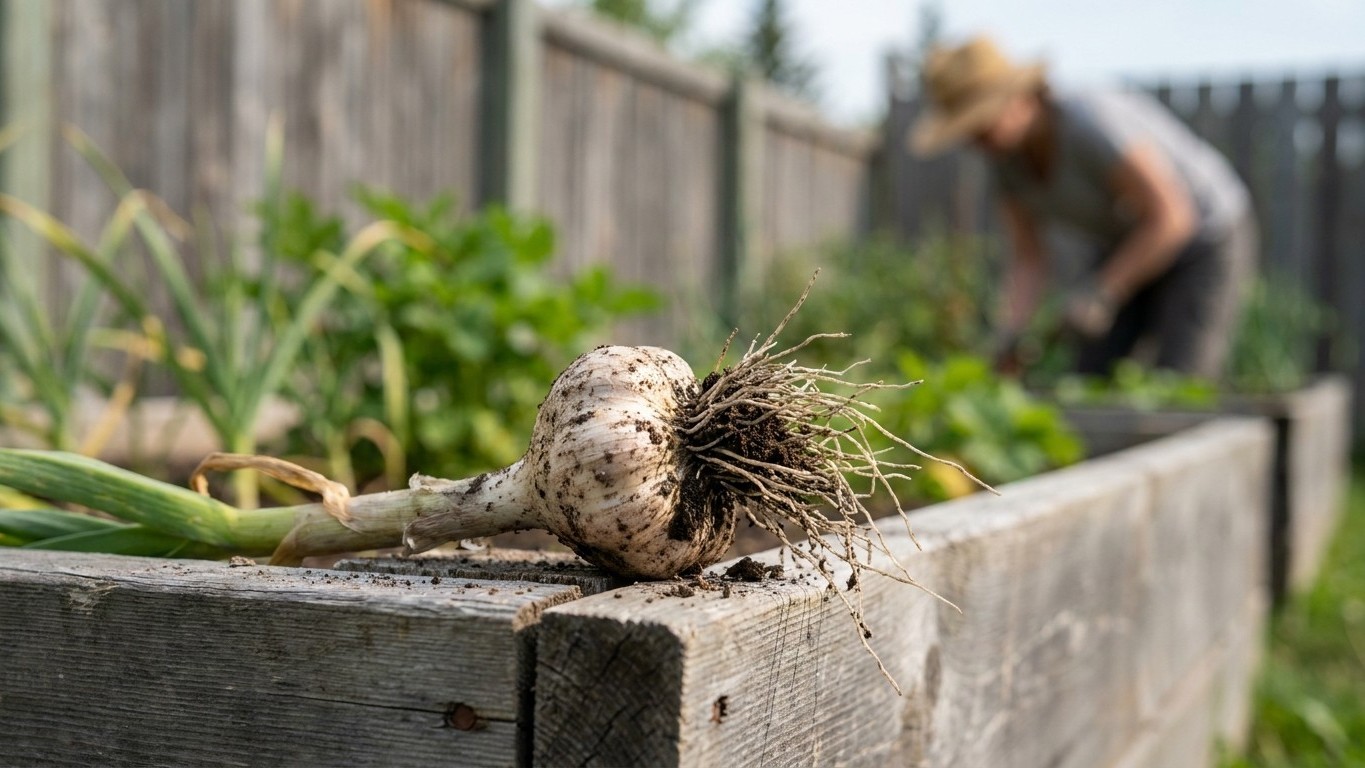

Late August, not October the way most garlic advice assumes, is when a clove has to be in Alberta soil. Elsewhere growers get to wait for cooler fall rains; here that extra patience burns through the three weeks of root-building time a clove needs before Calgary’s mean frost settles in mid-September. That compressed window is also why hardneck types outlast softnecks underground here — a hardiness gap that matters far more in this province than the planting calendar most guides repeat.
The short answer for Alberta

Set garlic cloves out in late August across most of the province. That timing is anchored on the mean first fall frost recorded at Calgary Int’l A, September 16, according to Environment and Climate Change Canada’s 1981-2010 Climate Normals. Cloves planted in late August get roughly three weeks to push roots into still-warm soil before that average frost date, and root growth, not top growth, is what determines whether a clove survives the winter buried underground until it’s lifted the following summer.
That September 16 figure is a mean, not a guarantee. A thirty-year average means the real first fall frost lands after that date in roughly half of those years and before it in the other half. Treat it as the center of a window that can swing by two weeks or more, never as a date you can plant right up against.
The full list of cultivars below all share that same late-August window, because the goal is identical regardless of neck type: enough weeks of soil warmth to root before freeze-up, and enough cover once the freeze sets in. What differs between them is winter hardiness once planted, which is where the hardneck-versus-softneck split starts to matter more than any single date.
| Variety | Type | Set out |
|---|---|---|
| Early Red Italian | Softneck | Late August |
| Inchelium Red | Softneck | Late August |
| Italian Late | Softneck | Late August |
| Lorz Italian | Softneck | Late August |
| Bavarian Purple | Hardneck | Late August |
| Blue Music | Hardneck | Late August |
| Chesnok Red | Hardneck | Late August |
| Duganski | Hardneck | Late August |
| Fall Festival | Hardneck | Late August |
| Georgian Crystal | Hardneck | Late August |
| Georgian Fire | Hardneck | Late August |
| German Red | Hardneck | Late August |
| German White | Hardneck | Late August |
| Ivan | Hardneck | Late August |
Working it out for your own garden
The roughly three-week cushion between a late-August planting and the Calgary-area mean frost date is arithmetic you can redo for your own address, because Alberta is not one climate. Start with the nearest Environment and Climate Change Canada station’s average first fall frost date, then count backward far enough that the clove has time to grow a root system before the ground cools hard, typically several weeks rather than days. If your local station’s mean frost date runs a week or two later than Calgary’s September 16, you have room to push planting a few days later too. If it runs earlier, move earlier by roughly the same margin.
Reading your own station’s normal
Environment and Climate Change Canada publishes 1981-2010 climate normals for stations across the province, and the mean first fall frost is the number to look for. Two things matter when you read it: it is built from thirty years of records, and it is a mean, so the real frost in any single year lands later about half the time. A grower who plants exactly on the mean date, instead of a week or two ahead of it, is gambling with the later half of that record.
Elevation is the biggest single mover once you leave a station’s immediate area. Ground that sits several hundred feet above a reference station cools faster in autumn and holds that cold longer into spring, which argues for planting toward the earlier end of the late-August window rather than the later end. A large lake pulls the opposite direction: the water holds summer heat into fall and can delay the first frost near its shoreline compared with open prairie a short drive away. Neither effect is quantified station by station for every district, so the practical move is to compare your own observed frost dates against the Calgary figure rather than assuming your yard matches it exactly.
None of this changes the planting method itself. Break the bulb into cloves just before planting, keep the papery wrapper on each one, and set them root-down a couple of inches deep with mulch pulled over once the ground starts to cool. The planting calendar for Alberta garlic walks through that sequence in more detail, including how deep to mulch and when to pull it back in spring.
What changes across Alberta
The Peace Country in the province’s north sits at a higher latitude and typically loses its growing season sooner than the Calgary area, which argues for a hardneck cultivar there and for treating the late-August window as a hard deadline rather than a target to aim near. Growers in that region benefit more from a cultivar chosen for cold survival than one chosen for bulb size or clove count.
The foothills and mountain-adjacent districts west of Calgary, sitting well above the elevation of Calgary Int’l A itself, cool faster once autumn sets in and hold snow cover longer into spring. That snow cover isn’t entirely bad news for garlic, since a consistent blanket insulates cloves better than bare frozen ground does, but it does mean spring green-up starts later and the following summer’s harvest window compresses.
Southern Alberta around Lethbridge and the Chinook belt sees periodic winter warm spells driven by chinook winds, weather patterns that can strip snow cover and expose garlic beds to hard cold with no insulation at all. That flips the risk from the foothills pattern: the danger there isn’t surviving a steady deep freeze, it’s surviving repeated freeze-thaw cycles that heave cloves loose in softened soil. A heavier, well-anchored mulch layer earns its keep more in that belt than almost anywhere else in the province.
None of these regional patterns are broken out station by station in the way the Calgary figure is here, so the honest approach for any of these districts is to track down the nearest station’s own normal rather than borrowing Calgary’s number outright.
The mistakes this climate punishes
Planting a softneck where winters run cold
Softneck cultivars like Early Red Italian, Italian Late and Lorz Italian store well and produce reliably where winters run gentle, but they were bred for regions milder than much of Alberta sees. In a district colder than the Calgary reference point, a hardneck cultivar such as Duganski, German White or Chesnok Red is the safer bet, since hardneck types as a group carry better winter survival than softneck types bred for milder growing regions. Save the softnecks for a yard with a proven record of mild winters and dependable snow cover.
Planting too shallow or too late
The opposite failure runs the other direction: planting cloves too late in the fall, or too shallow, so they never build enough root mass before the ground locks up. A clove that goes in after the late-August window, especially once September arrives, is racing a frost date that Environment and Climate Change Canada’s own normals put, on average, at September 16 for Calgary Int’l A, and racing a mean means losing about half the time. Shallow planting compounds the problem, because a clove sitting near the surface freezes and thaws with every swing instead of settling into stable cold below it.
- Softneck cultivar planted in a district that regularly runs colder than the Calgary reference point
- Cloves planted after the late-August window, racing a mean frost date that arrives by mid-September in roughly half of all years
- Mulch applied while soil is still warm, trapping moisture against cloves before they callus over
Disease pressure this climate does not remove
Cold winters don’t erase garlic disease risk, they just shift which diseases matter. UC IPM’s Pest Management Guidelines for onion and garlic, published by the University of California, list white rot, caused by the fungus Sclerotium cepivorum, as active across a 50 to 75°F soil temperature range, and Alberta’s growing-season air temperatures fall inside that range for roughly three months, including one month at the pathogen’s published optimum. Fusarium basal rot, caused by Fusarium oxysporum f. sp. cepae, needs warmer conditions, but the growing season still spends one month inside its published range. Neither figure means the disease is guaranteed to show up. It means clean, certified seed stock matters more than climate alone, because both pathogens travel in infected cloves no matter how cold the following winter turns out to be.
Checking this against your county
Alberta’s Ministry of Agriculture and Irrigation publishes crop and climate guidance by region, and its agriculture and irrigation site is the place to check county-level detail a single Calgary station can’t give you. Look for local frost records or a regional contact before locking in a planting date, especially if your county sits in the foothills, the Peace Country, or the Chinook belt discussed above. If you’ve watched frosts land consistently later than mid-September in your own garden in past years, you have real grounds to nudge the late-August window a few days later. If they’ve landed earlier, don’t wait for a printed source to tell you to plant sooner.
Common questions
Can I Plant Garlic in spring instead of fall in Alberta?
You can, but expect smaller bulbs. Garlic needs a period of sustained cold to divide properly into cloves the following summer, and a spring-planted clove misses most of that exposure. Fall planting in late August remains the standard approach for hardneck and softneck cultivars alike. See the broader steps in Growing Garlic in Alberta if you’re setting up a bed for the first time.
What happens if I miss the late-August planting window?
You can still plant into September, but you’re cutting into the weeks of root growth a clove needs before Calgary’s mean first fall frost of September 16 arrives, and in colder districts that margin shrinks further. A late-planted clove that hasn’t rooted well before hard freeze often survives the winter smaller or not at all. If you miss the window entirely, it’s usually better to hold the cloves and try again the following fall rather than force a spring planting.
Do I need to mulch garlic over an Alberta winter?
Yes, in most districts a mulch layer over the bed once soil has started to cool protects cloves from repeated freeze-thaw cycles, particularly in the Chinook belt where snow cover can strip away mid-winter. Straw or shredded leaves both work. Mulching too early while soil is still warm can trap moisture against the clove before it has callused, so wait until the topsoil has genuinely cooled rather than mulching on a calendar date.
Is hardneck garlic always more cold-hardy than softneck?
As a group, yes, hardneck cultivars tend to handle harsh winters better than softneck ones, which is why cultivars like Bavarian Purple, Georgian Fire and Ivan show up more often in colder Alberta districts. That’s a general tendency across the type, not a guarantee for every individual cultivar or every yard, and a softneck like Inchelium Red can still do fine in a garden with reliable snow cover and good drainage.