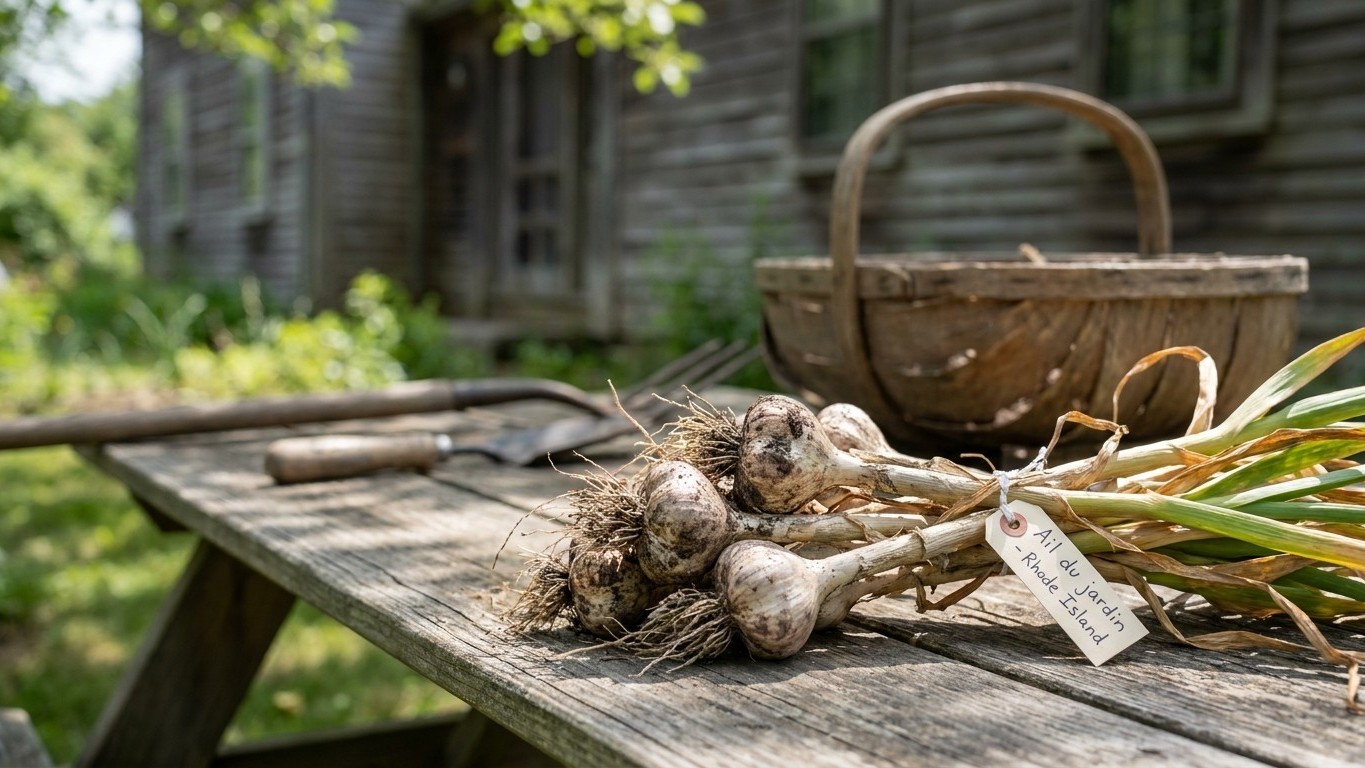

Planting garlic in Rhode Island? Get cloves in the ground from early October to mid October, and you’re set. That window gives roots six to eight weeks to grow before the ground freezes solid, which is what garlic needs to size up properly by summer. Before you pick your exact date, though, walk your own yard on a cold morning and see where frost actually settles — a low spot or an inland garden can freeze up a week or two earlier than the timing this range is built around, and that difference matters more than the calendar does.
The short answer for Rhode Island

Set garlic cloves out in Rhode Island from early October to mid October. That range applies to every cultivar sold for fall planting here, softneck and hardneck alike, because the difference between types shows up later, in storage life and clove count, not in the calendar. The anchor point is NOAA’s 1991-2020 climate normals for the Providence station, which put the first fall freeze at October 24 to November 3.
A frost date is a midpoint, not a guarantee. In roughly half the years behind that normal, frost at Providence has arrived after November 3. In the other half it has come before October 24. Treat the range as the center of a spread, not a line you can plant right up against and expect to beat every year.
Garlic planted in that window needs two things working in its favor: enough weeks of root growth before the soil freezes hard, and enough weeks of winter cold afterward to trigger clove division. University of Georgia Extension (publication C854) sets that chilling requirement at six to eight weeks below 40°F. Rhode Island clears that easily. NOAA’s data for the reference station average 26.1 weeks per growing season with mean temperatures below 40°F, more than three times what a clove needs to split. That margin is why the question here is less about whether the winter gets cold enough, and more about whether the roots got established before the ground closed.
The varieties available for fall planting in Rhode Island share this same window:
- Early Red Italian (softneck)
- Inchelium Red (softneck)
- Italian Late (softneck)
- Lorz Italian (softneck)
- Bavarian Purple (hardneck)
- Blue Music (hardneck)
- Chesnok Red (hardneck)
- Duganski (hardneck)
- Fall Festival (hardneck)
- Georgian Crystal (hardneck)
- Georgian Fire (hardneck)
- German Red (hardneck)
- German White (hardneck)
- Ivan (hardneck)
For a fuller look at what separates these types in the kitchen and in storage once you lift the crop next summer, see Garlic Varieties That Suit Rhode Island Winters.
Working it out for your own garden
Start from the same two numbers used above: the Providence frost window of October 24 to November 3 (NOAA’s 1991-2020 normals) and the six to eight week rooting period garlic needs before the ground freezes hard. Counting back roughly three to four weeks from the start of that frost window lands in early to mid October, which is why that range works across the whole state as a starting point. If you already have a bed prepped from a previous season, the soil and mulch steps this timing assumes are covered in Growing Garlic in Rhode Island.
Reading your own frost record
The Providence figure comes from one weather station at the airport. NOAA’s own data carries a caution with it: suburban and rural gardens typically see the first fall frost arrive earlier than the airport figure, often by one to two weeks, and more at elevation. If your garden sits away from the coast, in a low spot, or up in the hills, treat October 24 as the optimistic end of the range and move your own planting window earlier by that same margin.
What moves the date locally
Three things push a garden’s real frost date away from the reference figure: height above sea level, closeness to a large body of water, and how low the ground sits relative to what surrounds it. A garden near Narragansett Bay or the open ocean picks up a buffering effect from the water, which holds warmth into the fall and can delay frost by a week or more compared with the airport reading. A garden set into a valley or hollow collects cold air on still nights and can see frost noticeably earlier than a garden a quarter mile away on a slope. None of this reduces to a single number you can look up. It comes from watching your own site: note where frost settles on the lawn or driveway some October morning, and use that as your working answer rather than leaning on the Providence figure alone.
What changes across Rhode Island
Rhode Island is small, but its frost timing is not uniform across it. Coastal towns such as Newport, Block Island, and the shore of Aquidneck Island sit close to Narragansett Bay and the open Atlantic, both of which hold summer heat into the fall and typically push frost later than the Providence airport figure suggests. Inland and upland places see the opposite pull.
| Area | Frost tendency vs. the Providence figure | Main cause |
|---|---|---|
| Newport, Block Island, coastal Aquidneck Island | Later, often milder than the reference date | Ocean and Narragansett Bay hold warmth into fall |
| Blackstone Valley and other low river valleys | Can run earlier on calm, clear nights | Cold air drains downhill and pools in low ground |
| Upland interior towns such as Foster and Glocester | Earlier, sometimes by a week or two | Higher elevation and distance from ocean moderation |
None of these come with their own NOAA station record the way Providence’s does, so treat them as direction, not degree. A gardener in Glocester planning entirely off the Providence range risks planting a week or two later than the ground there actually allows for root establishment before freeze. When your town isn’t the reference station, lean early rather than late.
The mistakes this climate punishes
Rhode Island’s winters run long and cold enough, as already noted, that under-chilling isn’t the risk here. The mistakes worth watching for are the ones that cost roots before winter even sets in, and the one risk climate alone can’t rule out.
Planting too late for roots to establish
The mistake this climate punishes hardest is treating mid October as a floor rather than a ceiling. Gardeners who wait until after Halloween, hoping to squeeze in a few more weeks of fall cleanup first, often find their cloves have barely cracked a root by the time the ground stiffens. A clove that goes dormant without root growth is exposed to frost heave and can dry out over winter instead of anchoring down.
Setting cloves too shallow
Rhode Island’s freeze-thaw swings through late fall and again in early spring will walk a shallow-planted clove right out of loose soil. This shows up more on the state’s sandier coastal soils than on the heavier loam found further inland, since sand offers less resistance to heaving. A generous mulch layer, put down once the ground has begun to cool rather than while it’s still warm, insulates against the swings that cause this.
Assuming seed stock is automatically clean
Garlic diseases don’t need a warm climate to get started. They need infected planting stock, and Rhode Island’s temperatures don’t rule them out. Mean air temperatures in parts of the growing season, September, October, and again from May through July, fall inside the 50 to 75°F range in which white rot (Sclerotium cepivorum) is active, according to the University of California’s IPM guidelines for onion and garlic (UC ANR Publication 3453), with one of those months sitting right at the pathogen’s published optimum. Fusarium basal rot has a similar opening in September, June, and July. These are air-temperature figures set against a threshold published for soil, and soil lags air by weeks and swings far less than a monthly average suggests, so read the overlap as a possibility that exists, not a forecast for this fall. The practical response has nothing to do with weather: buy seed garlic from a supplier who inspects stock for rot, not a grocery store bulb, since infected cloves are what actually introduce these pathogens to a garden, whatever the thermometer does that month.
Checking this against your county
The Providence figures anchor this whole page, but Rhode Island’s coastline, elevation changes, and river valleys mean your own garden can run a week or two ahead of or behind that station’s numbers. Before you lock in a planting date, especially if your garden sits inland, upland, or right on the coast, it’s worth a call to the University of Rhode Island Cooperative Extension. Extension staff work with finer-grained frost and soil data than a single airport station provides, and can tell you how your town has historically tracked against the Providence figure.
Common questions
Can I still Plant Garlic in November in Rhode Island?
You can, but you’re working against the calendar. Providence’s own frost window, per NOAA’s 1991-2020 normals, sits at October 24 to November 3, so a November planting date already falls inside or past that window in most years, leaving cloves less time to root before winter closes in. If you have to plant that late, mulch heavily and expect smaller bulbs next summer rather than a failed crop.
Does it matter if I plant hardneck or softneck first?
No, order doesn’t matter, and both types go into the ground in the same early October to mid October window here. What differs between hardneck and softneck is clove count and how long the bulbs keep once you lift them the following summer, which is worth reading up on before you order seed stock.
What if I miss the window, can I plant in spring instead?
Garlic planted in spring rarely bulbs properly because it misses the extended stretch of cold that triggers clove division, the same six to eight week chilling requirement discussed above. If you miss the fall window, it’s usually better to wait for next fall than to plant a spring clove and end up with a small, undivided round instead of a bulb.
How do I know if my cloves rooted before winter?
Dig gently at the edge of a planted row about three to four weeks after planting and look for white root threads at the base of the clove, not top growth. Some varieties send up a green shoot before frost and some don’t, so the shoot isn’t a reliable sign either way. The roots are what to check.
If you follow the almanac, here is when to plant garlic by the moon. It is a tradition, not a proven method.