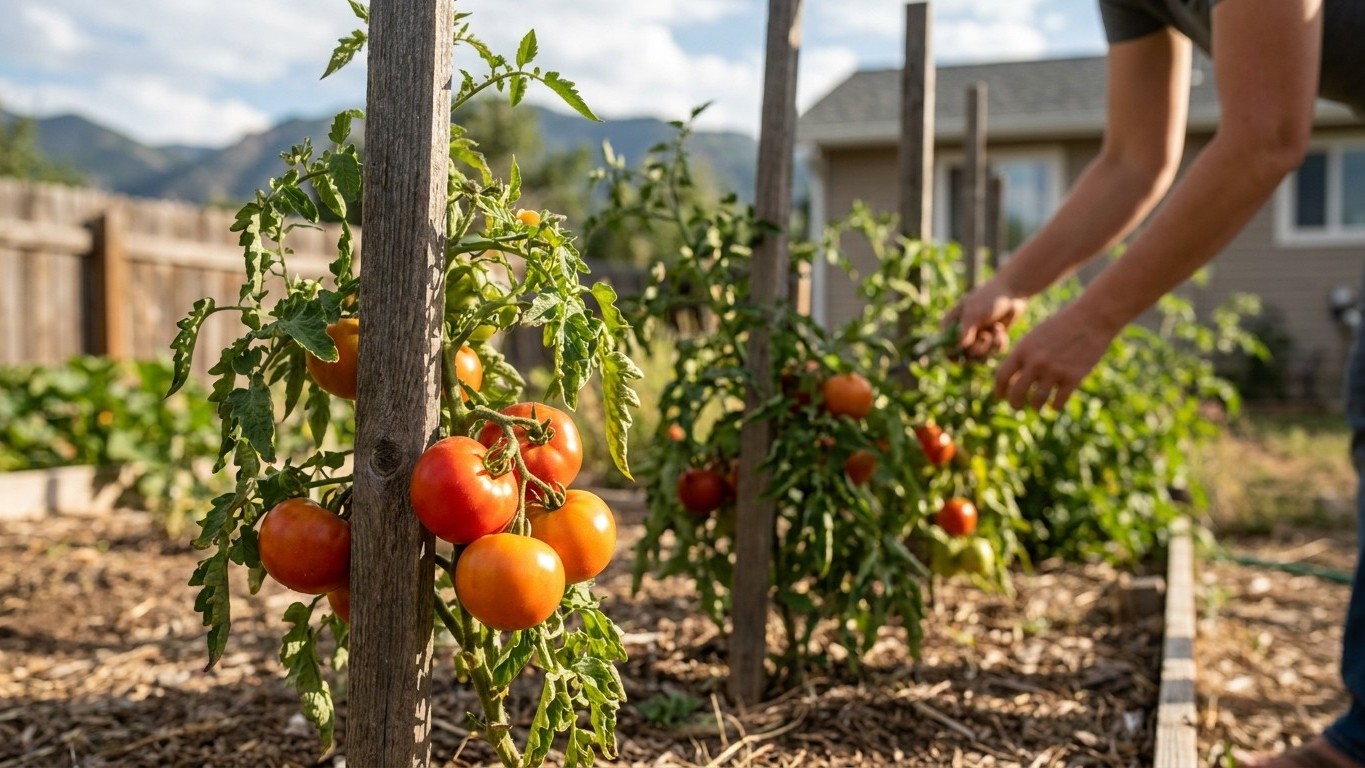

May 1 to May 11 — that’s the last-frost window for Denver-area tomatoes, and it’s a band of probability, not a promise. Plant on the early edge of that range and a cold morning can still take your seedlings out overnight, tomatoes being the crop with zero frost tolerance to spare. Up in the mountains that window shrinks hard, with frost possible into July some years, and the Western Slope runs on an entirely different calendar. So before you set a single plant out, know which Colorado you’re actually gardening in.
When to plant Tomatoes in Colorado

Tomatoes are a warm-season crop with zero tolerance for frost, so the Denver-area freeze window matters more for this plant than almost anything else you’ll grow. NOAA’s 1991-2020 normals for station USW00003017 place the last spring frost between May 1 and May 11. That’s a probability band, not a guaranteed frost-free date: even at the end of that window there’s still meaningful risk of a cold morning. Treat May 11 as the earlier edge of safety, not the target date, and keep frost cloth on hand into the back half of May if a cold front is forecast.
That window is measured at Denver on the plains at 5,280 feet. If you garden in a mountain town, expect a much shorter season with frost possible even in July some years, and if you’re on the Western Slope, your local frost pattern runs on its own schedule entirely. Check county-level dates before you commit to a planting day, and browse our other Colorado guides for how elevation reshapes timing on other crops too.
Starting seeds indoors
Tomato seed needs six to eight weeks of indoor growth before it’s ready to go in the ground. Counting back from the Denver frost window: six weeks before May 1 lands on March 20, and eight weeks before May 11 lands on March 16. That puts the Front Range seed-starting window in mid to late March for most home gardeners, a touch earlier if you’re growing larger, sturdier transplants and want extra time under lights.
Use a seed-starting mix, not garden soil, and keep the trays somewhere consistently warm. Seedlings grown too cool or too dark end up leggy and weak, and a leggy tomato seedling never fully catches up once it’s in the ground.
Hardening off and transplanting
A week to ten days before you plan to transplant, start hardening seedlings off: a few hours outside in a sheltered spot the first day, building up to full sun and a full day outdoors by the end of the week. Skip this step and the seedlings can scorch or stall the moment they hit real sun and wind.
Transplant only once the frost window has fully passed. Since NOAA’s normals put that window at May 1 to May 11 for Denver, most Front Range gardeners are safest waiting into the back half of May before setting plants out without protection, and even then it pays to watch the short-range forecast for a week after transplanting. Cold, wet soil slows tomato roots badly even without a frost, so a late, warm start often outperforms an early, cold one.
Soil and site preparation
Tomatoes want a full six to eight hours of direct sun a day, and less than that shows up fast as leggy growth and thin fruit set. Pick the sunniest, most open spot in the yard, ideally with some wind shelter since Colorado’s plains and foothills both see stretches of hard, drying wind that stress young plants.
Soil texture across the state runs from sandy on parts of the plains to heavy, slow-draining clay in parts of the Front Range foothills. Neither extreme suits tomato roots well on its own. Work two to three inches of finished compost into the bed a few weeks before transplanting, not the same day, so it has time to start integrating into the soil rather than sitting as a separate layer. If drainage is genuinely poor after a hard rain, a raised bed solves it faster than any amount of amending.
Give plants real room: 24 to 36 inches apart for most varieties, more for big sprawling indeterminates like Brandywine or Cherokee Purple. Crowded tomatoes hold humidity in the canopy and that’s exactly the condition that lets foliar disease take hold. Space for airflow first, and worry about filling the bed second. Set your cage or stake at planting time, not weeks later, since driving a stake through an established root ball does real damage.
Varieties that suit Colorado
The single most useful trait for this state is a short, predictable days-to-maturity count, because a late frost on one end and an early one on the other can trim real weeks off the growing season depending on where you are. Days-to-maturity figures on seed packets are counted from the transplant date, not from seed, and they shift by a week or two either way depending on the season’s heat and sun, so treat them as a planning tool rather than a promise.
Run the arithmetic against the Denver frost window and you get a real answer, not a guess. Sakura, at 55 days from transplant, set out anywhere from May 1 to May 11, would be ready roughly from late June to early July. San Marzano II, a longer 78-day paste tomato, transplanted in that same window lands closer to mid to late July for first ripe fruit. That gap matters if your growing season is already tight at higher elevation.
Disease resistance is worth reading on the packet too, especially since Colorado’s dry climate keeps a lot of fungal pressure lower than it is in more humid states. Growers dealing with tropical humidity face an almost opposite set of pressures, worth a look in our guide to growing tomatoes in Hawaii for contrast. Here, resistance to soil-borne wilts and viruses tends to matter more than resistance to leaf fungus, since dry air already does some of that work.
| Variety | Days to maturity | Type | Notable resistance | Good for |
|---|---|---|---|---|
| Sakura | 55 | Indeterminate | Nematodes, Tomato Mosaic Virus, Fusarium 1 & 2 | Earliest cherry tomato for a short season |
| Sun Gold | 57 | Indeterminate | Tobacco Mosaic Virus, Fusarium 1 | Sweet snacking cherry |
| Jasper | 60 | Indeterminate | Late Blight, Early Blight | Cherry tomato with strong disease defense |
| Supersweet 100 | 60 | Indeterminate | Verticillium, Fusarium 1 | Heavy cherry producer |
| Juliet | 60 | Indeterminate | Late Blight, Early Blight | Small paste-type, good for sauce or snacking |
| Amalfi | 68 | Determinate | Nematodes, Late Blight, Early Blight | Compact paste tomato for containers |
| Cherokee Purple | 72 | Indeterminate | None listed | Slicing flavor, needs the full season |
| Big Beef Plus | 72 | Indeterminate | Nematodes, Gray Leaf Spot, Tomato Mosaic Virus | All-purpose slicer with broad resistance |
| Tiren | 75 | Indeterminate | Verticillium, Tomato Mosaic Virus, Fusarium 1 | Reliable slicer for a long-season bed |
| Granadero | 75 | Indeterminate | Nematodes, Verticillium, Tomato Mosaic Virus | Paste tomato, needs the longer end of the season |
| San Marzano II | 78 | Indeterminate | None listed | Classic sauce tomato, plant it early |
| Celebrity Plus | 78 | Determinate | Nematodes, Gray Leaf Spot, Tomato Mosaic Virus | Compact plant, good for smaller beds |
| Brandywine | 78 | Indeterminate | None listed | Heirloom flavor, best in a long warm season |
| Amish Paste | 85 | Indeterminate | None listed | Longest season here, start extra early indoors |
What to plant alongside
Basil is the pairing everyone repeats, and the honest version of that claim is modest: it doesn’t measurably change tomato flavor, but it does draw in pollinators and its dense, low growth shades the soil around the base of the plant, which helps a little with moisture retention. Marigolds have a real mechanism behind them, not just folklore. French marigolds release compounds that suppress root-knot nematodes, though the benefit shows up over a full season of the roots being in the ground, not from a single plant tucked in at transplant time.
Borage and other flowering herbs bring in bees and other pollinators, which helps fruit set generally even though tomatoes are mostly self-pollinating. Alliums like onions and garlic take up little space and share almost no pests or diseases with tomatoes, so they slot into the same bed without competing for much.
- Good neighbors: basil, marigolds, borage, onions, garlic, carrots
- Keep well away: potatoes (share late blight and other soil-borne disease), corn (shares tomato fruitworm, the same insect as corn earworm), fennel (releases compounds that stunt many neighboring plants)
Potatoes are the pairing to actually avoid, not out of tradition but because they’re close enough botanically to share late blight and several other diseases, so an outbreak on one can jump straight to the other. Skip fennel near tomatoes entirely, since it’s genuinely allelopathic and can stunt a lot of nearby plants, tomatoes included. Corn shares the same fruitworm pest as tomatoes, so planting them side by side just gives that insect a bigger buffet rather than confusing it.
Watering, feeding and support
Water deeply and less often rather than a little every day. A deep soak encourages roots to grow down into cooler, more stable soil, while frequent shallow watering keeps roots near the surface where they dry out fast in wind and heat. Consistency matters more than volume: irregular watering, especially a dry stretch followed by a heavy soak, is the single biggest driver of both blossom end rot and fruit cracking.
A two to three inch layer of mulch, straw or shredded leaves both, does real work here. It slows evaporation, keeps soil temperature more even, and stops soil from splashing up onto lower leaves during watering, which is one of the main ways fungal spores spread from the ground onto the plant.
Feed lightly at transplant with a balanced fertilizer, then again once the first fruit clusters set. Go easy on nitrogen once flowering starts, since too much nitrogen late pushes lush leafy growth at the expense of fruit, a common mistake with a heavy dose of an all-purpose lawn or vegetable fertilizer applied out of habit rather than need.
Indeterminate varieties like Sun Gold, Cherokee Purple and Amish Paste keep growing and setting fruit all season and need a sturdy stake or cage from day one, since they’ll easily reach five feet or more. Determinate types like Celebrity Plus and Amalfi grow to a set size, set most of their fruit in a shorter window, and need less aggressive staking. Pruning suckers, the small shoots that form in the joint between the main stem and a branch, on indeterminate types improves airflow and directs energy into fewer, larger fruit, though it’s optional rather than required.
Common problems

Blossom end rot
This isn’t a disease and no fungicide touches it. It comes from uneven watering interrupting calcium delivery to the fruit, not usually from a lack of calcium in the soil itself. Fix the watering rhythm first, and the next flush of fruit is usually clean.
Cracking
Cracking shows up after a heavy rain or a big watering following a dry stretch, when the fruit takes up water faster than the skin can stretch. Keep soil moisture steady with mulch and a consistent watering schedule, and pick fruit slightly before full ripeness during a wet week rather than risking a split.
Curling leaves
Leaf curl on its own, without yellowing or spotting, is usually a physiological response to heat and water stress rather than disease, and it often resolves once temperatures moderate. Curl paired with yellowing or a mosaic pattern on the leaf is a different story and worth watching for spread to other plants.
Wilt diseases
Fusarium and Verticillium wilt both live in the soil and cause the same basic symptom: yellowing and wilting that starts low and often on one side of the plant. There’s no cure once a plant is infected, so remove it rather than let it sit. This is exactly why disease-resistant cultivars like Tiren and Granadero, both bred with resistance to Verticillium and Fusarium race 1, are worth choosing if a previous crop in that bed struggled.
Tomato hornworms
These are large enough to see easily once you know to look, and they can strip a branch of leaves in a couple of days. Hand-picking works fine on a home garden scale, and checking the plant in the early morning or evening makes them easier to spot since they tend to hide during the heat of the day.
Aphids
Aphids cluster on new growth and the undersides of leaves and can be knocked back hard with a strong spray of water from the hose, repeated every few days. A heavy infestation, especially one with visible ants tending the colony for the honeydew they produce, is worth treating with insecticidal soap before it spreads to the whole plant.
Humidity-driven fungal disease is a smaller problem here than in wetter states. Growers in more humid climates like Pennsylvania deal with early and late blight showing up almost every season, worth a look in our growing tomatoes in Pennsylvania guide for how that pressure plays out differently. Colorado’s dry air limits both, though a stretch of wet, humid weather can still bring them on, so it’s still worth choosing a variety with some blight resistance, like Jasper or Amalfi, if your site tends to stay damp.
Pests that actually show up in Colorado
Colorado State University Extension’s PlantTalk Colorado insect list for vegetable crops names ten pests, but only a handful actually bother tomatoes. Squash bug, harlequin bug and spotted cucumber beetle feed on cucurbits and brassicas. They matter if you grow squash, cucumbers or cabbage nearby, but they largely leave tomato plants alone.
Flea beetles (Phyllotreta and Epitrix species) leave a peppering of small round holes across leaves, and CSU Extension flags June as the month they do the most damage. Young transplants take the worst of it since a heavily riddled seedling leaf can’t produce much for the plant. Floating row cover over transplants until they harden off is the one control that consistently works.
Spider mites (Tetranychus urticae) show up as a fine stippling or bronze cast on leaves, sometimes with faint webbing on the undersides once numbers build. CSU Extension fact sheet 5.507 notes mites favor hot, dry stretches, so pressure climbs through the warmer months of the season. A firm daily spray of water on the undersides of leaves knocks them back. Letting the soil run dry only makes an infestation worse.
Tomato/potato psyllid causes a distinctive yellowing and curl in new growth along with wiry, stunted stems, a symptom set growers call psyllid yellows. It tends to appear once summer heat sets in. Yellow sticky traps near the plants catch adults before nymphs settle onto leaf undersides.
Cutworms cut young transplants clean through at the soil line, usually overnight, in the first weeks after planting out. A cardboard collar pushed an inch into the soil around each stem blocks them without any spray.
Grasshoppers (Melanoplus species) chew ragged holes straight through leaves and can strip a plant fast in a heavy year, especially as dry field edges push them toward irrigated gardens. Row cover is the practical home defense, since sprays rarely keep pace with a hopper population on the move.
Corn earworm moths, the same species also known as tomato fruitworm, do not overwinter in Colorado. CSU Extension notes they reinvade each summer as migrating adults, and the larvae bore straight into ripening fruit. Check fruit at first blush of color and pull anything with an entry hole before the worm works its way deeper.
Harvest and end of season
Pick tomatoes once they’ve reached full color for the variety, whether that’s the deep red of Celebrity Plus or the dusky pink-purple of Cherokee Purple. Fruit color is a better guide than the calendar, since the days-to-maturity number on the packet is an average, not a fixed date. A slight give under gentle pressure is the other reliable sign that a fruit is ready.
Store ripe tomatoes at room temperature, never in the refrigerator, since cold temperatures break down the texture and dull the flavor. Fruit that’s still hard and green when picked can ripen indoors on a counter out of direct sun, though it never quite matches the flavor of one that ripened on the vine.
As the season winds down, watch the local forecast rather than a fixed date for the first fall frost, since that timing varies across the state the same way the spring frost window does. Once a hard freeze is forecast, pick everything on the vine, including full-size green fruit, and bring it indoors. Green tomatoes ripen slowly wrapped individually in newspaper in a cool room, and a batch picked ahead of a frost easily stretches fresh eating and cooking well into the following weeks. Anything too small or damaged to ripen is worth using green, in a batch of fried green tomatoes or a green tomato relish, rather than composting it outright.
Local help
County-level frost dates, soil testing and variety trial results all vary across Colorado’s range of elevations and microclimates, and the Denver figures here are only a starting point. Contact Colorado State University Extension through extension.colostate.edu for a county office near you, a soil test, and planting guidance calibrated to your specific elevation and location rather than the Front Range average.
Where to Go Next
Once you’ve got a feel for what growing tomatoes in Colorado actually involves, the details are what make or break a season. If you’re still working out when to put transplants in the ground, the tomato planting calendar walks through counting back from your last spring freeze, using NOAA’s 1991-2020 climate normals for Denver’s reference station to pin that window down to roughly May 1 through May 11.
Picking what to plant is its own problem, since the days-to-maturity number on a seed packet doesn’t count from your last frost or from New Year’s — it counts from transplant, and that quietly changes everything for a short Colorado season. The page on tomato varieties that ripen in time sorts out which ones actually make it.
And once plants are in the ground, know what’s coming for them. Colorado’s pest list is mercifully short — six names in all — and the rundown on tomato pests in Colorado covers flea beetles, Colorado potato beetle, aphids, beet leafhopper, two-spotted spider mite, and tomato hornworm, the ones that actually show up here.
Common questions
Can I grow tomatoes in the Colorado mountains?
Yes, but expect a much shorter and less predictable season than the Denver-area window described above, with frost possible even in summer some years at higher elevations. Lean on the shortest-season varieties available, like Sakura at 55 days or Sun Gold at 57 days, and consider a wall of water or cold frame to extend both ends of the season.
Do I need to cover my tomatoes if frost is forecast after I’ve already transplanted?
Yes, cover them. Even inside the frost window given by NOAA’s normals, a forecast freeze after transplanting is a real risk, not a formality. A simple frost cloth or an overturned bucket at night protects young plants until the danger passes.
Why did my tomato plant grow huge with lots of leaves but barely any fruit?
This is almost always too much nitrogen, often from a fertilizer applied too heavily or too often after flowering started. Ease off feeding and let the plant redirect its energy, and fruit set usually catches up within a few weeks.
Can I grow tomatoes in containers on a patio or balcony?
Yes, and determinate varieties like Amalfi or Celebrity Plus handle container life better than large sprawling indeterminates. Containers dry out faster than ground beds, so expect to water more often, sometimes daily in hot, dry stretches.
How many tomato plants do I actually need?
Four to six plants covers most families for fresh eating, mixing an early cherry type like Sakura with a slicer like Big Beef Plus and a paste type like Amalfi for sauce. Add more if you’re planning to can or freeze a surplus.