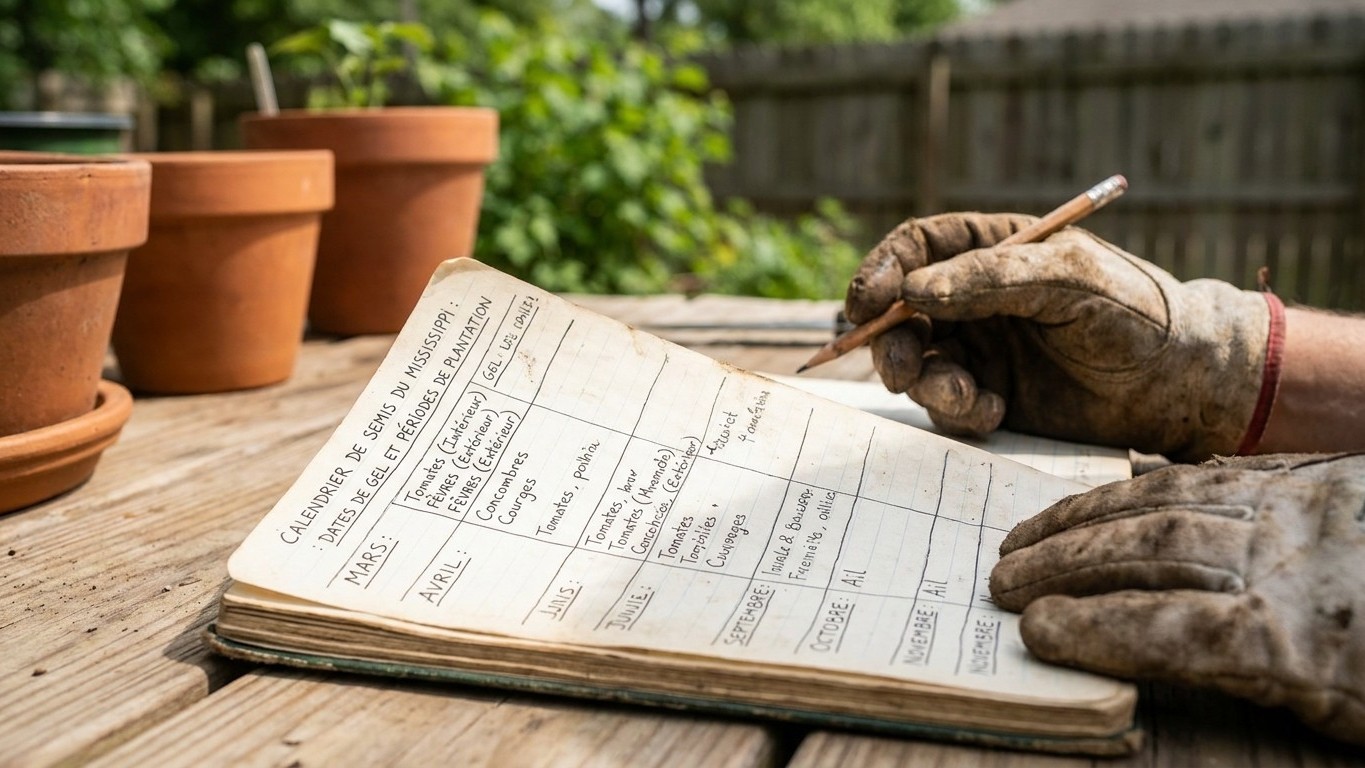

Mississippi’s frost window decides your tomato and pepper dates, and for most of the state that’s the second half of March into early April, later in the hills, earlier down the coast, so it’s worth knowing What to Plant in Mississippi in January before the season even starts, then What to Plant in Mississippi in February to get your cool-season crops and seed starting underway, then What to Plant in Mississippi in March before that window opens. Soil warmth matters more than the calendar square, so a transplant that goes out too early just sits and sulks in cold ground instead of growing. Check your own county’s last-frost record against that Mississippi average before you set anything tender outside, because a week’s difference either direction is often what separates a surviving transplant from a dead one.
The frost window in Mississippi

Every planting date in this calendar starts from two numbers. NOAA’s NCEI 1991-2020 climate normals put the last spring freeze at Jackson’s airport station (USW00003940) between March 6 and March 22, and the first fall freeze between November 7 and November 22. These are 30 to 70 percent probability windows for a 32°F freeze, not hard cutoffs, so frost can still show up a few days either side of the stated range in a given year.
Jackson sits near the middle of the state, and that matters more here than in a lot of states because Mississippi runs on a strong north-south climate gradient. Gardeners in the hill country around Tupelo or Corinth should expect their last spring frost to land later than Jackson’s window and their first fall frost to arrive earlier, sometimes by a week or two. Gardeners near the coast, from Gulfport down to Pascagoula, typically see the opposite: an earlier spring thaw and a later fall frost, stretching the frost-free season closer to nine months in favorable years.
Set the two Jackson windows against each other and you get a frost-free growing season of roughly 230 to 260 days, depending on which end of each range you land on in a given year. That’s long enough to run two full crop cycles on many vegetables, spring and fall, with a hot midsummer lull for anything that dislikes 90°F nights, so it helps to know What to Plant in Mississippi in April as that spring window opens, follow up with What to Plant in Mississippi in May as the season builds momentum, check What to Plant in Mississippi in June as the heat sets in, know What to Plant in Mississippi in July before that stretch of heat sets in, check What to Plant in Mississippi in August as that heat lingers int, and plan ahead with What to Plant in Mississippi in October as the second fall cycle gets underway, and look ahead to What to Plant in Mississippi in November as that first fall freeze approacheso late summer, look ahead to What to Plant in Mississippi in September as that fall window opens, and to plan ahead with What to Plant in Mississippi in December once the fall season winds down.
The 30 to 70 percent probability band is the important detail here, not the calendar dates themselves. A last-frost date of March 6 means there’s still a real chance of freezing weather after that day, just better-than-even odds against it. Treat the early end of the window as the point where you can start hardening off transplants outdoors during the day, and the late end as the point where you stop routinely covering them at night.
Compare this to a state like North Carolina’s planting calendar, where mountains and coastline pull the frost dates apart by even more than they do here, or to Connecticut’s planting calendar, where a single short frost-free season leaves far less room for two full growing cycles. Mississippi’s advantage is length: even a cautious gardener working from the late end of the spring window and the early end of the fall window still gets most of eight months outdoors.
Cool-season crops
Cool-season crops don’t wait for the frost-free date. They go in while frost is still likely, because the plants tolerate temperatures that would kill a tomato outright. English peas, spinach, and lettuce handle a light frost on their leaves without real damage, and radishes and turnips germinate in soil too cool for beans.
The practical approach is to count backward from the Jackson frost window rather than from a fixed calendar date. Cool-season crops generally go into the ground several weeks before the last expected frost, and since NOAA’s NCEI normals put that date at Jackson somewhere between March 6 and March 22, that puts direct-sown peas, spinach, and radishes in the ground in late winter for most of the middle of the state, earlier along the coast and later up in the hills.
Brassica transplants, cabbage, broccoli, and collards, go out a little later than the direct-sown roots and greens, because a young transplant is more tender than a seed sitting in cold soil. Setting these out in the weeks leading up to the last-frost window gives them time to size up in cool weather before summer heat pushes them to bolt.
Bolting is the real limit, not frost
Bolting, not frost, is the real limit on cool-season crops in Mississippi. Once daytime temperatures climb into the 80s, lettuce turns bitter and sends up a flower stalk, spinach does the same, and radishes go woody. That means the spring window for these crops is often shorter here than in states with cooler summers, because Mississippi moves from cool to hot faster than it moves from frost to freeze.
Root crops like carrots and beets sit in between the fast greens and the slower brassicas. They tolerate cold soil for germination and a light frost on top growth, but the roots themselves need several weeks of cool-to-mild weather to size up properly before heat sets in. Sown at the early end of the pre-frost window, they’ll usually finish before the worst of the heat. Sown late, they often bolt or turn woody before the roots amount to much.
Hold spinach and lettuce successions to short intervals through the cool window rather than sowing the whole bed at once. A single sowing date bets everything on one narrow stretch of mild weather, and Mississippi’s spring doesn’t always cooperate with a narrow bet.
Warm-season crops

Warm-season crops don’t care about the calendar date so much as the soil Temperature, and that’s the piece a generic planting calendar misses. Tomatoes, peppers, squash, beans, and corn all stall out or rot in soil that’s still cold even when the air itself is frost-free. Waiting past Jackson’s last-frost window, rather than planting right on it, usually pays off in faster germination and sturdier transplants.
For transplants, that means setting out tomatoes and peppers from mid-March to early April, a span that starts within the back half of NOAA’s NCEI 1991-2020 last-frost window for Jackson (March 6 to March 22) and extends roughly two weeks past it, giving extra soil-warming time for varieties bred with disease resistance for a long, humid season. Direct-sown beans, squash, and corn can go in on a similar schedule, since their seed rots quickly in cold, wet soil but germinates fast once the ground has warmed.
Count-back arithmetic for starting tomatoes indoors
Tomato seed is typically started indoors six to eight weeks before the transplant date, not before the frost date. If the transplant window for the middle of the state runs mid-March to early April, counting back six to eight weeks lands indoor sowing in late January to mid-February. Gardeners further north in the hill country, where the last frost runs later, should shift both the transplant date and the indoor sowing date a week or two later to match.
Days-to-maturity figures on the seed packet are counted from the transplant date, not the sowing date, and they shift by a week or two either direction with the season’s actual weather. The table below works from the mid-March-to-early-April transplant window and Jackson’s fall frost range of November 7 to November 22, as reported by NOAA’s NCEI 1991-2020 normals, to show how much margin each variety leaves before the first freeze.
| Variety | Days to maturity | Type | First ripe | Margin before fall frost |
|---|---|---|---|---|
| Sakura | 55 | Indeterminate | Late May | 161 days |
| Edox | 55 | Indeterminate | Late May | 161 days |
| Valentine | 55 | Indeterminate | Late May | 161 days |
| Glacier | 55 | Determinate | Late May | 161 days |
| Sun Gold | 57 | Indeterminate | Early June | 159 days |
| Supersweet 100 | 60 | Indeterminate | Early June | 156 days |
| Juliet | 60 | Indeterminate | Early June | 156 days |
| Amalfi | 68 | Determinate | Mid June | 148 days |
| Cherokee Purple | 72 | Indeterminate | Mid June | 144 days |
| Big Beef Plus | 72 | Indeterminate | Mid June | 144 days |
| Tiren | 75 | Indeterminate | Mid June | 141 days |
| Granadero | 75 | Indeterminate | Mid June | 141 days |
| San Marzano II | 78 | Indeterminate | Late June | 138 days |
| Celebrity Plus | 78 | Determinate | Late June | 138 days |
Every variety on that list clears the fall frost window with well over a hundred days to spare, which tells you the limiting factor for tomatoes in Mississippi is almost never season length. It’s disease pressure through a long, humid summer that determines success, which is why the resistance codes printed on the seed packet, nematodes, fusarium wilt, early blight, matter as much as the days-to-maturity number.
Peppers run on a similar transplant schedule to tomatoes but take longer to size up and often don’t hit their stride until the soil is thoroughly warm, sometime after the tomatoes have already set their first fruit. Squash and beans, direct-sown after the frost window, usually catch up fast enough that a slightly later planting date costs little in the end.
The fall planting window
Fall planting works backward from the first frost instead of forward from the last one. NOAA’s NCEI 1991-2020 normals put Jackson’s first fall freeze between November 7 and November 22, so the question for any fall crop is straightforward: does its days-to-maturity figure, plus a margin for slowing autumn growth, fit inside the stretch between a late-summer sowing date and that November window.
Fast crops are the easy fits. Bush beans, summer squash, and quick turnips, most under 60 days to maturity, can go in through mid-to-late summer and still finish well before the earliest of Jackson’s fall frost dates. Slower crops need to go in earlier, in the worst heat of the year, which is its own challenge since germination for lettuce and spinach slows or stalls in hot soil.
Add a margin, not just the days-to-maturity number
Fall growth slows as day length shortens and nights cool, so a crop that took a certain number of days to mature from a spring transplant can take noticeably longer from a late-summer sowing. Add two to three weeks of margin onto the seed packet’s days-to-maturity figure for anything sown for fall harvest, and count that total back from the early end of the frost window, November 7, rather than the late end, to leave room for a year when frost arrives on schedule instead of running late.
Some crops don’t just tolerate a light frost in fall, they improve with one. Kale, collards, and Brussels sprouts convert starches to sugars when nights turn cold, which is why gardeners who taste them before and after a frost usually notice the difference. Carrots and turnips left in the ground through a light frost do the same thing underground, turning sweeter without any loss in texture as long as the ground doesn’t freeze solid.
That makes the fall garden more forgiving of an early frost than the spring garden is of a late one. A tomato caught by a surprise frost in April is dead. A bed of collards caught by a light frost in November is arguably better for it. The practical result is that fall plantings of cold-hardy greens and roots can push right up against, and even slightly past, Jackson’s early-window frost date without much risk, while anything still tender at that point should already be harvested.
Reading a planting calendar properly
A statewide planting calendar, this one included, is built from a single weather station and averaged over thirty years. It’s a starting point, not an instruction, and treating it as the latter is how gardeners lose a flat of transplants to a frost the calendar said wouldn’t come.
Elevation is one reason local conditions drift from the reference figures. The hill country in the northeast corner of Mississippi sits noticeably higher than the Delta or the coastal plain, and cold air pools in low spots and drains away from ridges, so two gardens a few miles apart can have meaningfully different frost timing. Lakes and large rivers moderate temperature swings nearby, which is part of why the Delta and coastal counties tend to run warmer at the margins of the season than the Jackson figures alone would suggest.
Urban heat does the same thing at a smaller scale. A garden against a south-facing brick wall in a paved-over part of town holds heat overnight that a garden in an open rural field several counties over does not, and that difference alone can shift an effective frost date by a week or more. None of this shows up in a station-level climate normal, because the normal measures one specific location, an airport, not the whole state.
The single most useful thing a gardener can do is keep their own frost log, a written record, year over year, of the date frost actually hit a specific garden. Three or four years of that record will tell you more about your own last and first frost than any statewide figure, because it measures the exact microclimate your plants live in rather than an airport tarmac.
A late cold snap is the other thing no calendar predicts. NOAA’s 30 to 70 percent probability band means frost is still plausible outside the stated window in any given year, so treat the calculated planting dates in this piece as the center of a range to watch, not a date to mark on the wall and forget.
Local help
For county-level frost dates, soil testing, and variety recommendations specific to your part of the state, contact the Mississippi State University Extension Service. County offices run soil tests for a fee and can tell you how your local frost record compares to the Jackson figures used throughout this piece. A soil test before spring planting is worth more than any calendar adjustment, since it tells you what your particular ground needs rather than what the state average assumes. For more on planning a Mississippi garden year-round, see our full collection of Mississippi gardening guides.
Common questions
Is the Jackson frost date accurate for where I live in Mississippi?
Only as a reference point. NOAA’s NCEI 1991-2020 normals measure one weather station, and suburban and rural gardens away from that station typically see a later last frost in spring and an earlier first frost in fall, sometimes by one to two weeks. Treat the Jackson window as the middle of the state’s range, not your own garden’s number, and check with your county extension office or your own frost log for a closer estimate.
I planted tomatoes early and frost is forecast. What do I do?
Cover them overnight with a sheet, row cover, or an overturned bucket, making sure the material reaches the ground so it traps soil warmth around the plant. Pull the covering off again once temperatures rise the next morning so the plants don’t cook or rot underneath it during the day.
Should I direct-sow tomato seed instead of buying transplants?
You can, but it rarely makes sense in Mississippi’s growing season. Direct-sown tomato seed needs the same six-to-eight-week head start that a transplant gets indoors, and starting it in the ground after the last frost date pushes first ripe fruit weeks later than the dates in the variety table above, cutting into the hot, humid stretch when disease pressure is highest.
Why did my spring lettuce turn bitter and shoot up a stalk so fast?
That’s bolting, and it happens once daytime temperatures climb into the 80s regardless of how recently you planted. Mississippi’s spring warms up quickly, so lettuce, spinach, and other cool-season greens often have a shorter window here than in cooler-summer states. Sowing every couple of weeks through the cool window, rather than all at once, usually gets more harvest in before the heat arrives.
Can I get a second tomato crop in before the fall frost?
It’s tight but possible with a fast variety. A tomato needing 55 to 60 days to maturity, set out in mid-summer, can still finish before Jackson’s earliest fall frost date of November 7, though the margin shrinks fast with anything slower, and fruit set often struggles in the hottest weeks of July and August regardless of the variety’s days-to-maturity rating.
Some gardeners layer an older custom on top of frost dates: planting by the moon, which we explain as almanac tradition, not fact.
Related guides
- Louisiana Planting Calendar: When to Sow and Plant, Frost Dates Included
- Arkansas Planting Calendar: When to Sow and Plant, Frost Dates Included
- North Carolina Planting Calendar: When to Sow and Plant, Frost Dates Included