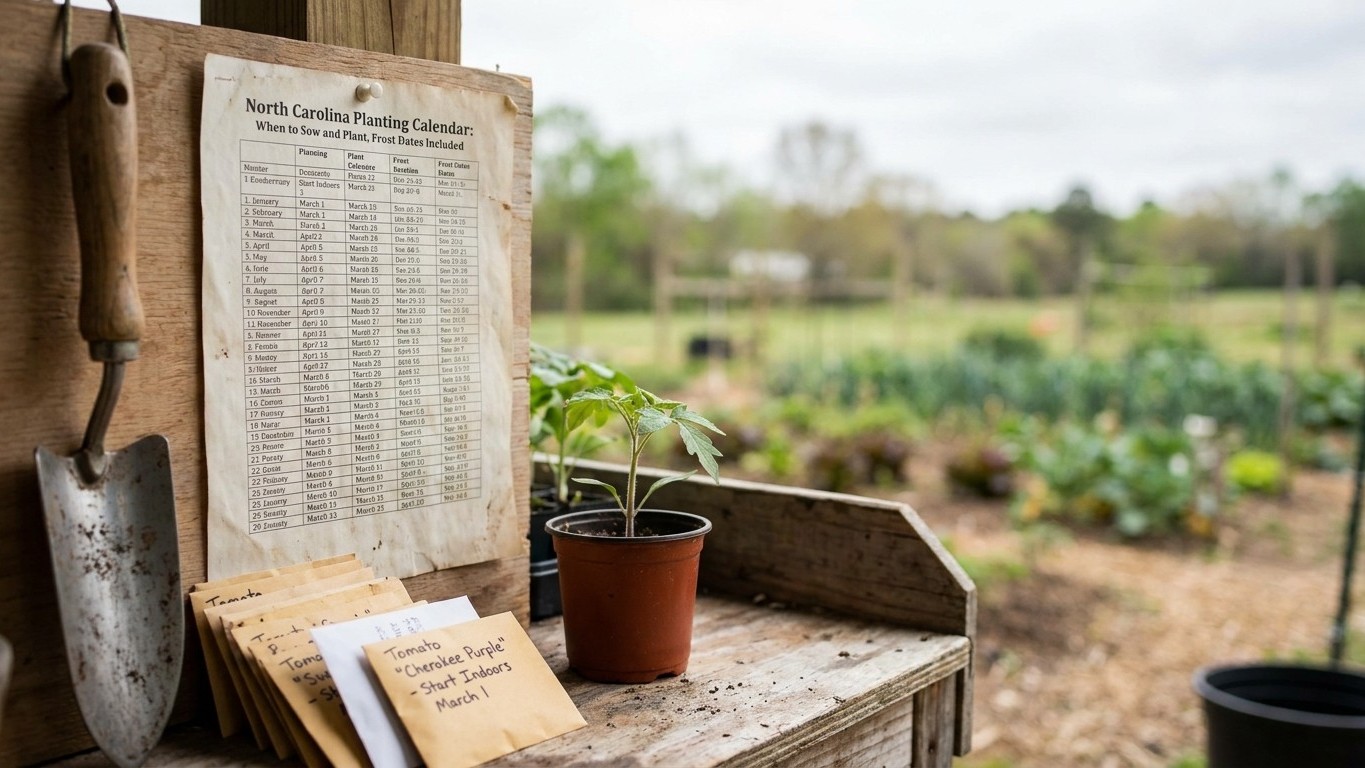

North Carolina’s growing season doesn’t start on a date you can circle on a calendar — it starts on your last frost, and around Charlotte that’s somewhere between March 23 and April 5. Push west into the mountains and you’re waiting weeks longer; drop toward the coast and you can plant weeks sooner. So the first move isn’t buying seed, it’s looking up your own county’s frost record and lining it up against that Piedmont window, because everything else in this calendar is built off that one number.
The frost window in North Carolina

NOAA’s 1991-2020 climate normals for the Charlotte area put the last spring freeze between March 23 and April 5, and the first fall freeze between October 30 and November 8. Those two windows bracket the growing season for the Piedmont, the band of rolling terrain running through Charlotte and Greensboro. Everything in this calendar starts from that pair of dates — and since the last frost typically clears right around the start of April, it’s worth checking What to Plant in North Carolina in April for the specifics of that transition month, moving into the heart of summer with What to Plant in North Carolina in July, and later in the season, What to Plant in North Carolina in August for guidance on the late-summer window before the first fall freeze. As that first freeze approaches, What to Plant in North Carolina in November lays out what can still be tucked in before winter sets in, and once the growing season wraps up, What to Plant in North Carolina in December covers what little can still go in the ground during the coldest, dormant stretch of the year.
Charlotte sits at a moderate elevation in the middle of the state, and North Carolina covers a lot of ground on either side of it. The Blue Ridge Mountains to the west run several weeks later in spring and correspondingly earlier in fall, so a gardener in Boone or Asheville should plan on a noticeably shorter season than these dates suggest. The coastal plain to the east, closer to sea level and warmed by the Atlantic, tends to clear its last frost earlier and hold off its first fall frost longer. Gardeners just south of the state line work with an earlier spring frost date still, covered in the South Carolina Planting Calendar. If you garden outside the Piedmont, treat the Charlotte dates as a starting point and adjust, not as your own frost dates.
What the range means for your growing season
Because both frost dates are ranges rather than single days, the growing season itself is a range too. Counting from the earliest possible last frost (March 23) to the latest possible first frost (November 8) gives close to 230 frost-free days in a mild year. Counting from the latest last frost (April 5) to the earliest first frost (October 30) gives closer to 208 days in a slower year. Plan around the shorter number for anything you can’t afford to lose, and treat the longer number as bonus time for a second planting or an extended harvest.
A season of 200-plus frost-free days is generous by national standards, long enough for two full rounds of many crops if you time the transitions instead of trying to run everything from a single frost-free start date. For a month-by-month breakdown of what to get in the ground first, see What to Plant in North Carolina in January, and for guidance on late-summer succession planting, see What to Plant in North Carolina in Septembera in January, and once the season is underway, check out What to Plant in North Carolina in March for the window when most Piedmont gardeners get serious about their first plantings.a in January.
Cool-season crops
Peas, spinach, lettuce, brassicas (broccoli, cabbage, kale, collards) and root crops like carrots, beets, and radishes all tolerate a light frost and grow — and for gardeners eager to get a head start, our guide on What to Plant in North Carolina in February covers exactly which of these can go in the ground before the last frost even arrives poorly once the weather turns hot. These go into the ground while the last spring freeze is still a real possibility, not after it.
Timing against the frost date, not the calendar
Instead of picking a calendar date, count backward from the Charlotte last-frost window of March 23 to April 5, adjusting earlier for the coastal plain and later for the mountains. Peas and spinach seed can go into workable soil while that window is still open, since both germinate in cold soil and shrug off a freeze that would kill a tomato outright. Direct-seeded pea seed rots if the soil is too cold and wet, so gardeners wait for soil that can actually be worked rather than a fixed date, then get seed in while frost risk is still present. Lettuce and the hardier brassicas follow similar logic: set out transplants a few weeks ahead of the last frost date, then direct-seed a bit later once the soil has started to warm.
Root crops split into two groups. Carrots, beets, radishes, and turnips are direct-seeded and don’t transplant well, so they go into the ground as soon as the soil can be worked in late winter, well ahead of the frost window closing. Radishes are the fastest of the group and can be resown every couple of weeks through the whole cool season for a steady supply.
- Peas and spinach: direct-seed while the frost window is still open
- Lettuce and hardy brassicas: transplant a few weeks before last frost, direct-seed slightly later
- Carrots, beets, radishes, turnips: direct-seed as soon as soil is workable
The main risk with cool-season crops in North Carolina comes from heat rather than cold. Once the weather warms into a real spring pattern, lettuce and spinach bolt toward flower and lose quality fast. The practical planting window is bounded on one side by frost and on the other by the arrival of spring heat, which in the Piedmont tends to follow the last frost date by only a matter of weeks.
Warm-season crops

Tomatoes, peppers, squash, beans, and corn are killed outright by frost, so the last-frost date is a floor, not a target. Soil temperature matters more than the calendar: warm-season seed and transplants stall or rot in cold soil even after the air has stopped freezing. Setting transplants out early April to mid April, comfortably after the March 23 to April 5 Charlotte last-frost window has closed, gives most warm-season crops the head start they need.
Counting backward for indoor starts
If you’re starting tomatoes indoors, count back roughly six to eight weeks from your intended transplant date rather than from the frost date itself. With a transplant target of early to mid April, that puts seed-starting indoors sometime in late winter, adjusted for your own setup and how fast a given cultivar grows.
Catalogue days-to-maturity figures are counted from the transplant date, not from seed, and they shift by a week or two depending on the season’s heat. The table below shows the range calculated for the Charlotte last-frost window: a transplant set out early April to mid April leaves well over 100 days of margin before the first fall frost for every variety listed, so the limiting factor is usually taste and use rather than running out of season.
| Variety | Days to maturity | Type | Notable resistance | First ripe (calculated) |
|---|---|---|---|---|
| Sakura | 55 | Indeterminate | Nematodes, ToMV, Fusarium 1 & 2 | mid June |
| Edox | 55 | Indeterminate | Nematodes, ToMV, Fusarium 1 & 2 | mid June |
| Valentine | 55 | Indeterminate | Early Blight (Intermediate) | mid June |
| Glacier | 55 | Determinate | None listed | mid June |
| Sun Gold | 57 | Indeterminate | ToMV, Fusarium 1 | mid June |
| Supersweet 100 | 60 | Indeterminate | Verticillium, Fusarium 1 | mid June |
| Juliet | 60 | Indeterminate | Late Blight, Early Blight (Intermediate) | mid June |
| Amalfi | 68 | Determinate | Nematodes, Late Blight, Early Blight (Intermediate) | late June |
| Cherokee Purple | 72 | Indeterminate | None listed | late June |
| Big Beef Plus | 72 | Indeterminate | Nematodes, Gray Leaf Spot, ToMV | late June |
| Tiren | 75 | Indeterminate | Verticillium, ToMV, Fusarium 1 | early July |
| Granadero | 75 | Indeterminate | Nematodes, Verticillium, ToMV | early July |
| San Marzano II | 78 | Indeterminate | None listed | early July |
| Celebrity Plus | 78 | Determinate | Nematodes, Gray Leaf Spot, ToMV | early July |
For a fast salad tomato with strong disease resistance, Sakura and Edox both reach 55 days from transplant and carry resistance to nematodes, tomato mosaic virus, and two races of fusarium wilt, ripening by mid June from an early to mid April transplant. At the other end of the table, a paste tomato like San Marzano II needs 78 days and won’t ripen until early July, still leaving well over 100 days before the Charlotte-area first fall frost arrives.
Peppers follow tomatoes by a week or two since they’re even more sensitive to cold soil. Cucurbits (squash, cucumbers, melons) and beans are usually direct-seeded once the soil has warmed further, after the frost window has fully closed rather than right at its edge. Sweet corn is planted in blocks rather than single rows for reliable pollination, and successive plantings two to three weeks apart extend the harvest through summer.
The fall planting window
Fall planting works backward from the first fall frost rather than forward from spring. NOAA’s 1991-2020 normals put that date for the Charlotte area between October 30 and November 8, again running later on the coastal plain and earlier in the mountains. To find a fall sowing date, take a crop’s days-to-maturity, add a margin of one to two weeks for the slower growth that comes with shortening daylight and cooling soil in September and October, and count back from the earlier end of the frost range so a timely frost isn’t the thing that decides the outcome.
Crops that improve after a frost
Kale, collards, and other brassicas taste better after a light freeze. Cold converts some of the starch in their leaves to sugar, which is why fall collards picked after the first frost are noticeably sweeter than the same plant picked in September. Carrots and parsnips left in the ground do the same thing with their roots, and many gardeners deliberately leave a fall carrot bed in place until after the first freeze rather than harvesting early.
Spinach and lettuce can also go in for a fall crop, timed so they reach usable size before the shortest, coldest part of the year rather than trying to grow through it. A fall sowing of these crops needs to start earlier relative to the frost date than the spring sowing does, because the days are getting shorter instead of longer, which slows growth even before the cold arrives.
Root crops grown for fall storage (beets, turnips, and a second round of carrots) go in with enough lead time to size up before growth slows in the cooler, shorter days of October. Because the fall frost date in North Carolina is a range rather than a fixed day, treat the early end of the range (October 30 for the Charlotte area) as the planning date for anything a hard freeze would end, and treat the later end as a bonus rather than something to count on.
Garlic runs opposite to this logic: cloves go into the ground in fall for harvest the following summer, planted with enough time to root before the ground freezes hard but after summer heat has broken. That’s a separate calculation from the frost-date arithmetic used for the vegetables above, and it’s worth checking county-specific guidance rather than guessing at it.
Reading a planting calendar properly
Treat these dates as a starting point, not an instruction, and adjust for what’s actually happening in your own yard.
What shifts the date in your yard
Elevation is the biggest factor. Every rise of a few hundred feet delays the last frost and hastens the first one, which is why gardeners in the North Carolina mountains work with a meaningfully shorter season than the Charlotte numbers describe, and why a calendar built for a much colder, shorter-season state like Maine, covered in the Maine Planting Calendar, would push every one of these dates weeks later still. Urban heat matters too: a garden against a south-facing brick wall in the middle of a city holds warmth overnight and can run a week or two ahead of an open field outside town, even at the same elevation. Low-lying ground where cold air pools, a hollow or the bottom of a slope, frosts earlier and harder than the surrounding area, sometimes by more than the stated range would suggest.
A late cold snap after what looked like a safe planting window is the most common way gardeners lose a warm-season crop. The NOAA range for Charlotte’s last frost already reflects thirty years of variation, but any single year can still fall outside it. Watching your own thermometer and soil in the two weeks around your planned planting date catches what a regional average cannot.
Keep a simple record from year to year: the date you actually saw the last frost, the date the ground was workable, when a given crop first flowered or bolted. After two or three seasons, your own log will be a better predictor for your specific yard than any published range, including this one.
Local help
For frost dates and soil-test recommendations specific to your county, contact NC State Extension, the state’s land-grant extension service. Every county has its own office, and a county agent can confirm how far your local dates diverge from the Charlotte figures used throughout this calendar, along with soil pH and fertility numbers a state-wide guide can’t give you. A soil test through your county office is worth doing before your first planting of the season. For more North Carolina growing topics tied to this same frost window, see our North Carolina guides.
Common questions
Can I plant tomatoes before the last frost date if I cover them?
A row cover or wall of water buys you some protection from a light freeze, but it doesn’t fix cold soil, which is what actually stalls warm-season transplants. Most gardeners get better results waiting for the Charlotte-area window of early April to mid April than pushing earlier under cover.
My county’s frost date seems different from Charlotte’s. Which one do I use?
Use your own, if you know it. The Charlotte figures in this calendar are a Piedmont reference point, and NC State Extension’s county offices can tell you how your local dates actually compare, especially if you’re in the mountains or on the coastal plain.
Is it too late to start a fall garden if I missed the count-back date?
Not necessarily. A faster-maturing cultivar or crop can often still fit before the first fall frost even if the original plan is off the table, and a cold frame or row cover can stretch the harvest a bit further into the range between the earlier and later fall frost dates.
Do transplants need to be hardened off before going outside?
Yes. Seedlings grown indoors or in a greenhouse need several days of gradually increasing outdoor exposure before they go into the ground full-time, or the sudden change in light, wind, and temperature can set them back even after the frost risk has passed.
Can I get two rounds of tomatoes out of one North Carolina season?
It’s possible with a short cultivar. Something like Sakura or Edox, both 55 days from transplant, ripens by mid June from an early to mid April transplant and leaves enough of the season left, well over 100 days to the first fall frost, to consider a second planting for a fall crop in areas with a long enough remaining window.
Some gardeners layer an older custom on top of frost dates: planting by the moon, which we explain as almanac tradition, not fact.
Related guides
- Virginia Planting Calendar: When to Sow and Plant, Frost Dates Included
- Tennessee Planting Calendar: When to Sow and Plant, Frost Dates Included
- South Carolina Planting Calendar: When to Sow and Plant, Frost Dates Included
- When to Plant Melons in North Carolina
- When to Plant Onions in North Carolina
- What to Plant in North Carolina in October