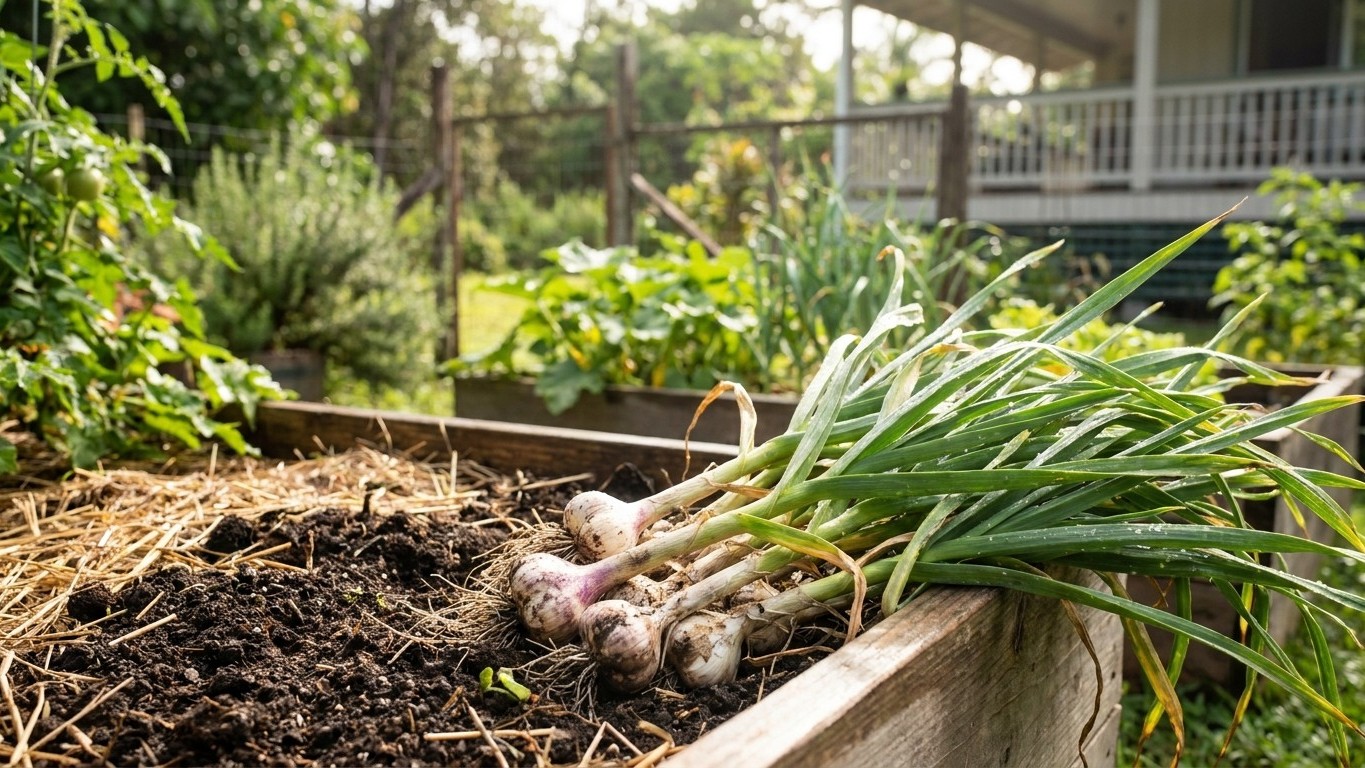

There isn’t a frost date to count back from in Hawaii. NOAA’s 1991-2020 Climate Normals for the Honolulu-area station (USW00022521) record zero days per year at or below 32°F, and every freeze-percentile field for that station comes back not computable, because a freeze simply doesn’t happen where people garden in this state. The action that replaces the frost countdown: set your planting date from the start of your district’s cooler, drier stretch, and lean on elevation and rainfall instead of a calendar frost line.
The short answer for Hawaii

There’s no frost to count back from here, so forget the calendar math you’d use anywhere else — Hawaii answers this question with rain instead of freeze. Garlic still wants a cool, dry stretch to root into before it bulbs and cures, so the day that matters is the day your district’s wet season starts to break, not some date lifted off a mainland frost chart. Go check when your own ground typically dries out on top after the rains ease, factoring in how high up you are and which side of the island you’re on, and plant from that day, not from a countdown.
That changes what “When to Plant Garlic” even means here. On the mainland, growers count back a set number of weeks from the average first fall freeze so the cloves root before the ground locks up. Hawaii has no ground-lock event to plan around. Instead, the calendar that matters is built from two things: the arrival of the cooler, drier months in your specific district, and how much elevation you have to work with. Garlic bulbs best after some sustained cool, and it cures best in a dry spell near harvest, so those two windows, cool and dry, are what you’re actually timing your planting against.
The seasonal arc itself doesn’t change: garlic still goes into the ground in autumn and comes out the following summer, the same rhythm as everywhere else garlic is grown. What moves is the trigger. Instead of watching a frost forecast, a Hawaii grower watches rainfall records and elevation, and picks the start of the local dry season as the signal to plant rather than a freeze date that will never arrive.
Working it out for your own garden
Since there’s no frost midpoint to subtract weeks from, the arithmetic runs the other direction. Instead of counting backward from a freeze date, you’re counting forward from the point your district typically drops out of its wettest months. That point isn’t the same island to island, or even valley to valley on the same island, which is exactly why a single statewide planting date doesn’t exist for this crop the way it might in a state with one dominant climate.
What to check before you pick a date
Three things move the timing meaningfully: how high your garden sits, whether it faces the windward or leeward side of its island, and what the local rainfall pattern looks like in a normal year. None of these are numbers this article can hand you as a single figure, because they change from one ridge to the next. What you can do is work through them for your own plot:
- Note your approximate elevation. Gardens higher up run cooler than gardens near sea level, and garlic responds to that cooling even without frost.
- Note your exposure. Windward slopes catch the trade winds and the rain that rides them; leeward slopes sit in a rain shadow and dry out sooner.
- Track when your own rainfall typically eases. That eased stretch is your practical planting window, not a date on a statewide chart.
- Check your soil drainage. Heavy rain sitting around a clove does more damage here than any amount of cool ever will.
Put those together and you get a district-specific answer, not a state-specific one. A garden with good elevation on a leeward slope, where the wet season breaks earlier and drainage is naturally better, can often go in earlier than a low, windward garden that stays wet later into the year. Neither is wrong. They’re just answering a different local question, which is the point: Hawaii’s planting calendar is built district by district, and the frost-based method the rest of the country uses simply has no anchor point to give you here.
Once you’ve settled on a site using the general steps laid out in Growing Garlic in Hawaii, this elevation-and-rainfall exercise is the piece that turns “sometime in fall” into an actual working date for your own beds.
What changes across Hawaii
The windward and leeward split does more to change garlic timing here than anything else. Windward districts, the ones facing directly into the trade winds, such as the Hilo side of the Big Island, stay wetter for longer into the year and take longer to reach the drier stretch garlic wants before planting. Leeward districts, like the Kona coast on the same island, sit in a rain shadow and dry out sooner, which generally opens the planting window earlier for a grower there.
Elevation cuts across that same split. Upcountry areas like Kula on Maui and Waimea (Kamuela) on the Big Island sit high enough that they run noticeably cooler than the coastal towns below them, even without ever touching freezing. That extra cool is useful for garlic, particularly for the varieties that lean toward needing some chill to bulb well, and it’s part of why upcountry growers often see better bulb formation than a grower working the same variety at sea level a few miles away.
Kauai’s north shore and windward valleys generally hold more year-round rainfall than the island’s south side, which shifts the “dry enough to plant” moment later there than it would be on a drier stretch of coastline. None of this means one part of the state is simply “better” for garlic. It means the planting window is a local calculation, not a state one, and the district you’re actually gardening in matters more than the island name on the map.
The mistakes this climate punishes
The frost-based mistakes that ruin a mainland garlic crop, planting too early into warm ground or too late for roots to establish before a freeze, don’t apply here because there’s no freeze to miss. The mistakes that actually cost a Hawaii grower a crop are different, and they’re mostly about moisture and chill, not cold.
Choosing the wrong type for a winter that never really arrives
Hardneck garlics such as German Red, Chesnok Red, Duganski, Bavarian Purple, Blue Music, Georgian Crystal, Georgian Fire, Fall Festival and Ivan generally want a real stretch of cold to bulb up properly. Plant one in a low, warm Hawaii garden with no cold coming and you can end up with a plant that grows a healthy-looking top and never forms a proper bulb underneath. Softneck types such as Early Red Italian, Inchelium Red, Italian Late and Lorz Italian generally need much less chill to bulb reliably, which is why they’re worth weighing more heavily for a warm, non-freezing garden. The full rundown of which type suits which situation here is in Garlic Varieties That Suit Hawaii Winters.
Ignoring what warm, wet soil does to disease pressure
UC IPM’s Pest Management Guidelines for onion and garlic (UC ANR Publication 3453) lay out the temperature ranges several major garlic diseases need to develop, and Hawaii’s air temperatures sit inside more of those ranges, for more of the year, than a temperate garden ever does.
| Disease | Published temperature range | Months in range (growing season) | Pathogen |
|---|---|---|---|
| Fusarium basal rot | 59-90°F | 11 of 11, including 6 at optimum | Fusarium oxysporum f. sp. cepae |
| Pink root | 75-85°F (optimum) | 7 of 11, all at optimum | Setophoma terrestris |
| White rot | 50-75°F | 4 of 11 (Dec-Mar) | Sclerotium cepivorum |
| Southern blight | 86-95°F (optimum) | 0 of 11 | Sclerotium rolfsii |
Those figures are published soil temperature ranges being compared against air temperature means, and a monthly average hides plenty of daily swing, so treat the count as a measure of how often the window is open, not a forecast of infection. It’s also drawn from one reference station near Honolulu, and conditions differ around the state. The zero-month reading for southern blight does not mean the disease can’t occur, it means the mean air temperature rarely sits in its optimum range. Infected seed cloves can introduce any of these diseases regardless of climate. The practical response is the same everywhere but matters more here: buy clean seed stock, and never plant into a bed that stays soggy, since standing moisture is what actually turns a warm month into a rot outbreak.
Checking this against your county
Rainfall and elevation patterns shift enough across the state that county-level guidance is worth pulling before you commit a whole bed. The University of Hawaii’s College of Tropical Agriculture and Human Resources (CTAHR) extension service is the place to check for guidance specific to your island and district. A quick call or visit to your local CTAHR office is the fastest way to confirm whether your particular valley or upcountry slope runs earlier or later than the general pattern described here.
Common questions
Do I even need to worry about frost dates for garlic in Hawaii?
No. NOAA’s 1991-2020 Climate Normals show no measurable freeze at the Honolulu-area station, and frost in this state occurs only on the high summits, never in a garden. Plan around rainfall and elevation instead of a frost calendar.
Can hardneck garlic actually grow in Hawaii or should I not bother?
It can grow, but it often struggles to bulb properly without a real cold spell, since hardneck types generally need more chill than a warm, frost-free garden provides. Softneck types tend to be the more forgiving choice at lower, warmer elevations, with hardnecks worth trying mainly in the coolest upcountry spots you have access to.
Is sea level too warm to grow garlic in Hawaii at all?
Sea level isn’t off limits, but it’s harder, since the extra warmth and the wetter stretches of the year raise the risk of the basal rot and pink root problems covered above. An upcountry site, or at least good drainage and careful timing around your local dry season, improves the odds considerably.
How long does garlic actually sit in the ground once I plant it here?
It follows the same general arc as anywhere else garlic is grown: planted in autumn and lifted the following summer. The exact stretch depends on your variety and your local growing conditions rather than a fixed count of days, so watch the foliage and the bulb rather than the calendar alone as harvest approaches.
Some gardeners also time this by the Moon: when to plant garlic by the moon, as almanac tradition rather than fact.