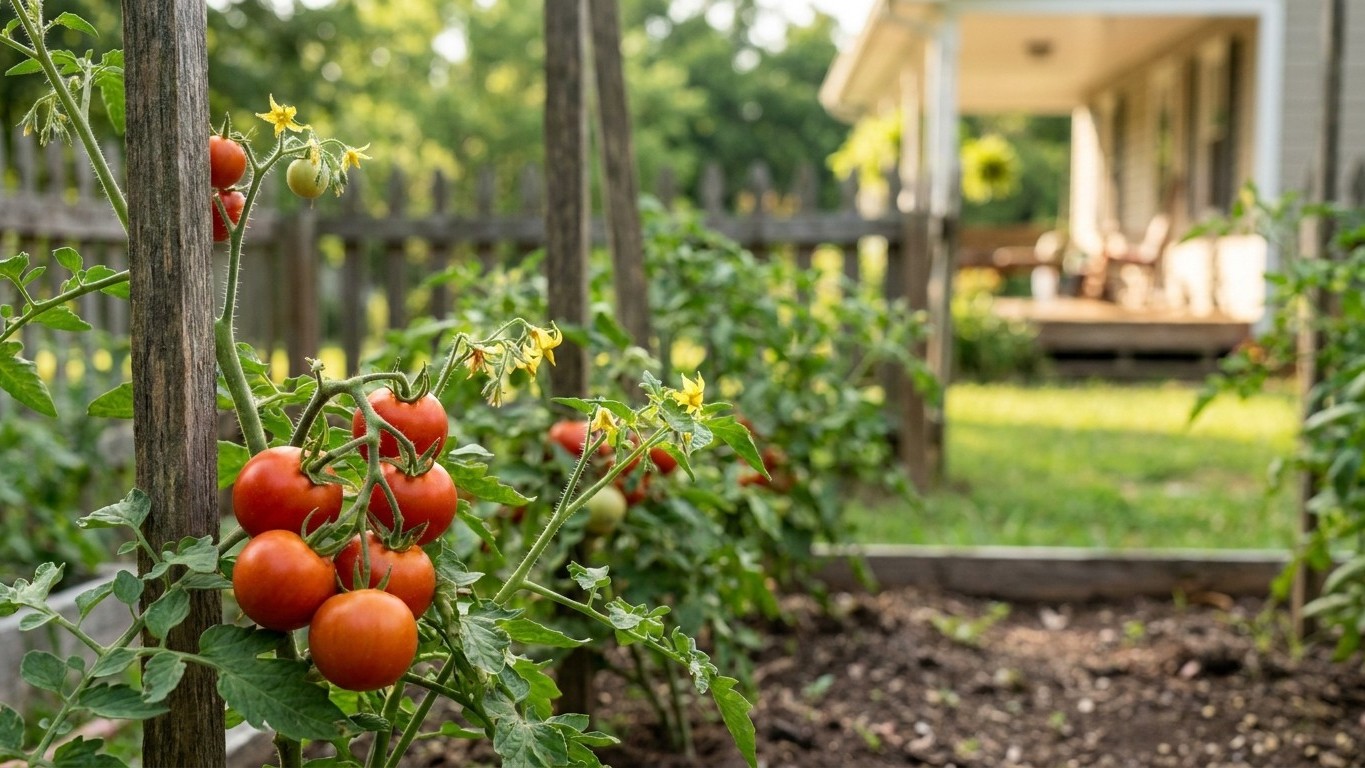

Nashville’s frost data draws a line that gets treated like gospel across the entire state, but that early-April window belongs to one station in Davidson County. Head up toward Knoxville’s foothills or Chattanooga’s ridges and the same probability curve shifts later, sometimes by weeks. Tomatoes planted on faith in a single number are the ones that get bitten by a freeze the chart never accounted for.
When to plant Tomatoes in Tennessee

The frost window from NOAA’s 1991-2020 normals, measured at the Nashville station, gives you the anchor point for the whole season. That March 31 to April 12 range reflects a 30 to 70 percent probability of a 32°F freeze, meaning frost is still a real possibility on either side of it in an average year. If you garden in Knoxville, Chattanooga, or anywhere with more elevation than Nashville, push your own timeline later rather than trusting this figure directly. It’s measured at one station, and Tennessee’s terrain varies enough that a date good for Davidson County can be two or three weeks early for the mountains.
Starting seed indoors
Tomato seed needs six to eight weeks of growth under lights before it’s ready to go in the ground. Counting back six to eight weeks from the Nashville frost window puts indoor sowing at early February to early March, depending on which end of the frost range you’re aiming for and how much buffer you want. If you’re gardening in a colder pocket of the state, shift this later by the same amount you shift your transplant date. Keep the seedlings under fluorescent or LED grow lights for 14 to 16 hours a day; a sunny windowsill alone almost always produces leggy, weak stems.
Hardening off and transplanting
About a week to ten days before you plan to set plants outside, start hardening them off. Move the trays outdoors for an hour or two the first day, in a shaded, wind-protected spot, and add an hour or two of exposure each following day. By the end of that stretch the plants should be able to sit outside all day in full sun without wilting. Skipping this step is the single most common reason transplants stall or die within days of going in the ground.
Don’t rush the actual planting date. Even after the NOAA frost window closes, soil temperature matters more than the calendar for tomatoes, since cold soil stunts root growth even if the air stays above freezing. Many Nashville-area gardeners wait a week or two past the tail end of the frost window before setting plants out, which also gives a cushion against a late cold snap. If a frost warning comes through after you’ve transplanted, cover plants overnight with a sheet, cloche, or overturned bucket.
Soil and site preparation
Tomatoes want full sun, at least six to eight hours a day, and a spot with nothing shading them from the east or south as the season goes on. Pick the site now, even if planting is weeks off, so you have time to fix what’s wrong with it.
Working the bed
Tomatoes need soil that drains well but holds enough moisture to avoid swinging between soggy and bone dry, since that swing is what causes blossom end rot and fruit cracking later on. Heavy clay, common across much of Middle and West Tennessee, benefits from a few inches of compost worked into the top eight to ten inches of soil weeks before planting, not the day of. If the ground stays wet and slow to warm in spring, raised beds or mounded rows solve that faster than amending in place.
Get a soil test done through your county extension office before you guess at fertilizer needs. Tomatoes are heavy feeders and a test tells you whether you’re short on phosphorus or potassium specifically, rather than throwing a generic fertilizer at the bed and hoping. Lime, if your test calls for it, needs time to adjust soil pH, so apply it as early in spring as you can rather than at transplant time.
Spacing and layout
Space indeterminate varieties 24 to 36 inches apart in rows 3 to 4 feet apart if you’re staking or caging them; determinate types can go slightly tighter since they stay more compact. Crowded plants get less airflow, and poor airflow is exactly what fungal diseases like early blight need to spread. If you’re working in a small bed, one strong, well-supported plant per 2 to 3 square feet beats three plants stuffed into the same space and fighting each other for light.
Varieties that suit Tennessee
Tennessee’s growing season is long enough, once the March 31 to April 12 frost window closes, to ripen almost any tomato on the market, including 80-plus day heirlooms. The bigger question locally is disease pressure. Humid summers push early blight, late blight, and fusarium and verticillium wilts hard, so disease resistance codes on the seed packet matter more here than squeezing every last day out of a short season.
For an early harvest while you wait on the main crop, Sun Gold (57 days from transplant, indeterminate) and Sakura (55 days, indeterminate) both carry resistance to Fusarium Wilt race 1, with Sakura adding Tomato Mosaic Virus resistance and intermediate nematode tolerance. Supersweet 100 (60 days) resists both Verticillium Wilt and Fusarium Wilt race 1 and keeps producing cherry tomatoes right through the heat of summer.
For slicing tomatoes built to shrug off common regional diseases, Celebrity Plus (78 days, determinate) and Big Beef Plus (72 days, indeterminate) both carry resistance to nematodes, gray leaf spot, and tomato mosaic virus. Cherokee Purple (72 days) and Brandywine (78 days) are heirloom slicers with no listed disease resistance, so they’re a better fit for a gardener willing to watch closely and treat problems early rather than lean on genetics.
For sauce and paste tomatoes, Amalfi (68 days, determinate) resists nematodes and shows intermediate resistance to both early and late blight, which makes it a solid choice where blight has been an issue in past seasons. San Marzano II (78 days), Granadero (75 days) and Amish Paste (85 days) round out the paste options at different points in the season, with Granadero adding verticillium wilt and tomato mosaic virus resistance. Jasper (60 days) is worth naming for anyone who’s lost a cherry tomato crop to late blight before, since it carries high resistance to that disease specifically.
Days-to-maturity figures on every packet are counted from transplant, not from seed, and they shift by a week or so depending on the weather that particular season. Gardeners on the Cumberland Plateau, working a season closer in length to what growers face in Ohio, should lean toward the shorter end of this list, the same logic covered in our guide to growing tomatoes in Ohio.
| Variety | Days to Maturity | Type | Notable Resistance | Best For |
|---|---|---|---|---|
| Sakura | 55 | Indeterminate | Nematodes, ToMV, Fusarium 1/2 | Earliest cherry harvest |
| Sun Gold | 57 | Indeterminate | TMV, Fusarium 1 | Sweet early cherry |
| Supersweet 100 | 60 | Indeterminate | Verticillium, Fusarium 1 | Season-long cherry |
| Jasper | 60 | Indeterminate | Late blight, early blight | Blight-prone gardens |
| Amalfi | 68 | Determinate | Nematodes, late/early blight | Sauce, compact plants |
| Big Beef Plus | 72 | Indeterminate | Nematodes, GLS, ToMV | All-purpose slicer |
| Celebrity Plus | 78 | Determinate | Nematodes, GLS, ToMV | Compact, disease-resistant slicer |
| Amish Paste | 85 | Indeterminate | None listed | Long-season sauce |
What to plant alongside
Basil, planted between tomato plants, doesn’t change flavor in the ground despite the garden lore, but it does draw pollinators and fills space that would otherwise grow weeds. Borage does the same for bees and is worth including if fruit set has been spotty in past years. Marigolds, especially French marigolds, have shown some suppression of root-knot nematodes in university trials, which pairs well if you’ve chosen a nematode-resistant variety like Big Beef Plus or Granadero as extra insurance rather than sole protection.
Keep tomatoes away from potatoes, peppers, and eggplant in your rotation plan, since all four are nightshades that share the same soil-borne diseases, including early blight and verticillium wilt. Planting them in the same bed year after year builds up disease pressure in the soil that no amount of care fixes mid-season.
- Good neighbors: basil, borage, marigolds, onions, carrots
- Avoid: potatoes, corn (competes for nutrients and can shade tomatoes unevenly), fennel (suppresses many neighboring plants), any nightshade grown in the same bed the previous year
Corn and tomatoes are sometimes paired for space efficiency, but corn earworm and tomato fruitworm are the same insect, so planting them side by side can actually concentrate that pest rather than confuse it. The claim that companion planting alone controls hornworms or fruitworms doesn’t hold up under scrutiny. Treat companion planting as a support to good bed management, not a replacement for it.
Watering, feeding and support
Watering rhythm
Tomatoes want deep, consistent water rather than frequent light sprinkling. Aim for roughly an inch to an inch and a half a week, delivered in one or two deep soakings rather than a daily splash, and water at the base rather than overhead to keep foliage dry. Wet leaves sitting overnight are what let fungal spores take hold. A three-inch layer of mulch, straw or shredded leaves both work, keeps soil moisture even and cuts down on the splash-up that spreads soil-borne disease onto lower leaves.
Feeding
Work compost or a balanced fertilizer into the bed at planting, then hold off on heavy nitrogen once flowering starts. Too much nitrogen mid-season produces a lush plant with plenty of leaves and few tomatoes, since the plant puts its energy into foliage instead of fruit. A side dressing of a fertilizer higher in phosphorus and potassium once the first flower clusters appear supports fruit set better than another round of high-nitrogen feed.
Staking, caging and pruning
Indeterminate varieties, which is most of the list above, keep growing and producing until frost and need real support: a sturdy stake driven at planting time or a cage built from concrete reinforcing wire, which holds up better over a season than the thin cone cages sold at most garden centers. Determinate varieties like Celebrity Plus and Amalfi stay shorter and bushier and need less support, though a simple cage still keeps fruit off the ground.
Prune suckers, the shoots that grow in the joint between the main stem and a branch, on indeterminate plants to keep the plant from turning into an unmanageable tangle. Pinch them out while small, by hand, once a week or so through the first half of the season. Determinate varieties should not be pruned this way, since removing growth points reduces their total yield rather than improving it.
Common problems

Most tomato failures trace back to a handful of repeat offenders, and reading the symptom correctly saves you from treating the wrong problem.
Fruit and vine symptoms
- Blossom end rot: a flat, sunken, dark leathery patch on the bottom of the fruit, caused by inconsistent watering interrupting calcium uptake, not a calcium deficiency in the soil itself. Even watering fixes most cases.
- Cracking: rings or splits radiating from the stem end, usually after a heavy rain following a dry spell. Mulch and steady watering reduce it, though a hard downpour after weeks of drought will crack fruit no matter what you do.
- Leaf curl and yellowing: upward-curling leaves can be simple heat stress in July and August, but paired with mottling or stunted new growth it points to a viral infection, most often carried by aphids or whiteflies. Pull and destroy infected plants rather than composting them.
- Wilting despite wet soil: a strong sign of fusarium or verticillium wilt, both soil-borne fungi that clog the plant’s vascular system. There’s no cure once symptoms show, which is exactly why resistant varieties like Tiren or Granadero, both rated high for verticillium wilt, are worth choosing if you’ve had wilt problems in that bed before.
Pests
Tomato hornworms, large green caterpillars that strip foliage fast, show up across Tennessee gardens every summer and are easiest to control by handpicking them off in the early morning when they’re most visible. Stink bugs cause cloudy, discolored spots just under the skin of ripening fruit. Aphids cluster on new growth and the undersides of leaves, and a strong water spray or insecticidal soap handles light infestations before they need anything stronger. None of these should be assumed to be the dominant pest in your specific garden. Check with your county extension agent if an infestation looks unusual, since regional pest pressure shifts from year to year.
Pests that actually show up in Tennessee
The University of Tennessee Extension’s PB 595, You Can Control Garden Insects (rev. 2020), lists twelve or so insects for the whole vegetable garden, and most of them never touch a tomato plant. Squash vine borer, squash bug, spotted and striped cucumber beetles stay on squash and cucumbers. Imported cabbageworm, cabbage looper, diamondback moth and harlequin bug work the cabbage family. Mexican bean beetle sticks to beans, and root maggots go after seed corn, onion and cabbage roots. If you grow those crops alongside your tomatoes, keep them on your radar, but they are not a tomato problem.
Cutworms and flea beetles show up right at planting and through the first few weeks after. Cutworms sever a young transplant clean at the soil line overnight, so you find a healthy-looking seedling toppled over with no stem left standing. A cardboard collar pushed an inch into the soil around each transplant stops them cold. Flea beetles chew tiny round shot holes through young leaves, which can stunt a seedling before it gets going. Once plants have a few true leaves and some size on them, the damage matters much less.
Corn earworm, called tomato fruitworm on this crop, turns up later in summer and bores straight into green and ripening fruit, leaving a clean entry hole and rot working in behind it. Once a worm is inside the fruit, nothing you spray reaches it, so the fruit is lost. Checking developing fruit clusters every few days and removing damaged ones before the worm moves on to the next fruit is the only practical control in a home garden.
Colorado potato beetle will feed on tomato foliage as well as potato, leaving leaves skeletonized down to the veins, usually starting on the lower and inner leaves. The reliable home fix is checking leaf undersides for the bright orange egg clusters and crushing them before they hatch. Hornworms and aphids are already covered above and belong on this same watch list. UT Extension notes several of these insects run three to seven generations a season, which is why one clean pass through the garden in June never means you are finished for the year.
Harvest and end of season
Pick tomatoes when they’ve reached full color for the variety, whether that’s the deep red of Big Beef Plus or the near-black shoulders of Cherokee Purple, and give them a gentle twist rather than pulling straight down, which can tear the stem. Fruit that’s still firm but fully colored keeps a day or two longer on the counter than one picked dead ripe, which matters if you’re not eating or canning the same day.
Ripening off the vine
Tomatoes that show color but haven’t fully ripened will finish indoors at room temperature, out of direct sun, in three to five days. Never refrigerate a tomato you plan to eat fresh, since cold temperatures break down the compounds responsible for flavor and turn the texture mealy. Refrigeration is fine only for fruit you’ve already cut or that’s overripe and headed for the stockpot.
As frost approaches
When nights start turning cold in fall, watch the extended forecast rather than a calendar date, since NOAA’s frost data cited earlier only covers the spring side of the season. Once a hard frost is forecast, pick everything on the vine, including green fruit. Mature green tomatoes, meaning full-sized but unripe, wrapped individually in newspaper and stored somewhere cool and dark, will slowly ripen over several weeks and stretch your harvest well past the first freeze.
Local help
County-level frost dates, soil test results, and pest alerts specific to your part of the state go beyond what any general guide can safely tell you. The University of Tennessee Extension service runs offices in every county and is the right first call for a soil test or a pest you can’t identify. For more on other crops and seasonal timing across the state, our Tennessee guides cover the same regional variation.
Where to Go From Here
Everything about growing tomatoes in Tennessee comes back to that last frost date, so it’s worth working through the details in order. Start with the tomato planting dates guide, which counts backward from Nashville’s frost window to tell you when to start seeds indoors and when to move transplants outside. Once you know your timing, take a look at tomato varieties that ripen in time, since almost anything will mature here as long as the transplant goes in on schedule — the page walks through which ones make the most of that window. Finally, don’t skip the rundown on tomato pests in Tennessee, because the bugs show up on a calendar of their own tied to that same frost window, with flea beetles arriving on transplants right around the March 31 to April 12 mark, followed by aphids and Colorado potato beetles. Read the three together and you’ll have a full picture: when to plant, what to plant, and what to watch for once it’s in the ground.
Common questions
Can I plant tomatoes in Tennessee in March?
Only indoors, as seedlings. NOAA’s frost data for the Nashville station puts the last spring freeze between March 31 and April 12, and outdoor transplanting before that window closes risks losing the whole planting to a late cold snap. Gardeners east of Nashville or at higher elevation should wait even longer.
Why are my tomato leaves curling but the plant still looks healthy otherwise?
Simple leaf curl from heat and bright sun during a hot stretch is common and usually harmless if the rest of the plant looks normal and fruit set continues. It becomes a concern only when paired with yellowing, stunted new growth, or mottled leaf patterns, which point toward a viral infection instead.
Do I need to rotate where I plant tomatoes every year?
Yes, ideally on a three-year rotation away from any bed that grew tomatoes, potatoes, peppers, or eggplant the previous two seasons. These are the diseases, especially fusarium and verticillium wilt, that persist in soil for years and build up faster the more often nightshades occupy the same ground.
Is it too late to start tomatoes from seed if I missed the indoor sowing window?
Buying started transplants from a local nursery is a reasonable fallback and still lets you hit the outdoor planting window fine, since the plant’s age matters more than how it got started. Look for stocky, dark green transplants with no yellowing at the base rather than the tallest plant on the shelf.
Why did my tomatoes stop setting fruit in the middle of summer?
Extended heat, particularly nights that stay warm, interferes with pollen viability and causes blossom drop even on healthy plants. This is a known summer slump rather than a disease or pest problem, and fruit set typically resumes once temperatures moderate later in the season.