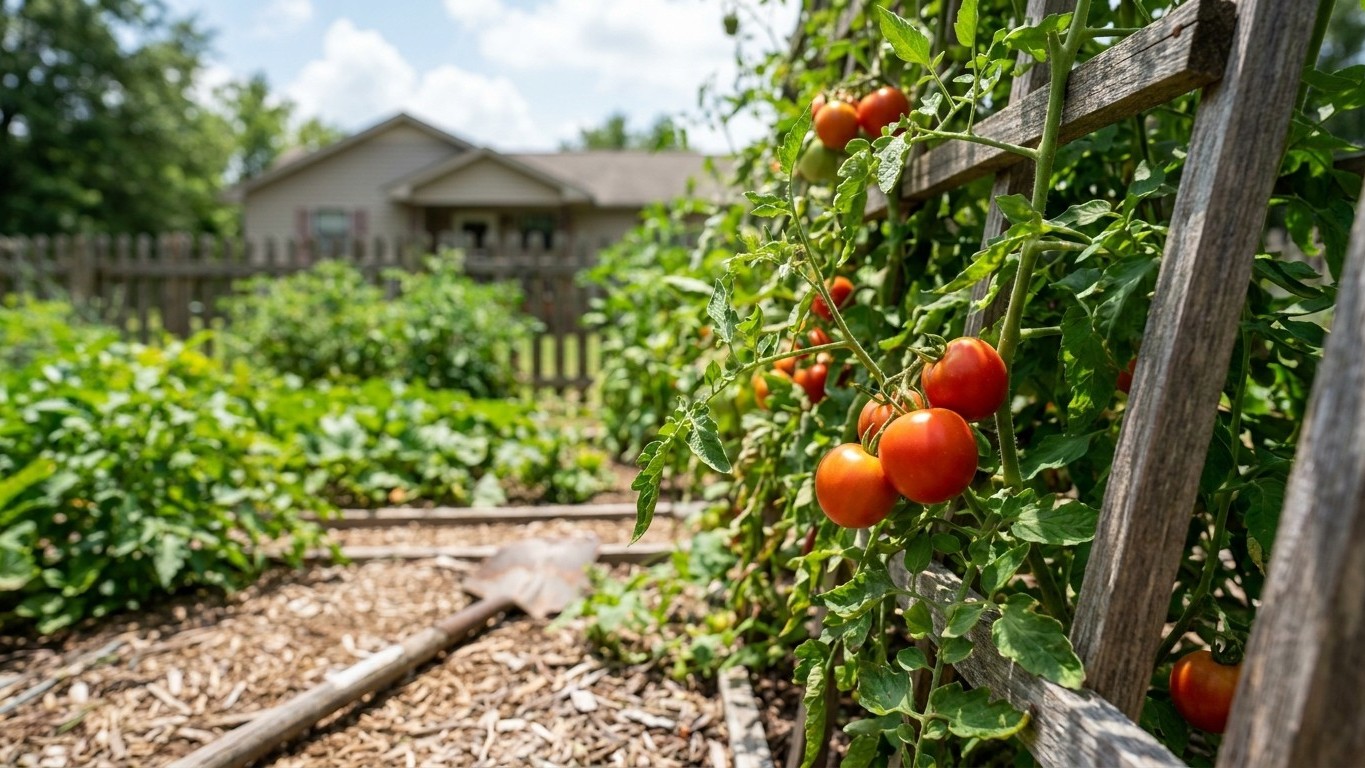

Tomatoes go into the ground in Arkansas once the real risk of a killing frost has passed, and near Little Rock the National Weather Service puts that light-frost date at April 3. NOAA’s 1991-2020 climate normals, measured at the Little Rock station (USW00013963), give a wider band for a hard 32F freeze, March 12 to March 28, but tomatoes suffer damage well before a hard freeze arrives. Check your own county’s date with the state extension service before a single transplant goes in the ground, since the Ozarks and other higher ground run colder and later than Little Rock.
When to plant Tomatoes in Arkansas

April 3 to October 31 — that’s the frost-free stretch Little Rock gardeners work with, and it’s long enough to change how you plant, not just when. Growers in Wyoming squeeze everything into a narrow transplant window and pick varieties around that pressure. Arkansas doesn’t force that choice. You’ve got room for quick cherry tomatoes and slow paste and heirloom types in the same bed, the same season, which changes the whole conversation below.
Arkansas’s frost-free stretch, from that April 3 spring date to the October 31 fall date the National Weather Service also tracks for Little Rock, runs long compared with high-elevation and short-season states. Growers in a place like Wyoming work with a far tighter transplant window, and it shows in how they choose varieties, something covered in Growing Tomatoes in Wyoming. Arkansas gardeners have room to grow both fast cherry tomatoes and slow-ripening paste and heirloom types in the same season.
Starting seeds indoors
Count back six to eight weeks from the April 3 transplant target and you land in early February to late February for gardeners working from the Little Rock date. Sow seed in trays or small pots indoors, keep the surface consistently damp until germination, and give the seedlings the brightest window or grow light you have once they emerge. Weak, leggy stems at transplant time almost always trace back to too little light during these first few weeks, not a problem with the variety.
Hardening off and transplanting out
Seedlings raised entirely indoors need a week to ten days outside before they go into the bed for good. Start with an hour or two in dappled shade, add time and direct sun each day, and cut back watering slightly so the plant toughens up rather than wilting the first hot afternoon it faces. Do not transplant before your local light-frost date has passed, and if a late cold snap is forecast right after you plant, cover the bed with row cover or an overturned bucket for the night rather than losing the crop. Gardeners well north of Little Rock or up in elevation should expect that date to land later, and the state extension service is the right place to check a county-level figure rather than guessing from the Little Rock number.
Soil and site preparation
Sun and soil
Tomatoes want at least six hours of direct sun, and more helps both fruit set and disease control, since foliage that dries quickly after rain or dew is less hospitable to the fungal diseases that build up in humid summers. Soil needs to drain well. Heavy clay, common in parts of the state, holds water around the roots long enough to cause rot and makes the inconsistent moisture that drives blossom end rot and fruit cracking later in the season. A raised bed or a mounded row solves this without reworking the whole yard.
Bed prep timeline
Work compost into the bed a few weeks ahead of planting rather than the same day, two to three inches worked into the top of the soil is a reasonable amount for a new bed. Skip a heavy dose of high-nitrogen fertilizer at this stage. It pushes leafy growth at the expense of flowers and fruit later on. Test soil pH before the season starts through the extension service rather than guessing, since Arkansas soils vary enough county to county that a blanket number would be misleading. Space indeterminate varieties 24 to 36 inches apart with rows 3 to 4 feet apart, and set determinate types slightly closer since they stay more compact. If you are staking or caging, drive the stakes or set the cages at planting time, not weeks later once roots have spread and a driven stake would slice through them.
Varieties that suit Arkansas
Matching days to maturity to the season
With roughly seven months between the April 3 spring date and the October 31 fall date near Little Rock, there is room for both quick cherry tomatoes and slow full-season types. Counting forward from an early-April transplant, a 55 to 60 day cherry tomato ripens by late May to early June, while a 78 to 85 day paste or heirloom tomato needs until mid-to-late June or into July. Either way there is comfortable margin before the fall frost date, though catalogue day counts are always measured from transplant and shift a week or two with how warm or cool the season runs.
| Variety | Days to Maturity | Type | Notable Resistance | Best For |
|---|---|---|---|---|
| Sun Gold | 57 | Indeterminate | Tobacco Mosaic Virus (High), Fusarium Wilt race 1 (High) | Earliest sweet cherry tomato |
| Sakura | 55 | Indeterminate | Nematodes (Int), Tomato Mosaic Virus (High), Fusarium Wilt races 1,2 (High) | Earliest of the whole list |
| Supersweet 100 | 60 | Indeterminate | Verticillium Wilt (High), Fusarium Wilt race 1 (High) | Heavy cherry yields all summer |
| Juliet | 60 | Indeterminate | Late Blight (Int), Early Blight (Int) | Grape tomatoes in humid, disease-heavy years |
| Jasper | 60 | Indeterminate | Late Blight (High), Early Blight (Int) | Best blight resistance in a cherry type |
| Amalfi | 68 | Determinate | Nematodes (Int), Late Blight (Int), Early Blight (Int) | Sauce tomato with a full disease package |
| Cherokee Purple | 72 | Indeterminate | None listed | Heirloom flavor, needs closer watching |
| Big Beef Plus | 72 | Indeterminate | Nematodes (Int), Gray Leaf Spot (High), Tomato Mosaic Virus (High) | Large slicer with broad resistance |
| Tiren | 75 | Indeterminate | Verticillium Wilt (High), Tomato Mosaic Virus (High), Fusarium Wilt race 1 (High) | Slicer for wilt-prone ground |
| Granadero | 75 | Indeterminate | Nematodes (Int), Verticillium Wilt (High), Tomato Mosaic Virus (High) | Paste tomato for wilt-prone ground |
| Celebrity Plus | 78 | Determinate | Nematodes (Int), Gray Leaf Spot (High), Tomato Mosaic Virus (High) | Compact slicer, good for cages or pots |
| Brandywine | 78 | Indeterminate | None listed | Classic heirloom flavor, long season |
| San Marzano II | 78 | Indeterminate | None listed | Canning and sauce |
| Amish Paste | 85 | Indeterminate | None listed | Longest-season paste tomato on the list |
Choosing by disease pressure
Arkansas summers run hot and humid, conditions that favor early blight and late blight once the canopy closes in. That makes Jasper, Amalfi, and Juliet worth a look for their blight resistance, and Big Beef Plus, Celebrity Plus, Tiren, and Granadero worth it for wilt and nematode resistance in ground that has grown nightshades before. Cherokee Purple and Brandywine carry no listed disease resistance at all, which does not rule them out, but it does mean they need more careful watering, mulching, and airflow to avoid the same fungal problems that resistant varieties shrug off.
What to plant alongside
Good neighbors
Basil shares the same sun and water needs as tomatoes and is worth the space for the kitchen alone, though the idea that its scent repels tomato pests has little real evidence behind it. French marigolds have a better case: research on Tagetes patula shows it suppresses root-knot nematodes in the soil, but mainly when grown as a season-long cover crop ahead of tomatoes, not as a single border plant tucked in beside them the same year. Borage and nasturtium both draw pollinators and predatory insects into the bed, and nasturtium doubles as a trap crop that pulls aphids off tomato foliage and onto itself.
Keep away
Potatoes, eggplant, and peppers are all nightshades like tomatoes, and planting them close together, or in the same ground year after year, spreads the same early blight, late blight, and Verticillium wilt spores between crops. Rotate tomatoes away from other nightshades rather than interplanting them. Corn shares an insect problem rather than a disease one: the corn earworm and the tomato fruitworm are the same species, and a bed of both crops side by side just concentrates the pest. Fennel is worth avoiding outright, since it releases compounds that stunt the growth of many neighboring plants, tomatoes included.
Watering, feeding and support
Watering and mulching
Tomatoes want roughly one to two inches of water a week, delivered at the soil level rather than sprayed over the foliage, since wet leaves sitting overnight are exactly what fungal disease needs to take hold. Water deeply and less often rather than a little every day, which pushes roots down instead of keeping them shallow and thirsty. A two to three inch layer of straw or shredded leaf mulch holds that moisture and stops rain from splashing soil-borne fungal spores up onto the lower leaves, which is usually how early blight gets started.
Feeding schedule
A balanced fertilizer worked in at planting gets the plant established, but heavy nitrogen through the middle of the season buys you a jungle of leaves and not much fruit. Side-dress after the first cluster of fruit has set with something lower in nitrogen and higher in potassium, which supports fruit development rather than more foliage.
Staking, caging and pruning
Indeterminate varieties, which is most of the list above, keep growing and setting fruit until frost and need a sturdy stake or cage five to six feet tall set at planting time. Determinate types like Celebrity Plus and Amalfi stay compact and stop growing once they set their fruit, so a shorter cage does the job and heavy pruning is unnecessary since it just removes fruiting wood. On indeterminate plants, pinch out the small suckers that form in the leaf axils on a weekly basis to keep the vine open. Good airflow through the plant matters more in Arkansas’s humid summers than it does in a dry climate, since a dense, unpruned tomato plant holds moisture and disease pressure a pruned one does not.
Common problems

Blossom end rot, cracking and leaf curl
Blossom end rot shows up as a sunken, leathery, brown-to-black patch on the bottom of the fruit, and it comes from calcium failing to reach the fruit during a dry spell that is then followed by heavy watering. It is a watering problem far more often than a soil calcium problem, so consistent moisture through mulch and a steady watering schedule fixes most cases. Cracking, the concentric rings or splits on the shoulder of the fruit, comes from the same root cause, a dry stretch followed by a sudden soak. Leaf curl on its own, with otherwise healthy-looking new growth, is usually just a heat and moisture stress response to Arkansas summer weather rather than disease. Leaves that are also yellowed, mottled, or stunted point toward a virus instead, which is where a resistant variety like Sun Gold earns its keep against Tobacco Mosaic Virus.
Wilts and poor fruit set
Fusarium and Verticillium wilt start as yellowing on one side of the plant or on the lower leaves, working upward until the plant collapses even in wet soil. Both are soil-borne fungi that persist in the ground for years once established, and a resistant variety plus rotation is the only real fix, which is why Sun Gold, Supersweet 100, Sakura, Tiren, and Granadero carry that resistance on the list above. Gardeners in other humid, disease-heavy climates face the same tradeoffs, and it is worth seeing how growers handle it in Growing Tomatoes in Delaware. Poor fruit set, flowers dropping without forming fruit, happens when nights stay warm for a stretch during the height of summer and pollen becomes less viable. There is nothing to spray for it. Keep the plant watered and healthy and fruit set typically resumes once nights cool off again.
Insect pests
- Tomato hornworm: a large green caterpillar with white diagonal stripes that strips leaves and chews into green fruit fast. Handpick it off, but check its back for small white cocoons first, those are a beneficial parasitic wasp already at work.
- Stink bugs: cause pale, cloudy spots just under the skin of the fruit. Hard to spray effectively, so keeping nearby weeds down helps more than a chemical fix.
- Aphids: cluster on new growth and the undersides of leaves. A strong spray of water or insecticidal soap knocks a light infestation back.
- Whiteflies: flutter up in a small cloud when the foliage is disturbed. Yellow sticky traps are the easiest way to track how bad the problem is getting.
Pests that actually show up in Arkansas
The University of Arkansas Division of Agriculture Cooperative Extension keeps a running list of summer garden insect pests for the state, and only four of the seven show up on tomato plants. Squash vine borer and squash bugs are cucurbit pests, going after squash and pumpkin vines rather than tomatoes, and scale insects mostly turn up on shrubs and ornamentals. If you grow squash or zucchini alongside your tomatoes, watch those separately.
Aphids are the one you find by accident, clustered on the underside of new leaves and along stem tips, leaving a sticky residue behind them. They build up steadily through the growing season rather than arriving all at once. A strong blast of water knocks most of a colony off, and insecticidal soap handles what’s left. Heavy infestations distort new growth before you notice the insects themselves, so check the undersides of leaves every week or two once plants are established.
Whiteflies scatter in a small white cloud when you brush a plant, which is usually how gardeners find them before they spot any actual damage. They feed the same way aphids do and leave the same sticky film on leaves. Yellow sticky traps near the plants catch adults, and insecticidal soap applied to leaf undersides handles nymphs.
Stink bugs show up as damage before insect: small, hard, discolored spots on the fruit itself, sometimes with a faint cloudy area underneath the skin where they’ve fed. They’re present all summer and hide well, so hand-picking in the early morning when they’re sluggish works better than trying to spray them out of hiding.
Japanese beetles peak from June through August, and their damage is unmistakable: leaves skeletonized down to the veins, with the green tissue eaten away between them. They feed in groups, so hand-picking into a jar of soapy water in the morning, when they’re slow-moving, keeps numbers down without reaching for a broad-spectrum insecticide that would also kill pollinators working the blossoms.
Harvest and end of season
Harvesting and ripening
Pick fruit once it has reached full color for the variety, or at the breaker stage, just starting to blush, if birds, splitting, or an incoming storm are a bigger worry than a few extra days on the vine. Ripen picked fruit at room temperature out of direct sun rather than on a sunny windowsill, which can cook the fruit rather than ripen it evenly. Skip the refrigerator for anything you plan to eat soon. Cold storage dulls both texture and flavor.
Closing out the season
The National Weather Service’s 36F light-frost date for Little Rock lands around October 31, and the nights leading up to it usually slow ripening well before the frost itself arrives. Once that date is close, pull every fruit off the vine, including full-size green ones, rather than risk losing them to frost overnight. Green tomatoes ripen indoors over a few weeks in a paper bag or a box, or go straight to the skillet as fried green tomatoes. Compost healthy vines at the end of the season, but bag and trash any plant that showed blight or wilt symptoms, since a home compost pile rarely gets hot enough to kill off those spores before next spring.
Local help
For a planting date, frost risk, and soil test specific to your own county, the University of Arkansas System Division of Agriculture’s Cooperative Extension Service is the right first call, reachable at uaex.uada.edu. The Little Rock figures are a starting point, not a statewide fact, and the extension office can tell you how much later your own county runs. Our other Arkansas guides cover the same kind of local timing for other crops around the state.
Where to Go Next
Once you’ve got a feel for the Arkansas tomato season, the details are where the real work happens. Start with timing: counting back from your frost window walks through why April 3 matters more than the hard-freeze date NOAA also publishes for Little Rock, since that number measures a different, lighter threshold entirely. Once you know your dates, the question turns to what to actually put in the ground — tomato varieties that ripen in time lines up days-to-maturity against the roughly eight months of frost-free growing season Little Rock’s climate normals give you, so you’re not caught picking green fruit in November. And once plants are in, the pests show up on schedule whether you’re ready or not: which pests actually show up here runs through the six that turn up almost every year, in the order they arrive — cutworms and flea beetles at transplant, aphids building through spring, then stink bugs and hornworms later on. Read the three together and you’ve got the season mapped from planting date to harvest to whatever’s chewing on the leaves in between.
Common questions
Can I plant tomatoes before the last frost date if I use a cover?
You can push the date a little earlier with row cover or a cloche, but a cold snap well below the light-frost threshold will still get through most home covers. It buys a few days of margin, not a few weeks, so it is not a substitute for waiting until your local date has actually passed.
Why did my tomato plant flower but not set any fruit?
Warm nights are the usual cause, since tomato pollen loses viability when nighttime temperatures stay elevated for a stretch. Keep the plant watered and fed through that period and fruit set typically picks back up once nights cool.
Should I remove all the suckers on an indeterminate tomato plant?
Not all of them, especially once summer heat sets in. Leaving a bit more foliage than usual in July and August helps shade the fruit and prevents sunscald, so ease off aggressive pruning during the hottest stretch of the season.
Can I grow tomatoes in containers on a patio in Arkansas?
Yes, and a compact determinate variety like Celebrity Plus or Amalfi handles a container better than a sprawling indeterminate type. Expect to water daily once summer heat arrives, since pots dry out far faster than a garden bed.
Is it too late to plant tomatoes in July?
Not necessarily. Many Arkansas gardeners set out a second round of transplants in mid-summer for a fall crop, choosing a shorter-season variety and counting back from the October 31 fall frost date near Little Rock rather than the spring date. Local nurseries often carry transplants through summer for exactly this reason.