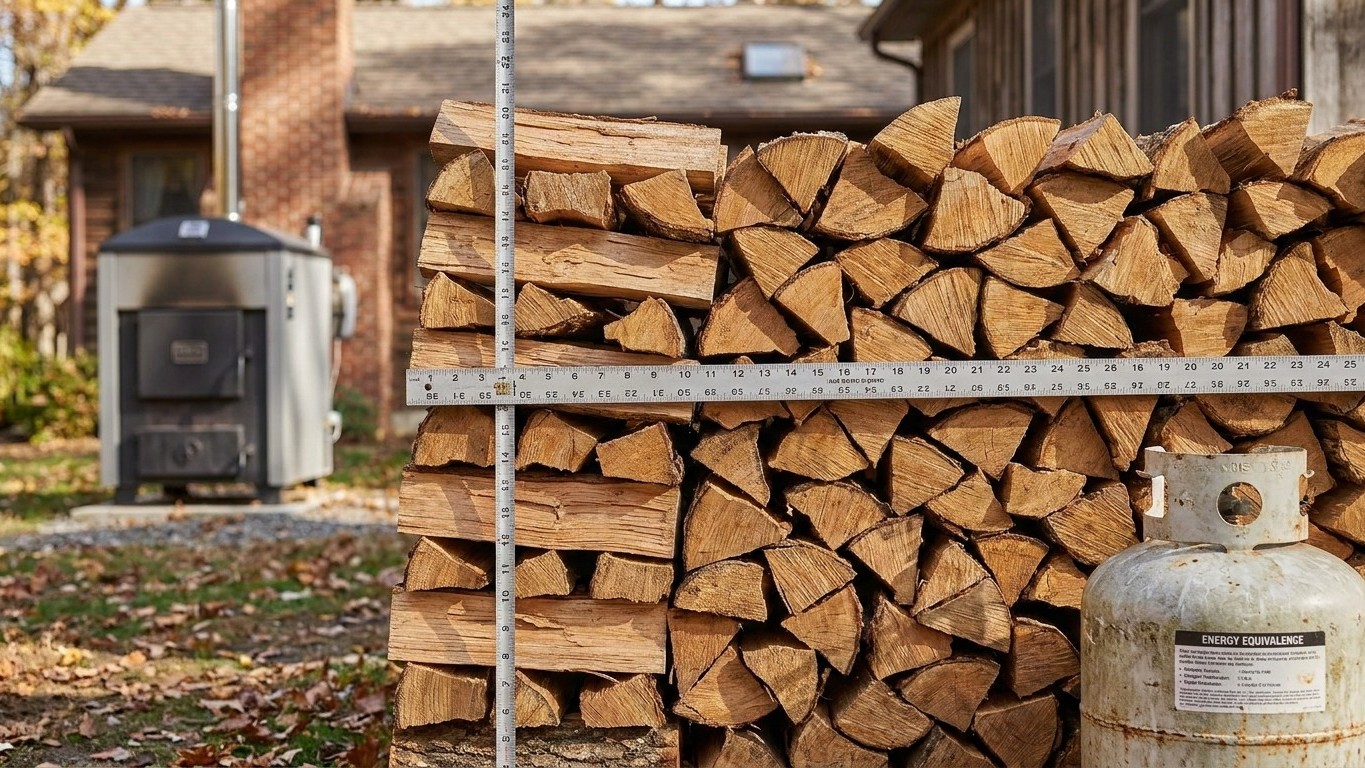

A cord of well-seasoned hardwood delivers about 20 million BTU, according to Michigan State University Extension. That’s the rough equivalent of 145 gallons of #2 fuel oil, or 215 gallons of propane. But that number only holds if two conditions are met: the cord is actually a cord, and the wood is actually dry—burn wet or unseasoned wood, or the wrong material entirely, and you’ll not only lose BTU output, you’ll likely run into the firewood glass-goes-black problem, the firewood fire-wont-catch problem, the firewood house-smells-of-smoke problem, the firewood wood-hisses-and-bubbles problem, discover that There Are Insects in Your Firewood, learn the basics of Bringing Firewood Indoors Without Bringing Its Insects, find out too late What You Should Never Burn, or learn Why You Should Not Move Firewood across county lines in the first place. Miss either one, and the math falls apart fast.
What a cord actually gives you

Twenty million BTU sounds abstract until you put it next to what’s already running your house. If your furnace burns fuel oil, a single cord of seasoned hardwood is doing the work of roughly 145 gallons of that oil. If you’re on propane, it’s closer to 215 gallons. That’s Michigan State University Extension’s figure, and it’s a useful yardstick for anyone trying to decide whether wood heat is worth the labor—though the real payoff depends on Sizing a Wood Stove for Your House correctly, understanding How Much Firewood a Winter Takes for your climate, along with the labor of Cutting Your Own Firewood, stacking, Splitting Firewood: When and How, and hauling—work that goes a lot smoother once you’ve sorted out The Tools a Firewood Season Actually Needs, and worth little at all if you later discover Your Woodpile Is Rotting—or, if you’d rather skip the cutting altogether, Finding Firewood Without Buying It—though the exact number depends heavily on which species you’re burning, since not all hardwoods deliver the same BTU per cord—softer, lower-density woods like Redcedar / Rocky Mt. Juniper as Firewood, Ponderosa pine as Firewood, Shortleaf pine as Firewood, or even a middling hardwood like American elm as Firewood fall well short of oak or hickory in output, while a mid-range option like Birch as Firewood lands somewhere in between, and a mid-range option like Elm as Firewood lands somewhere in between—how much of that heat actually reaches your living space depends on whether you’re burning it in an Open Fireplace, Insert or Stove, whether you know How to Light a Fire That Stays Lit, and whether you know the technique for Making a Fire Last Through the Night. Hickory firewood, for instance, sits near the top of the BTU chart, alongside dense options like Black locust as Firewood, well above more moderate performers like Ash as Firewood and lower-output species such as Willow as Firewood, and Birch as Firewood, though even it is outpaced by Osage orange as Firewood, with Bur oak as Firewood holding its own not far behind, well above softer hardwoods like Basswood firewood, with Green ash as Firewood falling somewhere in the middle of that range, while Hackberry firewood and Cottonwood firewood land somewhere in the middle to lower end of the pack (see Firewood by Species: What Actually Burns Well).
None of that comparison means anything, though, if the wood you bought isn’t actually dry, and the only real way to know for sure is by Measuring Firewood Moisture a cord. A cord is a specific, legally defined volume: a stack measuring 4 feet by 4 feet by 8 feet, which works out to 128 cubic feet. That’s it. Not an estimate, not a “roughly this size” pile in the back of a pickup truck. If a seller can’t tell you the stacked dimensions of what you’re buying, you have no way of knowing whether you’re getting 20 million BTU or half that—and species matters here too, since a cord of dense hardwood like White oak firewood, Sugar maple firewood, Honeylocust firewood, or even Mulberry firewood will outperform a cord of lighter, less dense species even when both are measured out to the exact same 128 cubic feet, or Red oak firewood outperforms a cord of something like Black walnut firewood, or other lighter-density options further down the BTU chart.rgy/heating-cooling/firewood/american-elm/”>American elm firewood, or something likergy/heating-cooling/firewood/elm/”>Elm firewood, which burns cooler and is notoriously harder to season, or Boxelder firewood, which sits even lower on the BTU scale despite being widely available, or a fruitwood like Apple & Crabapple firewood, prized more for its aromatic smoke than its raw BTU output and split.
This is where most firewood buyers get burned, often literally, by paying full price for a fraction of the wood. Terms like “face cord” or “rick” get thrown around as if they’re standardized units. They aren’t. A face cord is typically 4 feet by 8 feet, but the depth, meaning the length of the individual logs, is left undefined. A face cord stacked with 12-inch logs holds a third of the wood that one stacked with 24-inch logs does. Both get called a “face cord.” Both get sold at whatever price the seller feels like charging.
The fix is simple, even if it requires an awkward conversation. Ask for the measurements in feet, not the name of the unit. A true cord is 128 cubic feet, full stop. If someone quotes you a price per “cord” but can’t confirm the stack dimensions, you’re buying blind. Bring a tape measure if you have to, and brush up on the tactics sellers use to shortchange buyers by reading Buying Firewood Without Getting Cheated—and once you get the wood home, knowing the basics of Seasoning Firewood: Why Green Wood Steals Your Heat, and once you get the wood home, knowing the basics of Stacking and Storing Firewood properly will help you verify the volume yourself while keeping the pile seasoning correctly. It’s a strange thing to do at a farm stand or roadside pull-off, but it’s the only way to know you’re paying for 20 million BTU and not 12.
Dry wood beats good wood
Here’s the mechanism that decides whether any of that BTU math holds up: wood has to give up its water before it gives up any heat. Green, freshly cut wood can hold more than 60 percent of its weight in moisture, according to Michigan State University Extension. Before that wood can burn hot, every bit of that water has to boil off first, and boiling water takes energy. That energy comes out of the wood itself, meaning a portion of every log’s potential heat gets spent just drying the log as it burns, instead of warming your house.
The target most burners aim for is moisture content below about 20 percent. Below that threshold, the wood ignites cleanly, burns hotter, and produces far less smoke and creosote. Above it, you’re feeding a stove that spends its first hour just steaming, not heating, and you’ll hear it hiss and pop as trapped moisture escapes.
This is why the species you choose matters less than most people assume. A middling species, split small and given a full season to dry, will outperform a premium hardwood that’s been cut, split, and burned within a few weeks. Heat output on paper doesn’t matter if the wood never reaches the moisture level required to release it. Put plainly: a poor species properly dried beats a good species burnt green, every time.
How long does drying actually take
The general rule among extension foresters is one full summer, split and stacked off the ground, with airflow on at least two sides. Cut in late winter or early spring, stack immediately, and the wood should be ready to burn by the following fall or winter. Red oak is the frustrating exception. Its cell structure resists moisture movement, so it dries far more slowly than most other hardwoods and often needs a second season before it’s genuinely ready. If you’ve bought red oak and it still hisses in the stove after a year, that’s likely why.
Which species, and for what
Across the 26 species documented in extension research, heat output per cord ranges from 13 million BTU at the low end to 31 million BTU at the high end. Osage orange sits at the top of that range, and basswood sits at the bottom. That’s nearly double the heat from the same volume of wood, which matters if you’re buying by the cord and paying by the cord regardless of species.
But BTU per cord isn’t the only number that matters, and treating it as the only ranking that counts leads people straight into disappointment. Some species burn hot and clean. Others burn hot and smoky. Some throw sparks that are a non-issue in a closed stove and a genuine hazard in an open fireplace. The appliance you’re feeding changes which species make sense.
Sugar maple is a good example of the gap between heat and comfort. It burns nearly as well as some of the top-tier species, but it smokes heavily while doing it. In a closed wood stove with a properly drafting flue, that’s manageable. In front of an open hearth, it’s the reason your living room smells like a campfire for the rest of the evening.
Sparking behaves the same way, just with a different risk. Mulberry, redcedar and Rocky Mountain juniper, and spruce all throw noticeably more sparks than average. Call that dangerous in an open fireplace, where a stray ember can land on a rug or curtain. Call it a non-issue in a closed stove, where the door and screen contain everything. The species itself isn’t “bad firewood.” It’s simply mismatched to an open flame.
| Species | Known for | Best suited to |
|---|---|---|
| Osage orange | Highest heat output, about 31 million BTU per cord | Wood stoves, furnaces |
| Basswood | Lowest heat output, about 13 million BTU per cord | Kindling, quick-burning fires |
| Sugar maple | Heavy smoke despite strong heat output | Closed stove with good draft, not open fireplace |
| Mulberry | Heavy sparking | Closed stove only |
| Redcedar / Rocky Mt. Juniper | Heavy sparking | Closed stove only |
| Spruce | Heavy sparking | Closed stove only |
For a full species-by-species breakdown of BTU output, smoke, and sparking behavior across all 26 documented species, the dedicated ranking guide in this series lays out the numbers side by side rather than in isolated comparisons.
What goes wrong
Most firewood problems trace back to one of three failures, and each one has a specific fix rather than a vague “burn better wood” answer.
Creosote buildup and chimney fires start with moisture. Burning wood above that 20 percent threshold sends unburned compounds up the flue as smoke, and those compounds condense on the cooler surfaces of the chimney as creosote. Enough buildup, and a stray spark ignites it inside the flue itself, a chimney fire that can spread to the structure of the house. The guide on drying times and moisture testing in this series covers how to check your wood before it ever reaches the stove, using nothing more than an inexpensive moisture meter.
Wood sold as “seasoned” that’s actually green is the second common failure, and it’s often not even dishonest so much as sloppy. A seller may genuinely believe wood cut six weeks ago counts as seasoned, when it needs closer to six months. The buyer has no way to check this at the point of sale except by asking directly how long the wood has been split and stacked, and ideally testing a split log with a moisture meter before paying.
The undefined “face cord” is the third, and it’s the one worth repeating because it costs money directly. A stack sold as a face cord with no stated log length could be a third of a true cord’s volume or closer to half of it, depending on how it’s cut. The buying guide in this series walks through exactly how to measure a stack before handing over cash, and what questions to ask a seller who won’t give you dimensions in feet.
One more failure isn’t about the wood’s condition at all, but about where it came from. Buying firewood locally, rather than hauling it in from out of state or even from a few counties away, matters more than most people realize. Transported firewood is how the emerald ash borer spread through the Midwest, killing more than fifty million ash trees according to South Dakota State University Extension and the Missouri Department of Conservation. That insect travels inside the wood itself, invisible until the damage is already done in a new forest. Buying within a short radius of where you’ll burn it isn’t just a nicety. It’s one of the few things an individual buyer can do to slow a problem that state agencies have been fighting for over a decade.