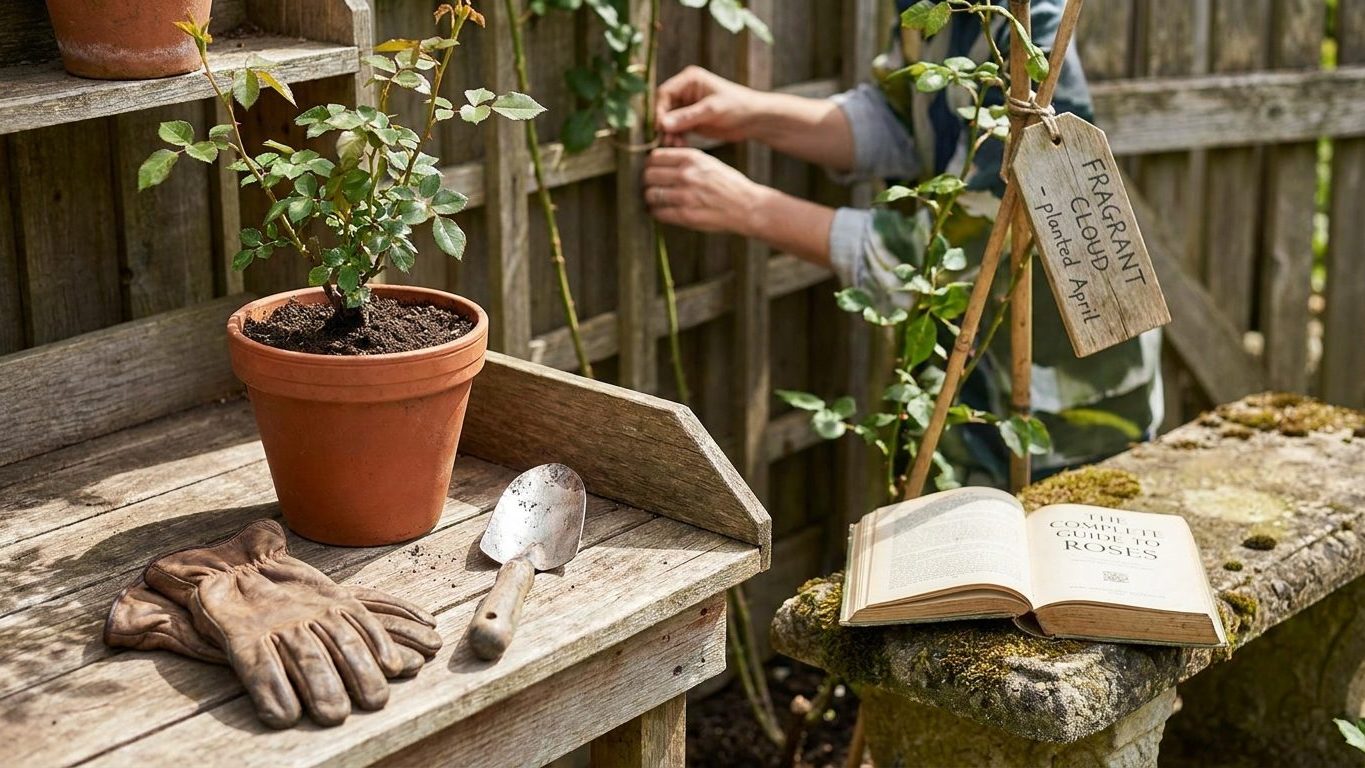

That bare-root bundle in the nursery bin, canes cut to stubby six-inch stubs and roots wrapped in damp burlap, will only turn into a healthy rose if you match its type to your yard before you dig the hole. A hybrid tea planted in four hours of shade will survive for years and never bloom well. Check the tag for the rose’s type and mature size first, then pick the spot to match it, not the other way around.
The types of rose, and why the type decides everything else
Every rose sold falls into one of a handful of types, and that type dictates when you prune, how disease-prone the plant will be, and whether it needs a fence or trellis at all. Buy without checking the type and you end up training a rambler meant for an arbor onto a three-foot bed, or cutting back an old-fashioned shrub rose in spring and losing the entire season’s bloom.
Hybrid Tea

The classic florist rose: one large, high-centered bloom on a long stem, repeating through the growing season. The bush grows upright and a bit gawky, often bare at the base. Hybrid teas are the most demanding type in the group, needing regular feeding and the most attention to black spot and powdery mildew, but they give the cleanest cut flower of any rose you can grow.
Floribunda

Bred to carry clusters of smaller blooms rather than one perfect flower per stem. The plant stays bushier and lower than a hybrid tea, flowers more continuously, and tends to shrug off disease pressure a little better. Floribundas work well massed in a bed where you want color rather than individual cutting stems.
Climbing Rose

Not a true vine. A climbing rose throws long, stiff canes that need to be tied to a support, and it produces most of its flowers on side shoots that grow off canes trained horizontally. Left to grow straight up a post, a climber will bloom only at the top. Bending the canes sideways is what forces flowering along their whole length, a detail covered in the training section below.
Rambler

Related to climbers but far more vigorous, with canes that can run well past knee height every season and small blooms carried in large clusters, usually in one big flush rather than repeating. Ramblers suit an arbor, a fence line, or a tree they can be allowed to scramble into, not a small trellis against a house wall.
Shrub Rose

A broad category that includes many of the newer disease-resistant landscape roses. The bush is rounded, self-supporting, and usually bred for a long bloom season with minimal spraying. Shrub roses are the forgiving choice for a gardener who wants flowers without a spray schedule.
Miniature Rose

A scaled-down rose, often under two feet, with proportionally small leaves and flowers. Miniatures suit containers and small border edges and are frequently sold as houseplants, though they do best outdoors and only tolerate short spells indoors.
A dedicated guide to Types of Roses walks through hybrid tea, floribunda, climber, rambler, shrub and miniature in more depth, including which ones tolerate the least attention.
Choosing a rose: matching the plant to the spot you have
Start with the site, not the catalog photo. A rose bought for its color and then wedged into a shady corner behind the garage will survive on foliage alone and rarely flower. Full sun, meaning at least six hours of direct light, is the baseline every rose type needs to bloom well, and the fewer hours a spot gets, the sparser and smaller the flowers will be regardless of how disease-resistant the variety claims to be.
Next, think about mature size before you think about the bloom. A rambler planted where a floribunda would fit will outgrow its space in two or three seasons and need constant hacking back to stay in bounds. Check the tag or catalog listing for spread as well as height, since a rose planted too close to its neighbors loses the air movement that keeps foliage dry and disease down. A dedicated guide on Rose Spacing covers distances by type and explains why crowding is really a disease decision, not just a tidiness one.
Purpose matters as much as size. A rose grown mainly for cut flowers wants a hybrid tea or a floribunda on a long stem, planted somewhere you don’t mind cutting into. A rose grown for a privacy screen or a fence line wants a climber or rambler with something sturdy to climb. A rose meant for a patio pot needs a compact shrub or miniature bred to stay small in a container, a use covered in a separate guide on Growing Roses in Pots.
Weigh disease resistance against how much spraying you’re willing to do before you buy, not after. Older hybrid teas bred purely for flower form are often the most susceptible to black spot and powdery mildew. Many newer shrub and landscape roses are bred specifically to resist both without a spray program. If you want roses but not the maintenance that comes with the showiest varieties, that resistance rating on the tag is worth more than the flower photo next to it.
Bare-root or container: what you are actually buying
A bare-root rose arrives dormant, roots exposed and packed in damp material, top growth cut back to a handful of short canes. It looks unpromising in the box, but a healthy bare-root plant has an intact root system you can inspect before you ever put it in the ground, and mail-order specialists typically offer a far wider range of varieties this way than local garden centers stock in containers.
Bare-root roses need to go into the ground while still dormant, and they need their roots kept moist from the moment you open the box until the moment they’re covered with soil. Roots allowed to dry out in the sun for even an hour can kill a bare-root rose before it ever breaks a bud. Soak the roots in a bucket of water for several hours before planting if they feel dry.
Container roses are already growing, sold in soil, and forgiving about timing since you’re not racing a dormant root system against the weather. They cost more for the same variety and the selection at a garden center is usually narrower than a mail-order bare-root catalog. What you gain is the ability to see the plant’s actual growth before you buy it and to plant across a longer stretch of the season.
Grafted roses, whether sold bare-root or in a container, carry a swollen knob near the base of the canes where the top growth was budded onto a different rootstock. Own-root roses, grown from a cutting rather than grafted, have no such knob and no risk of the rootstock suckering up through the top growth later. That graft union, when present, changes how deep you plant, a detail the next section covers directly. A separate guide on Buying Roses compares bare-root against container in more detail, including how to judge grade and root quality at the point of sale.
Sun, drainage and soil pH: what roses need from a site
Sun and drainage matter more than any amendment you can dig in afterward. A spot that holds water after rain, even for a day, rots rose roots before the plant has a chance to establish, and no amount of feeding will fix a rose sitting in soggy ground. Walk the planting site after a heavy rain before you commit a rose to it, and if water is still standing after several hours, either build up the bed or choose another spot.
Soil texture and organic matter
Roses want a loose, crumbly soil that drains but still holds enough moisture to get the plant through dry stretches. Heavy clay needs organic matter such as compost or aged manure worked in before planting to open up the structure. Pure sand needs the opposite: organic matter to help it hold water and nutrients instead of letting both wash straight through. Either way, the fix happens before planting, not after, since digging around an established rose’s roots to amend the soil does more harm than good.
Soil pH
Roses grow in soil anywhere from acid to neutral, below 6.0 up to 8.0, and they do best toward the slightly acidic end of that range. The distinction matters when you get a test back: a reading of 7.0 is well within what roses tolerate and needs no correcting, while soil above roughly 7.5 is where iron becomes hard for the plant to take up even when it is present in the soil, so a rose can be fed correctly and still show yellowing leaves if the pH itself is off. A basic soil test through your state’s extension service is worth doing before planting, since it tells you not just the pH but whether lime or sulfur is actually needed to correct it, rather than guessing.
A separate guide on Soil Preparation for Roses covers pH correction and what to dig into the hole in more detail, including how much compost to use for a single planting hole versus a whole new bed.
Planting a rose: how deep, and what to do with the graft union
Dig the hole wider than it looks like it should be, at least twice the width of the root system, so roots can spread out naturally rather than curl back on themselves. Depth matters more than width for one specific reason: the graft union.
Why the graft union decides planting depth
On a grafted rose, that swollen knob near the base of the canes is the single most important thing to get right when you plant. In climates with hard winters, the graft union needs to sit an inch or two below the soil surface, buried where cold air can’t reach it and kill the bud union outright. In mild-winter climates, the same union is usually planted at or just above soil level, since burying it deep in a warm climate can encourage rot and doesn’t offer any winter protection benefit it doesn’t need. Check the USDA Plant Hardiness Zone Map for your area before planting, since the right depth depends on which side of that cold line you’re on, not on a fixed rule that works everywhere.
Own-root roses skip this decision entirely, since there’s no graft union to protect and no rootstock to worry about suckering from below the soil line. Plant them at roughly the same depth they were growing in the nursery pot.
Spreading the roots and backfilling
Build a small cone of soil in the bottom of the hole and drape bare roots over it so they angle downward and outward rather than pooling in a tangle at the bottom. Container roses need their roots teased loose at the edges before planting, especially if they’ve been circling the inside of the pot, or they’ll keep growing in that same circular pattern for years. Backfill in stages, firming soil around the roots as you go and watering partway through to settle out air pockets, then finish filling and water again thoroughly once the hole is full.
A dedicated guide on Planting a Rose Bush covers hole size, root spreading and graft depth step by step, with more detail than fits here.
Watering and mulching, and why the leaves stay dry
Roses want deep, infrequent watering at the soil level, not a daily sprinkle over the top of the plant. A soaker hose or drip line laid at the base delivers water straight to the root zone where it’s needed and keeps foliage dry in the process, which matters more for roses than for almost any other garden plant.
Why wet leaves are the real problem
Black spot and the various mildews that trouble roses all spread through water sitting on the leaf surface, whether that water comes from rain, an overhead sprinkler, or a hose held too high while watering by hand. A rose watered at the base every time stays measurably cleaner through the season than one watered overhead, even with identical disease pressure in the neighborhood, because the fungal spores simply never get the wet leaf surface they need to germinate. If overhead watering is the only option available, do it early in the day so foliage has hours to dry before evening rather than sitting wet overnight.
A separate guide on Watering Roses covers how much and how often for different soil types, along with the specific case for never wetting the leaves.
Mulch
A two to three inch layer of mulch, whether shredded bark, compost, or straw, keeps soil moisture even between waterings and keeps weeds from competing for water and nutrients at the root zone. Keep mulch pulled back an inch or two from the base of the canes rather than piled against them, since mulch mounded against the stem holds moisture against the bark and invites rot and crown disease exactly where you don’t want it.
Feeding through the season, and when to stop
Roses are hungry plants, especially the repeat-blooming types that are constantly building new flowering wood through the season. Start feeding once new spring growth is a few inches long, using either a granular rose fertilizer or a balanced feed worked lightly into the soil at the base, then repeat on a regular cycle through the main bloom period rather than feeding once and assuming it carries the plant for months.
Matching feed to bloom cycle
Repeat bloomers such as hybrid teas and floribundas benefit from feeding again after each flush of bloom fades, since they’re rebuilding the wood for the next round of flowers rather than resting. Once-blooming types like most ramblers and many old shrub roses don’t need that same repeated cycle, since they’re not trying to push out a second or third flush in the same season.
When to stop
Stop feeding well before your area’s first fall frost, since fertilizer applied late pushes soft new growth that has not had time to ripen by the time cold arrives, and that soft growth is what winter injury targets first. Check your local extension service or the USDA Plant Hardiness Zone Map for your area’s typical frost timing and count backward from there, rather than feeding on a fixed calendar date that might be wrong for your climate. A dedicated guide on Feeding Roses covers specific products and rates at each stage of the season.
Pruning: when to cut, how far, and why the type changes the date
Pruning intimidates more new rose growers than any other task on this list, but the sequence is the same for almost every rose: remove dead and damaged wood first, then shape what’s left. What changes by type is the calendar and how hard you cut.
Old wood versus new wood
The whole timing question comes down to whether a rose flowers on wood it grew this season or on wood it grew last season. Repeat bloomers like hybrid teas, floribundas and most modern shrub roses flower on new wood, the growth that comes after the spring prune, so cutting them back hard in late winter or very early spring doesn’t cost you bloom. It sets up a stronger flush.
Once-blooming ramblers and many old garden roses flower on last year’s wood instead. Prune those in late winter the way you’d prune a hybrid tea and you cut off the very canes that were about to flower, losing the whole season’s show. Ramblers and once-bloomers get pruned right after they finish flowering, not in late winter.
The three Ds, then shape
Whatever the type, start by removing anything dead, diseased, or damaged, cutting back into clean healthy wood well below any discoloration. Remove canes that cross and rub against each other, since the wound where bark rubs through becomes an entry point for disease. Take out any growth coming from below the graft union, since that’s rootstock suckering rather than the rose you planted, covered in more depth in a separate guide on Rose Suckers.
With the damage cleared, shape what’s left. Cut to an outward-facing bud so new growth heads away from the center of the plant rather than into it, using a clean angled cut just above the bud. Hybrid teas typically get cut back hardest, often to a fairly low framework of a few strong canes, which pushes fewer but larger blooms. Floribundas and shrub roses are usually pruned lighter, thinning and shortening rather than cutting hard back, since the goal is more of the smaller repeat blooms rather than fewer large ones.
Climbers
Climbing roses need a different approach again: the main framework canes tied to the support should stay in place year after year rather than being cut back hard, while the side shoots that grew off those canes get shortened each dormant season to a few buds, which is where next season’s flowers come from. Cutting the main canes back the way you’d cut a hybrid tea removes the structure you spent years training.
A dedicated guide on Pruning Roses covers cutting height and timing by type in far more detail, including what a hard prune looks like on paper versus on the actual plant.
Deadheading: where to cut, and when to leave the hips
Deadheading removes a spent bloom before it goes to seed, and on a repeat-blooming rose that’s the signal the plant needs to put energy into another flush rather than seed production. Cut the spent flower stem down to the first leaf that has five leaflets rather than three, since that’s typically where a strong new shoot will break, and use a clean angled cut just above that leaf’s bud.
Where deadheading stops helping
Once-blooming ramblers and many old garden roses don’t rebloom no matter how much you deadhead, so cutting spent flowers off them is purely cosmetic rather than something that buys you more flowers. On repeat bloomers, deadheading through the height of the season keeps the show going, but it needs to stop at a specific point in fall.
Stop deadheading in early fall and let the last flush of spent blooms turn into hips instead of cutting them off, since that shift signals the plant to slow down and start hardening for winter rather than pushing another round of soft new growth right before cold weather arrives. The hips themselves are a bonus: many roses produce colorful fruit through fall and into winter that feeds birds and adds color to an otherwise bare border. A separate guide on Deadheading Roses covers the five-leaflet cut and the exact seasonal cutoff in more detail.
Training a climber: supports, and bending canes sideways
A climbing rose doesn’t grip or twine on its own the way a true vine does. It needs to be tied to whatever structure you want it to cover: a wooden trellis, horizontal wires run along a wall or fence, an arbor, or a sturdy post. Whatever the support, install it before or at planting time rather than trying to work a support in around an established, thorny plant later.
Why horizontal beats vertical
A climber tied straight up a post will bloom mostly at the top, because the growth hormone that suppresses side shoots concentrates in an upright cane and only weakens once the cane is bent away from vertical. Fan the main canes out sideways along horizontal wires or across a wide trellis instead of running them straight up, and the plant responds by breaking flowering side shoots all along each cane’s length rather than just at the tip.
Tie canes loosely with soft garden twine or flexible plastic tape, leaving enough slack for the cane to thicken as it ages. A tie cinched tight against a growing cane eventually cuts into the bark as the cane expands, girdling it in the same spot year after year until that section weakens or dies. Check ties once or twice a season and loosen or replace any that have gone tight.
New canes on an established climber are usually flexible enough to bend into position with steady, gentle pressure rather than force. An older cane that’s gone stiff and woody can snap if bent too far too fast, so work it into position gradually over a week or two rather than trying to tie it flat in a single session. A dedicated guide on Training Climbing Roses covers wire spacing, tying material, and the fan technique step by step.
Diseases: black spot, the mildews, and rose rosette
Most rose disease problems trace back to wet foliage, poor air movement, or both, which is exactly why watering at the base and spacing plants correctly does more preventive work than any spray. Three problems account for the majority of disease complaints on roses.
Black Spot
Black spot shows up as circular black lesions with a feathered or fringed edge, usually surrounded by a ring of yellowing leaf tissue. Infected leaves drop early, and a bad infection can defoliate a rose well before fall, weakening the plant heading into winter. Once the feathered black lesions appear, fungicide can slow the spread but can’t reverse damage already on the leaf, so the leaves that show spots are the leaves that need to be removed and disposed of, not sprayed and left in place. A separate guide on Black Spot on Roses covers the fungicide options and the point at which spraying stops being worth the effort.
Powdery Mildew
Powdery mildew coats leaves, buds, and young stems in a white to gray powdery film, and new growth often comes in curled or distorted where the infection is active. Unlike black spot, powdery mildew actually spreads faster in dry conditions with high humidity rather than on wet foliage, so it can show up even on plants watered carefully at the base. Improving air movement around the plant and avoiding heavy shade both reduce pressure.
Downy Mildew
Less common than the other two but more aggressive when it hits, downy mildew appears as purple to red angular blotches on the upper leaf surface with a grayish fuzz sometimes visible underneath in humid weather. It can defoliate a rose within days under the right cool, wet conditions, faster than black spot typically manages.
Rose Rosette
Rose rosette is viral, spread by a tiny mite, and has no cure. Watch for excessive thorniness, tightly clustered witches’-broom growth, and new shoots that come in red and distorted rather than the plant’s normal color. A rose confirmed with rose rosette needs to come out, roots and all, since it will act as a source of infection for every other rose nearby for as long as it’s left in the ground.
Pests: Japanese beetles, aphids, mites and what eats them
A rose in good health tolerates a certain amount of pest damage without real harm, and the goal with most rose pests is management rather than elimination.
Japanese Beetles
Japanese beetles are roughly half an inch long with metallic green bodies and copper-bronze wing covers, and they feed in groups, skeletonizing leaves and chewing holes straight through flower petals. Hand-picking beetles into a jar of soapy water in the early morning, when they’re sluggish, controls small populations better than most sprays, since broad insecticides applied to open blooms also kill the pollinators visiting those same flowers.
Aphids
Aphids are small, soft-bodied, pear-shaped insects, usually green or pink, that cluster on buds and new growth tips and suck sap directly from the plant. A strong jet of water from the hose knocks most aphid colonies off a rose without any spray at all, and populations that survive are usually brought back under control within a couple of weeks by ladybugs and lacewings if those predators are present in the garden.
Spider Mites
Spider mites are tiny enough to be nearly invisible without a hand lens, showing up as fine stippling on leaves and, in heavy infestations, faint webbing on the undersides. Mites build up fastest during hot, dry stretches, so a rose under moisture stress is more vulnerable than one being watered consistently at the root zone.
Encouraging beneficial insects
A garden that isn’t sprayed with broad insecticides tends to build up its own pest control over a season or two.
- Ladybugs and their larvae feed heavily on aphids and small soft-bodied pests.
- Lacewing larvae feed on aphids, mites, and small caterpillars.
- Parasitic wasps, too small to notice, lay eggs inside aphids and caterpillar pests.
Planting flowers that provide nectar for these predators nearby keeps them in the garden between pest outbreaks rather than relying on them to arrive only once an infestation is already underway.
When a rose grows but will not flower
A rose putting out plenty of healthy green growth but no flowers usually has one of a small number of causes, and most of them trace back to something the gardener is doing rather than the plant itself.
Too much shade
This is the single most common reason for a leafy, flowerless rose. A plant getting less than the sun it needs puts energy into leaf growth chasing light rather than into the far more expensive process of flowering. Moving a chronically shaded rose, if that’s practical, usually solves the problem faster than any feeding change will.
Too much nitrogen
A fertilizer heavy in nitrogen relative to phosphorus and potassium pushes lush green leaf growth at the direct expense of flower buds, which is a common mistake when a gardener reaches for an all-purpose lawn or vegetable feed instead of a formula balanced for flowering shrubs. Switching to a fertilizer with a more even ratio, or one specifically labeled for roses, usually brings flowering back within a season.
Wrong pruning at the wrong time
Pruning a once-blooming rambler or old garden rose in late winter, the way you would a hybrid tea, removes the very wood that was about to flower, covered in the pruning section above. The plant isn’t unhealthy, it’s just been cut back at the wrong point in its cycle.
A young or recently moved plant
A rose planted within the past year, or a mature rose recently transplanted, often puts its first season’s energy into rebuilding roots rather than producing a full flush of bloom. This is normal and usually resolves on its own the following season, covered in more depth in a separate guide on First-Year Rose Care and another on Moving a Rose Bush for plants relocated within an established garden.
Getting roses through the winter
Winter kills roses less often from cold air than from a graft union or crown that freezes and thaws repeatedly at the soil surface. Protecting that one vulnerable point matters more than wrapping the whole plant.
Mounding the graft union
Mound loose soil, compost, or mulch over the graft union and the base of the canes once the plant has gone dormant for the season, rather than while it’s still actively growing, since mounding over active growth traps moisture against soft tissue and invites rot instead of protecting the plant. Pull the mound away gradually in spring once new growth starts to break, rather than leaving it in place through the whole growing season, or the same rot risk applies in reverse. A dedicated guide on Winter Protection for Roses covers exact timing cues and materials in more depth than fits here.
What fails
The most common winter protection mistake is timing: mounding too early, while the plant is still pushing soft growth, or removing the mound too late, after new growth has already started pushing up underneath it in a warm spell. Both create the wet, warm, dark conditions that rot canes rather than protect them. The second most common mistake is materials: piling wet leaves or heavy clay soil against the base holds moisture against the bark far longer than loose, well-draining mulch or compost does.
Climbers and tender roses
A climbing rose trained on a wall or trellis can’t be mounded the way a bush rose can, since the canes are tied up rather than sitting in a low clump. In climates cold enough to injure exposed canes, some gardeners wrap the tied canes in burlap or another breathable material, or lay flexible canes down along the ground and cover them the way a bush rose gets mounded, lifting them back into position and retying once the risk of hard freezes has passed. Check with your local extension service or the USDA Plant Hardiness Zone Map for whether your zone actually needs this extra step, since it isn’t necessary everywhere climbers are grown.
Rose care by state and USDA zone
Every task in this guide, from planting timing to winter protection to when to stop feeding, shifts earlier or later depending on where you garden, and no single date works from Minnesota to Georgia. The right first step for any of these tasks is finding your USDA Plant Hardiness Zone Map rating and checking your state extension service’s rose recommendations for your specific region, rather than relying on a date from a gardening article written for a different climate.
| Region type | Winter protection | Planting timing |
|---|---|---|
| Cold-winter zones | Graft union mounding generally necessary; tender climbers may need canes laid down | Bare-root planted while still dormant in early spring; fall planting riskier |
| Mild-winter zones | Mounding often unnecessary; own-root and hardy shrub roses may need none at all | Wider planting window, including fall, since hard freezes are rare or absent |
| Hot-summer zones | Winter protection minimal; summer heat and drought stress a bigger concern than cold | Fall and winter planting often preferred over summer to avoid transplant stress in heat |
A single reference city’s frost date or hardiness rating never applies to an entire state, since elevation, coastal proximity, and local microclimate shift the effective zone significantly within the same state line. Check the specific rating for your county or nearest reporting station rather than assuming a rating that applies to a state’s major city applies to your own yard.
Common questions
why are my rose leaves turning yellow and falling off
Yellowing leaves that drop are most often black spot, especially if you can find black lesions with a feathered edge on the leaves before they yellow and fall. Overwatering, root problems, or a nitrogen deficiency can cause similar yellowing without the spots, so check the leaf surface for lesions before assuming disease.
can i plant roses in the same spot where roses died before
You can, but it carries risk if the previous rose died of a soil-borne problem or rose rosette rather than winter injury or a one-off accident. Replace as much of the old planting soil as practical and avoid replanting in the exact same spot for at least a season if the prior rose was pulled for disease rather than just old age or neglect.
do i need to spray roses even if i don’t see any bugs or spots yet
No, preventive spraying on a fixed schedule isn’t necessary for every rose, especially the disease-resistant shrub types. Watching for the first signs of trouble and treating early is usually enough for a resistant variety, though a hybrid tea in a humid climate with a history of black spot may genuinely need a regular preventive program to stay clean.
is it too late to prune my roses if i missed the window
It’s rarely too late to do some good, though a very late prune on a repeat bloomer can delay the first flush of bloom by cutting off growth that was already underway. Pruning a once-blooming rambler after it’s already set flower buds for the season is the one timing mistake that actually costs you that year’s flowers rather than just delaying them.
why did my rose bush turn into a different, wilder-looking plant
This usually means the rootstock has taken over after the grafted top died back, and what’s growing now is the rootstock variety, not the rose you originally bought. Rootstock growth, called suckering, often has different leaf shape, more vigorous thorny canes, and flowers that look nothing like the original if it ever blooms. Once the grafted top is gone, there’s no bringing the original variety back, since it wasn’t growing on its own roots.