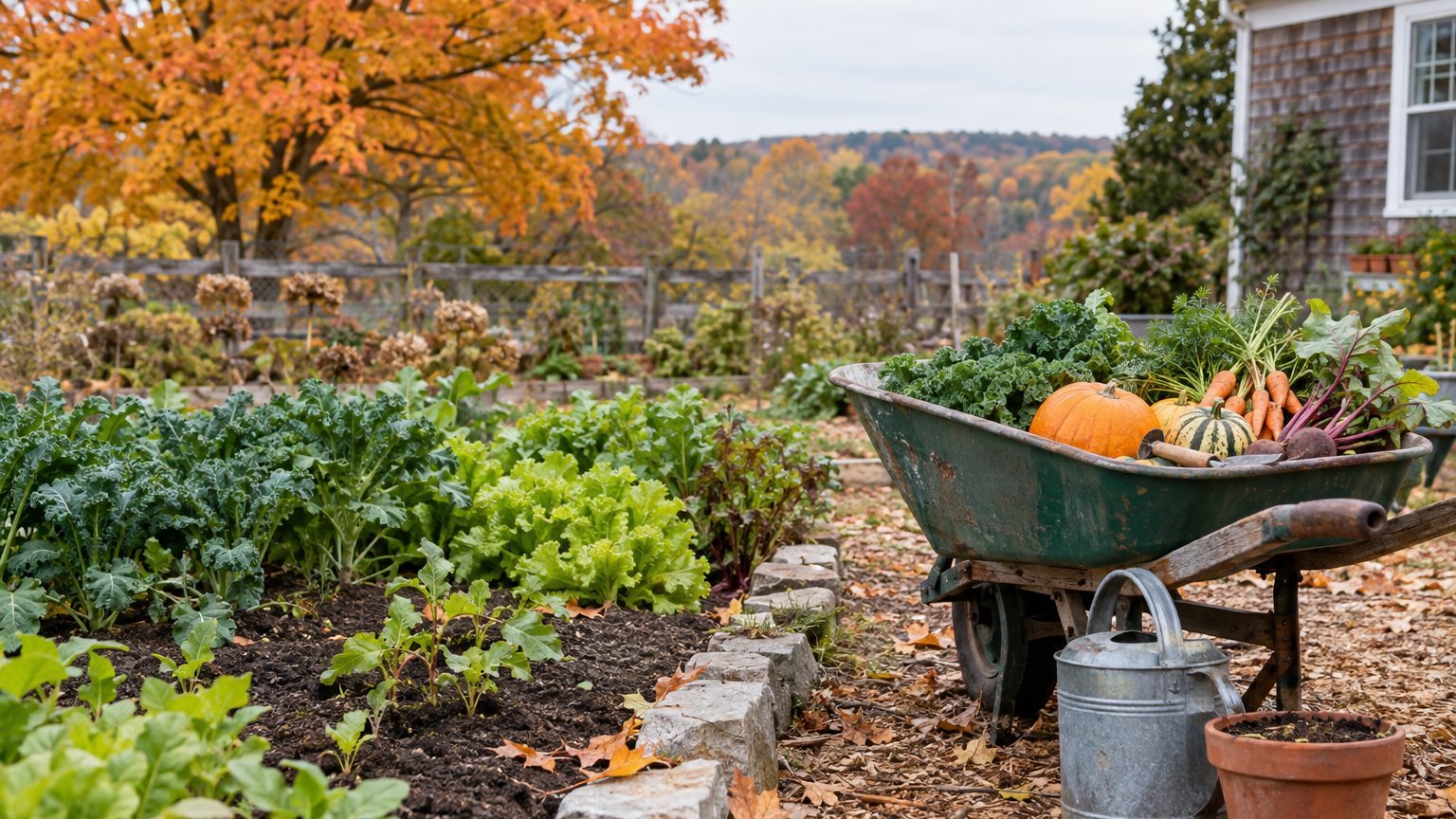

October planting follows the first fall frost, not the calendar page. Where that frost has normally already come, as in Wyoming or Alaska, the month is for protecting hardy greens and putting empty beds under a cover crop. Where it comes later, as in Georgia or Oregon, garlic and spring-flowering bulbs go in as the soil cools. Find your state in the table below and open its October page before you buy anything.
What to plant in October: it depends on how close frost is

What goes in the ground in October depends on where the first fall frost falls against the month, not on the date on your wall calendar. NOAA’s 1991-2020 U.S. Climate Normals and Environment and Climate Change Canada’s (ECCC) 1981-2010 Canadian Climate Normals, each read at a reference city, sort the 63 U.S. states and Canadian provinces and territories we cover into four groups.
| Where frost falls | How many of the 63 | Examples | What goes in the ground |
|---|---|---|---|
| First fall frost normally arrives before October | 11 | Alaska, Wyoming, Saskatchewan | Garlic and spring-flowering bulbs once the soil has cooled and before it freezes. Cover crops on empty beds. Hardy greens protected, not started from scratch. No tomatoes or peppers. |
| First fall frost window opens during October | 31 | Illinois, Maine, Ontario | Garlic and spring-flowering bulbs once the soil has cooled, ahead of the ground freezing. Cover crops on empty beds. Hardy greens protected. No tomatoes or peppers in cold climates. |
| First fall frost normally comes after October | 18 | Georgia, Oregon, British Columbia | The same autumn jobs, with the soil cooling later. Your state page sets the timing. |
| No freeze in an average year, or no reliable fall freeze date | 3 | Arizona, California, Hawaii | The cold-climate cautions may not apply. Your state page gives the local plan. |
The middle group is the largest, and it is the one where a few days either side of your own frost window matter most. In those 31 territories the frost window opens during the month, so the gardener who plants on the first of October and the one who plants on the thirtieth are working in different conditions. The 11 territories in the first group are already past frost at their reference cities, which makes October a month of finishing and protecting rather than starting.
The 18 territories in the third group have the most room. Frost normally comes after October there, so the soil cools later and the autumn jobs slide down the calendar. That is a matter of timing only. Garlic, bulbs and cover crops still wait for cooler soil, and you will find the local call on the state page.
All 63 state and province guides for October
Each guide below gives the month’s planting advice for one state or province. The zone range is the territory’s whole range, and the reference city is one place in it: your own county can differ by weeks.
Northeast
| Guide | Hardiness zone range | Reference city | Normal first fall frost |
|---|---|---|---|
| What to Plant in Connecticut in October | 6a-7b (USDA) | Bridgeport | October 28 to November 10 |
| What to Plant in Maine in October | 3b-6a (USDA) | Portland | October 9 to October 21 |
| What to Plant in Massachusetts in October | 5a-7b (USDA) | Boston | November 3 to November 14 |
| What to Plant in New Hampshire in October | 3b-6a (USDA) | Manchester | October 13 to October 26 |
| What to Plant in New Jersey in October | 6a-7b (USDA) | Newark | November 4 to November 16 |
| What to Plant in New York in October | 3b-7b (USDA) | New York City | November 14 to November 27 |
| What to Plant in Pennsylvania in October | 5a-7b (USDA) | Philadelphia | November 5 to November 16 |
| What to Plant in Rhode Island in October | 6a-7b (USDA) | Providence | October 24 to November 3 |
| What to Plant in Vermont in October | 3b-5b (USDA) | Burlington | October 3 to October 13 |
Midwest
| Guide | Hardiness zone range | Reference city | Normal first fall frost |
|---|---|---|---|
| What to Plant in Illinois in October | 5a-7b (USDA) | Chicago | October 24 to November 3 |
| What to Plant in Indiana in October | 5b-7a (USDA) | Indianapolis | October 21 to October 30 |
| What to Plant in Iowa in October | 4b-6a (USDA) | Des Moines | October 14 to October 25 |
| What to Plant in Kansas in October | 5b-7a (USDA) | Wichita | October 23 to November 2 |
| What to Plant in Michigan in October | 4a-6b (USDA) | Detroit | October 6 to October 21 (zone 6a) |
| What to Plant in Minnesota in October | 3a-5a (USDA) | Minneapolis | October 11 to October 23 |
| What to Plant in Missouri in October | 5b-7b (USDA) | Kansas City | October 18 to October 29 |
| What to Plant in Nebraska in October | 4a-5b (USDA) | Omaha | October 15 to October 26 |
| What to Plant in North Dakota in October | 3a-4b (USDA) | Fargo | September 25 to October 5 |
| What to Plant in Ohio in October | 5b-6b (USDA) | Columbus | October 5 to October 15 (zone 6a) |
| What to Plant in South Dakota in October | 3b-5b (USDA) | Sioux Falls | September 24 to October 4 |
| What to Plant in Wisconsin in October | 3b-6a (USDA) | Milwaukee | October 17 to October 29 |
Southeast
| Guide | Hardiness zone range | Reference city | Normal first fall frost |
|---|---|---|---|
| What to Plant in Alabama in October | 7a-9a (USDA) | Huntsville | November 2 to November 16 |
| What to Plant in Arkansas in October | 6b-8a (USDA) | Little Rock | November 7 to November 20 |
| What to Plant in Delaware in October | 7a-8a (USDA) | Wilmington | October 26 to November 7 |
| What to Plant in Florida in October | 8b-11b (USDA) | Jacksonville | November 26 to December 13 |
| What to Plant in Georgia in October | 6a-9b (USDA) | Atlanta | November 13 to December 1 |
| What to Plant in Kentucky in October | 6a-7a (USDA) | Louisville | November 2 to November 12 |
| What to Plant in Louisiana in October | 8a-10a (USDA) | New Orleans | December 17 to January 8 |
| What to Plant in Maryland in October | 5b-8a (USDA) | Baltimore | October 26 to November 5 |
| What to Plant in Mississippi in October | 7b-9a (USDA) | Jackson | November 7 to November 22 |
| What to Plant in North Carolina in October | 5b-8b (USDA) | Charlotte | October 30 to November 8 |
| What to Plant in South Carolina in October | 7a-9a (USDA) | Charleston | November 20 to December 5 |
| What to Plant in Tennessee in October | 5b-8a (USDA) | Nashville | October 28 to November 8 |
| What to Plant in Virginia in October | 5a-8b (USDA) | Virginia Beach | November 10 to November 24 |
| What to Plant in West Virginia in October | 5a-7a (USDA) | Charleston | October 18 to November 1 |
Southwest
| Guide | Hardiness zone range | Reference city | Normal first fall frost |
|---|---|---|---|
| What to Plant in Arizona in October | 4b-10b (USDA) | Phoenix | no reliable fall freeze; see the note |
| What to Plant in New Mexico in October | 4b-9a (USDA) | Albuquerque | October 29 to November 9 |
| What to Plant in Oklahoma in October | 6a-8a (USDA) | Oklahoma City | October 29 to November 8 |
| What to Plant in Texas in October | 6a-10a (USDA) | Houston | December 1 to December 19 |
West
| Guide | Hardiness zone range | Reference city | Normal first fall frost |
|---|---|---|---|
| What to Plant in Alaska in October | 1a-8a (USDA) | Anchorage | September 22 to October 1 |
| What to Plant in California in October | 5a-11a (USDA) | Los Angeles | no freeze occurs in an average year |
| What to Plant in Colorado in October | 3b-7b (USDA) | Denver | September 30 to October 12 |
| What to Plant in Hawaii in October | 9a-13a (USDA) | Honolulu | no freeze occurs in inhabited areas |
| What to Plant in Idaho in October | 3b-7b (USDA) | Boise | October 7 to October 21 |
| What to Plant in Montana in October | 3a-6a (USDA) | Billings | October 1 to October 14 |
| What to Plant in Nevada in October | 4a-10a (USDA) | Las Vegas | December 8 to December 23 |
| What to Plant in Utah in October | 4a-9a (USDA) | Salt Lake City | October 18 to October 29 |
| What to Plant in Wyoming in October | 3a-6a (USDA) | Cheyenne | September 24 to October 5 |
Pacific Northwest
| Guide | Hardiness zone range | Reference city | Normal first fall frost |
|---|---|---|---|
| What to Plant in Oregon in October | 4a-9b (USDA) | Portland | November 11 to November 27 |
| What to Plant in Washington in October | 4a-9a (USDA) | Seattle | November 13 to November 30 |
Canada (provinces and territories)
| Guide | Hardiness zone range | Reference city | Normal first fall frost |
|---|---|---|---|
| What to Plant in Alberta in October | 4a (Canadian system, not USDA) | Calgary | on average September 16 |
| What to Plant in British Columbia in October | 9a (Canadian system, not USDA) | Vancouver | on average November 10 |
| What to Plant in Manitoba in October | 3b (Canadian system, not USDA) | Winnipeg | on average September 22 |
| What to Plant in New Brunswick in October | 5a (Canadian system, not USDA) | Moncton | on average October 2 |
| What to Plant in Newfoundland and Labrador in October | 6a (Canadian system, not USDA) | St. John's | on average October 17 |
| What to Plant in Northwest Territories in October | 1b (Canadian system, not USDA) | Yellowknife | on average September 18 |
| What to Plant in Nova Scotia in October | 6b (Canadian system, not USDA) | Halifax | on average October 18 |
| What to Plant in Nunavut in October | 0a (Canadian system, not USDA) | Rankin Inlet | on average September 13 |
| What to Plant in Ontario in October | 7a (Canadian system, not USDA) | Toronto | on average October 16 |
| What to Plant in Prince Edward Island in October | 5b (Canadian system, not USDA) | Charlottetown | on average October 17 |
| What to Plant in Quebec in October | 5b (Canadian system, not USDA) | Montreal | on average October 5 |
| What to Plant in Saskatchewan in October | 3a (Canadian system, not USDA) | Saskatoon | on average September 18 |
| What to Plant in Yukon in October | 1b (Canadian system, not USDA) | Whitehorse | on average August 25 |
Frost dates for every state and province are on the first and last frost dates by state page.
What goes in the ground in October
Three jobs carry the month, and they are the same in a Vermont yard and a Tennessee one. Only the timing moves. The page for your state in the table above gives that timing, so use this section for the reasoning and the state page for the date.
Garlic and spring-flowering bulbs
Both are planted in autumn, once the soil has cooled and ahead of the ground freezing. The two conditions bracket the job. Plant into warm soil and you invite top growth you do not want before winter. Wait until the ground is frozen and you cannot plant at all. Judge by the soil, not by how warm the afternoon feels, and loosen the bed before you start so the cloves and bulbs sit in crumbly ground rather than clods.
If October gets away from you, the November planting guide follows the same state-by-state approach for the next month.
Cover crops on empty beds
Any bed that has finished its season is a candidate. A cover crop keeps living roots in the soil and stops the bed sitting bare through winter, when rain and wind do their damage. Sow it as the summer crops come out, rather than leaving the bed for a later weekend that does not arrive. Pull spent plants, rake the surface level, scatter the seed evenly and rake it in lightly. Which species suits your region, and how late you can sow it, is a local question for your state page and your county extension office.
Hardy greens: protect, don’t restart
Greens already growing are worth defending. Greens started from scratch in October have little time left to size up, so protect what is established instead of seeding a fresh row. Row cover, a low tunnel or a cold frame all buy protection against the frosts that arrive in the second and third groups above. Set the cover up before the first frost, not after you see the damage, and prop it open on mild days so the plants do not overheat underneath.
What not to plant in October, even on a warm afternoon
Tomatoes and peppers do not go out in autumn in cold climates. A sunny October afternoon can feel like May, and that is exactly what catches people. The air warms in a few hours. The soil warms slowly and cools just as slowly, and the night that follows a warm day can still bring frost.
Those are warm-season crops, and a single frost ends them. A transplant set out in October has no season ahead of it, only a cold night waiting. The sensible move is to clear the old plants and use the bed for the jobs above. Spring is when their turn comes, and our April planting guide works through that month state by state.
This caution is written for cold climates. In Arizona, California and Hawaii, where no freeze occurs in an average year or no reliable fall freeze date exists, it may not apply the same way. Read your own state’s October page rather than assuming either way.
Reading the dates: United States and Canada are not measured the same way
The two countries use different data, so their numbers are not interchangeable. The U.S. figures come from NOAA NCEI’s U.S. Climate Normals for 1991-2020, which give a window built from the probability of a 32F freeze, the band running from 30 to 70 percent. The Canadian figures come from ECCC’s Canadian Climate Normals for 1981-2010, and they are an average date rather than a probability band.
Because the period and the measure both differ, never set a Canadian date beside an American one. A date in Ontario and a window in Ohio do not describe the same thing.
Zones follow the same rule
The USDA Plant Hardiness Zone Map (2023) applies to the United States only. Canada uses its own plant hardiness zone system, so a Canadian zone is never a USDA zone. A U.S. state also spans a range of zones, which is why the state pages give a range rather than one number.
Every frost window is read at a reference city, and a reference city is one place, not a whole territory. Texas spans four USDA zones, and Houston sits at its mild end. If you garden in the Panhandle, Houston’s window is a starting point at best. The same is true of every state and province in the table.
Find your own date
Find your state or province in the table, then open its October page. That page carries the zone range, the reference city and the normal frost window, which is what you need to place your garden in one of the groups above.
Then adjust for where you actually garden. Low ground, a hilltop and a town heat island can each shift your frost by days compared with the reference city. The cooperative extension office for your county knows those local differences, so check the timing with them before you commit bulbs or seed. Our frost dates by state page is the place to compare the window against the rest of the season.
Common questions
Can I still plant garlic if my first frost has already passed?
Often yes, as long as the ground is not frozen. Garlic goes in once the soil has cooled and ahead of the ground freezing, so the test is the state of the soil, not whether frost has happened. Check your state’s October page for the local timing.
Should I wait on garlic if October stays warm?
Yes, if the soil has not cooled yet. A warm spell means the ground may not be ready even though the calendar says October. Plant when the soil has cooled, and still ahead of the ground freezing.
Does the frost window on a state page mean frost will hit on those dates?
No. A U.S. window is a band of freeze probability from NOAA’s 1991-2020 normals, and a frost can fall before or after it. Canadian figures from ECCC’s 1981-2010 normals are an average date. Treat either as a planning guide and keep an eye on the forecast.
Why are Arizona, California and Hawaii grouped separately?
In these three, no freeze occurs in an average year, or no reliable fall freeze date exists. Advice built around a frost date does not fit them well. Their state pages give the local approach.
Frost windows and local guidance get revised, so confirm current details with your state’s cooperative extension office before acting.