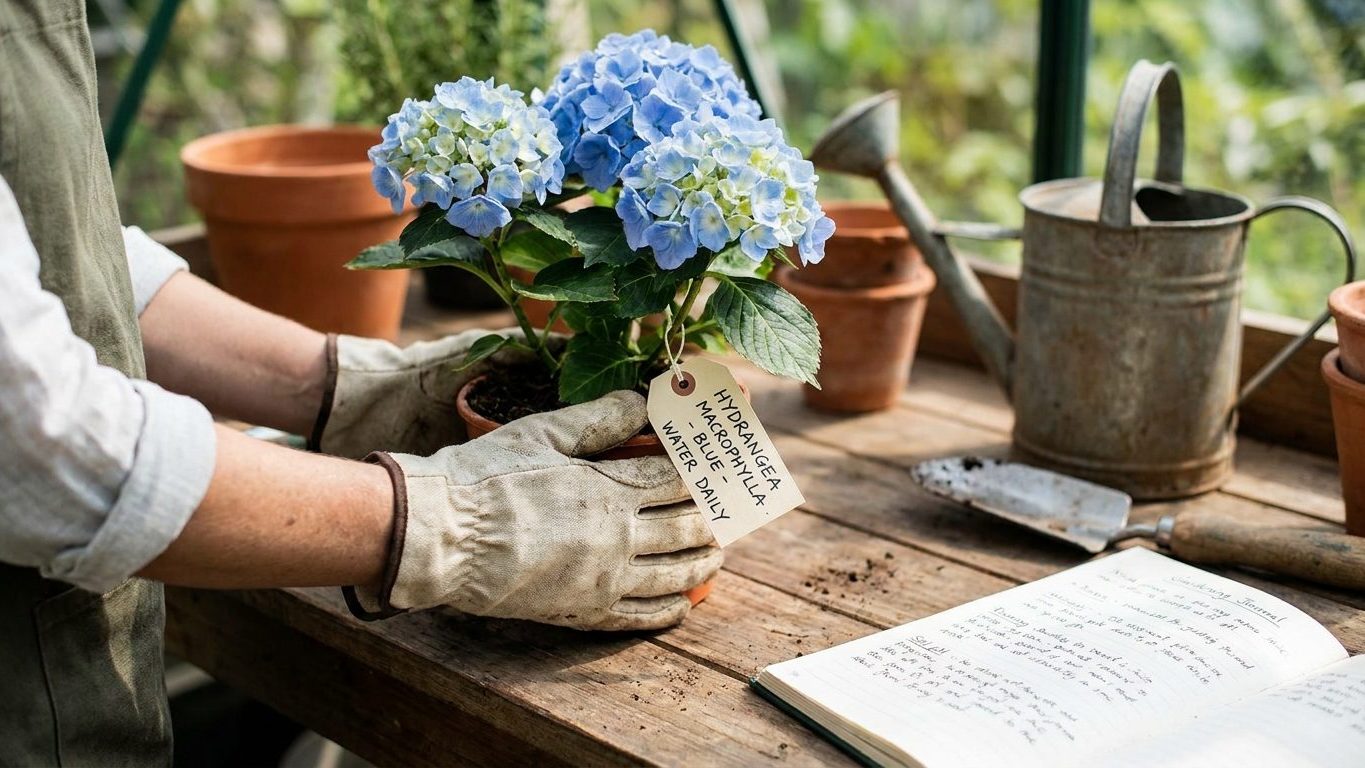

Bigleaf hydrangeas are the ones that break the most hearts: full of healthy green leaves every summer and not a single flower. The type of hydrangea planted in that spot decides whether pruning, winter cold, or plain bad timing is behind it. Check which of the six types is actually in the ground before you cut, feed, or worry about color, because every rule after this one depends on that answer.
The six types of hydrangea, and why the type decides everything else
Six species get sold as “hydrangea” in US nurseries, and they do not behave like variations on one plant. They differ in when they set flower buds, how much cold those buds survive, how much sun the leaves tolerate, and how hard the shrub can be cut back without losing next year’s blooms. Get the type wrong and every later decision, pruning, winter cover, even fertilizer choice, compounds the mistake. A dedicated guide, Types of Hydrangea Explained, goes further into named cultivars within each group than there is room for here.
Bigleaf Hydrangea (Hydrangea macrophylla)

This is the classic mophead or lacecap hydrangea, with big rounded or flat flower clusters in blue, pink, purple, or white depending on soil chemistry. It blooms on old wood, meaning the buds for this summer’s flowers formed on last year’s stems the previous fall. That single fact explains most of the complaints about this type: a hard prune at the wrong time, or a late frost that kills those buds, costs the whole season’s flowers. Mature plants generally reach 3 to 6 feet tall and wide, and the group is generally hardy in USDA zones 6 to 9, with a handful of rebloomer cultivars bred to push new buds further into zone 5.
Panicle Hydrangea (Hydrangea paniculata)

Panicle hydrangeas carry cone-shaped flower clusters rather than round ones, opening white and aging to pink or deep red as the weeks pass. They bloom on new wood, the stems that grow that same spring, so a hard prune in late winter does not touch the flower buds at all. That makes this the type to plant where reliable bloom matters more than blue-or-pink drama. Paniculata types are generally hardy across USDA zones 3 to 8 and can be trained as a large shrub or a small single-stem tree.
Smooth Hydrangea (Hydrangea arborescens)

Smooth hydrangea, the type behind ‘Annabelle’, produces rounded white flower clusters on new wood, which makes it close to foolproof to prune. It tolerates more shade than the other types and tends to grow at woodland edges in its native range. The tradeoff is weak stems: big flower heads flop after rain unless the plant gets support or a variety bred for sturdier stems. It is generally hardy in USDA zones 3 to 9.
Oakleaf Hydrangea (Hydrangea quercifolia)

Oakleaf hydrangea earns its name from leaves shaped like an oak’s, which turn burgundy and orange in fall while every other type here just drops green leaves. Its elongated, cone-shaped flower clusters open white and age to pink and tan, and older stems peel into cinnamon-colored bark that adds winter interest. It blooms on old wood like bigleaf, so the same pruning-timing caution applies. Oakleaf is generally hardy in USDA zones 5 to 9 and tolerates more drought once established than any other type on this list.
Climbing Hydrangea (Hydrangea anomala subsp. petiolaris)

This is the only vine on the list, climbing brick, fences, or trellises by aerial roots the way ivy does, and carrying flat white lacecap flower clusters against glossy heart-shaped leaves. It is slow to establish, often taking several years before it flowers at all, and blooms on old wood. Once it takes hold it can climb 30 to 50 feet and is generally hardy in USDA zones 4 to 8.
Mountain Hydrangea (Hydrangea serrata)

Mountain hydrangea is a smaller, more cold-tolerant relative of bigleaf, with narrower leaves and smaller lacecap flower clusters. Breeders have leaned on it heavily for rebloomer cultivars, because its buds sit lower on the stem and some regrow even after top growth is killed back by cold. It stays compact, usually 2 to 4 feet, and is generally hardy in USDA zones 6 to 9. For named cultivars across all six groups, with published mature sizes and bloom colors, Hydrangea Varieties Compared lays out the full lineup.
Working out which type you have from the plant in front of you
A plant tag is the fastest answer, but plenty of hydrangeas get inherited with no tag at all, passed along from a neighbor or already established at a new house. Four things narrow it down fast: leaf shape, flower cluster shape, stem or bark texture, and whether the plant climbs or stands as a shrub.
Leaf shape and texture
Oakleaf hydrangea is the easy one: its deeply lobed leaf looks like a red oak’s, and nothing else on this list has that shape. Bigleaf and mountain hydrangea leaves are broad, glossy, and toothed at the edge, though mountain hydrangea’s are noticeably smaller and thinner. Panicle and smooth hydrangea leaves are plainer, oval, and matte rather than glossy.
Flower cluster shape
Round, ball-shaped flower heads point to bigleaf mophead types or smooth hydrangea. Flat clusters with tiny center florets ringed by a few larger ones are lacecaps, which show up in bigleaf, mountain, and climbing hydrangea. Cone-shaped or football-shaped clusters, tapering to a point, belong to panicle hydrangea and, in a more elongated form, to oakleaf.
Stem, bark, and habit
A woody vine clinging to a wall or fence by small aerial roots can only be climbing hydrangea. Peeling, cinnamon-colored bark on older stems is oakleaf’s signature and shows up clearly in winter once the leaves are down. If stems die back hard every winter and regrow fresh from the base each spring, that pattern fits smooth hydrangea, which does not keep the permanent woody framework that old-wood types rely on.
- Lobed leaf like an oak: oakleaf hydrangea
- Round mophead flower cluster: bigleaf or smooth hydrangea
- Cone-shaped flower cluster: panicle or oakleaf hydrangea
- Climbing a wall by aerial roots: climbing hydrangea
Getting the identification wrong is behind a good share of the complaints covered in Common Hydrangea Problems, from bare stems in spring to a plant that never flowers at all.
Which types survive which winters
Cold does two different kinds of damage to a hydrangea: it can kill the whole plant, or it can leave the plant alive while killing only the flower buds. The second kind is the one that actually confuses people, because the shrub leafs out fine every spring and still never blooms. Old-wood bloomers carry their buds through winter exposed on last year’s stems, so a cold snap after the buds have started to swell in late winter can wipe out flowers without touching the plant itself. New-wood bloomers set their buds fresh each spring, so winter cold barely factors into whether they flower at all.
| Type | Typical USDA hardiness | Buds on old or new wood | Winter risk to flowers |
|---|---|---|---|
| Bigleaf | Zones 6-9 (rebloomers to zone 5) | Old wood | High in cold or fluctuating winters |
| Panicle | Zones 3-8 | New wood | Low |
| Smooth | Zones 3-9 | New wood | Low |
| Oakleaf | Zones 5-9 | Old wood | Moderate to high |
| Climbing | Zones 4-8 | Old wood | Moderate, once established |
| Mountain | Zones 6-9 | Old wood, lower buds | Moderate, often reblooms from lower buds |
The USDA plant hardiness zone map is the standard reference for whether a type is rated to survive an area’s average winter minimum, but a zone rating is an average, not a guarantee. A yard’s own microclimate, whether it sits in a low frost pocket or against a heat-holding south-facing wall, can push actual results a full zone in either direction. Check the current USDA map and a state extension service for the rating that applies to a specific address, since a single reference city’s figure does not hold across an entire state.
Why a hydrangea grows well and never flowers
A hydrangea with plenty of healthy green leaves and zero flowers almost always comes down to one of a few causes, and the first two account for most cases by far.
The wrong pruning cut at the wrong time
Cutting an old-wood bloomer back hard in fall, winter, or even early spring removes the stems that were about to carry this year’s flowers. This is the single most common reason a healthy bigleaf, oakleaf, climbing, or mountain hydrangea skips a season. New-wood types like panicle and smooth do not have this problem because their buds have not formed yet when they get cut back.
A late freeze after the buds have started to swell
Old-wood bloomers can survive a cold winter and still lose their flowers to a late-season freeze that hits just as the buds are swelling and losing their cold tolerance. The plant itself shows no damage at all, which is what makes this cause so easy to misdiagnose as a pruning mistake or a soil problem when it was neither.
Too much shade or too much nitrogen
Bigleaf and panicle types both need real sun to flower well, and a shrub planted under a canopy that has filled in over the years can gradually stop blooming as the light drops. A high-nitrogen fertilizer, or lawn feed drifting onto the root zone, pushes leafy growth at the direct expense of flower buds.
A young plant, or one planted too deep
A hydrangea moved or planted within the last year or two may simply be too young to flower yet, particularly after transplant stress. Planting the crown below the surrounding soil line buries the lower buds on types that set them close to ground level, which delays or blocks bloom entirely.
Working through which of these applies is the entire subject of Hydrangea Not Blooming, and for plants that used to flower and stopped, Reblooming Hydrangeas covers the rebloomer cultivars bred specifically to recover from a bad winter.
Pruning by type: old wood, new wood, and what a wrong cut costs
The cost of pruning at the wrong time is not the plant, it is a year of flowers, and that makes pruning the single highest-stakes task in hydrangea care.
Old-wood bloomers: prune right after flowering
Bigleaf, oakleaf, climbing, and mountain hydrangeas set next year’s buds on the current season’s stems within weeks of finishing their bloom. The safe pruning window is right after the flowers fade, cutting back to a healthy bud and removing dead or crossing wood. Wait until fall or the following spring and that cut removes the very stems carrying next year’s flowers.
New-wood bloomers: prune in late winter or early spring
Panicle and smooth hydrangea build their flower buds on growth put out that same spring, so cutting them back hard while still dormant does not cost a single bloom. Many growers cut smooth hydrangea nearly to the ground each year to force fewer, stronger stems that hold the flower heads upright.
Rebloomers: prune lightly and prune less than you think
Rebloomer cultivars, bred mostly from mountain hydrangea genetics, set buds at multiple points along the stem rather than only at the tip. A mistimed cut usually leaves some bud-bearing wood behind, but a full hard prune still sacrifices the earliest flush. Light shaping right after the first bloom, rather than one aggressive annual cut, keeps the most buds in play.
Removing spent flower heads, deadheading, is a different job from pruning stems and can be done through the season on most types without touching next year’s buds. Cutting stems for indoor arrangements, and drying blooms so they hold color instead of turning brown, both come with their own timing rules, covered in Deadheading Hydrangeas, Cutting Hydrangeas for Arrangements, and Drying Hydrangea Blooms. For the full pruning calendar by named cultivar, Pruning Hydrangeas by Type sets out exact cut points for each group.
Blue, pink and purple: what actually sets the color
Soil pH does not change hydrangea color directly. It changes how much aluminum the roots can take up, and aluminum is the actual pigment switch behind blue versus pink in bigleaf and mountain hydrangea flowers.
Why aluminum is the real switch
In acidic soil, aluminum becomes soluble and available to plant roots, and hydrangea flowers that take it up turn blue or purple-blue. In alkaline or neutral soil, that same aluminum locks up in a form roots cannot absorb, and the identical variety blooms pink. White-flowered types, including most oakleaf and panicle cultivars, do not carry the pigment this reaction acts on, so no amount of soil amending changes them.
Soil pH as the lever you actually pull
The thresholds are worth knowing before you amend anything: bigleaf and mountain hydrangeas flower blue below about pH 5.5, pink above about pH 6.5, and somewhere between the two they come out purple or muddled. A soil test reading of 6.2 explains a plant that refuses to turn properly blue no matter how much you water it. Lowering soil pH with elemental sulfur, applied over a season and worked into the root zone, is the standard way to push toward blue by making existing soil aluminum available. Raising pH with garden lime pushes toward pink by locking that aluminum back up. Both changes happen gradually over one to two growing seasons, not overnight, and overshooting either direction risks a pH the roots cannot draw nutrients from well.
Test before you treat
A soil test through a state extension service gives an actual pH reading rather than a guess, and shows whether the amendment is even needed before a season is spent adding sulfur or lime the soil did not want. Purple and lavender blooms usually mean a soil pH sitting in the middle of the range, neither firmly acidic nor firmly alkaline, which is often the easiest color to end up with by accident and the hardest to hold steady on purpose.
The full method, timing, and which products actually work versus which do nothing, are covered in Changing Hydrangea Colour.
Sun, shade and where a hydrangea wants to be
How much sun a hydrangea can take depends more on type than on any general rule about the genus, and planting a shade-lover in full sun, or a sun-tolerant type in deep shade, shows up as scorched leaf edges or weak, sparse flowering within the first season.
Types that take real sun
Panicle hydrangea handles the most direct sun of any type here and often flowers better with more of it, provided the roots get consistent moisture. Smooth hydrangea and many newer bigleaf rebloomer cultivars also tolerate a good half-day of direct sun in most of the country, though afternoon sun in the hottest regions still stresses the leaves.
Types that want shade from afternoon sun
Classic bigleaf mopheads and lacecaps, along with mountain hydrangea, generally do best with morning sun and shade through the hottest part of the afternoon. Climbing hydrangea tolerates a fairly shaded wall, part of why it works on north-facing brick where little else flowers. Oakleaf hydrangea sits in between, tolerating more sun than bigleaf but still benefiting from afternoon shade in hot climates.
Sun and Shade for Hydrangeas breaks this down further by named cultivar and by region, since the sun a plant can handle in a cooler, cloudier climate is not the same as what it can handle somewhere hot and dry.
Planting a hydrangea, and what to do about shallow roots
Hydrangeas root shallowly compared to a lot of shrubs, which makes the planting hole’s width more important than its depth, and makes mulch and consistent moisture matter more in the first two years than almost anything else.
Digging in and prepping the soil
Dig a hole roughly twice the width of the root ball but no deeper than it, since setting the crown below grade is a common cause of poor establishment and delayed flowering. Loosen soil in a wide ring around the hole rather than only within it, so shallow roots have somewhere to spread once they reach the edge of amended soil. Preparing Soil for Hydrangeas covers adjusting texture and drainage for heavy clay or fast-draining sandy ground before the plant goes in.
Spacing by mature size
Spacing depends entirely on which type is going into the ground, since a smooth hydrangea topping out around 4 feet and a panicle hydrangea trained as a small tree need very different room. Crowding plants that will eventually reach 6 feet or more forces competition for the shallow root zone and cuts air circulation, which raises disease pressure later. Hydrangea Spacing by Type lists planting distances by named cultivar and mature size.
The first weeks in the ground
A newly planted hydrangea needs the soil kept consistently moist, not soaked, while its shallow root system establishes outward. A 2 to 3 inch layer of mulch over the root zone, kept a few inches back from the stems, holds that moisture and buffers soil temperature swings. Caring for a New Hydrangea covers the first full year in more detail, including when the plant is settled in enough to handle a dry week unassisted.
Watering, and why afternoon wilting is not always thirst
Hydrangea leaves droop in the hottest part of the afternoon on plenty of well-watered plants, and pouring on more water when the soil is already moist just adds root rot risk on top of a problem that was never about thirst.
How much and how often
A hydrangea generally wants deep, infrequent watering that reaches the full root zone rather than a light daily sprinkle that only wets the surface. Checking soil moisture a few inches down before watering again is a more reliable guide than a fixed schedule, since rainfall, soil type, and heat all change how fast that moisture disappears. Watering Hydrangeas sets out a fuller routine adjusted for pot-grown versus in-ground plants.
Afternoon wilting versus actual drought stress
Hydrangea leaves are large and thin, and they lose water to the air faster than the roots can pull replacement water up during the hottest, brightest part of the day, so the plant wilts as a temporary defense and recovers once temperatures drop in the evening. True drought stress looks different: wilting starts earlier in the day, persists into the next morning, and the soil underneath tests dry rather than moist. Hydrangea Wilting Explained walks through telling the two apart before assuming the answer is always more water.
Feeding, and the one fertilizer that turns blue flowers pink
A high-phosphorus fertilizer, the kind sold to boost blooms on other plants, is the one product that can turn a blue hydrangea pink even in acidic soil, because phosphorus binds aluminum in the soil and keeps roots from taking it up.
A light feed, not a heavy one
Hydrangeas generally need less fertilizer than gardeners assume, and a plant growing in reasonable soil with a yearly layer of compost often needs no additional feeding at all. Where soil is poor, a balanced, slow-release fertilizer applied in spring as growth resumes supports the season without overloading the plant with nitrogen, which, as covered earlier, pushes leaves at the expense of flowers.
Reading a fertilizer label for color’s sake
For a gardener actively working to hold a blue color, avoiding high-phosphorus formulas, often the middle number on a fertilizer bag, matters as much as the soil pH work described earlier, since the two act on the same aluminum uptake pathway from opposite directions. Feeding Hydrangeas covers rates and timing by type, including the adjustments that make sense for potted plants, which lose nutrients to watering runoff faster than plants in the ground.
Getting hydrangeas through winter, and protecting next year’s buds
Winter protection matters most for old-wood bloomers, since the point is keeping the flower buds already sitting on last year’s stems alive until spring, not keeping the plant itself alive.
Protecting buds on old-wood types
Piling loose mulch, straw, or leaves over and around the lower stems once the ground starts to freeze insulates the buds closest to the crown, which matters most for mountain hydrangea and marginal-zone bigleaf plantings where the lowest buds are the ones most likely to survive and rebloom anyway. A loose wrap of burlap around the whole shrub, held clear of the stems with stakes, blocks drying winter wind without trapping moisture against the plant the way a tight plastic wrap would. Both should come off gradually in spring rather than all at once, so new growth is not shocked by a sudden swing back to full exposure.
What established new-wood types can handle
Panicle and smooth hydrangea generally need no winter protection at all once established, since their flower buds have not even formed yet when winter cold arrives. Root hardiness, not bud protection, is what determines whether these types come through a hard winter, and both are rated hardy well into colder zones than the old-wood types on this list.
Container plants need more help than plants in the ground
A hydrangea in a pot has its entire root system exposed to air temperature on every side rather than insulated by surrounding earth, so a winter that an in-ground plant shrugs off can kill a potted one outright. Moving pots against a sheltered wall, grouping them together, or sinking the whole pot into the ground for winter are all standard fixes. Winter Protection for Hydrangeas covers the full range of methods by type and by how exposed the planting site is.
Diseases: leaf spot, the mildews and bacterial wilt
Most hydrangea disease problems trace back to wet leaves and poor air movement, which makes spacing and watering method as much a part of prevention as anything sprayed on afterward.
Leaf spot (Cercospora and Septoria)
Leaf spot shows up as small brown or purplish circular spots scattered across older, lower leaves first, sometimes ringed with a faint yellow halo. It rarely kills a hydrangea but can defoliate a plant early in a wet season. Removing and disposing of fallen infected leaves, rather than composting them, cuts down the spores available to reinfect the plant the following year.
Powdery mildew
Powdery mildew coats leaves and sometimes flower buds in a white to gray powder-like film, usually starting on the upper leaf surface. It thrives in humid conditions with dry leaf surfaces, common on plants crowded together with poor airflow between them. Spacing plants correctly for their mature size and watering at the base rather than overhead both reduce how often it shows up.
Downy mildew
Downy mildew produces angular yellow patches on the top of the leaf with a corresponding grayish-purple fuzzy growth underneath, and it needs wet leaf surfaces to spread, unlike powdery mildew. Watering early in the day, so foliage dries before evening, is one of the more effective ways to keep conditions from favoring it.
Bacterial wilt
Bacterial disease in hydrangea shows up as water-soaked, angular leaf spots that turn brown to black, sometimes with sudden wilting of a single stem even though the soil is moist. There is no cure once a plant is infected, and removing and destroying affected stems or the whole plant, along with avoiding overhead watering around wet foliage, are the main ways to stop it spreading to neighboring plants.
Hydrangea Diseases Identified covers treatment options and active ingredients by disease, and Brown Leaf Edges on Hydrangeas deals specifically with the scorched-margin symptom that gets mistaken for disease but is often a watering or salt problem instead.
Pests and deer
Hydrangeas are not a pest magnet compared to a lot of garden shrubs, but a handful of insects, and in a lot of yards, deer, account for nearly all the reported damage.
Aphids
Aphids are small, soft-bodied insects, usually green or black, that cluster on new growth and flower buds and feed by sucking sap, leaving a sticky residue that can attract sooty mold. A strong spray of water knocks most populations down, and insecticidal soap handles the rest on more heavily infested plants.
Spider mites
Spider mites are tiny enough to be nearly invisible without a hand lens, showing up first as fine stippling on the leaf surface and, in bad infestations, fine webbing between leaves and stems. They thrive in hot, dry conditions, which makes stressed, underwatered plants more vulnerable than well-watered ones.
Japanese beetles
Japanese beetles are metallic green and bronze and feed in groups, skeletonizing leaves down to the veins in a matter of days during their few weeks of summer activity. Hand-picking into soapy water works on light infestations, since the beetles are slow and easy to catch in the cooler part of the morning.
Scale
Scale insects look like small, immobile brown or tan bumps stuck to stems rather than obviously insect-shaped, and a heavy infestation can weaken a stem enough to affect the flowers it was supporting. Horticultural oil applied while the plant is dormant smothers overwintering scale before it becomes active in spring.
Deer
Deer damage looks different from insect damage: torn, ragged leaf and stem edges rather than clean cuts, since deer lack upper front teeth and rip rather than snip. Bigleaf hydrangea buds and new growth are a preferred browse in a lot of suburban yards, and repellent sprays reapplied after rain, or physical fencing during the dormant season, are the two approaches with any real track record.
Hydrangea Pests goes further into identifying each insect and the specific products that work against it.
Growing hydrangeas in pots, where you control the color
A potted hydrangea gives full control over the soil mix, and therefore over color in the blue-to-pink types, in a way that ground soil rarely allows without years of amending.
Pot size, drainage, and soil mix
A container needs real drainage holes and enough volume, generally starting around 16 to 18 inches across for a young plant and sizing up as it grows, since hydrangea roots are shallow but do spread wide. A potting mix built for the desired color, more acidic and amended with aluminum sulfate for blue, or with garden lime worked in for pink, changes color faster in a pot than it ever does in open ground, since the whole root zone is controlled soil rather than whatever pH the yard already has.
Moving and overwintering potted hydrangeas
Potted hydrangeas dry out faster than the same plant in the ground, since the container walls expose more of the root zone to air, and they need protection from freezing since roots are not insulated by surrounding earth in winter, a point covered in more depth in the winter protection section above. Moving a mature potted hydrangea, or transplanting one out of a pot into the ground once it has outgrown the container, is its own job with its own risk to the roots, covered fully in Transplanting a Hydrangea. Growing from a cutting taken off an existing plant is a cheap way to fill more pots, and the method is covered start to finish in Propagating Hydrangeas. Hydrangeas in Containers covers pot choice and repotting schedule by type in full.
Hydrangea care by state and USDA zone
Hydrangea care shifts by region mainly through two factors: how cold the winter gets and how hot and humid the summer runs, and both vary enough within a single state that a figure from one reference city cannot be assumed to hold across the rest of it. The USDA plant hardiness zone map is the standard national reference for average winter minimum temperatures, and checking a specific zip code against the current map is more reliable than going by state name alone. A coastal city and an inland valley in the same state can sit a full zone or more apart.
State university extension services publish region-specific planting calendars, spray timing for local pest and disease pressure, and lists of cultivars that perform well in that state’s conditions. Checking with the extension office for the county in question is worth more than a general national rule for anything time-sensitive, like bud-hardening dates or the first safe planting week of spring.
Common questions
My hydrangea died back to bare stems over winter, is it dead?
Not necessarily. Old-wood types often lose the top growth to cold while the roots and crown survive fine, and new stems push up from the base in spring. The plant will likely live, but if the dieback reached below where last year’s buds were forming, that year’s flowers on an old-wood type are usually lost even though the shrub itself recovers.
Can I turn a white hydrangea blue with soil amendments?
No. The blue-to-pink color shift depends on a pigment that only certain bigleaf and mountain hydrangea varieties carry, and white-flowered types, including most panicle and oakleaf cultivars, simply do not have it. Amending soil pH or adding aluminum sulfate to a white variety changes nothing about its flower color.
How long does a hydrangea actually live?
A well-sited hydrangea, planted in appropriate sun and soil for its type, commonly lives for decades with routine care. Lifespan drops sharply for plants stressed year after year by the wrong light exposure, poor drainage, or repeated wrong-time pruning that weakens the plant rather than the flowers.
I pruned my hydrangea at the wrong time, did I kill it?
Almost certainly not. A mistimed cut on an old-wood bloomer costs that year’s flowers, not the plant’s life, and the shrub typically leafs out and grows normally the following season. The only real risk is repeating the same mistake every year, which keeps the plant permanently one step behind on rebuilding its flowering wood.
Why are my hydrangea flowers turning green before they even fade?
Most hydrangea blooms naturally shift color as they age on the plant, moving from their peak color toward green, then often toward pink, red, or tan tones before drying. This is a normal part of the bloom cycle rather than a sign of a problem, and it is actually the stage a lot of growers wait for when cutting flowers to dry, since the aged color often holds better than the fresh one.
Are hydrangeas poisonous?
Only bigleaf hydrangea is documented as toxic, and only if large quantities are
eaten. The toxic principle is hydracyanoside, a cyanogenic glycoside, and it is present
in the bark, flowers, leaves and stems. In people the recorded symptoms are nausea,
stomach pain, vomiting and sweating. The North Carolina Extension Gardener Plant Toolbox
rates the severity as low.
It also lists bigleaf hydrangea as a problem for cats, dogs and horses, which matters
more in practice than the risk to adults: a dog that strips a low branch eats a great
deal more leaf, for its size, than a curious child does. Plant it where a dog
does not graze, and clear the prunings rather than leaving them on the lawn.